Venice AI Raises $65 Million at a $1 Billion Valuation, Founder Declares "No Token Sales", Is $VVV Set for a New Catalyst?

marsbitPublished on 2026-07-02Last updated on 2026-07-02

Abstract

Privacy AI platform Venice AI raised $65 million in a Series A funding round at a $1 billion valuation, led by Dragonfly with participation from Coinbase Ventures and others. This marks the company's first external funding since its launch two years ago. Founder Erik Voorhees emphasized that the team has not sold any VVV tokens. The deal involves selling 8.98% equity, granting investors rights to 1.5 million VVV tokens, and warrants to purchase an additional 5 million VVV over eight years at a set price. If fully exercised, this could bring total funding to roughly $131.5 million. Voorhees estimates that post a one-year lockup, warrant exercises could introduce around 6,000 VVV tokens daily, approximately 0.2% of current daily trading volume. Venice AI, which claims over 3 million users, reported profitability in Q1 2026 with an annualized revenue run-rate exceeding $70 million. The platform positions itself as a private, uncensorable alternative to ChatGPT, offering access to over 200 AI models. The capital will be used to build proprietary computing infrastructure, including its first data center, to reduce reliance on leased GPUs. The company states it will continue using a portion of revenue to buy back and burn VVV tokens while gradually reducing token issuance.

Author: Claude, Deep Tide TechFlow

Deep Tide Introduction: Privacy AI platform Venice has completed its first external funding round of $65 million, reaching a $1 billion valuation and becoming a unicorn. The round was led by Dragonfly, with participation from Coinbase Ventures. For $VVV holders, the real story isn't the money, but this round's equity+token hybrid structure: Founder Erik Voorhees emphasized that the team has not sold a single token and will continue buyback-and-burns while reducing token issuance; however, investors hold warrants to purchase 5 million $VVV tokens over 8 years, exercisable starting one year from now, bringing approximately 6,000 new tokens into the market daily. $VVV rose on the news, with the market interpreting it as a positive catalyst.
Erik Voorhees's Venice has secured its first external capital.

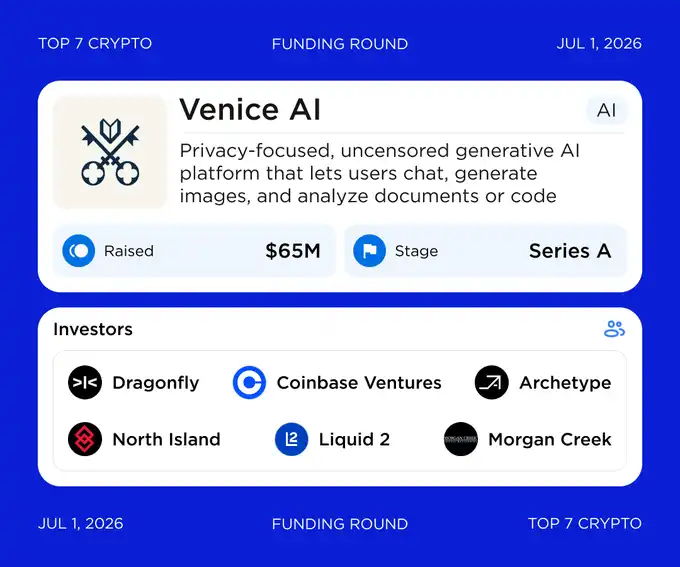
According to The Block, the privacy AI platform built by ShapeShift founder Voorhees, has closed a $65 million Series A funding round at a $1 billion valuation. The round was led by crypto venture firm Dragonfly, with participation from Coinbase Ventures, North Island Ventures, F-Prime, Archetype, Liquid2 Ventures, Morgan Creek, and others. This is Venice's first external capital raise since its launch two years ago. Previously, it had neither conducted a VC private sale nor monetized $VVV tokens from its treasury.
Equity+Token Two-Tier Structure: Investors Get Nearly 9% Equity Plus Two Batches of $VVV

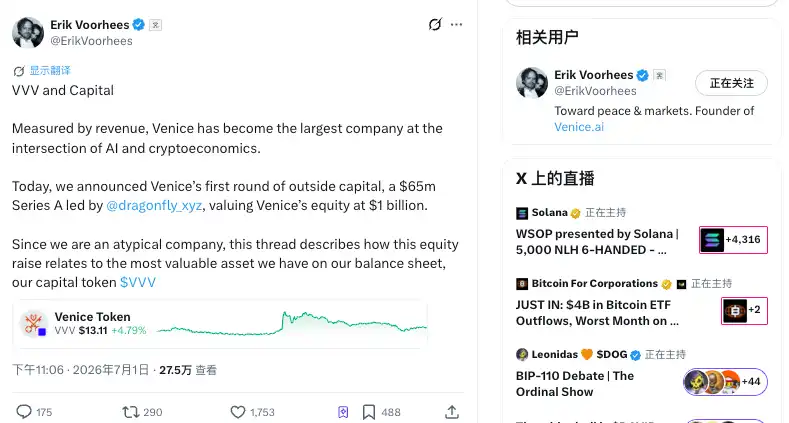
In a lengthy X post, Voorhees disclosed the full consideration for this round. The $65 million buys three things: 8.98% equity in Venice the company, vesting rights to 1.5 million $VVV tokens, and warrants giving the right to purchase an additional 5 million $VVV tokens over the next 8 years at an agreed price.

A warrant is a right to purchase tokens at a predetermined price at a future date. According to Voorhees's calculations, if investors fully exercise these 5 million warrants, they would pay approximately another $66.5 million to Venice, bringing the total potential raise from this round to roughly $131.5 million. Both the token vesting and the warrants have a one-year lock-up period, after which they unlock linearly over the following three years.

What investors receive now is equity plus an option to "buy tokens later at a set price," not immediately liquid tokens. This structure, bundling equity, token vesting, and token warrants together, is not common in crypto financing. Most projects opt for either pure equity or directly sell tokens to VCs.

Founder's Approach: "Build Product and Token First, Then Bring in VC," Reversing Industry Norms

Voorhees emphasized that Venice chose to sell equity rather than finance by selling tokens from its treasury. He stated that Venice remains the largest holder of $VVV, owning over 30 million of the current total supply exceeding 80 million tokens. Neither the company nor the team has sold a single $VVV token to date, despite the token rising over 700% this year.

Venice's funding cadence is the reverse of common industry practice. Most projects presell tokens to VCs under non-public terms first, promising to build the product and find users later. Venice launched its product and token first, generated users and revenue, and then brought in external investors.

This approach is backed by business metrics. According to company disclosures, Venice reached 3 million users in April, was profitable in Q1, and multiple media outlets cited Voorhees stating its annualized run-rate revenue already exceeds $70 million. It is unusual for an AI startup at the Series A stage to be profitable before raising funds.

Warrants Represent Future $VVV Selling Pressure, But Founder Calculates the Pace as "Negligible"

For token holders, those 5 million warrants are an unavoidable issue. They represent potential future issuance; once exercised, they become new circulating supply – selling pressure.

According to Voorhees's calculations, if investors fully exercise their warrants starting about a year from now, approximately 6,000 $VVV tokens would enter the market daily, equivalent to about 0.2% of current daily trading volume. This magnitude is relatively small compared to market depth. The portion of warrants not exercised corresponds to tokens that remain on Venice's balance sheet and do not enter circulation.

On the token strategy side, Venice states it remains unchanged: continuing to use a portion of revenue to buy back and burn $VVV while gradually reducing token issuance. Burns reduce the existing supply, while warrants increase potential supply—two forces moving in opposite directions. The direction of $VVV's net supply depends on whether the buyback-and-burn intensity can outweigh the warrant unlock and regular issuance. This is the core variable token holders need to watch next, more important than the funding news itself.

It's worth noting here that the figures "6,000 tokens daily, 0.2% of daily volume" come from Voorhees's own calculations, representing the funding party's self-reported numbers. Deep Tide currently lacks independent data for cross-verification; readers should treat this as a reference, not a definitive conclusion.

Capital to Be Used for In-House Compute, Targeting GPUs and First Data Center

According to the founder, this funding round will be used to build in-house compute infrastructure, including Venice's first data center, to reduce reliance on leased GPUs.

His stated logic is that owning compute capacity locks in production capability during the "impending resource crunch" and improves gross margins, thereby making "larger-scale $VVV burns possible."

In other words, owning compute lowers costs and increases profits, and profits are then used to buy back and burn $VVV. Besides compute, Venice also plans to use the funds to enter new markets, acquire "synergistic" businesses, hire, and expand its customer base.

On the product side, Venice positions itself as a privacy-focused, censorship-resistant alternative to ChatGPT, claiming not to store user prompts on its own systems, with requests encrypted and forwarded through external proxies, and paid subscriptions offering end-to-end encryption. The platform claims access to over 200 AI models, including both self-hosted open-source models and closed-source models like OpenAI and Anthropic accessed via anonymous API calls. Beyond $VVV, Venice has another token, DIEM: users stake $VVV to get sVVV, then lock a portion of sVVV to mint DIEM, with each DIEM token corresponding to $1 worth of non-expiring API credits on the platform.

Trending Cryptos

Related Questions

QWhat is the significance of the $650 million Series A funding round for Venice AI?

AThe $650 million Series A funding round, led by Dragonfly with participation from Coinbase Ventures and others, values Venice AI at $1 billion, making it a unicorn. It's the company's first external capital raise, notable because it was achieved by selling equity and future token warrants rather than selling existing VVV tokens from the treasury, which is contrary to typical industry practice.

QWhat is the structure of the deal for investors in Venice AI's funding round?

AThe deal grants investors 8.98% equity in Venice AI, immediate vesting rights to 1.5 million VVV tokens, and warrants giving them the right to purchase an additional 5 million VVV tokens over the next 8 years at a predetermined price. The tokens and warrants have a one-year lock-up period, followed by linear vesting over three years.

QAccording to the founder, what impact will the investor token warrants have on the VVV token supply?

AAccording to founder Erik Voorhees, if all warrants are exercised starting after one year, it would introduce approximately 6,000 new VVV tokens into the market daily, which he estimates would be about 0.2% of the current daily trading volume. He presents this as a manageable level of potential selling pressure.

QHow does Venice AI plan to use the funds raised from the Series A round?

AVenice AI plans to use the funds primarily to build its own computing infrastructure, including its first data center, to reduce reliance on leased GPUs. This aims to lock in capacity, improve gross margins, and enable larger-scale VVV token buybacks and burns. Funds will also go towards market expansion, strategic acquisitions, hiring, and growing the customer base.

QWhat is the core value proposition of the Venice AI platform as described in the article?

AVenice AI positions itself as a privacy-focused, anti-censorship alternative to platforms like ChatGPT. It claims not to store user prompts on its own systems, encrypts and routes requests through external proxies, and offers end-to-end encryption for paid subscriptions. The platform provides access to over 200 AI models, including both self-hosted open-source models and anonymously accessed proprietary models from providers like OpenAI and Anthropic.

Related Reads

The Largest Upgrade Since The Merge? How Glamsterdam Will Affect Ethereum?

Ethereum's next major upgrade, Glamsterdam (combining consensus layer "Gloas" and execution layer "Amsterdam"), is scheduled for late 2026 and considered the most significant overhaul since The Merge. It aims to fundamentally enhance L1 performance and architecture to prepare for substantial capacity increases. The upgrade centers on three core changes: 1. **Enshrined PBS (ePBS - EIP-7732):** Integrates the Proposer-Builder Separation directly into the protocol, eliminating reliance on external relays. This extends the window for processing execution payloads, allowing nodes more time to handle larger blocks and more data, paving the way for a higher Gas Limit. 2. **Block-Level Access Lists (BALs - EIP-7928):** Provides a pre-declared "map" in the block header of all state data (accounts, storage) that transactions will access and modify. This enables potential parallel transaction processing and faster state synchronization for nodes. 3. **Gas Repricing (EIP-8037):** Overhauls the gas model to more accurately reflect the real resource costs for nodes. It separates computation costs from state storage costs, making operations that create permanent state data (like new accounts) more expensive, while computation-heavy operations become relatively cheaper. These changes work together to solve the trilemma of scaling: giving nodes more time to process larger blocks (ePBS), reducing execution bottlenecks (BALs), and controlling unsustainable state growth (Gas Repricing). The goal is a credible path to a higher Gas Limit (e.g., 200M gas) without compromising decentralization by overburdening node hardware. For users: * Transaction fees for simple transfers may decrease and become more stable due to increased block space, but state-intensive operations (contract deployment) may cost more. * Gas estimation by wallets will improve in accuracy. * L2 data posting costs could become more stable long-term due to increased Blob capacity. * EIP-7708 will standardize logs for ETH transfers, improving tracking for wallets and exchanges. Node operators must upgrade clients, but ETH holders need take no action. In essence, Glamsterdam doesn't just raise the block size limit; it re-engineers Ethereum's core block production, execution, and economic models to enable sustainable, decentralized scaling.

marsbit21m ago

The Largest Upgrade Since The Merge? How Glamsterdam Will Affect Ethereum?

marsbit21m ago

Robinhood Chain Mainnet Goes Live: Can Stocks Finally Be Moved Into Wallets?

Robinhood has officially launched its public mainnet, Robinhood Chain, along with stock-like tokens, the USDG yield product, and a DeFi lending portal. This marks a significant shift where a major online broker is integrating its user interface, regulatory compliance, self-custody wallet, and on-chain protocols into a single, streamlined experience. The goal is to simplify access to stock exposure, stablecoin yields, collateralized lending, and AMM trading for mainstream users. Eligible non-U.S. users can hold these "Stock Tokens"—structured as tokenized debt securities—in the Robinhood Wallet for 24/7 exposure to assets like U.S. stocks or ETFs. U.S. users can access an estimated ~7% APY on dollar-backed USDG through the Robinhood Earn program via self-custody wallets, with lending infrastructure powered by Morpho protocol. Built as a Layer 2 on Arbitrum, Robinhood Chain leverages existing DeFi protocols like Uniswap. The core strategy is not to reinvent DeFi but to channel Robinhood's large traditional finance user base (27.4 million funded customers as of Q1 2026) into on-chain finance, lowering the technical barriers. However, key limitations exist. The stock tokens are not direct equity ownership and are unavailable in the U.S. and some jurisdictions due to regulatory constraints. The ~7% yield is variable and carries inherent DeFi risks, not guaranteed principal protection. Furthermore, while AMMs enable trading, price discovery for major stocks will likely remain anchored in traditional markets like NASDAQ for the foreseeable future. Ultimately, Robinhood Chain is an early experiment in "on-chain brokerage." Its success will depend on real-world metrics like trading volume, sustained user migration to self-custody, stable yield performance, and regulatory feedback, rather than its launch narrative.

marsbit1h ago

Robinhood Chain Mainnet Goes Live: Can Stocks Finally Be Moved Into Wallets?

marsbit1h ago

Circle CEO Responds to OUSD Challenge: Stablecoin Market Is 'Winner-Takes-All', Consortium Model Doomed to Fail

Circle CEO Jeremy Allaire addresses market concerns following the announcement of the Open USD (OUSD) stablecoin project backed by 140 global companies. Allaire argues the stablecoin market exhibits "winner-takes-all" dynamics due to powerful network effects. He cites USDC's near-decade lead in three key areas: 1) **Application Integration & Protocol Development**: Thousands of integrated services and protocols (like CCTP) create utility and lock-in for developers and users. 2) **Liquidity Network Effects**: A deeply embedded, globally distributed liquidity infrastructure across primary and secondary markets, built over years. 3) **Regulatory Integration**: Extensive licensing and compliance groundwork ensuring USDC's acceptance in major markets like Europe and Japan. Allaire challenges OUSD's proposed advantages. He contends that promises of free redemption, while appealing, face market realities where such models can become exit routes for other stablecoins. He also questions the feasibility of fully distributing all revenue to an alliance, stating it would "starve" the critical infrastructure investments needed for scale and utility. Furthermore, he expresses skepticism about large alliance governance models, noting they often lead to slow decision-making and misaligned incentives. While welcoming OUSD to the ecosystem, Allaire reaffirms confidence in USDC's dominant position, backed by its long-term infrastructure investments and strong partnerships, including its ongoing collaboration with Coinbase.

marsbit1h ago

Circle CEO Responds to OUSD Challenge: Stablecoin Market Is 'Winner-Takes-All', Consortium Model Doomed to Fail

marsbit1h ago

Circle CEO Responds to OUSD Challenge: Alliance Model Doomed to Fail, It's a 'Winner-Takes-All' Game

Circle CEO Jeremy Allaire addresses the challenge posed by the new Open USD (OUSD) stablecoin project, backed by 140 global companies. He argues that the stablecoin market exhibits "winner-take-all" characteristics, where USDC's near-decade-long lead in application integrations, global liquidity, and regulatory compliance secures its dominant position. Allaire outlines three key network effects underpinning USDC's strength: 1) Extensive integration as an internet protocol layer, 2) Deep, globally distributed liquidity networks, and 3) Deep integration with global policy and regulatory frameworks. He cites data showing USDC facilitated 80% of on-chain USD stablecoin transaction volume in Q1 2026. He directly counters OUSD's proposed advantages: 1) "Free minting and redemption" may not be sustainable against market realities, which USDC addresses via contractual mechanisms. 2) "Sharing all revenue" risks starving the infrastructure of necessary investment for growth and reliability. 3) A "consortium model" often leads to slow innovation and poor coordination compared to focused, independent operators like Circle. Allaire reaffirms Circle's strong partnership with Coinbase and notes that Circle continues to collaborate with many OUSD founding members. He concludes by welcoming OUSD to the ecosystem while expressing confidence in USDC's entrenched network advantages and continued expansion.

Odaily星球日报1h ago

Circle CEO Responds to OUSD Challenge: Alliance Model Doomed to Fail, It's a 'Winner-Takes-All' Game

Odaily星球日报1h ago

Trading

Spot

Hot Articles

Discussions

Welcome to the HTX Community. Here, you can stay informed about the latest platform developments and gain access to professional market insights. Users' opinions on the price of AI (AI) are presented below.

活动图片