US Treasurys lead tokenization wave as CoinShares predicts 2026 growth

cointelegraphPublished on 2025-12-08Last updated on 2025-12-08

Abstract

CoinShares predicts the tokenization of real-world assets (RWAs) will continue growing in 2026, driven by global demand for dollar yield. Tokenized U.S. Treasurys more than doubled in 2025, reaching $8.68 billion, while private credit nearly doubled to $18.58 billion. Ethereum remains the leading network for tokenized Treasurys, with over $4.9 billion. The report highlights that RWA tokenization has moved beyond a crypto niche, attracting established firms and regulatory engagement. Excluding stablecoins, the RWA market grew 229% in 2025, from $5.5 billion to $18.1 billion. CoinShares expects U.S. Treasury-backed products to lead 2026 expansion due to yield demand and efficient crypto settlement rails.

Digital asset investment company CoinShares predicts that the surge in tokenized real-world assets (RWAs) in 2025 will continue into 2026, driven by increasing global demand for dollar yield.

In its 2026 Digital Asset Outlook report, CoinShares said tokenized RWAs saw strong growth in 2025, led by tokenized US Treasurys. According to the report, onchain Treasurys more than doubled this year, climbing from $3.91 billion to $8.68 billion. Private credit nearly doubled as well, rising from $9.85 billion to $18.58 billion over the same period.

“Tokenisation has materially moved beyond the longtime narrative of crypto enthusiasts,” CoinShares digital asset analyst Matthew Kimmell said. “Real assets, issued by reputable firms, receiving material investment. Even real regulators engage with crypto rails as credible infrastructure.”

Ethereum remains the most dominant network for tokenized US Treasurys. Data from RWA.xyz showed that as of Monday, Ethereum has over $4.9 billion in US Treasurys tokenized in the blockchain.

Ethereum leads US Treasurys by market capitalization. Source: RWA.xyz

US Treasurys are the most “immediate” growth vector

CoinShares expects US government debt-backed products to lead the next leg of expansion in 2026, citing global demand for dollar yield and the efficiency of crypto-based settlement rails.

CoinShares said investors tend to prefer holding Treasurys over stablecoins when yield is available with minimal incremental risk.

“We’ve observed stablecoins demonstrating significant global demand for tokenised dollars as both a reserve and transactional asset,” CoinShares wrote. “Yet, when investors, as opposed to transactors, have the option, they generally prefer to hold Treasurys over holding dollars directly.”

CoinShares also argued that RWA tokenization has already moved beyond a niche experiment by crypto enthusiasts.

The company said that as established financial firms issue these assets, it attracts material capital and draws engagement from regulators who increasingly view blockchain as credible infrastructure.

The company also added that efficiency improvements are no longer theoretical. CoinShares said that settlement, issuance and distribution are starting to happen directly onchain, rather than through legacy custodial processes.

CoinShares expects the shift to continue, though not without competitive tension. According to the company, multiple networks and settlement systems are vying for market share. As a result, it remains uncertain which platforms will emerge victorious and how liquidity will consolidate.

Related: Hua Xia state-linked Chinese bank tokenizes $600M in yuan bonds

Tokenized RWAs grew 229% in 2025

RWA.xyz data showed that excluding stablecoins, which have a market capitalization of over $300 billion, RWAs grew from $5.5 billion on Dec. 31, 2024, to $18.1 billion at the time of writing. This represents a 229% growth in nearly a year.
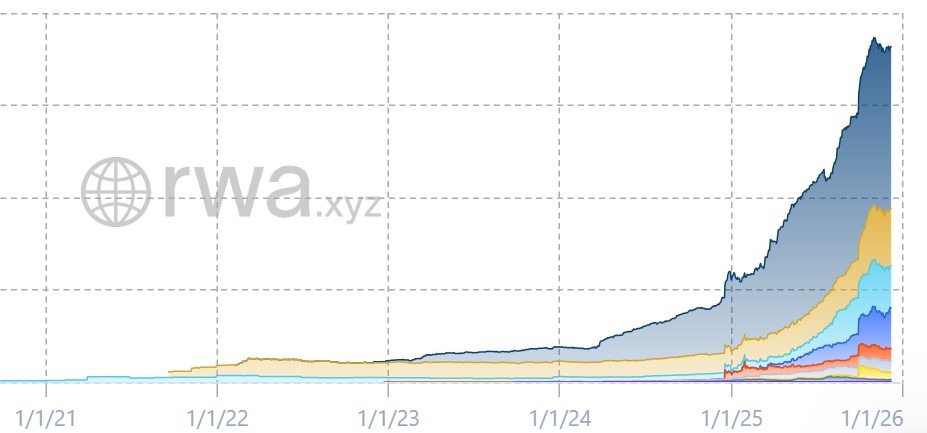
RWA growth from 2021 to 2025. Source: RWA.xyz

CoinShares CEO Jean-Marie Mognetti said digital assets are no longer operating outside the traditional economy. He said they are embedded within it.

“If 2025 was the year of the graceful return, 2026 looks positioned to be a year of consolidation into the real economy,” he said.

Magazine: Koreans ‘pump’ alts after Upbit hack, China BTC mining surge: Asia Express

Related Reads

You Bet on the News, the Pros Read the Rules: The True Cognitive Gap in Losing Money on Polymarket

The article explains that the key to profiting on Polymarket, a prediction market platform, lies not just predicting real-world events correctly, but in meticulously understanding the specific rules that govern how each market will be resolved. It illustrates this with examples, such as a market on Venezuela's 2026 leader, where the official rules defining "officially holds" the office overruled the intuitive answer of who was in practical control. Other examples include debates over the definition of a "token" or what constitutes an "agreement." The core argument is that a "reality vs. rules" gap creates pricing discrepancies that savvy traders ("车头" or "whales") exploit. The platform has a formal dispute resolution process managed by UMA token holders to settle ambiguous outcomes. This process involves proposal submission, a challenge window, a discussion period, and a final vote. However, the article highlights a critical flaw in this system compared to a traditional court: the lack of separation between the arbiters (UMA voters) and the interested parties (traders with financial stakes in the outcome). This conflict of interest undermines the discussion phase, leads to herd mentality, and results in opaque final decisions without explanatory rulings. Consequently, the system lacks a body of precedent, making it difficult for users to learn from past disputes. The ultimate takeaway is that success on Polymarket requires a lawyer-like scrutiny of the rules to identify and capitalize on the cognitive gap between how events appear and how they are contractually defined for settlement.

marsbit40m ago

You Bet on the News, the Pros Read the Rules: The True Cognitive Gap in Losing Money on Polymarket

marsbit40m ago

Will the Fed Still Cut Interest Rates? Tonight's Data Is Crucial

The core debate surrounding the Federal Reserve's potential interest rate cuts is intensifying amid geopolitical conflict and rebounding inflation. The key question is whether high energy prices will cause persistent inflation or weaken consumer demand enough to force the Fed to cut rates. Citigroup presents a bullish case for cuts, arguing that oil supply disruptions from the Strait of Hormuz are temporary and will not lead to lasting inflationary pressure. They point to receding bond yields and oil prices as evidence the market is pricing in a short-lived shock. Citi's data also shows tightening financial conditions, a stabilizing labor market, and healthy tax returns, supporting their view that the path to lower rates remains open. Conversely, Deutsche Bank offers a starkly contrasting, more hawkish outlook. They argue the Fed's current policy is already neutral and expect rates to remain unchanged indefinitely. Their view is based on stalled disinflation progress and a shift toward more hawkish rhetoric from key Fed officials like Waller, who cited risks from prolonged Middle East conflict and tariffs. Other officials, including Williams and Hammack, signaled rates would likely stay on hold for a "considerable time." The market pricing has shifted dramatically, now forecasting zero cuts in 2026. The imminent release of the March retail sales "control group" data is highlighted as a critical test. This metric, which excludes gas station sales, will reveal if high gasoline prices are eroding consumer spending in other areas. A weak reading could support the case for imminent rate cuts, while a strong one would bolster the argument for the Fed to hold steady. This data is pivotal for determining the near-term policy path.

marsbit1h ago

Will the Fed Still Cut Interest Rates? Tonight's Data Is Crucial

marsbit1h ago

Trading

Spot
Futures
活动图片




