Trump’s crypto empire generates $1.4B in 2025: WLFI, TRUMP under scrutiny

ambcryptoPublished on 2026-07-01Last updated on 2026-07-01

Abstract

Former President Donald Trump's cryptocurrency holdings have become the primary revenue source for his business empire, generating over $1.4 billion in 2025. Key contributors were the sale of WLFI tokens and his TRUMP memecoin. This financial success coincides with major U.S. regulatory initiatives like the GENIUS and CLARITY Acts, raising significant scrutiny over potential conflicts of interest. Critics argue that favorable crypto regulations could directly benefit Trump's commercial ventures. Concurrently, regulatory enforcement by agencies like the SEC has decreased sharply as focus shifts to creating new market frameworks. While markets remain driven by traditional fundamentals, the intertwining of Trump's crypto wealth with policymaking is expected to lead to increased ethics oversight and stricter disclosure requirements for the industry going forward.

President Donald Trump’s latest financial disclosure signals a fundamental shift in his business empire. This comes after his cryptocurrency investments overtake traditional ventures as his largest revenue source.

That transition stems from the rapid expansion of family-backed crypto projects, which generated more than $1.4 billion in reported income during 2025.

Of that, nearly $600 million came from the sale of tokens by World Liberty Financial [WLFI]. And even though the price of Official TRUMP [TRUMP] memecoin fell from $74.24 at its peak to $1.67 at one point, it still managed to generate approximately $636 million.
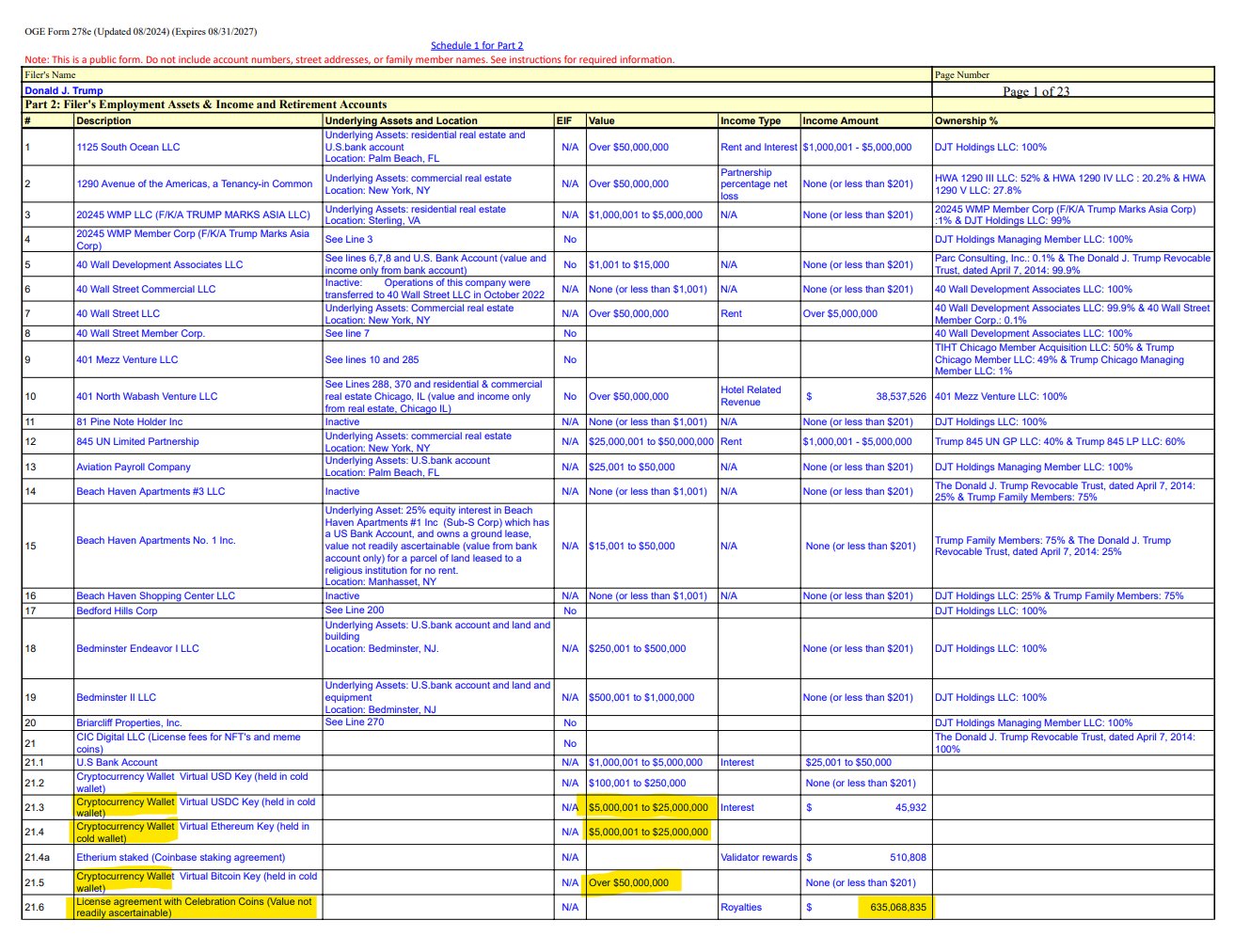
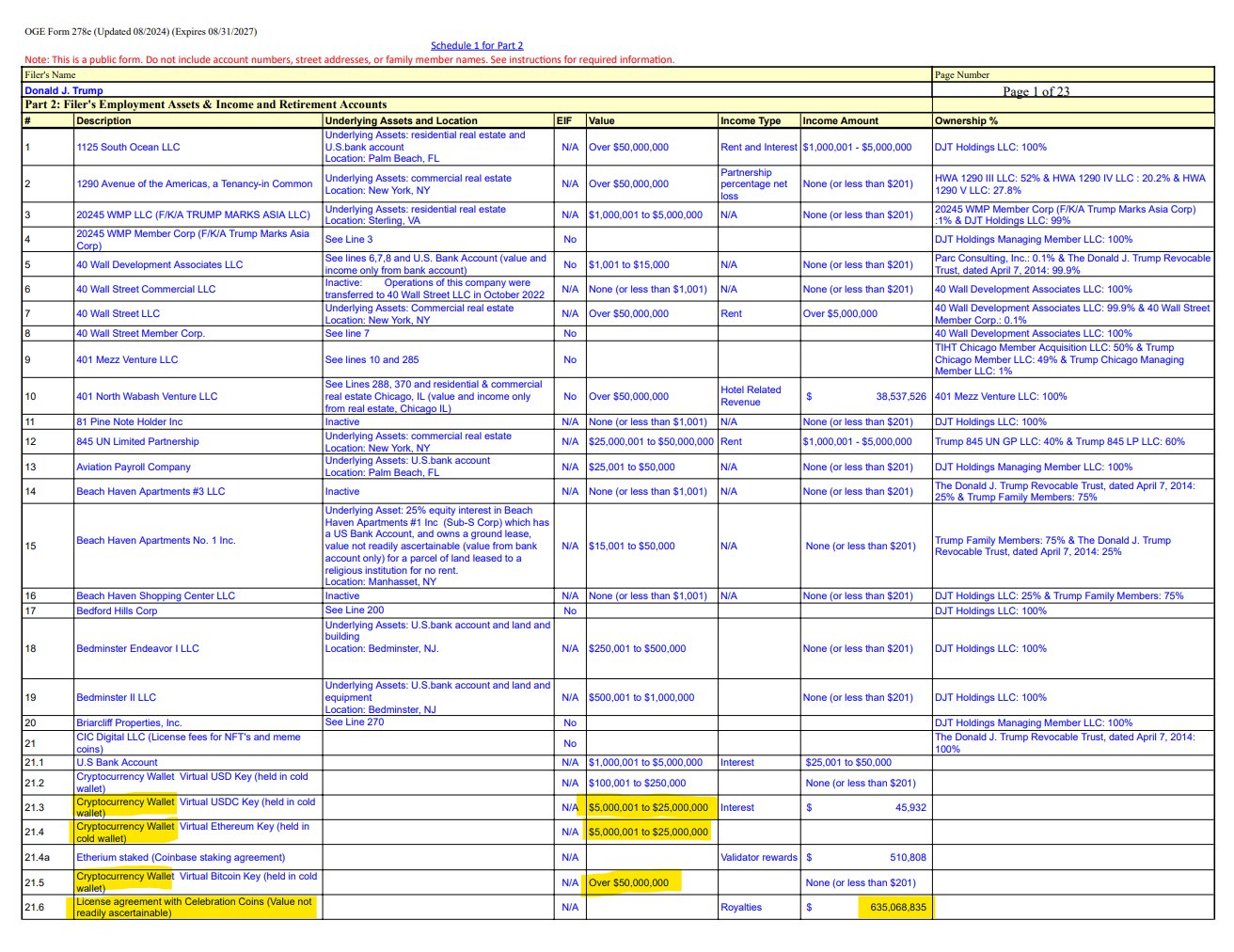
Source: Office of Government Ethics

Other types of equity sales furthered crypto earnings. Altogether, the data points to the conclusion that earning money is no longer dependent solely upon the value of his crypto assets.

Rather, the main drivers of Trump’s increasing digital assets include license agreements, token sales, and equity transactions.

Crypto wealth and policy collide under growing scrutiny

Trump’s crypto success has now shifted attention beyond profits toward policymaking. That focus emerged because his business interests expanded alongside major regulatory reforms.

Meanwhile, the administration also created an executive order, the GENIUS Act. It was followed by the CLARITY Act, and both acts support clearer rules for stablecoins, as well as a larger digital asset marketplace.

Those disclosures have since become central to the debate, as they link the president’s commercial interests to an industry undergoing significant regulatory reform.

That overlap intensified concerns because friendlier regulations could strengthen businesses tied to the president. AMBCrypto earlier reported that Trump leverages the CLARITY Act in broader negotiations, stalling its 4th of July passage amid housing bill disputes.

As scrutiny increased, lawmakers proposed stronger ethics safeguards and disclosure requirements. This will result in increasing oversight of the policies and laws regarding cryptocurrency going forward.

Markets test the impact of crypto policy shifts

Political scrutiny has now shifted toward how regulators oversee the cryptocurrency industry. Beginning in 2022, the political spotlight began focusing on regulators’ supervision of the digital assets sector.

At that time, enforcement activities were decreasing rapidly due to increasing activity for rule-making from U.S. federal agencies.

According to Cornerstone Research, enforcement by the SEC regarding cryptocurrencies decreased approximately 60 percent in 2025, with CFTC enforcement action for virtual currencies dropping to almost zero.
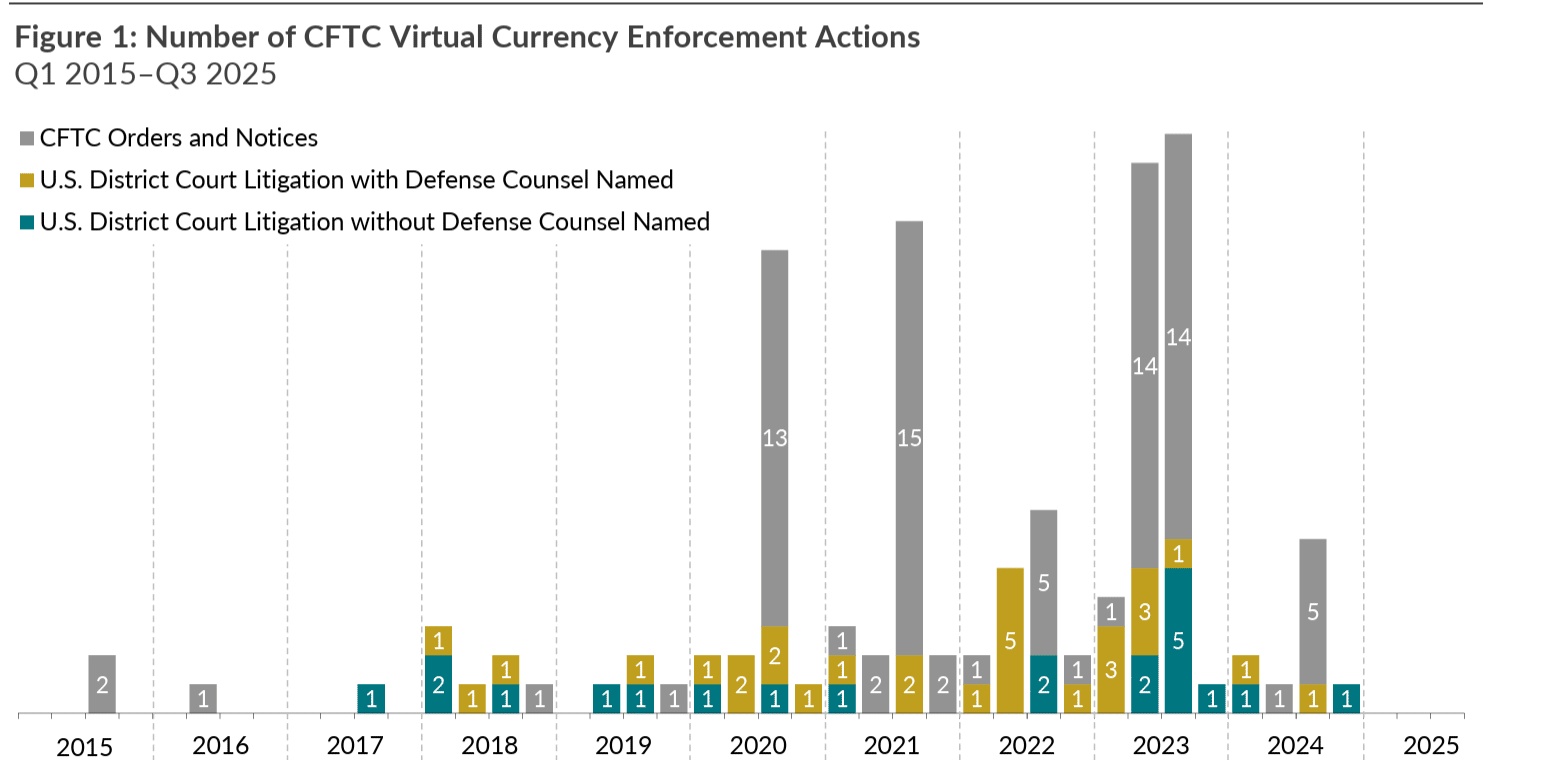
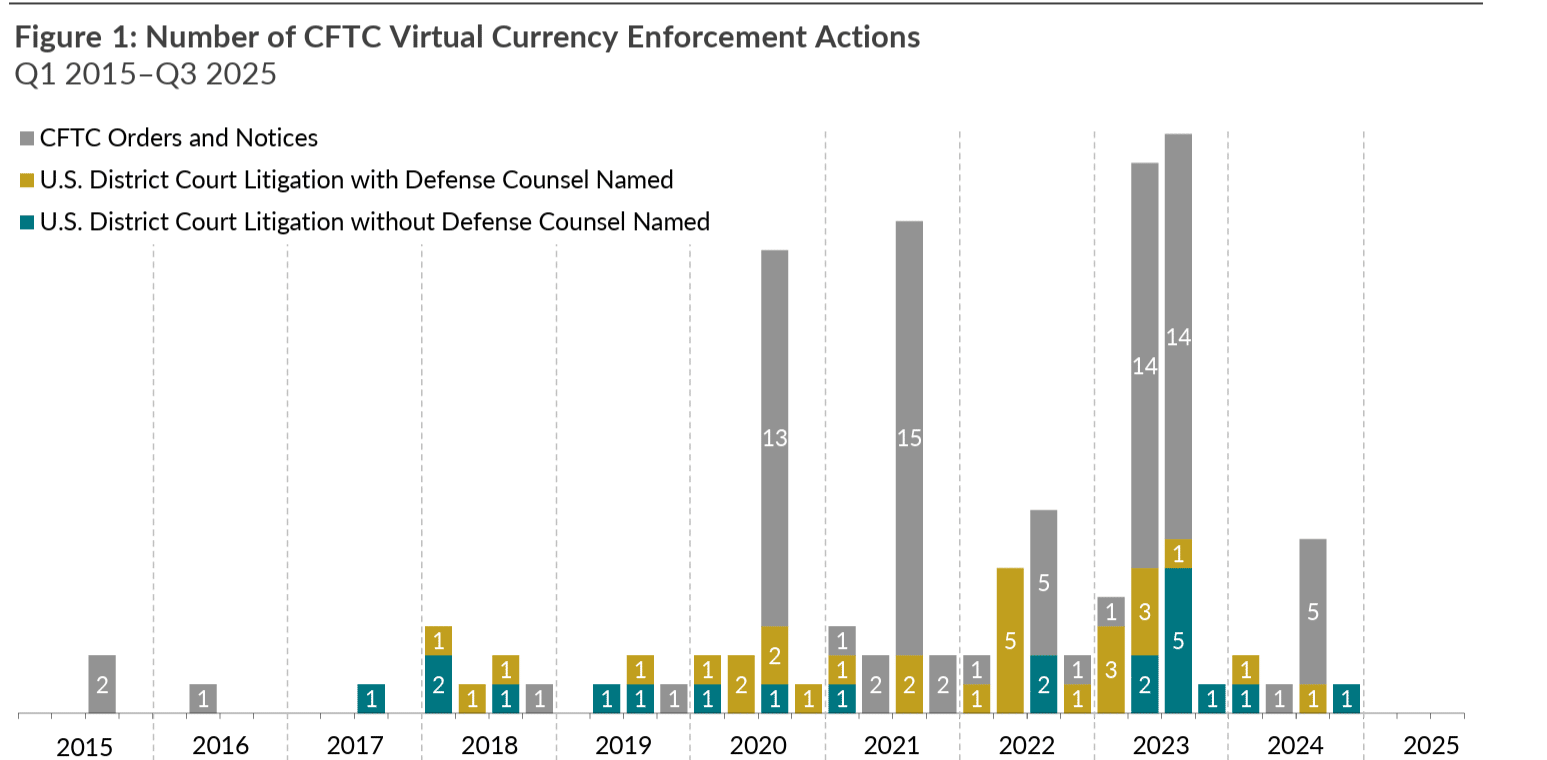
Source: Cornerstone Research

The transition in both areas was reflective of an emerging focus for regulators on developing frameworks for stablecoins and implementing structural changes in digital asset markets.

However, investors largely continued following interest rates, ETF flows, and broader macroeconomic conditions instead. That distinction suggests markets still prioritize fundamentals over politics.

Going forward, mounting ethics scrutiny could reshape regulatory standards and strengthen institutional accountability across future crypto oversight.


Final Summary

  • Trump’s crypto empire now extends beyond business into U.S. digital asset policy.
  • Crypto regulation now faces greater scrutiny as ethics and innovation increasingly collide.

Trending Cryptos

Related Questions

QWhat was the total reported income generated by Trump's family-backed crypto projects in 2025, and what were the two main sources?

ATrump's family-backed crypto projects generated more than $1.4 billion in reported income during 2025. The two main sources were: nearly $600 million from the sale of World Liberty Financial (WLFI) tokens, and approximately $636 million from the Official TRUMP (TRUMP) memecoin.

QAccording to the article, what are the main drivers of Trump's increasing digital assets, moving beyond simple asset value?

AThe main drivers of Trump's increasing digital assets are license agreements, token sales, and equity transactions. The article states that earning money is no longer dependent solely on the value of his crypto assets.

QHow did U.S. regulatory enforcement actions in the cryptocurrency sector change in 2025, according to Cornerstone Research?

AAccording to Cornerstone Research, enforcement by the SEC regarding cryptocurrencies decreased by approximately 60 percent in 2025. Furthermore, CFTC enforcement action for virtual currencies dropped to almost zero in the same year.

QWhy has Trump's crypto success shifted attention toward policymaking and regulatory reforms?

AAttention has shifted toward policymaking because Trump's business interests expanded alongside major regulatory reforms. There is concern that friendlier regulations could strengthen businesses tied to the president, creating an overlap between his commercial interests and an industry undergoing significant regulatory change.

QWhat are the two legislative acts mentioned in the article that support clearer rules for the digital asset marketplace?

AThe two legislative acts mentioned are the GENIUS Act, an executive order, and the CLARITY Act. Both acts support clearer rules for stablecoins and aim to foster a larger digital asset marketplace.

Related Reads

$2 Trillion: Countdown to AI's Largest IPO in History

The countdown for the largest IPO in AI history, a potential $2 trillion listing for Anthropic, is underway for October. The staggering valuation, reportedly projected by several investors, contrasts with the company's own internal restraint on setting a public target. Founded five years ago by former OpenAI core members, Anthropic's growth has been meteoric. Annual recurring revenue (ARR) surged from ~$9B in late 2025 to $47B by May 2026, with Q2 2026 revenue of $11.5B marking a 14x year-over-year increase. Bank valuations are even based on internal 2028 revenue forecasts of $190-200B. A key growth driver is Claude Code, its AI coding assistant. Its ARR quintupled in five months to $2.5B by February 2026, now constituting nearly 20% of total revenue. Surveys indicate Anthropic commands roughly 40% of enterprise LLM spending, doubling OpenAI's share in programming-specific use. However, alongside this explosive growth, reports detail significant internal cultural strife. Critics describe a divisive "priesthood" of PhD executives, led by CEO Dario Amodei, who promote a "save humanity" narrative that some employees find cult-like and alienating. This has reportedly created a demoralized workforce and a covert "underground network" of dissent among engineers torn between lucrative pre-IPO equity and a toxic work environment. Anthropic now faces a pivotal paradox: pursuing its mission of "safe" AI requires immense capital for compute, yet that capital demands relentless commercial growth. As it approaches its historic IPO, the company must navigate intense regulatory scrutiny, soaring operational costs, and internal tensions—any of which could destabilize its post-listing trajectory, much like SpaceX's significant post-IPO stock drop. The stage is set for a defining moment in tech history.

marsbit1h ago

$2 Trillion: Countdown to AI's Largest IPO in History

marsbit1h ago

AI Boosting Efficiency and Cutting Costs Makes VC Increasingly Expensive

"AI for Cost Reduction Makes VC Funding More Expensive" Despite the "cost-reduction and efficiency" narrative of AI, venture capital (VC) investment in the AI sector is becoming increasingly costly. While AI tools lower the initial costs for many startups—with team sizes shrinking across funding stages—the market is polarizing. For top-tier AI teams, especially those from leading companies like Google and OpenAI, funding rounds are now larger and valuations are higher than ever at the seed and early stages. For example, new ventures by prominent researchers are securing billions in funding with valuations reaching tens of billions before having a mature product. This creates a "barbell" market: lightweight startups need less capital, while elite AI firms attract massive investments early on. This dynamic raises the cost for VCs to acquire and maintain meaningful ownership stakes. As valuations soar early, securing the same equity percentage requires significantly larger capital commitments. VCs must now invest more upfront and reserve substantial funds for follow-on rounds to avoid dilution, prompting large firms like Accel and a16z to raise massive new funds. Consequently, capital is concentrating intensely in a few perceived winners like OpenAI and Anthropic, widening the gap between large and small VC funds. While high valuations bake in future growth expectations, they also compress potential returns, demanding that portfolio companies achieve unprecedented scale. For major VCs, the core strategy is clear: secure early positions in potential winners and maintain the capital to keep investing as valuations rapidly escalate.

marsbit2h ago

AI Boosting Efficiency and Cutting Costs Makes VC Increasingly Expensive

marsbit2h ago

An Eight-Year Investment Takes a Sharp Turn: Why Did Ethereum Suddenly Abandon Poseidon?

On August 13, Ethereum researcher Justin Drake announced a significant shift in Ethereum's Layer-1 cryptographic roadmap: abandoning the SNARK-friendly hash function Poseidon in favor of traditional functions like SHA2 or BLAKE2. This decision ends eight years of research and investment, marking a major revision to the post-quantum security strategy. Poseidon, introduced in 2019, was highly efficient for zkRollups and zkVMs within SNARK circuits. However, its need for prolonged cryptanalysis and the pressing timeline for quantum resistance revealed limitations. Recent breakthroughs in SNARK design, specifically using binary fields, now enable traditional, battle-tested hash functions to perform as efficiently as Poseidon within SNARKs. Benchmarks show modern laptops can now verify over a million traditional hash calls per second. This change is partly driven by accelerated concerns over quantum computing threats. Reports warn that "Cryptographically Relevant Quantum Computers" could break current blockchain signatures like ECDSA by the early 2030s, risking trillions in assets. Ethereum's response focuses on hash-based post-quantum signature schemes, deemed more quantum-resistant than some lattice-based alternatives under pressure from AI cryptanalysis. Ethereum's updated post-quantum roadmap targets a production-ready "leanVM" for signature aggregation by 2027, with full deployment across consensus, execution, and data layers by 2028. The shift to mature hash functions like SHA2 reduces reliance on newer algorithms and aligns with the goal of using widely analyzed cryptographic primitives. Other major blockchains are also preparing. Solana's core teams have independently chosen the NIST-standardized Falcon signature scheme for its compact size. Starknet plans a phased migration, starting with replacing its Pedersen hash with BLAKE2. Ethereum's move signifies a strategic pivot towards proven security foundations for the quantum era.

marsbit3h ago

An Eight-Year Investment Takes a Sharp Turn: Why Did Ethereum Suddenly Abandon Poseidon?

marsbit3h ago

Programmers Worldwide Are Wasting Money on Anthropic! The Company Can't Stand It Anymore

Anthropic recently published guidelines to help developers using Claude Code reduce unnecessary token costs. The key recommendations include: 1) Clear (/clear) conversations after completing a task to avoid carrying irrelevant file reads and command outputs into the next task. 2) Set the model and reasoning effort level at the start of a session, as switching mid-session invalidates the prompt cache, requiring a full-price recalculation of the entire dialog history. 3) Attach files using @ references instead of typing paths manually to avoid extra tool calls and searches that bloat the context. 4) Add quiet flags to verbose commands (e.g., in CLAUDE.md) to minimize lengthy output in the dialog history. 5) Use /compact while the session cache is still warm (before breaks) to compress the dialog at one-tenth the cost. 6) Offload large-output tasks to a sub-agent, which runs in an isolated context and only returns conclusions, preventing intermediate outputs from polluting the main dialog. The article explains token pricing: input tokens (prefill) are processed in parallel, while output tokens (decode) are generated serially, making output tokens five times more expensive. Caching is crucial for savings—if a request's prefix (system prompt, CLAUDE.md, dialog history) matches the previous one byte-for-byte, reading it costs only 10% of the standard input price. However, cache invalidation occurs when changing models, effort levels, fast mode, compressing dialogs, after cache expiration, or when resuming old sessions. Dialog history also grows quadratically (O(n²)) as file contents and command outputs accumulate, increasing costs per round. Proactive context management—like isolating noisy tasks, using /rewind to trim unproductive turns, and task-based session clearing—is becoming an essential skill for cost-effective AI-assisted development.

marsbit5h ago

Programmers Worldwide Are Wasting Money on Anthropic! The Company Can't Stand It Anymore

marsbit5h ago

Trading

Spot

Hot Articles

Discussions

Welcome to the HTX Community. Here, you can stay informed about the latest platform developments and gain access to professional market insights. Users' opinions on the price of S (S) are presented below.

活动图片