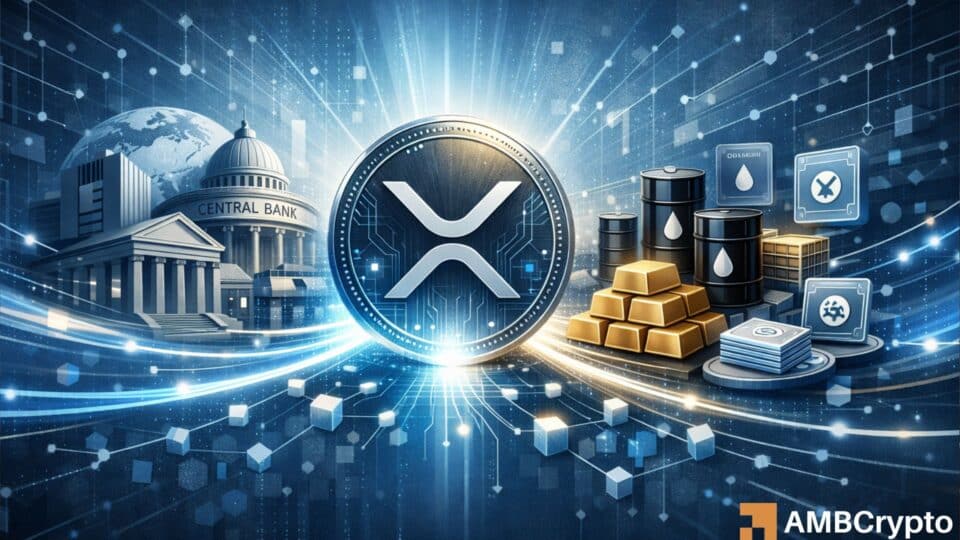







Tokenized commodities cross $1B on XRPL! What’s behind this shift?

ambcryptoPublished on 2026-03-16Last updated on 2026-03-16

Abstract

Tokenized commodities on the XRP Ledger (XRPL) have surpassed $1 billion in value, marking a significant milestone in the adoption of real-world asset (RWA) tokenization. This growth is driven by the increasing institutional and retail interest in leveraging blockchain for commodity trading, which offers benefits like enhanced liquidity, faster settlement, and reduced transaction costs. The XRPL's efficiency, low fees, and robust infrastructure make it an attractive platform for this shift. Key players, including institutional investors and fintech companies, are contributing to this expansion by launching tokenized commodity products. This trend reflects a broader movement towards digitizing traditional assets to improve accessibility and efficiency in global markets.

Related Questions

QWhat milestone has been achieved by tokenized commodities on the XRPL?

ATokenized commodities have surpassed $1 billion in value on the XRPL.

QWhich blockchain network is experiencing this significant shift in tokenized commodities?

AThe XRP Ledger (XRPL) is the blockchain network where this shift is occurring.

QWhat does the $1 billion milestone indicate about the adoption of tokenized assets?

AThe $1 billion milestone indicates growing institutional and retail adoption, as well as increasing trust in using blockchain technology to represent real-world assets.

QWhat are the likely benefits driving the shift towards tokenizing commodities on the XRPL?

ALikely benefits include increased liquidity, fractional ownership, faster and cheaper transactions, enhanced transparency, and easier access to global markets for a wider range of investors.

QWhat type of real-world assets are being referenced by the term 'tokenized commodities'?

A'Tokenized commodities' typically refer to digital representations of physical goods like precious metals (gold, silver), oil, agricultural products, and other natural resources on a blockchain.

Related Reads

Why Do You Always Lose Money on Polymarket? Because You're Betting on News, While the Pros Read the Rules

Why do you always lose money on Polymarket? Because you bet on news, while the pros study the rules. This article explains how top traders ("che tou") profit by meticulously analyzing market rules, not just predicting events. Polymarket, a prediction market platform, often sees disputes over event outcomes due to ambiguous rule wording. For instance, a market asking "Who will be the leader of Venezuela by the end of 2026?" was misinterpreted by many who bet on Delcy Rodríguez, assuming she held power. However, the rules specified "officially holds" as the formally appointed, sworn-in individual. Since Nicolás Maduro was still recognized as president officially, he won the market—even being in prison. To resolve such disputes, Polymarket uses a decentralized arbitration system via UMA protocol. The process involves: 1. Proposal: Anyone can propose a market outcome by staking 750 USDC, earning 5 USDC if unchallenged. 2. Dispute: A 2-hour window allows challenges with a 750 USDC stake; successful challengers earn 250 USDC. 3. Discussion: A 48-hour period on UMA Discord for evidence and debate. 4. Voting: UMA token holders vote in two 24-hour phases (blind then public). Outcomes require >65% consensus and 5M tokens voted; otherwise, four re-votes occur before Polymarket intervention. 5. Settlement: Results are final and automatic. Unlike traditional courts, Polymarket’s system lacks separation between arbitrators and stakeholders—voters often hold market positions, creating conflicts of interest. This leads to herd mentality in discussions and non-transparent outcomes without explanatory rulings, preventing precedent formation. Thus, success on Polymarket hinges on deep rule interpretation, not just event prediction, exploiting gaps between reality and contractual wording.

marsbit2h ago

Why Do You Always Lose Money on Polymarket? Because You're Betting on News, While the Pros Read the Rules

marsbit2h ago

DeepSeek Funding: Liang Wenfeng's 'Realist' Pivot

DeepSeek, a leading Chinese AI company, has initiated its first external funding round, aiming to raise at least $300 million at a valuation of no less than $10 billion. This move marks a significant shift from its founder Liang Wenfeng’s previous idealistic stance of rejecting external capital to maintain independence. Despite strong financial backing from its parent company, quantitative trading firm幻方量化 (Huanfang Quant), which provided an estimated $700 million in revenue in 2025 alone, DeepSeek faces mounting challenges. Key issues include a 15-month gap in major model updates, delays in its flagship V4 release, and the loss of several core researchers to competitors offering significantly higher compensation. The company is also undergoing a strategic pivot by migrating its infrastructure from NVIDIA’s CUDA to Huawei’s Ascend platform, a move aligned with China’s push for technological self-reliance amid U.S. export controls. However, DeepSeek lags behind rivals like智谱AI and MiniMax—both now publicly listed—in areas such as product ecosystem, multimodal capabilities, and commercialization. The funding round, though relatively small in scale, is seen as a way to establish a market-validated valuation anchor, making employee stock options more competitive and facilitating talent retention. It also signals DeepSeek’s transition from a pure research-oriented organization to a commercially-driven player in the global AI ecosystem.

marsbit2h ago

DeepSeek Funding: Liang Wenfeng's 'Realist' Pivot

marsbit2h ago

Trading

Spot
Futures

Hot Articles

Discussions

Welcome to the HTX Community. Here, you can stay informed about the latest platform developments and gain access to professional market insights. Users' opinions on the price of S (S) are presented below.

活动图片








