This report is written by Tiger Research,Crypto companies are generally facing "Fear of Missing Out" (FOMO). From exchanges to security firms, they are all racing to launch AI-driven services. We will explore why they are choosing to act now.
Key Points Summary
- Crypto companies in areas like exchanges, security, payments, and research are simultaneously launching AI services.
- Unlike previous cycles, proven profitable firms like Coinbase and Binance are leading the charge. AI has shifted from a theory to a practical necessity.
- Adoption motives vary by sector: exchanges aim to prevent user churn; security firms aim to fill audit blind spots; payment infrastructure targets the emerging agent economy.
- Having a feature and actually using it are two different things. The "FOMO" and competitive pressure in the AI space are accelerating its adoption far beyond actual demand.
- Both genuine demand and competitive anxiety are at play. Distinguishing between value-creating adoption and mere labeling is the key issue.
1. Crypto Companies Are Offering AI Services
Artificial Intelligence (AI) is the most watched field in the global market today. General-purpose tools like ChatGPT and Claude have integrated into daily life, while platforms like OpenClaw have lowered the barrier to building agents.
The cryptocurrency industry, although it missed this wave, is now integrating AI across various verticals.
What AI services do these companies offer? Why are they entering this market?
2. How Crypto Companies Are Adopting AI Technology
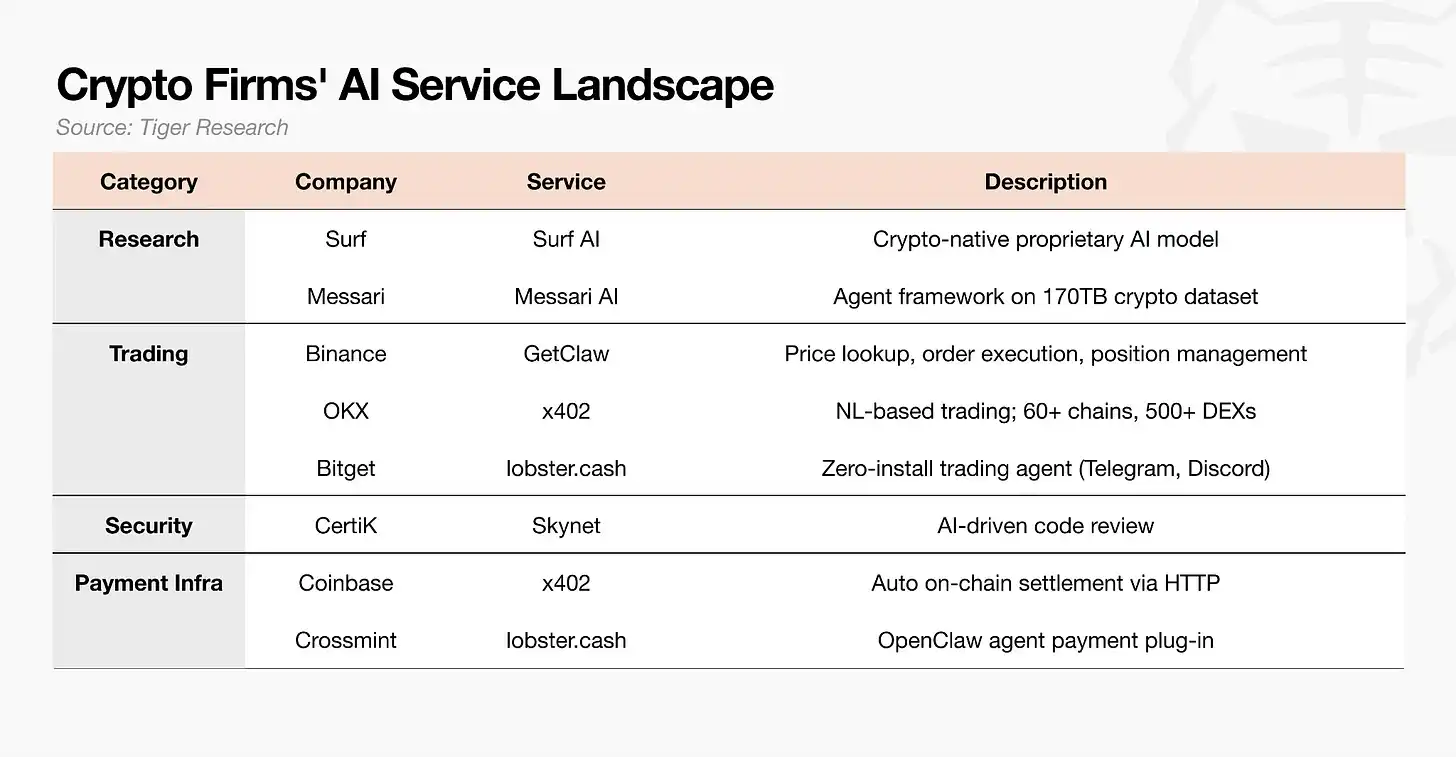
2.1 Research
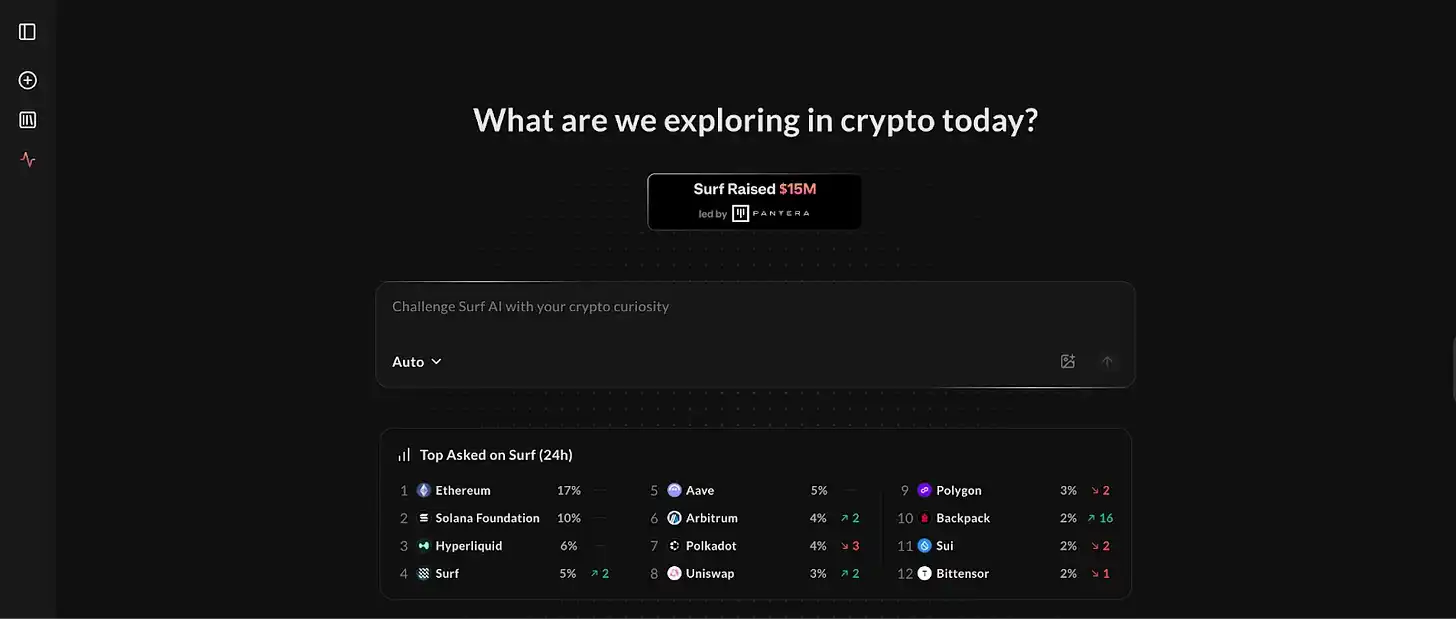
Crypto research has structural problems: on-chain data, social sentiment, and key metrics are scattered across various platforms, making verification difficult. General AI often returns inaccurate answers to crypto queries.
Projects like Surf address this by providing crypto-specific AI research tools that can integrate scattered data sources. Among all crypto AI application scenarios, research has the lowest barrier to entry for average users, requiring no programming or trading expertise.
2.2 Trading

Exchanges are leading the application of AI in trading.
Methods vary. Some directly expose proprietary trading data to users; others allow users to issue natural language commands to AI agents, which complete the entire process from analysis to execution in one step.
Exchanges have offered APIs for years. The difference now is an added layer: interfaces like MCP and AI Skills enable non-developers to access exchange functions via AI agents. Tools once limited to developers are now accessible via natural language.
This aligns with a broader community shift. Non-developer users are increasingly building automated trading strategies through AI agents without writing any code. They simply describe the strategy, and the agent builds and runs the algorithm.
For exchanges, this is both an opportunity and a challenge. As the number of AI users grows, user loyalty to a single exchange decreases, as traders can execute trades anywhere. The reason exchanges adopt AI is simple: quickly attract users and keep them active on the platform.
Trading involves real asset management, requiring higher judgment and responsibility than research. But with the barrier to entry lowered, this field is also opening to average users.
2.3 Security/Auditing
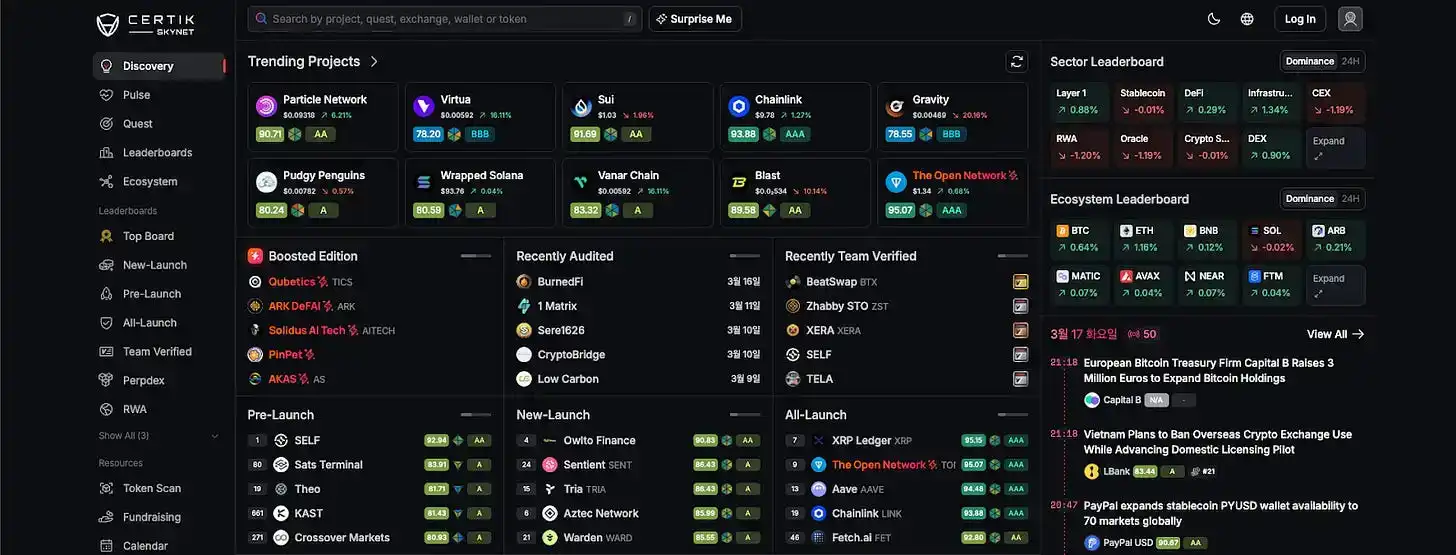
Traditional smart contract audits rely on manual line-by-line code review, which is slow, costly, and lacks consistency across auditors. Now, AI is integrated into workflows: AI first scans the code, then human auditors perform targeted deep reviews. This increases speed and coverage without replacing auditors.
CertiK is a prime example. The company was previously criticized for audited projects being exploited later. However, these incidents occurred outside the audit scope. Audits check code at a specific point in time and do not include continuous monitoring.
CertiK uses AI to bridge this gap. It added real-time post-audit monitoring functionality and publishes results via a public dashboard. Since the expanded monitoring scope is AI-driven rather than manual, both CertiK and the projects it audits benefit.
In security, AI application is not about disrupting existing services but expanding the scope of human work: increasing precision during audits and弥补 post-audit blind spots. For blockchain security companies, AI is not a new business area but a tool to address existing security vulnerabilities.
2.4 Payment Infrastructure
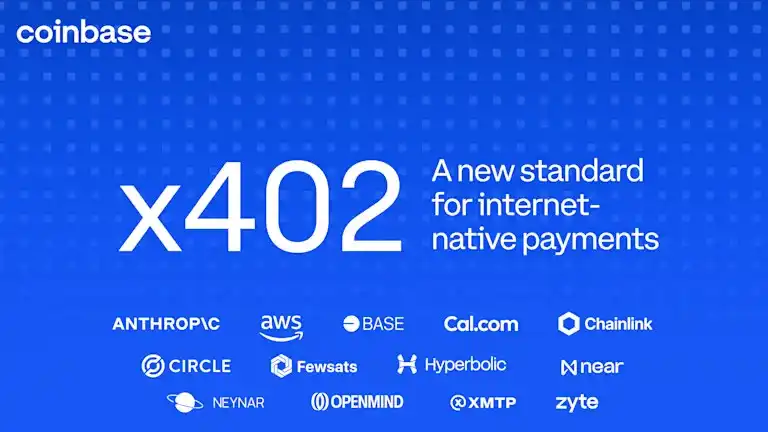
AI Agents need payment channels to participate in economic activities: e.g., paying API fees, buying data, and purchasing services from other agents. The most natural payment method for an agent is an on-chain wallet paired with stablecoins.
Two models are emerging. The first is a general protocol that embeds payment into HTTP requests, enabling agents to automatically settle on-chain when accessing paid APIs. The second is agent-specific payment plugins, where agents can only execute payments within human-preset permissions and limits.
Payment infrastructure is the area most closely linked to stablecoins. However, since the payer is an AI agent rather than a human, fully operational models have not yet emerged.
USDC issuer Circle is also in the spotlight. The company published a proposal to connect its Gateway payment infrastructure with the x402 protocol and invited developers and researchers to review and contribute.
This is not a mature market, but the market has begun to digest this trend. A key driver for the rise in Circle's stock price is its AI agent payment model. The realization of payment infrastructure will be slower than the other areas mentioned above, but it has become one of the most prominent macro themes in the current market.
3. Why Crypto Companies Are Entering the AI Space Now
When ChatGPT launched in November 2022, neither AI nor crypto were mature. AI models were impressive but couldn't reliably perform tasks. The crypto industry was reeling from the FTX collapse and a comprehensive trust crisis.
Since then, AI has advanced rapidly. Over the past year, all major models have significantly improved in functionality and utility. In contrast, crypto merely "leveraged" AI during the same period: flooded with AI-labeled "Meme coins," poorly functioning AI agents, and marketing-driven hype. Decentralized AI infrastructure projects continue to emerge, but their quality pales in comparison to native AI services at a similar level.
Today, the gap is widening further. In the AI industry, infrastructure like MCP (enabling agents to directly call external tools) and OpenClaw (supporting no-code agent building) has made the agent era a reality. Crypto companies are just starting to move.
The difference this time is who is acting. It's no longer nascent startups flying the AI flag, but companies with proven profitable models: Coinbase, Binance, and Bitget. These companies are launching AI services not for marketing purposes; they are driven not by immediate gains but by the fear of falling behind: FOMO (Fear Of Missing Out).
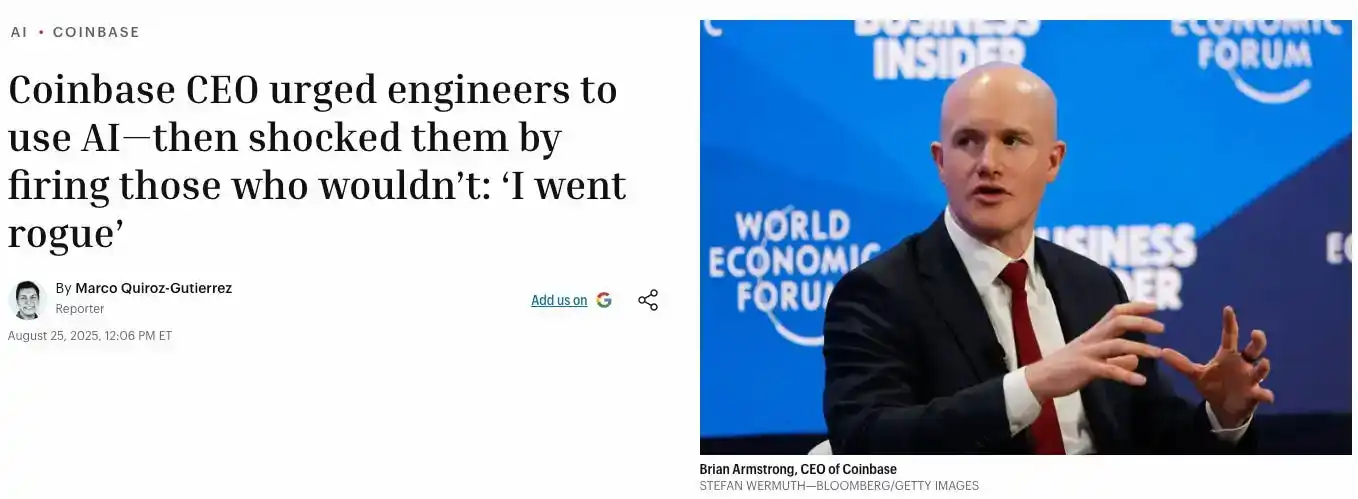
The actions of Coinbase CEO Brian Armstrong fully embody this sense of urgency. He issued a directive to all company engineers to launch AI coding tools within just one week and fired employees who did not comply.
But keeping a clear head is also crucial. Take trading automation, for example. Agents can look at prices and suggest strategies, but how many users will truly trust an agent to hand over funds for live trading? And is the x402 protocol actually being used in the real world?
Ultimately, the adoption of AI in the crypto space is not about chasing trends. As the AI era arrives, companies are acting proactively to avoid losing their market position. Having a feature and truly utilizing it remain two different problems. But who is acting is crucial.

Think of the AI industry as a swimming pool being filled with water. Those who jumped in before were just pretending to swim. Those jumping in now are former national team surfers. No one knows how high the water will rise or if this pool will become an ocean. But crypto will not be drowned in the flood.





















