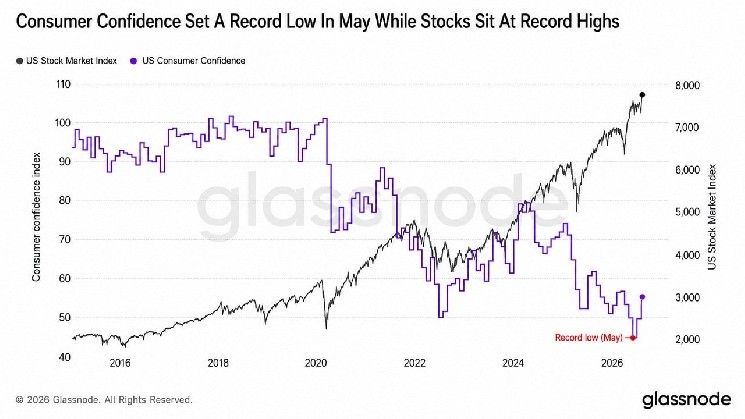
The optimal investment strategy in the current AI bubble environment is to simultaneously go long on "Arrogance" (AI technology leaders) and "Bias" (neglected, underperforming assets), capturing two-way returns during the final surge phase of the nominal GDP bubble.
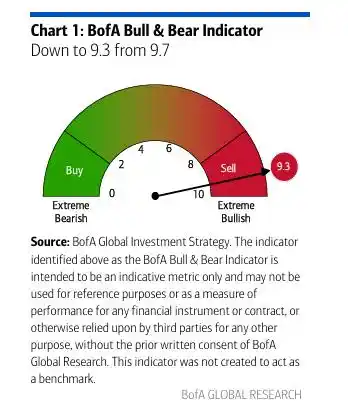
According to the Chasing the Wind Trading Desk, Michael Hartnett, Chief Strategist at Bank of America Securities, stated in his latest research report that the BofA Bull & Bear Indicator has slightly retreated from 9.7 to 9.3, remaining in extreme bullish territory, and continues to signal a "sell." Meanwhile, over the past week, capital flows showed structural divergence: technology stocks saw their largest weekly outflow in seven weeks, gold recorded its largest weekly inflow since January this year, commodities have delivered year-to-date returns as high as 58.9%, while Bitcoin has fallen nearly 28% year-to-date.
Bank of America points out that the core logic for major asset allocation currently remains the framework of avoiding bonds, avoiding the dollar, and fully investing in AI, further reinforced by policymakers viewing the stock market as "too big to fail." However, the strategist also warns that three potential constraints are suppressing the continuation of the bull market: surging bond yields, a shift towards caution in voter sentiment, and widespread positioning already skewed towards longs.
"Arrogance" Plus "Bias": The Optimal Two-Legged Strategy for the AI Bubble
Bank of America's core trading logic on the AI theme is derived from comparisons with historical bubble patterns.
The report points out, the optimal bubble trading strategy is to simultaneously go long on "Arrogance" (hubris)—which is AI technology itself—and go long on "Bias" (humiliation)—which are oversold cyclical assets that have been long neglected by the market and have the potential to be lifted during the final surge phase of nominal GDP.
The report cites historical examples: emerging markets during the 1999 internet frenzy, and the 2007-2008 subprime period, both played roles as "beneficiaries of spillover effects" just before the dominant bubble peaked. Bank of America believes that in the current environment, the assets most likely to replicate this path are in the consumer sector.
At the same time, Bank of America recommends shorting AI bonds—arguing that capital expenditure exceeding $1 trillion combined with negative net cash flow implies significant pressure for massive bond issuance that cannot be ignored.
Bull & Bear Indicator Remains at Extreme Levels, But Sell Signal's Impact is Limited
The BofA Bull & Bear Indicator fell slightly this week from 9.7 to 9.3, maintaining a sell signal, triggered by weaker inflows into high-yield bonds and net outflows from the technology and healthcare sectors.
The report notes that since the sell signal was issued on May 26 this year, the S&P 500 index has risen 4% cumulatively, and the MSCI World Index has gained 3%, despite experiencing a maximum drawdown of 5% during the period (from May 26 to July 30, interrupted by JPY/USD intervention and strong earnings from the "Magnificent Seven" tech stocks).
Bank of America cautions that overly concentrated positioning can disrupt the pace of a bull market, but truly ending a bull market requires the convergence of three elements: excessive positioning, overly optimistic profit expectations, and policy tightening. Currently, these three elements are not simultaneously present.
Historical data shows that since the Bull & Bear Indicator was established, it has issued 17 sell signals. Global stocks on average fell 2% to 3% within 2 to 3 months afterward, with a hit rate of about 60% and maximum drawdowns ranging between 15% and 20%.
Capital Flows: Gold and Commodities in Favor, Tech Stocks Sold
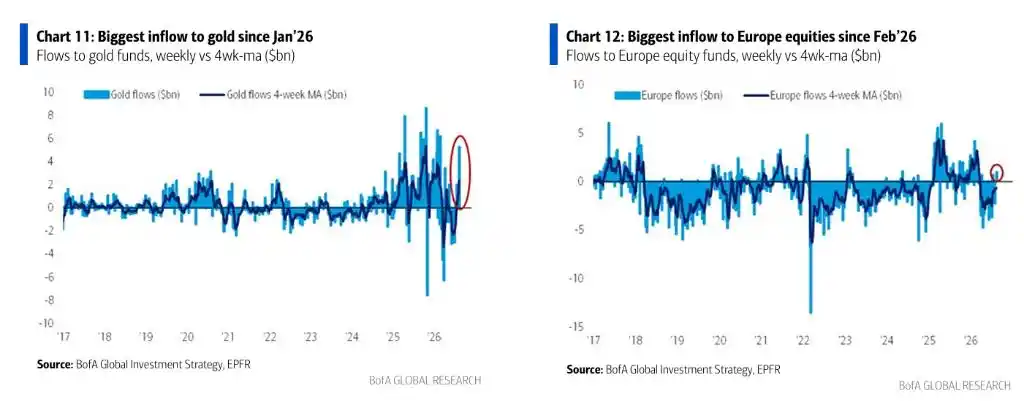
This week's capital flow data showed significant structural divergence. Gold funds recorded a net inflow of $6.3 billion, the largest weekly inflow since January this year; commodities, with a year-to-date total return rate of 58.9%, topped all asset classes, with crude oil up 43% year-to-date.
In contrast, technology funds saw a net outflow of $1.2 billion this week, the largest weekly outflow in seven weeks. European equity funds received a net inflow of $1.2 billion, the largest since February this year; South Korean equity funds recorded net inflows for the seventh consecutive week.
In fixed income, investment-grade bond funds saw inflows of $10.6 billion, the largest in five weeks; emerging market bond funds saw inflows of $1.4 billion, the largest in seven weeks. Cash-like assets attracted $25.4 billion in weekly inflows.
BofA Private Clients: Equity Allocation at Record High, Cash at Record Low
Data from BofA Private Clients shows that managed assets total $4.7 trillion, with equity allocation rising to 66.4%, a record high; bond allocation fell to 17.0%, the lowest since March 2022; cash allocation fell to 9.4%, the lowest level on record. Weekly net equity inflows were the largest since September 2022.
Within bonds, private clients are slightly extending duration, with allocations to 2-10 year U.S. Treasuries rising 15% year-to-date, while allocations to Treasury bills with maturities under one year have fallen over 30% since last November, though interest in 30-year long bonds remains lacking. Over the past four weeks, private clients have purchased ETFs in Japanese bonds, municipal bonds, and inflation-protected bonds, while reducing ETFs in emerging market debt, utilities, and the financial sector.
High Debt Pressure, U.S. Treasury Yields as the Key Variable
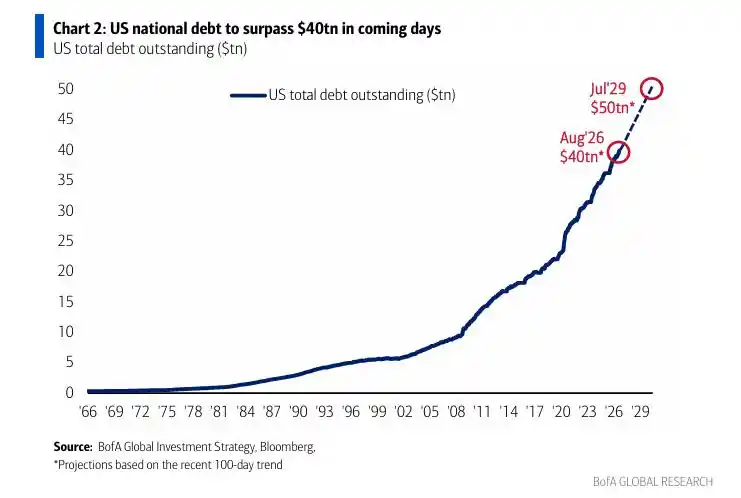
Bank of America warns that U.S. national debt is about to exceed $40 trillion and is projected to reach $50 trillion by July 2029. Federal government debt servicing costs over the past 12 months have reached $1.4 trillion and will continue to rise until the 5-year Treasury yield falls below 3.25%.
At the same time, the U.S. 30-year Treasury completed an auction at a yield of 5.126%, the highest in 25 years, while U.S. stocks hit record highs on the same day, highlighting the continued effectiveness of the "avoid bonds" allocation logic.
Bank of America points out that despite the overall upward trend in yields in 2026, long-duration, previously neglected assets such as REITs, small-cap stocks, biotech (XBI), and regional banks (KRE) are quietly outperforming the broader market, reflecting the market's advance pricing of expectations for "peak yields."
The report believes that the USD/JPY intervention has sent a clear signal that the U.S. government does not want the 10-year Treasury yield to break above 5%.
Strategists expect core CPI to fall to the 2.1%-2.6% range before the midterm elections. Hawkish Fed Chairman Warsh is then expected to use the Jackson Hole speech and the September FOMC meeting to declare "mission accomplished," working in tandem with a Bank of Japan rate hike to jointly cap the upside for yields.
Hong Kong Real Estate and Gold: Two Trades for "Avoiding the Dollar"
Under the "avoid the dollar" theme, Bank of America recommends two specific trade paths. First, go long on gold, viewing it as the best hedge against dollar depreciation, bond market collapse, and asset inflation. This week's gold inflows also confirm the market consensus in this direction.
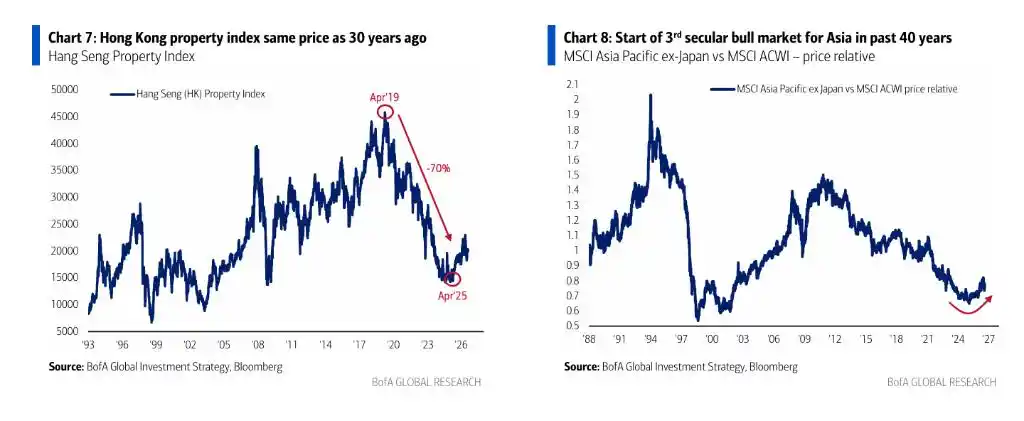
Second, go long on the Hong Kong real estate sector. BofA strategists summarize this logic as "buy humiliation, sell arrogance": the Hang Seng Properties Index is currently at the same level as 30 years ago, with a valuation of only about 12 times earnings.
The report believes Asia is entering its third long-term bull market in the past 40 years, driven by Japanese and Korean technology and Chinese AI. Hong Kong simultaneously benefits from the relative decline in attractiveness of Dubai (geopolitical conflict) and Singapore (taxes).
November Midterm Elections: The Political Variable Determining the AI Bull Market's Continuation
Bank of America lists the U.S. midterm elections on November 3 as one of the most critical events influencing market direction.
The report notes that if the Republican Party holds the Senate and Texas Governor Abbott secures re-election, AI-led risk assets are expected to accelerate towards a peak in 2027; however, if the Democratic Party wins the Senate or the Texas gubernatorial seat in November, stocks, the dollar, and bond yields could all experience sharp declines of over 10% before year-end.
The Texas gubernatorial election is seen as a referendum between "affordability" and "AI data centers": the state currently has 335 data centers, with another 247 planned. Abbott recently announced a temporary pause on data center expansion, reflecting voter concerns over grid stability and cost of living.
Additionally, key dates highlighted by Bank of America include: August 28 for Warsh's Jackson Hole speech, September 16 for the Fed FOMC meeting (current probability of a hike: 35%), and September 18 for the Bank of Japan meeting (probability of a hike: 74%).
This article is from the WeChat public account "Wall Street News," author: Zhang Yaqi