The Next Bitcoin ETF Boom May Be Coming From Japan – Here’s Why

bitcoinistPublished on 2026-06-07Last updated on 2026-06-07

Abstract

Despite recent outflows from US Spot Bitcoin ETFs, market attention is shifting to Japan as the potential next major market for such funds. This follows regulatory reforms in Japan that are moving cryptocurrency oversight to a financial instruments framework, potentially enabling Bitcoin ETF approval. Analysis suggests a Japanese spot Bitcoin ETF could attract significant inflows, ranging from ¥900 billion ($5.61 billion) in a conservative scenario to ¥3.1 trillion ($19.34 billion) in a bullish one. A base-case estimate of ¥1.4 trillion ($8.73 billion) would equate to demand for roughly 140,000 BTC. Beyond price impact, a Japanese ETF is seen as boosting Bitcoin's legitimacy and accessibility for investors and institutions. Bitcoin's price was around $61,038 at the time of writing, down 2.81% over 24 hours.

The US Spot Bitcoin ETFs are experiencing a sustained bearish performance, especially as the premier cryptocurrency succumbs to another wave of correction. Recent data suggest that these ETFs recorded 13 consecutive trading days of net outflows between Mid-May and early June, with investors pulling out about $4.33 billion. Nevertheless, these assets still boast of net assets valued at $75.12 billion.

In a quicktake post on the CryptoQuant platform, analytics group XWIN Research Japan reported that after years of approving the US Spot Bitcoin ETFs, investors and market participants are starting to anticipate which country might produce the next major ETF market, with Japan emerging as a likely candidate.

Regulatory Reforms Strengthen Japan’s Bitcoin ETF Prospects

In a QuickTake post on June 3, XWIN analysts report that, first, Japanese regulators were pushing reforms that would shift the jurisdiction of crypto assets from the Payment Service Act framework to the Financial Instruments and Exchange Act, so they could be recognized as investment products. With confidence, the seasoned analyst asserted that these changes have gradually shifted the discussion from “if” to “when” a Bitcoin ETF will be approved.

If the regulation reforms were successful, it is worth noting that there are about ¥2,350 trillion ($14.66 trillion) in household financial assets and about ¥300 trillion ($1.87 trillion) in investment funds. Based on adoption rates in other markets, the Japanese Spot Bitcoin ETF could attract up to ¥900 billion ($5.61 billion) in a conservative scenario that assumes events develop relatively slowly.
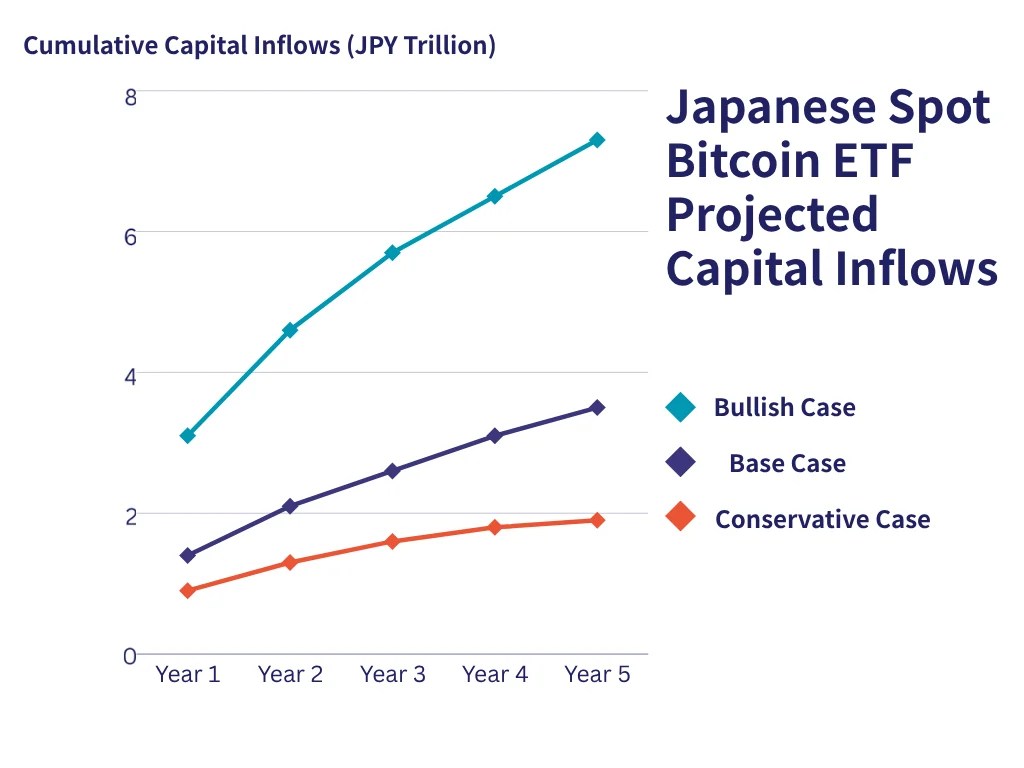
Source: CryptoQuant

In a base-case and most-likely scenario, deposits in the Japanese Bitcoin ETF could surge to around ¥1.4 trillion ($8.73 billion) upon launch. In a bullish scenario that assumes strong growth, high investor interest, and very positive market conditions, the inflow could possibly rise ¥3.1 trillion ($19.34 billion) during its first year. He stated that at current prices, a ¥1.4 trillion inflow would represent demand for approximately 140,000 BTC.

Finally, he added that the most pressing impact of the Japanese Bitcoin ETF launch goes beyond price appreciation. A spot Bitcoin ETF would allow investors to participate more easily, enable wealth managers to recommend Bitcoin exposure to clients, make institutional investors feel more comfortable investing, and give Bitcoin greater legitimacy within traditional finance.

Bitcoin Price At A Glance

As of this writing, the price of BTC stands around $61,038, reflecting a 2.81% decline in the past 24 hours.

BTC trading at $61,012 on the daily chart | Source: BTCUSDT chart on Tradingview.com

Trending Cryptos

Related Questions

QWhat is the main focus of the article regarding Bitcoin ETFs?

AThe main focus of the article is Japan's potential emergence as the next major market for spot Bitcoin ETFs, following the US. It explores the regulatory reforms in Japan and their implications.

QAccording to the article, what significant regulatory change in Japan supports the approval of a Bitcoin ETF?

AJapanese regulators are shifting the jurisdiction of crypto assets from the Payment Service Act to the Financial Instruments and Exchange Act. This change would recognize cryptocurrencies as investment products, paving the way for a Bitcoin ETF.

QWhat are the potential fund inflow estimates for a Japanese Spot Bitcoin ETF in its first year, according to XWIN Research Japan?

AXWIN Research Japan provides three scenarios: a conservative estimate of ¥900 billion ($5.61 billion), a base-case estimate of ¥1.4 trillion ($8.73 billion), and a bullish estimate of ¥3.1 trillion ($19.34 billion) in inflows during its first year.

QHow many BTC would a ¥1.4 trillion inflow into a Japanese Bitcoin ETF represent at the article's mentioned Bitcoin price?

AAt current prices, a ¥1.4 trillion ($8.73 billion) inflow would represent demand for approximately 140,000 BTC.

QWhat was the reported performance trend of US Spot Bitcoin ETFs in Mid-May to early June?

AThe US Spot Bitcoin ETFs experienced 13 consecutive trading days of net outflows between Mid-May and early June, with investors pulling out about $4.33 billion.

Related Reads

Solana Price Forecast for August 2026: Can $19 Million from Morgan Stanley and 330,000 Korean Merchants Break SOL's Triangle?

**Solana Price Forecast for August 2026: Key Catalysts and Technical Setup** As of July 31, Solana (SOL) trades at $73.59, consolidating within a triangle pattern formed between its May peak (~$98) and June low (~$60.29). A decisive breakout from this pattern is anticipated. Key resistance levels are clustered around $74.79 (0.382 Fib), $75.33 (20-day EMA), $76.01 (50-day EMA), and a critical zone near $79 (0.5 Fib & 100-day EMA). Support lies at $73.42, $69.25 (0.236 Fib), and the June low of $60.29. Two major institutional catalysts emerged recently: 1. **Morgan Stanley's MSOL ETF:** Launched July 28, it saw $19.06 million in inflows on its second day—the largest single-day inflow for any US SOL ETF since mid-May. 2. **KSNET Partnership:** The Solana Foundation signed an MoU with South Korean payment processor KSNET (serving 330,000 merchants) to explore integrating Solana Pay for domestic and AI-powered transactions. Historically, August has been volatile for SOL, marked by extreme gains in 2020 and 2021 but otherwise weak performance. The forecast for August 2026 is bifurcated: * **Bullish Case:** An upside triangle breakout, sustained MSOL inflows, and positive momentum from the KSNET news could propel SOL toward the $79 resistance cluster, especially if the CLARITY Act is passed by August 8. * **Bearish Case:** A downside break below $73.42, fading excitement around the new ETF, and stalled regulatory progress could see SOL retest support near $69.25, exacerbated by macro risks.

cryptonews.ru30m ago

Solana Price Forecast for August 2026: Can $19 Million from Morgan Stanley and 330,000 Korean Merchants Break SOL's Triangle?

cryptonews.ru30m ago

Trading

Spot

Hot Articles

Discussions

Welcome to the HTX Community. Here, you can stay informed about the latest platform developments and gain access to professional market insights. Users' opinions on the price of S (S) are presented below.

活动图片