The Midfield Battle of Perp DEX: The Declining, The Self-Rescuers, and The Latecomers

marsbitPublished on 2026-03-27Last updated on 2026-03-27

Abstract

The article "Perp DEX Midfield Battle: The Declining, The Self-Rescuers, and The Newcomers" discusses the shifting landscape of decentralized perpetual exchanges (Perp DEX). Hyperliquid saw a weekly trading volume of approximately $15 billion, driven largely by commodity contracts like crude oil, gold, and silver amid geopolitical tensions and market volatility. Meanwhile, GMX Labs is hiring a CEO, moving away from its founder-driven model, and dYdX's market share dropped from 73% in early 2023 to single digits by late 2024. The decline of GMX and dYdX is attributed to several factors: reliance on token incentives that inflated trading volumes artificially, architectural limitations (e.g., GMX's liquidity pool model capping open interest, dYdX's costly migration to Cosmos), and misjudging key competitive factors like performance and market maker density. Hyperliquid, in contrast, grew slowly without VC backing or token incentives. It built its own L1 chain with a fully on-chain order book, focusing on transparency to attract market makers. It strategically expanded into traditional assets only after establishing a robust ecosystem, enabling it to capture demand during events like the Iran crisis. It now leads with ~54% of open interest among top Perp DEXs, ahead of Aster (~15%). The article concludes that the first generation of Perp DEXs is transitioning to professional management, while new opportunities lie in replacing traditional financial infrastructure, as Hype...

Author:Zhou, ChainCatcher

Last week, Hyperliquid's trading volume reached approximately 15 billion USD, with commodity-related contracts such as crude oil, gold, and silver becoming the main drivers.

As oil prices fluctuated sharply, the daily trading volume of crude oil perpetual contracts on Hyperliquid exceeded 2.2 billion USD, second only to Bitcoin.

With the escalation of the situation in Iran and the Strait of Hormuz in crisis, and the CME closed over the weekend, global traders flocked to an on-chain decentralized exchange for price discovery.

At the same time, GMX Labs, which once held nearly a quarter of the decentralized perpetual contract market share, is publicly recruiting a CEO, admitting that the early founder-driven model is unsustainable and seeking to transition to a traditional leadership structure.

One is capturing the overflow demand from traditional finance, while the other is still rebuilding its foundation.

GMX and dYdX Why Did They Fail?

Looking closely at this announcement from GMX Labs, the candidate pool for CEO covers DeFi, CeFi, traditional finance, and the tech industry, with a base salary of 150,000 to 200,000 USD paid in stablecoins, and performance directly tied to protocol fee growth. This proposal passed in the DAO governance vote with 96.42% approval.

A decentralized protocol, with overwhelming community consensus, decides to introduce a traditional professional manager. This means the community has realized that the original makeshift model can no longer hold up, and the solution they can think of is to move closer to traditional enterprise management.

dYdX's situation is even more dire. At the beginning of 2023, dYdX held 73% of the decentralized perpetual contract market share, almost monopolizing it; by the end of 2024, this number had dropped to single digits, and its token price fell by over 90%.
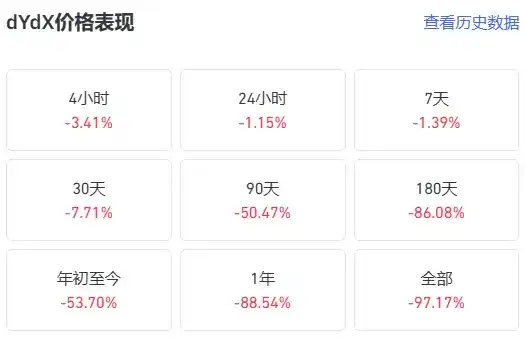
Now, the news about these two protocols in the media is not about product updates or market share, but token buybacks. When a protocol focuses its main energy on maintaining token value rather than winning market share, its strategic focus has fundamentally shifted.

GMX and dYdX's decline has complex reasons.

First is the starting point problem. An OKX Ventures report shows that in 2021, dYdX pushed its daily trading volume to about 9 billion USD through trading mining, once surpassing Coinbase. This number was built on token incentives, with users刷量ing for rewards, not real trading.

The more serious consequence is not the虚假 data itself, but the team treating虚假 user feedback as real product signals to respond to, so the iteration direction was off from the start.

Second is the architecture problem. GMX adopted a multi-asset liquidity pool plus oracle pricing model. This design had its合理性 in 2021, when the Ethereum chain couldn't handle order books, and the AMM model was a viable choice.

But this architecture has a quantifiable ceiling; the total open interest the protocol can carry is approximately 5 times the TVL, and the上限 of TVL locks the上限 of trading scale.

LPs are naturally at an information disadvantage in this model, acting as the collective counterparty for all traders but without the ability to actively manage risks. Professional market makers are unwilling to enter under these conditions, so liquidity depth is always limited.

dYdX saw the direction of order books and decided to migrate to Cosmos to build its own app chain. The technical judgment was correct, but there were problems in execution. After the migration, users needed to readapt to new wallets and cross-chain asset bridging, significantly increasing friction costs. More critically, in the v4 version, protocol fees flowed to validators instead of token holders, and the community's perception of growth红利归零.

The third point lies in the judgment of the decisive point. GMX bet on the liquidity model, dYdX bet on building its own chain, but the real decisive points in this赛道 are only two: performance, and the density of the market maker ecosystem.

OKX Ventures pointed out that most perpetual DEXs merely shift centralized risk from the custody layer to the less visible execution and liquidation layers. Decentralization is treated as a narrative, not a real product problem to be solved.

dYdX's turn to synthetic stock perpetual contracts and opening up to US users is about trading compliance for survival space, avoiding正面竞争. GMX recruiting a CEO is about using organizational upgrade to make up for strategic judgment欠账. These are correct self-rescue actions, but they are still dealing with the results, not the causes.

The Logic of the Latecomers

Hyperliquid launched in 2023, when GMX and dYdX were still the dominant players in this赛道. It had no financing, no VC backing, and no large-scale launch event.
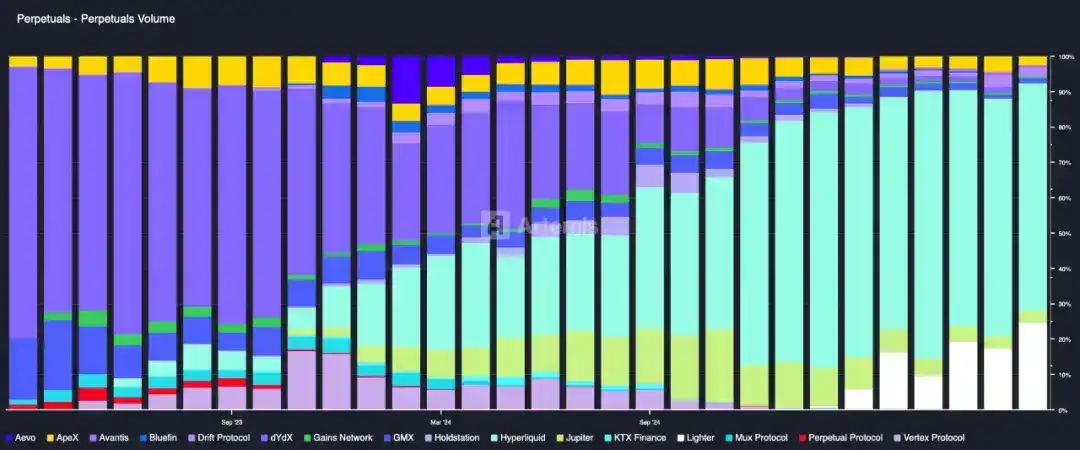
Early growth was slow. Without token incentives to刷量, the number of traders and market makers accumulated during the cold start was limited, and platform data was unattractive for a long time. The profit and loss of the HLP vault was verifiable on-chain in real-time, which attracted people willing to put real money in, but at the time, this was not an obvious advantage.

On the technical route, founder Jeff chose from the beginning to build his own L1 and create a fully on-chain order book. The logic behind this was that through a fully transparent on-chain environment, market makers could identify different types of trading flows and adjust their quoting strategies accordingly.

This line of thinking determined that it could not take the path of dYdX's migration to an app chain, nor could it follow GMX's reliance on oracle pricing; it had to rebuild from the ground up. Although this theory is still controversial in the industry, it provided a clear主线 for Hyperliquid's product direction.

In terms of布局 traditional assets, HIP-3 was launched in October 2025, first accumulating a market maker ecosystem with crypto assets, then依次 launching gold, silver, and crude oil.

The report points out that when dYdX launched permissionless traditional asset markets in 2024, the daily trading volume of Tesla synthetic stock was 4000 USD, and the Turkish Lira was 0. Without market makers present, asset listing is zero.

Hyperliquid's approach was to wait for the market maker ecosystem to mature before expanding asset categories, so when the Iran crisis broke out, it caught this wave of trading volume.

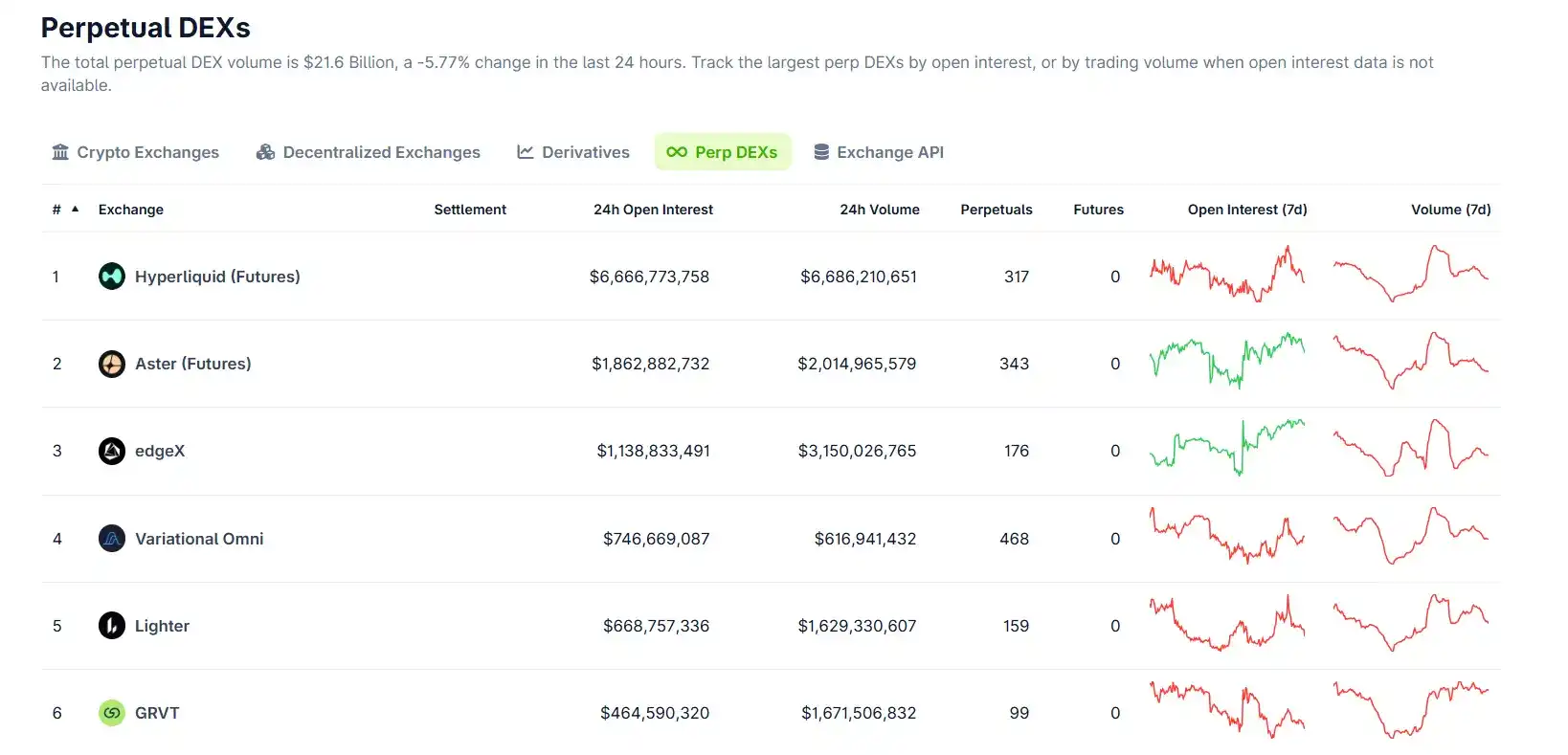
According to CoinGecko data, based on the 24-hour open interest as of March 26, among the top ten perpetual DEXs, Hyperliquid occupies about 54%, Aster ranks second with about 15%, and Hyperliquid's scale still exceeds the sum of the other nine.

Why did Hyperliquid come from behind and take the lead, while the second-ranked Aster entered the market almost at the same time?

Aster CEO Leonard said in an interview, "When dYdX appeared, we started trying to build our own thing on-chain, and the first version of Aster appeared, which was Apollo X. Since then, perpetual contract DEXs have gone through several cycles, with projects like GMX representing an era. We have always tried to build what the market really needs, so now we have Aster."

From his words, it can be seen that Aster's path is渐进. Starting from the AMM model, it gradually iterated, adding order books, and then adding private order functions to address the limitations of transparent markets. Each step responds to market feedback, and each step is a reasonable product decision.

Simply put, it has always been following the evolution of the赛道, not defining the evolution of the赛道.

Don't Release Your Product Too Early

In the crypto industry, the speed of technological paradigm shifts is too fast, and渐进 iteration means you are always chasing the decisive points of the previous era.

There have always been people in this赛道重新 looking for answers, and this is still the case now.

The crypto industry is not viewed favorably now, and a large amount of talent and capital is withdrawing. But precisely because people are leaving, the technology window will not be quickly filled, leaving builders with more time. Every infrastructure iteration, L2 maturity, app chain feasibility, and on-chain order book viability open up new product possibility spaces.

First-mover advantage is much more fragile in this industry than in traditional industries, which is both a risk for old players and a real opportunity for new players. Especially in the era where AI tools level the productivity gap, homogeneous competition is intensifying, and just-good-enough products are increasingly difficult to stand on their own.

Particle's founder, summarizing the lessons of the past year's entrepreneurship, quoted Google founder Sergey Brin's words at Stanford: Don't release your product too early. He meant that once you release a signal too early, you are tied to a delivery timeline and have no time to truly finish what needs to be done.

So, the real problem for entrepreneurship is not how fast you run, but figuring out where the endgame of this赛道 is.

Conclusion

GMX recruiting a CEO is not a big deal, but it may be looked back upon as a footnote at some point.

The entrepreneurial红利 period of the first generation of perpetual DEXs has ended. The era of makeshift teams, founder-driven, rapid iteration has reached a node that requires professional management.

The new window is elsewhere, just as Hyperliquid caught this wave of geopolitical行情 with commodity contracts. Decentralized exchanges are moving from internal competition within the crypto industry towards real替代 of traditional financial infrastructure, and this direction has just begun.


Related Questions

QWhat were the main reasons for the decline of GMX and dYdX in the perpetual DEX market?

AThe decline was due to multiple factors: 1) dYdX's initial trading volume was inflated by token mining incentives rather than real demand, leading to misguided product iterations. 2) GMX's AMM-based architecture had a capped capacity (5x TVL), limiting scalability, and its liquidity providers faced informational disadvantages. 3) dYdX's migration to Cosmos increased user friction and diverted protocol fees to validators instead of token holders, reducing community incentives. 4) Both misjudged the key competitive factors—performance and market maker density—while focusing on liquidity models or chain migration.

QHow did Hyperliquid manage to capture significant trading volume during the Iran crisis?

AHyperliquid captured volume by offering perpetual contracts for traditional commodities like crude oil, gold, and silver. When geopolitical tensions escalated and CME closed, traders sought decentralized price discovery. Hyperliquid had already built a mature market maker ecosystem for crypto assets before expanding to commodities, ensuring liquidity was available to handle the surge in demand.

QWhat technological approach did Hyperliquid take to differentiate itself from competitors like GMX and dYdX?

AHyperliquid built its own L1 blockchain and implemented a fully on-chain order book model. This provided complete transparency, allowing market makers to identify different types of trading flows and adjust pricing strategies. Unlike GMX (which relied on oracle pricing and AMM pools) or dYdX (which migrated to an app-chain), Hyperliquid's approach focused on performance and market maker efficiency from the ground up.

QWhy did GMX's community vote to hire a traditional CEO, and what does this signify?

AGMX's DAO voted 96.42% in favor of hiring a professional CEO because the community recognized that the early founder-driven model was unsustainable. The move signifies a shift toward traditional corporate management structures, acknowledging that decentralized protocols require professional leadership to address strategic challenges and scale effectively.

QWhat lesson does the article highlight about product development in the crypto industry, based on Sergey Brin's advice?

AThe article emphasizes that releasing a product too early can force teams into rigid timelines, preventing them from fully executing their vision. Instead, founders should focus on understanding the end-state of the market and building comprehensively before launching, as incremental iterations often fail to catching up with rapidly evolving technological paradigms.

Related Reads

In-Depth Report on the On-Chain Lending Market: When Off-Chain Credit Meets On-Chain Liquidation

The on-chain lending market has evolved from a peripheral DeFi niche into core financial infrastructure. As of early 2026, total value locked (TVL) in on-chain lending protocols has reached $64.3 billion, accounting for 53.54% of total DeFi TVL, making it the largest and most mature vertical within decentralized finance. Aave dominates the sector with approximately $32.9 billion in TVL, commanding nearly half of the market—a leadership position that is unlikely to be challenged in the foreseeable future. However, the path of on-chain lending forward is not without risk. Liquidation cascades, credit defaults, and cross-chain vulnerabilities remain systemic threats hanging over the industry. At the same time, a deeper structural transformation is underway: on-chain lending is shifting from a “leverage tool for crypto-native users” to a “compliant gateway for institutional capital”. The scale of RWA (Real World Asset) lending has surpassed $18.5 billion, with U.S. Treasuries and government securities increasingly serving as core collateral. Institutional capital inflows are reshaping both the user base and risk appetite of the sector. This report systematically analyzes the evolution of on-chain lending definitions, competitive dynamics, core risks, and future trends, providing a comprehensive industry outlook for investors and trade practitioners. Key findings suggest that the “one dominant player with several strong challengers” structure will persist in the short term, while fixed-rate lending, compliant collateral, and institutional credit underwriting will define the next phase of competition. For investors focused on DeFi infrastructure, three key opportunity tracks stand out, namely, the Aave ecosystem (Morpho, Spark), RWA lending protocols (Ondo, Maple) and fixed-rate innovation (Notional, Pendle).

HTX Learn1h ago

In-Depth Report on the On-Chain Lending Market: When Off-Chain Credit Meets On-Chain Liquidation

HTX Learn1h ago

Fu Peng's First Public Speech in 2026: What Exactly Are Crypto Assets? Why Did I Join the Crypto Asset Industry?

Fu Peng, a renowned macroeconomist and now Chief Economist at New火 Group, delivered his first public speech of 2026 at the Hong Kong Web3 Festival. He explained his perspective on crypto assets and why he joined the industry, framing it within the context of macroeconomic trends and financial evolution. Fu emphasized that crypto assets are transitioning from an early, belief-driven phase to a mature, institutionally integrated asset class. He drew parallels to the 1970s-80s, when technological advances (like computing) revolutionized traditional finance, leading to the rise of FICC (Fixed Income, Currencies, and Commodities). Similarly, current advancements in AI, data, and blockchain are reshaping finance, with crypto assets becoming part of a new "FICC + C" (C for Crypto) framework. He noted that institutional capital, including traditional hedge funds, avoided early crypto due to its speculative nature but are now engaging as regulatory clarity emerges (e.g., stablecoin laws, CFTC classifying crypto as a commodity). Fu predicted that 2025-2026 marks a turning point where crypto becomes a standardized, financially viable asset for diversified portfolios, akin to commodities or derivatives in traditional finance. Fu defined Bitcoin not as "digital gold" in a simplistic sense but as a value-preserving, financially tradable asset. He highlighted that crypto's future lies in regulated, institutional adoption, moving away from retail-dominated trading. His entry into crypto signals this maturation, where traditional finance integrates crypto into mainstream asset management.

marsbit2h ago

Fu Peng's First Public Speech in 2026: What Exactly Are Crypto Assets? Why Did I Join the Crypto Asset Industry?

marsbit2h ago

Justin Sun Sues Trump Family: What $75 Million Bought Was Only a Blacklist

Justin Sun, founder of Tron, has filed a lawsuit in federal court against World Liberty Financial (WLF), alleging he was made the "primary target of a fraudulent scheme" after investing $75 million. Sun claims the investment secured him an advisor title and WLFI tokens, which were later frozen by WLF, causing "hundreds of millions in losses." The dispute began in late 2024 when Sun's investment helped revive WLF's struggling token sale, which ultimately raised $550 million. Shortly after, the SEC dropped its lawsuit against Sun following Donald Trump's inauguration. However, relations soured when Sun refused WLF's demands for additional funding. In August 2025, WLF added a "blacklist" function to its smart contract, allowing it to unilaterally freeze tokens. Sun's holdings, worth approximately $107 million, were frozen, and he was threatened with token destruction. The lawsuit highlights WLF's structure, which directs 75% of token sale profits to the Trump family, who had earned $1 billion by December 2025. WLF's CEO is Zach Witkoff, son of U.S. Middle East envoy Steve Witkoff. The project faces scrutiny for opaque operations, including a controversial loan arrangement on the Dolomite platform, co-founded by a WLF advisor. Despite Sun's history with the SEC, the case underscores centralization risks within DeFi, as WLF controls governance and holds powers to freeze assets arbitrarily. Sun's tokens remain frozen as legal proceedings begin.

marsbit2h ago

Justin Sun Sues Trump Family: What $75 Million Bought Was Only a Blacklist

marsbit2h ago

Trading

Spot
Futures
活动图片




