The Market's Biggest Misconception About 'Quantum Computing': It's Still 'Too Early'

marsbitPublished on 2026-02-09Last updated on 2026-02-09

Abstract

This article, based on a Barclays research report, addresses the common market misconception that quantum computing is still a distant, futuristic technology. The report argues that the field is approaching a critical inflection point, with "quantum advantage" expected to be demonstrated within the next 12-24 months when systems can stably operate 100 logical qubits. It corrects several key misunderstandings: quantum computers will not replace classical systems like GPUs but will instead require them for error correction, creating a symbiotic relationship that could generate over $100 billion in incremental demand for classical computing by 2040. The report also highlights the differentiation in hardware approaches, noting the current lead of trapped ions, the scaling potential of silicon spin qubits, and the quantity advantage of neutral atoms. It dismisses fears of imminent encryption breaches and emphasizes that the investment universe is broader than often perceived, encompassing over 45 public companies across the entire quantum supply chain.

Author: Long Yue

Source: Wall Street News

Investors generally believe that quantum computing is still in the realm of science fiction, but Barclays' latest research report points out that this "too early" misconception might cause you to miss the most critical trend in the next 12 months.

According to Wind Trading Desk news, Barclays' analyst team recently released a research report titled "Quantum Computing: Correcting the Biggest Misconception Among Investors".

The core logic of the report is very straightforward: Wall Street underestimates the speed of technological breakthroughs and completely misunderstands the relationship between quantum and classical computing power (like NVIDIA). Barclays believes we are on the eve of transitioning from a "lab toy" to a "commercial tool".

Misconception 1: Quantum Computing is "Too Early"

Barclays' first correction is: Don't treat quantum computing as a purely long-term theme that "won't yield results for another decade."

The current market consensus is that perfectly functioning "Fault-Tolerant Quantum Computing" (FTQC) won't arrive until after 2030. This is correct, but Barclays reminds investors not to ignore the intermediate "tipping points".

Barclays points out that 2026 to 2027 will be the industry's watershed moment, when "Quantum Advantage" will be achieved.

More importantly is "how to define advantage". Barclays believes that "advantage is only proven when a system targets 100 logical qubits". It also cautions that any "claim of advantage" needs to be backed by "strong technical evidence", otherwise it's more like marketing than an inflection point.

"We expect major announcements within the next 12 months...... Quantum advantage will be proven when a system can stably run 100 logical qubits."

This is like the Wright brothers' first flight; although it couldn't carry passengers (commercialization), it proved that airplanes were better than horse-drawn carriages (quantum advantage). Once this signal appears, the valuation logic in the capital markets will be instantly reshaped.
Misconception 2: Quantum will replace classical computing, so NVIDIA is finished?

This is the market's biggest cognitive bias. The report points out that many people think quantum computers are so powerful they will replace current CPUs and GPUs. Barclays refutes this: it's not a replacement relationship, but a "strongest assistant" relationship.

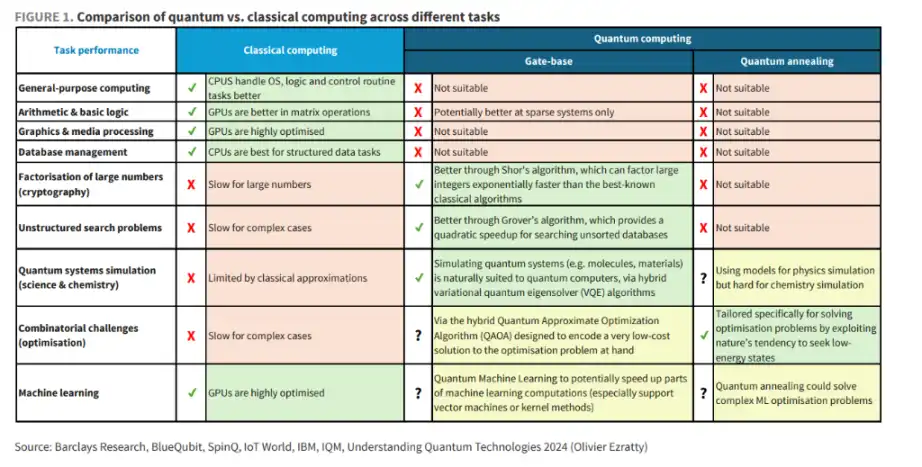
"Quantum computers will not replace classical computers as general-purpose machines, but will complement them."

The core logic behind this lies in "error correction": Qubits are very fragile and unstable (prone to errors). To make them work properly, an extremely powerful classical computing system is needed to monitor and correct them in real-time.

Barclays' research reveals a startling data relationship:

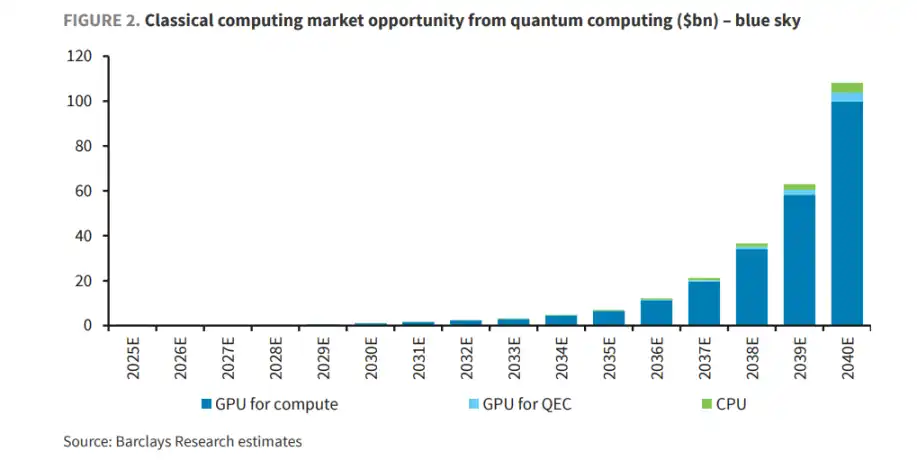
"Each logical qubit may require one GPU for error correction and control."

What does this mean? If you build a quantum computer with 1000 logical qubits, you would need to purchase 500 to 2000 GPUs to support it.

This is no longer competition, but symbiosis. The stronger the quantum computer, the more explosive the demand for chips from NVIDIA and AMD becomes. Barclays calculates that this "derived demand" could bring over $100 billion in incremental value to the classical computing market by 2040 in a blue-sky scenario.
Misconception 3: Quantum hardware is all similar, like buying a lottery ticket?

The truth about this misconception is that the field has already diverged, with clear strengths and weaknesses.

Quantum hardware approaches are not singular. Barclays categorizes mainstream physical qubit paths into electronic (superconducting, electron spin), atomic (trapped ions, neutral atoms), and photonic, among others, noting that their pros and cons stem from trade-offs between speed, accuracy, coherence time, external infrastructure (cryogenics, lasers, vacuum), and scalability.

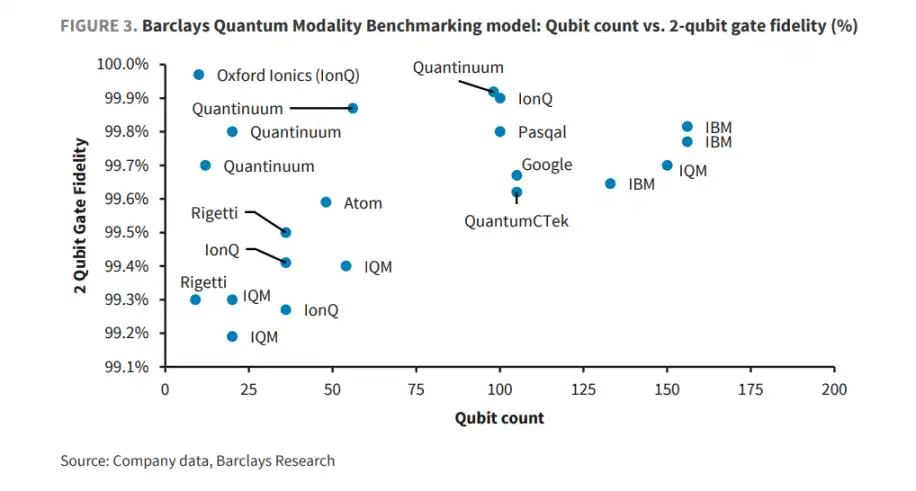
Using a "quantum benchmarking model," Barclays highlights key points in the currently chaotic hardware landscape:

  • Current "Accuracy King" — Trapped Ions: Represented by companies like Quantinuum and IonQ. Their advantage is accuracy, low error rates, and relatively mature technology.
  • Future "Mass Production Dark Horse" — Silicon Spin: The direction Intel is pursuing. Although performance is modest now, it can leverage existing semiconductor fabs for manufacturing. Once breakthroughs occur, it's the easiest to mass-produce.
  • Winning by Numbers — Neutral Atoms: Have a natural advantage in stacking large numbers of qubits.

Barclays concludes:

"Our testing indicates trapped ions are currently in the lead...... but the scalability of silicon spin warrants long-term attention."
Misconception 4: Encryption is about to be broken?

Regarding the panic that "quantum computers will crack bank passwords tomorrow," Barclays pours cold water on the idea: Think again, the computing power isn't there yet.

Cracking current RSA encryption requires thousands of perfect logical qubits, while humanity's top devices currently have only a few dozen. Barclays states bluntly:

"Quantum computers are not yet powerful enough...... modern encryption standards are not yet under threat."

Misconception 5: The quantum theme has "only two or three companies worth investing in"

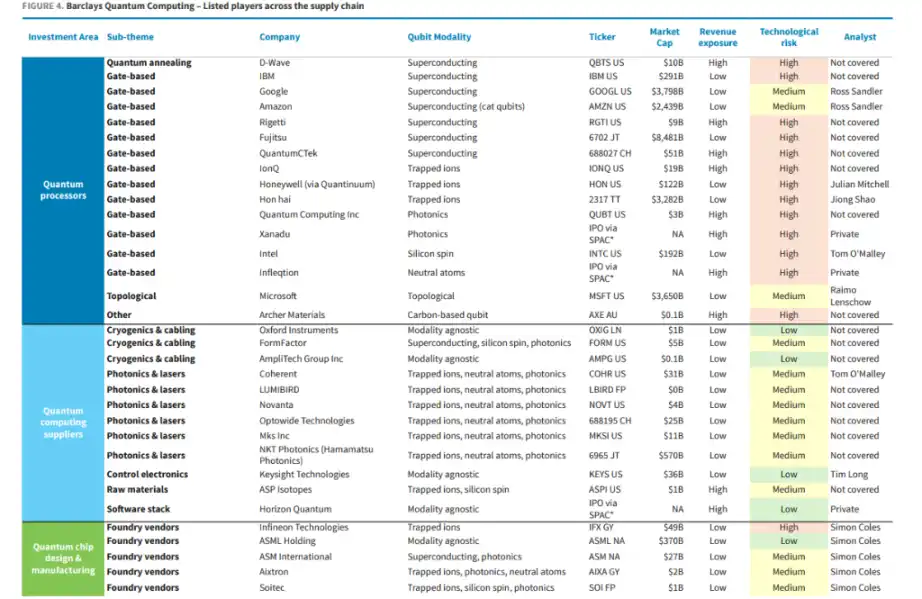
The market often perceives investment targets in this field as scarce, limited to a few well-known companies. But Barclays梳理 (sorted through) the entire industry chain, identifying 45 listed companies and over 80 private enterprises. They are mainly distributed across four areas:

1) Quantum Processors (system sales or QCaaS cloud access)

2) Quantum Supply Chain (cryogenics, lasers/optics, control electronics, materials, etc.)

3) Quantum Chip Design and Manufacturing (overlap with traditional semiconductor manufacturing)

4) Ecosystem Enablers (cloud, data center infrastructure, quantum simulators, quantum-classical integration: GPU/CPU/servers, etc.)

The framework provided by the report leans more towards "risk pricing": short-term often correspond to "higher revenue exposure" paired with "higher technical risk". It roughly categorizes technical risk as high (single approach), medium (few approaches), low (approach agnostic) based on whether the business model is tied to a single approach.

This also explains why the quantum narrative easily "focuses solely on pure quantum hardware stocks": their revenue exposure is most direct, but path uncertainty is also greatest; whereas the supply chain, semiconductor equipment & EDA, cloud & data centers, and hybrid integration segments might better transmit the "quantum progress → capital expenditure and supporting demand" linkage.
Related Questions

QWhat is the core argument of Barclays' report regarding the market's perception of quantum computing?

ABarclays argues that the market underestimates the speed of technological advancement in quantum computing and misunderstands its relationship with classical computing, emphasizing that we are on the verge of transitioning from 'lab toys' to 'commercial tools'.

QWhen does Barclays predict quantum advantage will be achieved, and how is it defined?

ABarclays predicts quantum advantage will be achieved between 2026 and 2027, defined as when a system can stably operate with 100 logical qubits, supported by strong technical data.

QHow does Barclays describe the relationship between quantum computers and classical computing hardware like GPUs?

ABarclays states that quantum computers will not replace classical computers but will complement them, requiring GPUs for error correction and control—each logical qubit may need one GPU, creating a symbiotic relationship.

QWhat are the three leading quantum hardware paths highlighted by Barclays, and their key strengths?

AThe three paths are: 1) Trapped Ions (e.g., Quantinuum, IonQ) for high accuracy and low error rates, 2) Silicon Spin (e.g., Intel) for potential mass production using semiconductor fabs, and 3) Neutral Atoms for scalability in qubit count.

QAccording to Barclays, how many companies are involved in the quantum computing ecosystem, and what are the four main areas they operate in?

ABarclays identifies 45 public and over 80 private companies across four areas: 1) Quantum processors (system sales or QCaaS), 2) Quantum supply chain (cryogenics, lasers, control electronics, materials), 3) Quantum chip design and manufacturing, and 4) Ecosystem enablers (cloud, data centers, quantum-classical integration).

Related Reads

a16z: Why Prediction Markets Could Become the Infrastructure for 'Future Probabilities'

The article explores the concept and potential of prediction markets, arguing that they are evolving from niche trading tools into a foundational infrastructure for assessing the probability of future events. A prediction market creates tradable contracts on specific event outcomes, using market price to aggregate dispersed information and approximate a collective probability assessment. This mechanism offers advantages over polls or expert forecasts by providing a real-time, incentivized signal, as participants risk real money on their judgments. Key strengths include the ability to generate probabilistic estimates, built-in financial incentives that encourage genuine information gathering, and the capacity to address specialized questions (e.g., AI model performance, geopolitical events) not easily captured by traditional financial markets. The author emphasizes that a prediction market is essentially a market—a tool for both resource allocation and information aggregation. However, the article also outlines significant challenges for reliability and effectiveness. Success depends on participation from well-informed traders, thoughtful contract design, unambiguous outcome resolution, and robust safeguards against manipulation (e.g., by insiders or groups seeking to influence public perception). Without these, prices may be mere noise or tools for propaganda. The future of prediction markets, therefore, lies not simply in scaling up trading volume, but in building more credible and transparent infrastructure. This includes clear rules for participation, auditable settlement mechanisms, and designs that mitigate manipulation. If these challenges can be addressed, prediction markets could become a vital public utility for navigating uncertainty, providing a new class of probability signals about the future.

marsbit13m ago

a16z: Why Prediction Markets Could Become the Infrastructure for 'Future Probabilities'

marsbit13m ago

Optical Modules Soar, Why Is NOK the Second Leader After MRVL?

Nokia's stock has surged nearly 170% to around $16.8 since Nvidia's $1 billion investment and AI-RAN partnership in October 2025, reflecting a market re-rating from a cyclical telecom equipment provider to an AI infrastructure player. This rise, adding roughly $60 billion in market cap, is driven by AI capex expansion into telecom edge, RAN, and optical networks. The company's Q1 2026 results showed strong momentum, with AI & Cloud net sales up 49% and 10 billion euros in new orders, prompting Nokia to raise its AI & Cloud market growth forecast to a 27% CAGR (2025-2028). Optical network growth of 20% further strengthens its position in connecting AI data centers. Recent tests with operators like T-Mobile and the opening of an AI Networking Innovation Lab demonstrate progress from concept to early commercial deployment. Nokia's strategy integrates Nvidia GPUs into its network hardware, enabling concurrent AI processing and RAN tasks for real-time optimization and new edge services. However, with a trailing P/E nearing 100x and consensus price targets lagging the current stock price, significant future growth is already priced in. The key constraint now is the pace and scale of large-scale operator deployments. While execution signals remain positive and the company's position in AI edge infrastructure is established, high valuation leaves limited room for error, making tangible commercial contracts the critical factor for further stock performance.

marsbit23m ago

Optical Modules Soar, Why Is NOK the Second Leader After MRVL?

marsbit23m ago

Popular Interactive Projects Collection | Xeffy Launches TG Mini Program; Pod Network Testnet Event (June 3rd)

Hot Interaction Roundup | Xeffy Launches TG Mini-App; Pod Network Testnet Campaign (June 3rd) Original: Odaily Planet Daily (@OdailyChina); Author: Asher (@Asher_0210) This article highlights interactive opportunities for three crypto projects. **1. Xeffy: An RWA + DeFi Yield Project** Xeffy focuses on real-world assets (RWA) and DeFi, aiming to build a one-stop institutional multi-strategy yield and infrastructure portal. It has raised $20 million in funding. The project recently launched a Telegram mini-app. Early participants and contributors can earn token airdrops. * **Interaction Guide:** Visit the Xeffy website, join its Telegram channel via "JOIN NOW," start the app, complete social tasks, then perform daily check-ins and tasks within the app to earn points. **2. Pod Network: A High-Performance Decentralized Exchange** Pod Network is an L1 blockchain aiming to create a high-performance, decentralized market for trading all global assets (stocks, bonds, forex, etc.). It completed a $10 million seed round in January 2025 and launched its testnet in April. * **Interaction Guide:** Go to the Pod Network testnet website, log in with a Google account, link your X account, receive test tokens to participate in stock trading simulations, and join the official Discord for an early community role. **3. Blockscout: An Open-Source Block Explorer** Blockscout is an open-source block explorer for EVM-compatible chains, allowing users to view and analyze blockchain data. It raised $3 million in a seed round in August 2024. * **Interaction Guide:** Visit the Catena (associated with Blockscout ecosystem) waitlist page, connect a wallet to log in and receive initial points, then complete the daily check-in in the "Merits" dashboard to earn 10 points per day.

Odaily星球日报38m ago

Popular Interactive Projects Collection | Xeffy Launches TG Mini Program; Pod Network Testnet Event (June 3rd)

Odaily星球日报38m ago

Trading

Spot
Futures

Hot Articles

Discussions

Welcome to the HTX Community. Here, you can stay informed about the latest platform developments and gain access to professional market insights. Users' opinions on the price of S (S) are presented below.

活动图片










