The First Cut of the New Year! Who is Secretly Harvesting Your 'Red Envelope'? Understand These 4 Signals to Avoid It!

marsbitPublished on 2026-01-04Last updated on 2026-01-04

Abstract

The crypto market has seen significant outflows from Bitcoin and Ethereum ETFs at the start of the new year, with institutions potentially taking profits and rotating capital into altcoins like Solana and XRP. This shift suggests a tactical move rather than a bearish turn, as macroeconomic factors such as potential Fed rate cuts and growing crypto adoption create both opportunities and volatility. Key strategies include holding core long-term positions in major cryptocurrencies, cautiously exploring altcoins with institutional inflows, and avoiding emotional reactions to short-term news or price fluctuations. Technical analysis indicates a tug-of-war between bullish and bearish forces near key resistance levels, emphasizing the need for patience and disciplined risk management. Overall, the focus should be on preserving capital, leveraging market inefficiencies, and making informed decisions based on broader trends rather than speculative hype.

Happy New Year, sisters! Qinglan's Crypto Class is starting. I'm Sister Qinglan!

Just after New Year's Day, are you, like me, hoping for a 'bountiful harvest' for your wallet in the new year? But have you noticed that despite all the positive news—expectations of Fed rate cuts, accelerated cryptocurrency adoption... our Bitcoin and Ethereum are actually seeing net outflows?

If you only look at the K-line charts and listen to the news, the 'New Year's red envelope' you just tucked into your pocket might quietly shrink by more than half in the blink of an eye!

Today, Sister Qinglan will cut through the fog for you and see who is behind this 'first cut' of the year. We not only need to avoid pitfalls but also learn to 'simmer' our wealth steadily amidst the waves and fluctuations, just like making soup!

One: ETF Funds 'Flowing Openly but Diverting Secretly': Don't Take the Big Players' Portfolio Adjustments Seriously. Data doesn't lie: At the start of the new year, Bitcoin spot ETFs saw a single-day net outflow of $348 million, Ethereum ETFs also saw an outflow of $72.05 million, and even giants like BlackRock are selling.

On the surface, it looks bearish, but behind it is 'expectation gap harvesting'.

Institutions don't celebrate the Spring Festival. They take advantage of the thin holiday trading and relaxed vigilance of retail investors to do two things:

Lock in profits: After such a big rise, taking profits is the way to go.

Create panic: Use large outflows to scare the market, making inexperienced sisters think 'the bull market is over, run!'.

But did they really run? No. Coinbase is still shouting 'accelerated crypto adoption in 2026'. This is suppressing the price while giving you a candy. Institutions are playing 'feint in the east, attack in the west'—quietly shifting profitable funds from mainstream coins to more promising directions.

Your mistake: Selling the moment you see outflows, only for the price to rise after you sell; chasing the rally as soon as you hear good news, only to get trapped.

Sister Qinglan's advice for you:

Hold your long-term positions (Bitcoin, Ethereum) steady. As long as the fundamentals haven't changed, ignore short-term fluctuations.

Don't rush to chase with short-term funds. Appropriately reduce positions that have risen too much, keep cash, and wait for the market to stabilize or for mistaken selling opportunities before entering the market in batches. This is the steady way of 'long-term foundation + swing trading for extra returns'.

Two: Altcoins 'Undercurrents Surging': Institutions Have Quietly Changed Battlefields. Just as funds were flowing out of Bitcoin and Ethereum, another signal lit up: ETFs for Solana and XRP are being bought by big money! Franklin Templeton's XRP ETF holdings have doubled in market value, and the Solana ETF assets have also broken through $950 million.

This is clearly an open secret of 'asset rotation'! Institutions know that the short-term explosive power of mainstream coins is weakening, so they take profits and switch to埋伏 (ambush) altcoins with stronger narratives and relatively lower positions. When market heat returns,配合 (coordinating with) news to pump the price, it's another perfect harvest.

Your mistake: Only staring at Bitcoin's rises and falls, chasing altcoins only after the rise is over,结果套在山顶 (resulting in being trapped at the top); or completely ignoring fund flows, missing swing opportunities.

Sister Qinglan's advice for you:

Keep holding long-term mainstream coins.

For short-term, you can pay small-position attention to altcoins with institutional inflows and positive expectations (like SOL, XRP). But remember: Altcoins are highly volatile,务必轻仓试探 (must use light positions to test), enter in batches, and run after making a profit—absolutely do not greedily linger in the battle!

Three: Macro Policy 'Simultaneous Ice and Fire': Don't Let News Lead You by the Nose. The macro picture is like a roller coaster:

On one side, Moody's predicts the Fed may aggressively cut rates three times in the first half of 2026 (bullish).

On the other side, market data shows a high probability of maintaining rates unchanged in January and March (reality).

At the same time, many countries are advancing crypto legalization, with Iran even accepting cryptocurrency payments.

This is a typical 'expectation gap game'. Rate cut predictions might just be a 'smokescreen' for institutions to boost market sentiment; when the actual rate cuts land, it might instead be 'buy the rumor, sell the news'. Regulatory legalization is a long-term positive, but it's often used to cover up distribution in the short term.

Your mistake: Hearing about rate cuts and thinking the bull market is confirmed, going All in; treating long-term positives as short-term暴涨 (surging) signals, resulting in being washed out repeatedly.

Sister Qinglan's advice for you:

Be bullish on the industry's future long-term, don't be disturbed by short-term noise.

Use the expectation gap for swing trading (buy low, sell high) short-term, but always set stop-profit and stop-loss, without greed or fear. Remember: Policy is the foundation, but not a guarantee of short-term surges.

Four: The K-line Chart is 'Lying': Bull-Bear Tug-of-War, the Calm Win. The technicals are interesting:

The daily and 1-hour trends are weakly downward.

But the 4-hour chart is strongly upward. The price is stuck near $88,000, with the $90,000关口 (gateway/level) close at hand.
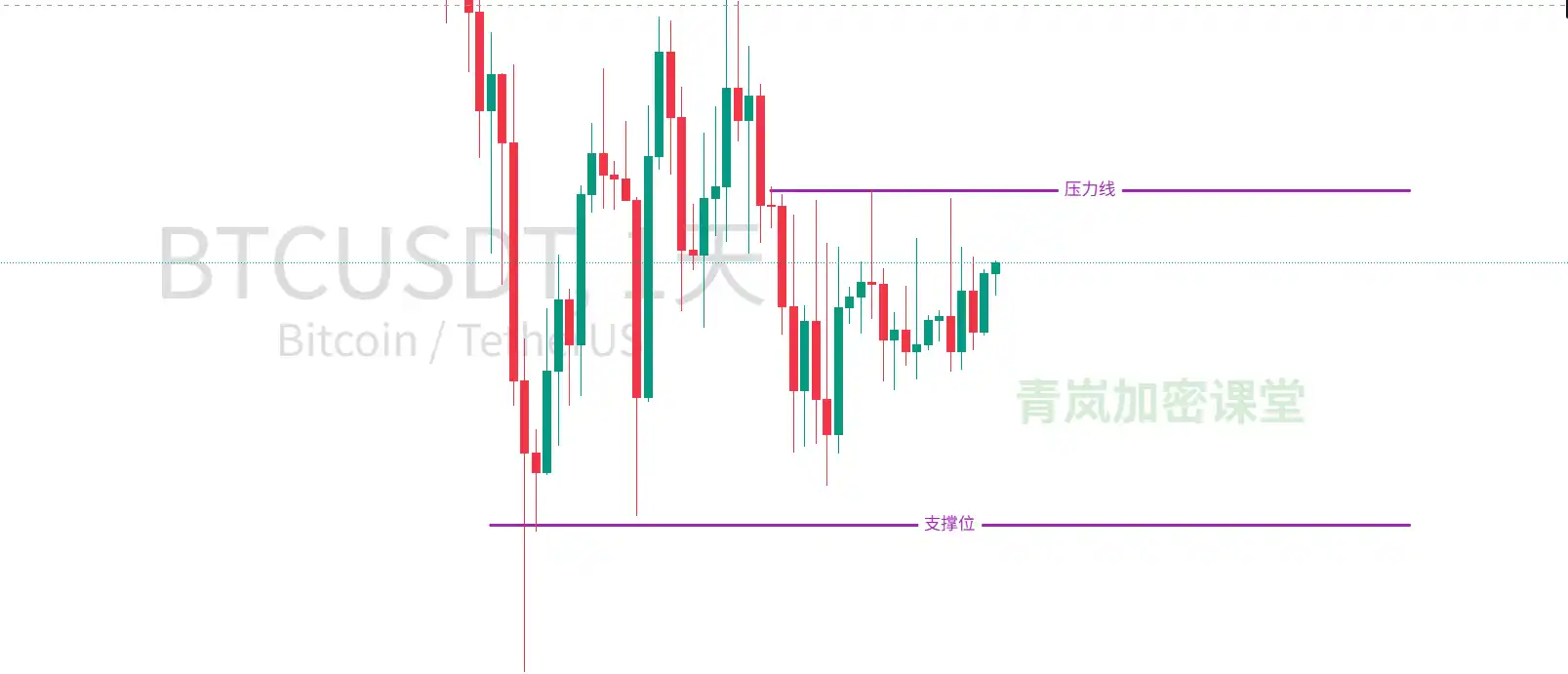
This is precisely a microcosm of the bull-bear psychological game: The weak trend shows bears are still applying pressure, possibly wanting to smash the price to accumulate; The strong rebound shows bulls are also gathering strength, wanting to use the opportunity to break through. Many sisters waver here, thinking the bull market is back when it rises, and thinking it will crash immediately when it falls.

Your mistake: Being confused by short-term fluctuations, trading frequently, losing all the money to fees, and容易在关键点位冲动决策 (easily making impulsive decisions at key points).

Sister Qinglan's advice for you:

Look at the major trend. Before the daily chart stabilizes, treat rebounds as 'dead cat bounces'.

If you want to speculate short-term, only试探 (test) with small positions at key support levels (like near $87,000), and must use a stop-loss.

The真正安全的加仓点 (truly safe point to add positions) is after a volume breakout above $90,000 and holding steady. Before that, hold cash and wait patiently.

Summary: For the Start of 2026, Do This to Protect Your Red Envelope and Grow Steadily. See through fund flows: ETF outflows don't mean the bull market is over; it could be institutional repositioning. Stabilize your long-term core holdings.

Follow the smart money: Pay attention to altcoins where funds are flowing,布局 (position) with small sizes, quick in and out.

Be rational about macro: Long-term positive ≠ short-term surge, use the expectation gap, but don't迷信 (superstitiously believe) news.

Respect the technicals: Look at the trend combining multiple timeframes, don't act impulsively at key points, wait for clear signals.

The crypto circle is like a江湖 (river lake - meaning a complex world), deep waters and rough waves. Don't just focus on how much others have earned; think more about how you can step on fewer pitfalls and survive more cycles. In 2026, let's together, with patience and strategy, simmer our wealth out steadily!

I am Sister Qinglan, accompanying you through bull and bear markets, earning money within our understanding clearly. See you next time!


Trending Cryptos

Related Questions

QAccording to the article, what is the main reason for the net outflow of funds from Bitcoin and Ethereum ETFs at the beginning of the new year?

AThe main reason is that institutions are locking in profits and creating panic to manipulate the market, while secretly shifting funds to more promising areas like certain altcoins.

QWhat strategy does Qinglan suggest for dealing with the short-term volatility of mainstream cryptocurrencies like Bitcoin and Ethereum?

AQinglan suggests holding long-term positions steady and not reacting to short-term fluctuations, while using short-term funds to reduce positions in overvalued assets, retain cash, and wait for market stabilization or opportunities to buy in batches.

QWhich altcoins are mentioned as receiving significant institutional investment inflows despite the outflow from major cryptocurrencies?

ASolana and XRP are mentioned as altcoins that are being bought by large funds, with Franklin Templeton's XRP ETF holdings doubling and Solana ETF assets exceeding $950 million.

QHow does the article advise interpreting macroeconomic policy signals like interest rate cuts and crypto legalization?

AThe article advises viewing interest rate cut predictions as potential 'smoke screens' to boost market sentiment and recognizing that long-term regulatory benefits are not guarantees of short-term price surges. It recommends using expectation disparities for trading but not relying solely on news.

QWhat technical analysis insight does Qinglan provide regarding the current price action of Bitcoin near the $88,000 to $90,000 range?

AQinglan notes that daily and 1-hour charts show weak downward trends, while the 4-hour chart shows a strong upward trend, indicating a tug-of-war between bulls and bears. She advises treating rebounds as potential 'dead cat bounces' until the daily trend stabilizes, and only cautiously testing key support levels with small positions and stop-losses.

Related Reads

Analysis of the Latest Portfolio Adjustment by the "Top Player" in the U.S. Stock Market: $9 Billion Short on NVIDIA, Shifting Focus to Power and Memory Sectors

AI investor Leopold Aschenbrenner has made a significant portfolio shift, taking a $9 billion nominal short position against top AI infrastructure stocks like NVIDIA, ASML, and Oracle. Simultaneously, he is redirecting capital towards what he sees as the next critical bottlenecks in the AI boom: power, memory, and data center networking, alongside private investments in AI model companies like Anthropic. This move is interpreted not as a call that the AI bubble has burst, but as a rotation within the infrastructure stack. The analysis highlights NVIDIA's recent $25 billion bond issuance as a potential signal, questioning why a cash-rich company would seek external debt despite high profits and increased dividends/buybacks. The core investment thesis is that the initial, crowded "picks and shovels" trade in semiconductors is maturing. The next wave of capital is expected to flow into the physical and logistical constraints of AI expansion: electricity supply, memory chip capacity, data center construction, and enabling technologies like optical networking (fiber) for high-bandwidth communication, where copper remains crucial for short distances. Aschenbrenner's substantial (approx. 20% of fund) private stake in Anthropic is noted as a key part of his strategy—investing directly in the "mine" (AI models) rather than just the "shovels." The discussion concludes that while certain segments may be overvalued, the overarching AI infrastructure demand driven by real product usage remains robust. The most promising long-term investments are seen in essential, non-sexy infrastructure—particularly energy and power companies—whose demand is viewed as a global constant irrespective of AI's cyclicality.

marsbit18m ago

Analysis of the Latest Portfolio Adjustment by the "Top Player" in the U.S. Stock Market: $9 Billion Short on NVIDIA, Shifting Focus to Power and Memory Sectors

marsbit18m ago

BIT Research: Liquidity is Disappearing, Will Bitcoin Replay the Bottoming Pattern of 2022?

The crypto market is currently in an adjustment phase driven by policy expectations and liquidity shifts. Despite a brief rebound fueled by geopolitical easing and SpaceX's strong IPO performance, unexpectedly hawkish signals from new Fed Chair Kevin Warsh have removed anticipated easing support. Concurrently, stablecoin liquidity is shrinking, with insufficient new capital inflows, pushing the market into a typically quiet summer period. Pricing lacks catalysts for a sustained rally. Daily trading volume has significantly contracted, stablecoin growth has slowed markedly, and the supportive effect of Strategy's (formerly MicroStrategy) STRC preferred stock-financed Bitcoin purchases is fading. Amid policy uncertainty, seasonal weakness, and liquidity contraction, Bitcoin faces near-term downward pressure. Warsh's hawkish pivot and refusal to provide a clear policy outlook have increased risk premiums, historically unfavorable for Bitcoin. Technically, the trend remains bearish below $73,700, with $62,446 as critical support. A break below could accelerate declines, though a prolonged consolidation phase, similar to 2022's bottoming process, is possible. Liquidity is a core constraint. Current daily volume is around $500 billion, roughly 25% of the peak during the July-Oct 2025 rally. The 12-month growth rates for USDT and USDC have fallen to ~20%, with 6-month growth near zero, indicating weak new inflows. Bitcoin ETF and Strategy-driven inflows have also weakened, with a 30-day rolling net outflow. With inflation at 4.2% above the Fed's target, combined hawkish policy, seasonal factors, and liquidity shortages challenge Bitcoin's ability to hold above $60,000. However, this adjustment phase may be forming a cyclical low this summer, potentially setting the stage for the next bull cycle.

marsbit46m ago

BIT Research: Liquidity is Disappearing, Will Bitcoin Replay the Bottoming Pattern of 2022?

marsbit46m ago

Who Makes the Best Use of Claude Code? The Answer Might Not Be Programmers

Claude Code Usage Report Summary (Based on ~400k sessions) Core Finding: In agentic programming with Claude Code, a clear division of labor has emerged: humans primarily decide *what* to build (planning decisions), while Claude decides *how* to build it (execution decisions). Key Insights: 1. **Effectiveness is not limited to programmers.** In code-generation tasks, success rates for users in non-technical fields (law, finance, management, research) are nearing those of software engineers. What matters most is the user's domain expertise and understanding of the problem to be solved. 2. **Domain expertise drives success and efficiency.** Sessions where users exhibited "expert" proficiency in the task's domain saw verified success rates double compared to "novice" sessions. Experts also delegated more work per instruction, with Claude executing more actions and producing more output. 3. **AI is amplifying, not replacing, domain knowledge.** Claude Code lowers the *implementation* barrier, not the *judgment* barrier. The value of knowing the "what" and "why" is increasing relative to just knowing the "how" to code. 4. **Usage is evolving.** Over a 7-month period (Oct '25 - Apr '26), the share of sessions for debugging halved, while use for software operations, data analysis, and non-code writing roughly doubled. The estimated economic value of typical tasks increased by ~25%. Conclusion: The data suggests coding agents are making programming background less critical for completing technical tasks. However, they reward and amplify deep domain understanding. The ability to successfully direct an AI agent stems more from mastery of a specific field than from coding skill itself. The primary gains come from being competent in a domain; deep specialization adds only marginal additional advantage. This may signal a shift where software creation becomes integrated into various professions.

marsbit1h ago

Who Makes the Best Use of Claude Code? The Answer Might Not Be Programmers

marsbit1h ago

Trading

Spot
Futures

Hot Articles

How to Buy RED

Welcome to HTX.com! We've made purchasing RedStone (RED) simple and convenient. Follow our step-by-step guide to embark on your crypto journey.Step 1: Create Your HTX AccountUse your email or phone number to sign up for a free account on HTX. Experience a hassle-free registration journey and unlock all features.Get My AccountStep 2: Go to Buy Crypto and Choose Your Payment MethodCredit/Debit Card: Use your Visa or Mastercard to buy RedStone (RED) instantly.Balance: Use funds from your HTX account balance to trade seamlessly.Third Parties: We've added popular payment methods such as Google Pay and Apple Pay to enhance convenience.P2P: Trade directly with other users on HTX.Over-the-Counter (OTC): We offer tailor-made services and competitive exchange rates for traders.Step 3: Store Your RedStone (RED)After purchasing your RedStone (RED), store it in your HTX account. Alternatively, you can send it elsewhere via blockchain transfer or use it to trade other cryptocurrencies.Step 4: Trade RedStone (RED)Easily trade RedStone (RED) on HTX's spot market. Simply access your account, select your trading pair, execute your trades, and monitor in real-time. We offer a user-friendly experience for both beginners and seasoned traders.

4.7k Total ViewsPublished 2025.03.05Updated 2026.06.02

How to Buy RED

Discussions

Welcome to the HTX Community. Here, you can stay informed about the latest platform developments and gain access to professional market insights. Users' opinions on the price of RED (RED) are presented below.

活动图片