Technology Has No Barriers, 24/7 Trading is the Key to Hyperliquid's Success

marsbitPublished on 2026-05-25Last updated on 2026-05-25

Abstract

The article argues that Hyperliquid's competitive edge lies not in technological superiority but in its 24/7 trading model, which fundamentally challenges traditional finance's fixed market hours. Based in Singapore with an 11-person team, Hyperliquid has generated significant revenue and trading volume. Its core advantage is the ability to facilitate trading continuously, including during weekends when major exchanges like the CME are closed. This was demonstrated when Hyperliquid listed a SpaceX pre-IPO perpetual contract on a Sunday, allowing the market to price the company hours before traditional institutions opened. This disruption has drawn regulatory scrutiny from traditional giants like CME and ICE, who cite risks like lack of KYC and market manipulation. However, the article suggests their concern stems from Hyperliquid eroding the "time monopoly" of established markets. The piece contrasts Hyperliquid's synthetic derivatives—pure price-betting contracts with no underlying asset or centralized issuer—with other models like PreStocks (dependent on real股权) and Ondo (licensed but targetable). Hyperliquid's code-based, decentralized structure makes it resilient to takedowns, even if founders face legal action. Ultimately, the author concludes that while it raises legitimate regulatory questions, Hyperliquid's "unforgeable" competitive barrier is the time advantage of non-stop trading, a feature legacy systems cannot replicate.

Written by: Thejaswini M A

Compiled by: Chopper, Foresight News

I am located in the UTC+5:30 time zone of Bengaluru. The opening of the U.S. stock market corresponds to 7 PM local time. I have been working in crypto market reporting for five years, and for five years, I have constantly watched the non-stop trading screen. There are no market closures, no pre-market or after-hours trading sessions here. Regardless of day or night, morning or evening, weekends or holidays, the market moves without interruption.

The operational model of traditional financial markets is completely different. The trading hours of the New York Stock Exchange are from 9:30 AM to 4 PM ET, Monday through Friday; the London Stock Exchange from 8 AM to 4:30 PM; and the Tokyo Stock Exchange from 9:00 AM to 3:30 PM, with breaks in between.

Major exchanges take turns opening. Theoretically, as the globe rotates and day and night alternate, capital should flow continuously. But in reality, mainstream exchanges all have fixed trading hours, and compliant markets experience long periods of inactivity.

This routine originates from the physical limitations of early pit trading with manual open outcry. Computer technology should have broken the shackles of time; instead, it merely sped up transaction matching, while fixed market opening rules were preserved.

The laws of physics state that an object at rest stays at rest unless acted upon by an external force. The unchanging nature of financial market trading hours is precisely due to the lack of a driving force for change. It was not until a Sunday morning this past May that the market, ahead of traditional investment banks, provided a valuation for SpaceX, breaking the established order.

The Hyperliquid platform operates around the clock. The related derivative contract went live at 05:16 UTC, achieving a trading volume of $33 million within 24 hours, while institutions like Morgan Stanley were not yet open for business.

The Indian time zone happened to witness this unique pricing competition. U.S. financial media only began reporting it at 9:30 AM ET, by which time I had already been watching the market for an afternoon.

CME Group is the world's largest derivatives trading platform. Institutional traders trade crude oil, gold, interest rates, stock indices, and Bitcoin futures there, with daily trading volumes reaching trillions of dollars. Its brand history can be traced back to 1898.

Intercontinental Exchange (ICE) owns the New York Stock Exchange and several other global derivatives trading platforms, making it another industry giant.

These two control the world's top financial infrastructure. Their risk warnings are easily taken seriously at the regulatory level. Now, these two institutions are lobbying the U.S. Commodity Futures Trading Commission and Congress to crack down on the Hyperliquid platform. They accuse the platform of operating without identity verification, making it easy to breed market manipulation and potentially become a channel for evading sanctions.

The Hyperliquid platform does not have a user identity verification mechanism. Although its website front-end blocks sanctioned addresses, the underlying protocol is completely open with no entry barriers. Users can bypass the web interface to interact directly with the smart contract, without any identity verification required.

The platform has no position limit rules, whereas CME limits the maximum position size per contract to prevent market manipulation and systemic risk. CME monitors trading patterns to guard against illegal activities like spoofing or coordinated trading. Hyperliquid lacks a corresponding risk control monitoring system.

These concerns are all reasonable. Affected by negative regulatory news, the price of the HYPE token fell 9% on May 15th; on May 18th, two market makers withdrew $100 million in liquidity.
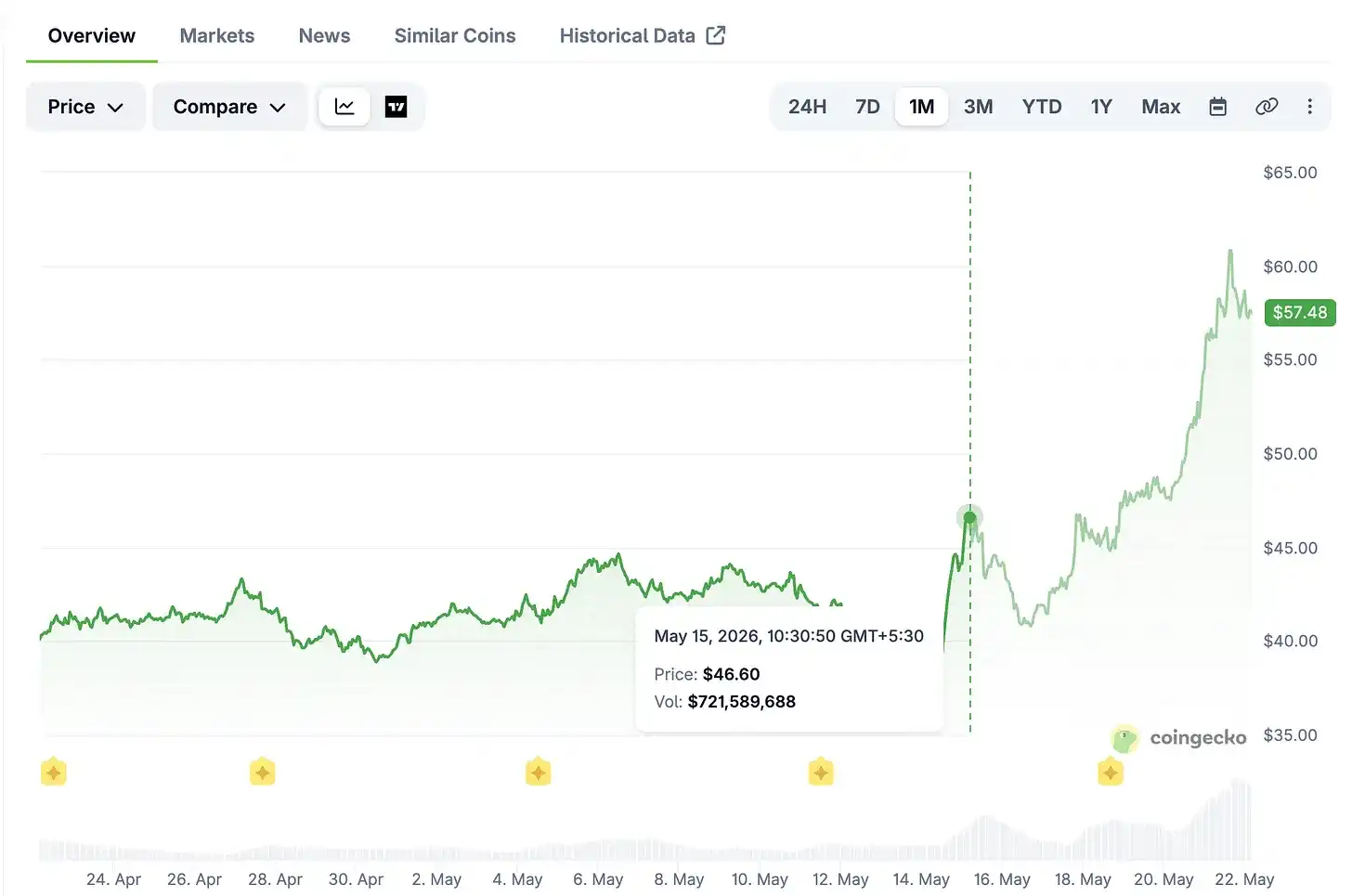
However, the regulatory scrutiny is not directed at crypto perpetual contracts, which have operated for years without regulatory intervention, but focuses on crude oil derivative contracts. These contracts achieved a trading volume of $720 million during CME's closed weekend, touching the interests of traditional institutions.

The concerns of CME and ICE are not unfounded, but they are not neutral observers either. Their business models rely on the monopoly barrier created by legally-defined trading hours. Technological competition within the industry is acceptable, but cross-dimensional competition in terms of time is intolerable to traditional giants.

Hyperliquid seizes the window when traditional markets are closed to trade crude oil, completely breaking the temporal operating system of traditional finance. Established institutions are trying to pressure regulators to unify trading hours, while emerging platforms advocate for the right to legally operate on weekends.

The Hyperliquid team consists of only 11 people, with offices in Singapore. In the 30 days leading up to May 21, 2026, the platform generated $51 million in revenue; in March of this year, the notional trading volume of derivatives reached $2.6 trillion.
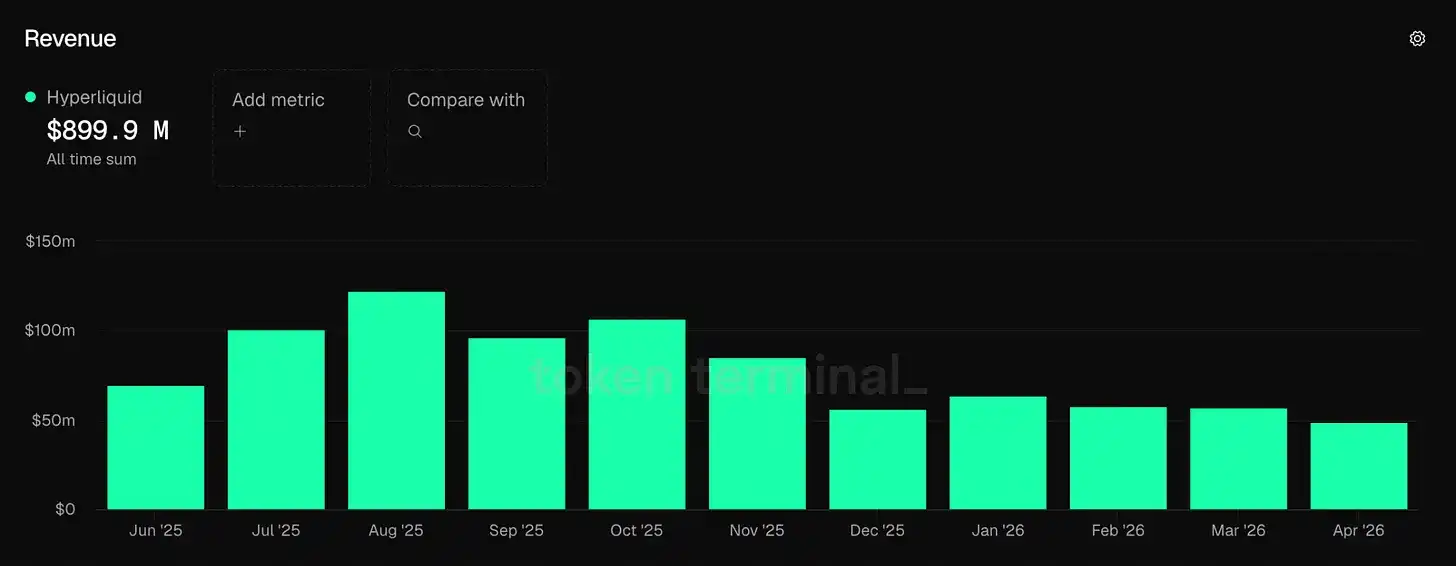
The platform allocates 97% of trading fees to an on-chain treasury pool, used to repurchase HYPE tokens. A small team generating high revenue makes for an exceptionally rare per-capita revenue-generating capability in both finance and crypto. As of late May, HYPE is up 101% year-to-date.

This competitiveness does not stem solely from technical advantages in derivative products. The temporal advantage of 24/7, non-stop trading is the core value proposition. Subsequent new product categories have further amplified this differentiated advantage.

On May 1st, the Trade.xyz platform built on Hyperliquid launched a pre-IPO perpetual contract for the AI chip company Cerebras, covering the two weeks leading up to the official IPO.

The market initially predicted the stock would trade at a 50% premium to the $185 offering price, estimating an opening price around $277. As information was continuously updated, one hour before the Nasdaq's official opening, the platform contract was quoted at $340, only a 3% error from the final opening price of $350. The stock rose 89% above its offering price after listing.

In contrast, traditional secondary market platforms like Forge and EquityZen had prediction values differing from the actual opening price by 35%, enough to highlight Hyperliquid's efficient price discovery capability. The market correcting its quotes as information gradually lands is a reasonable price discovery mechanism.

On Sunday, May 17th, Trade.xyz again launched a pre-IPO perpetual contract for SpaceX. The contract's initial reference price was $150, climbing to $216 within hours, eventually stabilizing at $203, corresponding to a total company valuation of $2.4 trillion.

At that time, SpaceX had not yet published its prospectus, Wall Street analysts had not issued valuation reports, and the company's roadshow had not started. Market traders had no way of knowing that the company had secretly filed with the SEC as early as April, with a preset valuation range of $1.75 to $2 trillion.

The market's self-calculated valuation directly hit the upper limit of the company's internal valuation range, without referencing any official disclosures. Several days later, on May 20th, SpaceX officially released its 277-page public filing.

Currently, three products offer investors exposure to SpaceX using different compliance logics, with each product adopting a distinct legal strategy.

The PreStocks platform uses a special investment fund structure, purchasing real company shares and then splitting them into on-chain tokens, allowing ordinary investors to indirectly hold shares. It once became a convenient channel for investing in non-listed tech companies.

However, just before the Hyperliquid-related contract launch, AI companies Anthropic and OpenAI publicly denied third-party tokenized equity products. Some platforms in Hong Kong and the UAE issued related tokenized assets without company permission. Both companies stated that such equity transfer activities lacked legal validity. Upon the news, PreStocks token prices were halved. Once the underlying company objects, derivative products based on its equity lose their foundation.

Ondo Global Markets, relying on a U.S. licensed broker-dealer, issues stock tokens, with each token backed by corresponding underlying securities. Its compliance system is sound, and the Depository Trust & Clearing Corporation (DTCC) is building supporting clearing infrastructure.

But Ondo's greatest strength is also its greatest weakness: its operational entity is clear and identifiable. If regulators halt operations or the company files infringement claims, the relevant institutions and custodians face direct accountability risks. Operating by the rules makes it easier to become a regulatory target.

The SpaceX synthetic perpetual contract launched by Hyperliquid is completely detached from underlying physical assets. The product has no corresponding equity, licensed institution, or physical asset ownership. It is a purely synthetic derivative, settled solely in USDC on a decentralized network, with trading purely based on price fluctuations.

Even if SpaceX wanted to halt related valuation trading, it would have nowhere to start. The product has no corresponding legal entity to hold accountable, nor a centralized issuer to pressure.

This model cleverly avoids accountability risk. Without a physical anchor, it cannot be directly targeted.

But the pros and cons of this model are equally hard to define. Unverified trading channels allowing massive capital flows outside the global banking system do pose national security risks. On May 17th, Hyperliquid co-founder Jeff Yan went to Washington to meet with policymakers, also indicating the platform faces serious regulatory pressure.

The founders have public identities and backgrounds. If SpaceX sues for trademark or intellectual property infringement, legal documents can be served to hold them accountable.

However, accountability against individuals cannot stop the smart contract from running. PreStocks products depend on real equity; if the equity becomes invalid, the product dies. Ondo's platform struggles to operate normally if accounts are frozen.

Hyperliquid contracts are deployed based on self-executing code. Once deployed, the smart contract is immutable, and on-chain order matching continues autonomously, even if founders face legal issues.

This is the idealized form of decentralization, but real-world operation still has shortcomings. The Ondo platform's validator network has only 20 nodes, not a large-scale distributed network, and identities are traceable. Past token incidents also prove that project parties can intervene based on their judgment; nodes are not absolutely non-interferable.

Ultimately, the temporal advantage of 24/7 non-stop trading is a core barrier that traditional finance cannot replicate.


Related Questions

QAccording to the article, what is described as the core competitive advantage of Hyperliquid, rather than its technological superiority in derivative products?

AThe article states that the core competitive advantage of Hyperliquid is its 24/7, all-day trading capability. This time advantage, which traditional finance cannot replicate, is the key differentiating factor.

QWhy are traditional financial giants like the CME Group and ICE reportedly pressuring regulators regarding Hyperliquid?

AThey are pressuring regulators because Hyperliquid's trading of products like crude oil derivatives during weekends and other times when traditional exchanges are closed breaks the established time monopoly of the traditional financial system. This 24/7 operation, especially in their asset classes, represents a direct competitive threat to their business models.

QWhat key feature of Hyperliquid's SpaceX synthetic perpetual contract makes it difficult for SpaceX itself to stop or directly target?

AThe contract is a purely synthetic derivative with no underlying physical assets, legal entities, or centralized issuers. It operates on a decentralized network, settling only in USDC based on price movements. Since there's no direct counterparty or clear legal entity to hold accountable, SpaceX would find it difficult to target the contract directly through legal means.

QHow did the market valuation of SpaceX on Hyperliquid's Trade.xyz platform compare to the company's later officially revealed valuation range?

AThe market on Trade.xyz priced SpaceX at a $2.4 trillion valuation. Days later, SpaceX's official filing revealed a confidential valuation range of $1.75 trillion to $2 trillion. The market's valuation directly hit the upper limit of the company's internal range, demonstrating efficient price discovery without access to the official documents at the time.

QWhat is a major regulatory concern cited in the article regarding platforms like Hyperliquid that operate without user identity verification?

AA major concern is that such platforms allow large sums of money to flow outside the global banking system, which poses potential national security risks. The lack of identity checks can facilitate market manipulation and potentially provide a channel for evading sanctions.

Related Reads

Dialogue with Morgan Stanley Executive: Wall Street Isn't Rejecting Bitcoin, It's Just Waiting for the Right Time

In a podcast interview, Amy Oldenburg, Head of Digital Asset Strategy at Morgan Stanley, discusses Wall Street's evolving stance on Bitcoin, explaining the bank's measured approach and the road ahead. Oldenburg, with 26 years at Morgan Stanley, traces her perspective to witnessing transformative tech cycles and her experience in emerging markets, where she observed the need for alternative financial systems like mobile money (e.g., M-Pesa). This background informs her view of Bitcoin's value proposition. She clarifies that Morgan Stanley is "client-driven." Regulatory hurdles, particularly as a bank holding company under Federal Reserve oversight, initially slowed their entry. While the firm couldn't act as quickly as independent asset managers, persistent client demand and a changing regulatory environment led to offerings like their low-fee Bitcoin ETP (MSBT). They are now gradually rolling out spot Bitcoin trading on their E*Trade platform. Regarding advisor adoption, Oldenburg cites a "lack of education" as the primary barrier. Morgan Stanley recommends a 0-2% allocation for more conservative portfolios and 2-4% for aggressive ones, but price volatility and confusion about its place in asset allocation persist. She notes competition for investor attention from AI and commodities. Addressing Bitcoin's price stagnation despite institutional buying, Oldenburg points to a confluence of factors: competing investment narratives (AI, quantum computing) and the complex financial landscape. She suggests a catalyst for Bitcoin as a neutral reserve asset might require a "slow-burn crisis" that exposes fragility in traditional systems. For wider bank adoption, including holding Bitcoin on balance sheets, she identifies the need for regulatory clarity to reduce punitive capital treatment and for the asset to be usable as collateral within financial ecosystems. Looking ahead, Oldenburg predicts steady, moderate adoption growth through 2030 rather than an explosive "J-curve." She emphasizes the importance of differentiating Bitcoin from other crypto assets and expresses concern that the core cypherpunk ethos of self-custody is being diluted as traditional finance enters the space. She concludes that the digital asset field remains in its early stages with significant innovation, like AI agents and micropayments, still to come.

marsbit1m ago

Dialogue with Morgan Stanley Executive: Wall Street Isn't Rejecting Bitcoin, It's Just Waiting for the Right Time

marsbit1m ago

10% Position Limit Proposed: UK Retail Authorized Funds to Gain Indirect Exposure to Crypto Assets

The UK Financial Conduct Authority (FCA) is consulting on a proposal (CP26/17) that would allow retail funds, including UCITS and most Non-UCITS Retail Schemes (NURS), to invest up to 10% of their total assets in cryptoasset exchange-traded notes (crypto ETNs). This would enable indirect exposure to cryptoassets for mainstream investors through regulated funds. The rule maintains the existing prohibition on funds holding underlying cryptocurrencies like Bitcoin or Ethereum directly. The proposal introduces a strict 10% cap, positioning crypto ETNs as a potential satellite holding within diversified portfolios. Funds must ensure these investments align with their stated objectives and risk profiles. Notably, the cap does not apply to Qualified Investor Schemes (QIS) for professional clients, while Long-Term Asset Funds (LTAFs) would be prohibited from holding crypto ETNs. This move builds on the FCA's 2025 decision to permit retail trading of crypto ETNs on UK regulated exchanges. However, significant compliance burdens fall on fund managers, who must conduct thorough due diligence, assess liquidity, and provide clear risk disclosures to investors. The FCA emphasizes that even a small allocation can significantly impact a fund's risk profile. The policy's practical impact remains uncertain. Widespread adoption depends on whether asset managers deem the potential benefits worth the operational costs, disclosure requirements, and reputational risks. The consultation is open for feedback until July 13, 2026. Ultimately, the proposal represents a cautious, incremental step toward integrating cryptoassets into the regulated fund landscape, rather than a broad opening.

Foresight News30m ago

10% Position Limit Proposed: UK Retail Authorized Funds to Gain Indirect Exposure to Crypto Assets

Foresight News30m ago

Public Version of Mythos Officially Launched: Analyzing the Advantages and Limitations of AI Smart Contract Auditing

Publicly available Mythos, Anthropic's AI model, has officially launched, demonstrating both significant potential and limitations in smart contract security auditing. The article analyzes its capabilities through real-world cases. AI excels in identifying subtle, low-level vulnerabilities through pattern recognition and large-scale code screening. A key example is detecting a storage slot collision between a custom rewards mapping and a third-party library's ReentrancyGuard, a vulnerability easily missed in manual audits. In the recent Zcash incident, AI also rapidly discovered a critical soundness bug that had remained hidden for years. However, AI currently struggles with complex, interconnected scenarios. When tested on the Curve LlamaLend sDOLA exploit, which involved manipulating prices across multiple protocols (Curve pools, lending markets) to trigger liquidations, Fable 5 failed to identify the core cross-protocol attack vector. These scenarios require a deep understanding of DeFi economic models and multi-contract interactions. In conclusion, while AI tools like Mythos significantly boost efficiency in finding standardized, syntactic vulnerabilities, they cannot yet replace expert analysis for complex, business-logic, and cross-protocol attacks. An effective audit workflow combines AI's speed for initial screening with human expertise for in-depth, holistic analysis.

marsbit35m ago

Public Version of Mythos Officially Launched: Analyzing the Advantages and Limitations of AI Smart Contract Auditing

marsbit35m ago

Trade.xyz's Rebase Refusal Sparks Controversy, On-Chain Pre-IPO Market Faces Major Pricing Test

The debate surrounding Trade.xyz's refusal to adjust its SPCX (SpaceX pre-IPO) perpetual contract pricing amid updated share count revelations highlights a key challenge for on-chain pre-IPO markets. While several centralized exchanges (CEXs) paused and repriced their contracts after SpaceX's filing showed a ~10% increase in total shares, Trade.xyz maintained its market-driven pricing logic, which tracks expected per-share price sentiment rather than fundamental valuation metrics like market cap. This discrepancy triggered cross-platform arbitrage and caused leveraged long positions on Trade.xyz to suffer significant losses, as the platform's HIP-3 architecture lacks a native "Rebase" mechanism to neutrally adjust all user positions following such corporate actions. The incident underscores the difficulty for decentralized perpetual exchanges (Perp DEXs) to implement Rebase—a process CEXs handle by centrally pausing markets and adjusting ledger data. On-chain, this requires complex smart contract modifications, increasing gas costs, complexity, and potential attack surfaces. While some DEXs have managed similar adjustments, Trade.xyz's current design does not natively support it, though the team is reportedly exploring solutions for future events like stock splits. Ultimately, the controversy serves as a critical case study for the nascent on-chain pre-IPO sector, raising questions about price discovery reliability, transparent rule disclosure, and the readiness of DeFi infrastructures to handle traditional corporate actions as real-world assets (RWAs) gain traction.

marsbit43m ago

Trade.xyz's Rebase Refusal Sparks Controversy, On-Chain Pre-IPO Market Faces Major Pricing Test

marsbit43m ago

Trading

Spot
Futures

Hot Articles

Discussions

Welcome to the HTX Community. Here, you can stay informed about the latest platform developments and gain access to professional market insights. Users' opinions on the price of S (S) are presented below.

活动图片