# TVL Related Articles

HTX News Center provides the latest articles and in-depth analysis on "TVL", covering market trends, project updates, tech developments, and regulatory policies in the crypto industry.

Ethereum 2026 Q1 Review: On-Chain Activity Hits Record Highs, Tokenized Assets Lead the Industry

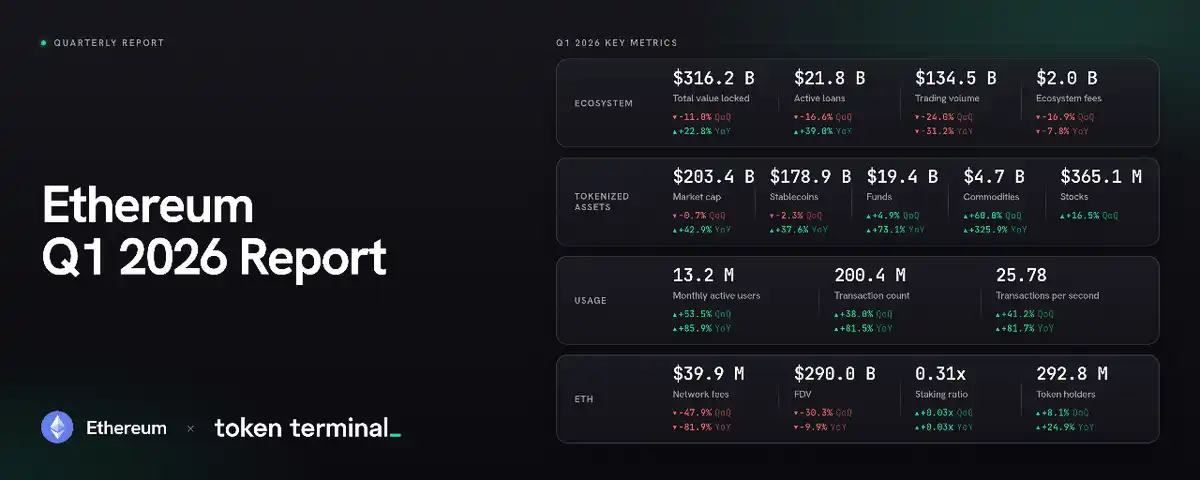
Ethereum Q1 2026 Review: Record On-Chain Activity, Tokenized Assets Lead the Industry. Despite a price correction impacting USD-denominated metrics, Ethereum's on-chain usage hit all-time highs in Q1 2026. Monthly active addresses surged 85.9% year-over-year to 13.2 million, while L1 transactions and throughput also set new records. This growth occurred alongside a significant 47.9% quarterly drop in L1 transaction fees, demonstrating the impact of network scaling via upgrades like the Blob Parameter Fork. The ecosystem maintained its dominance in decentralized finance (DeFi), holding 71% of the total value locked among top chains and 79.2% of active borrowing. Ethereum solidified its position as the primary platform for tokenized real-world assets (RWAs), with a total market cap of $203.4B. It holds leading shares in stablecoins (61.8%), tokenized funds (73%), and tokenized commodities (84%) across major chains. Key developments included the ERC-8004 standard for AI agents and heightened institutional engagement at forums. Major financial institutions like BlackRock, JPMorgan, and a European banking consortium announced new tokenized products on Ethereum throughout the period. The report draws parallels to the early internet, suggesting Ethereum is sacrificing short-term fee revenue for long-term network expansion and adoption. Its strategy focuses on becoming a neutral, open settlement layer for global finance, with scaling roadmaps aiming for tens of thousands of TPS by 2029.

marsbit06/18 09:52

Ethereum 2026 Q1 Review: On-Chain Activity Hits Record Highs, Tokenized Assets Lead the Industry

marsbit06/18 09:52

Ethereum Q1 2026 Review: On-chain Activity Hits New Highs, Tokenized Assets Lead the Industry

Ethereum Q1 2026 Review: Chain Activity Hits Record High, Tokenized Assets Lead the Industry In Q1 2026, the Ethereum ecosystem displayed a dual narrative: record-high on-chain activity coincided with declining USD-denominated metrics. User adoption surged, with monthly active addresses reaching 13.2 million (up 53.5% QoQ) and layer-1 transactions hitting 200.4 million (up 38% QoQ). However, the total value locked (TVL) decreased 11% to $316.2B, and protocol revenue fell 16.9% to $2.0B, largely due to a broader crypto market downturn. Tokenized assets emerged as a key strength. Their total market cap reached $203.4B, with significant growth in tokenized funds (+73.1% YoY) and commodities (+325.9% YoY). Ethereum dominated cross-chain comparisons, holding over 61% of stablecoin value and 84% of tokenized commodities value among top chains. A major development was the impact of network scaling. The "Blob" upgrade significantly increased data capacity, causing average transaction fees on layer-1 to plummet 47.9% QoQ despite higher usage. This demonstrates the "Jevons Paradox" in action: cheaper block space stimulates demand. The report highlights Ethereum's established position as the primary settlement layer for institutional tokenization, evidenced by new fund launches from giants like BlackRock and JPMorgan in May. Analysts draw parallels between Ethereum's current stage and the internet in the mid-1990s, suggesting its open, neutral network is poised to become the foundational infrastructure for global finance, outcompeting closed, private alternatives.

Foresight News06/18 09:07

Ethereum Q1 2026 Review: On-chain Activity Hits New Highs, Tokenized Assets Lead the Industry

Foresight News06/18 09:07

Kelp DAO's $400 Million Bad Debt Was Covered, But at a $12 Billion Cost to Aave

On May 26th, Kelp DAO successfully transferred its final batch of rsETH, completing the 37-day process of fully backing rsETH 1:1 after a security incident. However, the resolution came at a significant cost to Aave. The protocol's TVL plummeted by over $12 billion in the following month. Furthermore, a separate legal battle over 30,766 frozen ETH continues in court, posing ongoing reputational risk. The recovery was enabled by an unprecedented, one-time coalition dubbed "DeFi United," involving major contributions from Aave's founder, treasury, Consensys, Mantle, and others. Despite this, the event triggered a major outflow of funds, with whales like Justin Sun moving capital to competitors like Spark. Aave's path to regaining its position relies heavily on the successful execution of its multi-pronged strategy. Its new V4 protocol, designed for open, heterogeneous asset markets, faces delays due to internal governance disputes. Meanwhile, the V3 version remains the core revenue generator, and the permissioned Horizon fork is targeting institutional RWA (Real-World Assets) growth—a segment less impacted by the rsETH incident but dependent on traditional finance adoption timelines. The key takeaway is that while the immediate bad debt was covered, Aave paid a steep price in lost trust and capital. Recovering market share depends on accelerating V4's rollout and advancing its institutional RWA offerings, both of which face external and internal hurdles. The "DeFi United" safety net is unlikely to be replicable for future crises.

marsbit05/26 11:09
Kelp DAO's $400 Million Bad Debt Was Covered, But at a $12 Billion Cost to Aave

marsbit05/26 11:09

Why is the RWA Boom Failing to Benefit DeFi?

The rapid growth of the tokenized real-world assets (RWA) market, now nearing $30 billion on-chain, has largely bypassed the DeFi ecosystem. Only about $2.47 billion is actively locked in DeFi protocols, indicating a penetration rate of just 9%. A major barrier is the "permissioned" architecture of most RWA products, like BlackRock's BUIDL fund, which are designed for institutional compliance. They require whitelisting, off-chain settlement, and strict investor accreditation, making them incompatible with open, permissionless DeFi applications like Aave or Uniswap. This is evident in categories like bonds/money market funds ($16.6B on-chain, $920M in DeFi) and tokenized equities ($2.7B on-chain, $78M in DeFi). Notable exceptions are private credit protocols (e.g., Maple Finance, Centrifuge) and assets like Ondo's USDY, which were designed from inception for DeFi composability, allowing them to be used freely as collateral. Morpho and Aave Horizon also demonstrate successful RWA lending integrations. However, industry reports (IOSCO, ECB) warn that growth may remain confined within traditional financial systems due to fragmented regulations, lack of unified standards, and inherent conflicts between DeFi's open logic and compliance requirements like minimum investments and fixed redemption windows. The RWA sector is effectively split into two markets: a compliant, permissioned on-chain finance market and a smaller DeFi-native market focused on composability. For DeFi penetration to rise significantly, asset issuers must prioritize designs that enable permissionless circulation from the start, moving away from models centered solely on institutional compliance.

marsbit05/19 07:31

Why is the RWA Boom Failing to Benefit DeFi?

marsbit05/19 07:31

Annual Loss Rate Only 0.03%: Data Disassembles the Real Risk of DeFi Lending

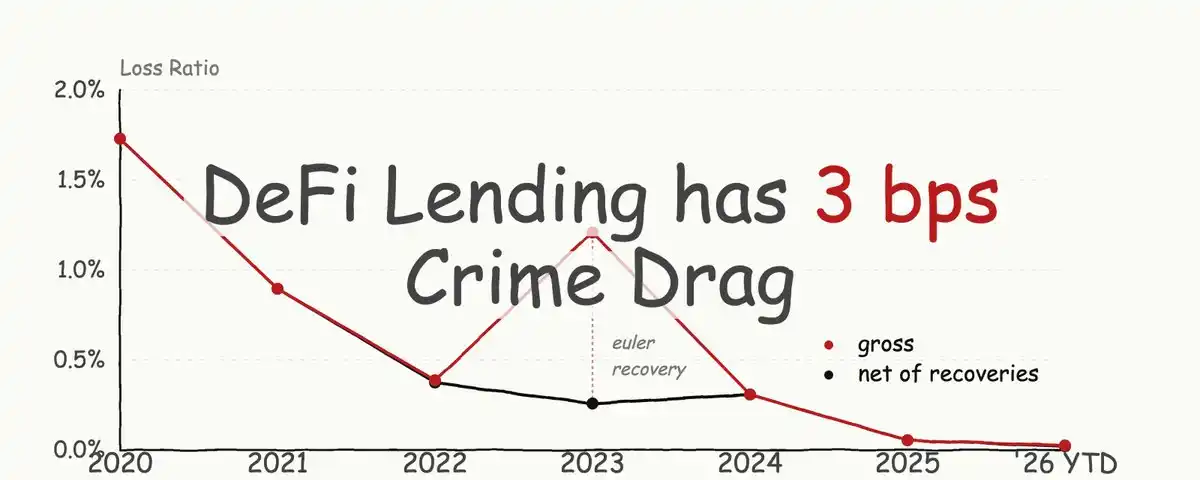
DeFi lending's real-world annual loss rate from hacks and exploits is approximately 0.03% of the Total Value Locked (TVL), excluding cross-chain bridge incidents. This analysis, based on data from DeFi Llama, shows that while lending protocols are frequent targets due to their concentrated assets, the actual financial impact relative to the sector's massive scale is minimal. The overall DeFi hack total of $77.51B is heavily skewed by cross-chain bridge breaches. Removing those, losses drop to $45.18B, with lending and AMM protocols being the most affected non-bridge categories. Risk has significantly improved as the ecosystem has matured. For the year leading to May 2026, net losses in EVM and Solana lending protocols were $30.1 million against an average daily TVL of $99.6 billion, resulting in the 0.03% loss rate. Notably, the industry's asset recovery capability, exemplified by the full recovery and surplus from the Euler Finance hack, mitigates net losses, with a ~20% recovery rate for non-bridge lending incidents. Attack scale follows a log-normal distribution, meaning most incidents are small, and catastrophic losses are rare. This demonstrates that diversification across protocols is an effective risk mitigation strategy. The data indicates that DeFi lending has evolved into a measurable, compartmentalized, and relatively low-risk sector within the broader digital asset landscape.

marsbit05/18 07:46

Annual Loss Rate Only 0.03%: Data Disassembles the Real Risk of DeFi Lending

marsbit05/18 07:46

活动图片