# Resilience Related Articles

HTX News Center provides the latest articles and in-depth analysis on "Resilience", covering market trends, project updates, tech developments, and regulatory policies in the crypto industry.

Iran's Path to 'De-Dollarization': When Weapons Begin to Be Settled in Cryptocurrency

Iran's "De-Dollarization" Path: When Weapons Begin to Be Settled in Cryptocurrency Iran has officially integrated cryptocurrency into its national survival and foreign strategy, as evidenced by its defense export center Mindex accepting crypto, barter, or rial for military contracts as of January 2026. This move highlights crypto’s role as an "anti-sanction financial tool" in one of the most sanctioned and regulated sectors: arms trade. Driven by severe constraints—including a depreciating rial, severed international banking ties, and high-risk energy and weapon export channels—Iran has turned to crypto to meet economic targets. In 2025, parliamentary leaders emphasized that without crypto, Iran could not achieve its goal of a 10% digital economy share. Iran is now the world’s fourth-largest cryptocurrency mining hub, leveraging subsidized electricity. Stablecoins, especially USDT, have also become critical for liquidity—reportedly facilitating around $1.5 billion in transactions linked to entities like the Islamic Revolutionary Guard Corps. During a nationwide internet blackout in January 2026, crypto demonstrated resilience through offline workarounds like satellite networks (Starlink, Blockstream), Bluetooth mesh systems (Bitchat), and SMS-based Bitcoin transfers (Machankura). Iran’s experience reflects a broader trend: nations like Russia and Venezuela are also using crypto to bypass sanctions, transforming it from a financial innovation into a strategic geopolitical tool for value transfer and access to global markets.

marsbit01/17 02:32

Iran's Path to 'De-Dollarization': When Weapons Begin to Be Settled in Cryptocurrency

marsbit01/17 02:32

What Endures Through Bull and Bear Markets Is Not Consensus, But Structure: Learning from Century-Old Football Clubs to Understand Web3

This article draws parallels between the sustainability of century-old European football clubs and the challenges faced by Web3 projects in building lasting communities. It argues that while Web3 excels at discussing growth, incentives, and tokenomics, it often lacks the deep sense of belonging and trust that allows communities to endure market cycles. The piece uses the origins of clubs like Manchester United, FC Barcelona, and Juventus to illustrate how they were founded on strong cultural identity, grassroots community, and a shared sense of purpose—principles that Web3 projects can emulate. It highlights how these identities, forged in local communities and through powerful narratives, created unwavering fan loyalty. Furthermore, it examines how clubs like Liverpool and Borussia Dortmund survived existential crises not through wealthy owners, but through the unwavering support of their fan communities. The article points to governance models like the member-owned structure of FC Barcelona or Germany’s “50+1” rule as examples of how deep community integration creates resilience. Finally, it discusses the role of legendary figures, like Liverpool’s Bill Shankly, as spiritual leaders who embody the community’s values and provide a narrative anchor. For Web3, this underscores the importance of authentic leadership and using key figures to build emotional resonance, while also ensuring the community’s culture is institutionalized to outlast any individual. The core conclusion is that Web3 can learn from football’s focus on authentic identity, community-powered governance, and shared cultural narratives to build projects that survive beyond short-term hype.

比推12/30 04:52

What Endures Through Bull and Bear Markets Is Not Consensus, But Structure: Learning from Century-Old Football Clubs to Understand Web3

比推12/30 04:52

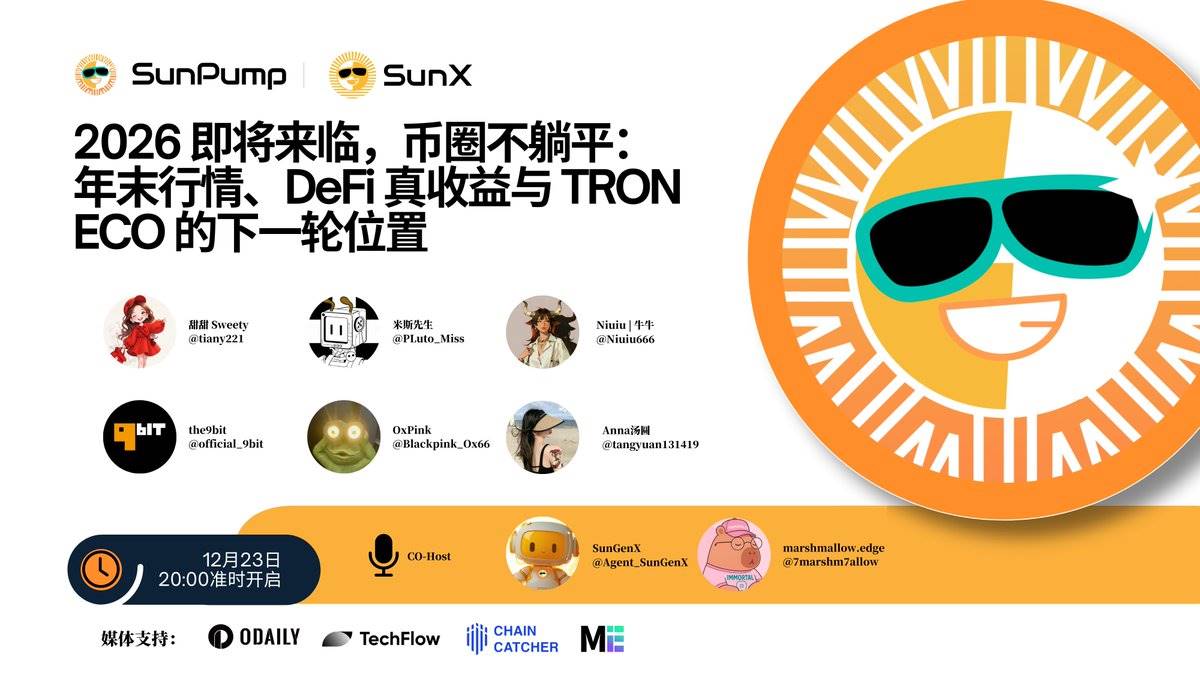
Space Review|2026 Outpost: Narrative Recedes, Value Flows to Resilient Ecosystems with Real Yield

As 2025 draws to a close, the crypto market is shifting from hype-driven speculation to a focus on sustainable value. The recent SunnPump roundtable, "2026 is Coming, No Laying Flat in Crypto," explored this transition, emphasizing that the path to 2026 depends on ecosystems with real utility and organic demand, not short-term narratives. Experts agreed that the market is moving towards a phase driven by genuine cash flows and capital efficiency. Tron was highlighted as a prime example of a mature "digital financial infrastructure," distinguished by its dominant role in stablecoin settlements. With nearly $80 billion in on-chain USDT circulation—half the global market—and daily stablecoin transfers of $20-24 billion, Tron has built a resilient ecosystem anchored in real-world use cases like payments and lending. Its TVL of ~$24 billion, including $10.4 billion in JUST Protocol, reflects deep liquidity and organic activity. The discussion on DeFi sustainability centered on projects with real revenue generation, not subsidized yields. Protocols like JustLend DAO exemplify this with a diversified income model from staking services and lending, using fees to buy back and burn its JST token, creating a deflationary feedback loop. This aligns protocol success with tokenholder value. Tron’s $204 million in protocol revenue in November 2025, leading all public chains, underscores the power of its real economic activity. In conclusion, the key to enduring market cycles lies in ecosystems like Tron’s that provide essential, high-utility services—low-cost transfers, reliable staking, and lending—forming an organic, self-sustaining financial infrastructure with inherent resilience.

深潮12/24 08:51

Space Review|2026 Outpost: Narrative Recedes, Value Flows to Resilient Ecosystems with Real Yield

深潮12/24 08:51

Don't Waste Every Loss: The 'Sisyphean Revelation' of the Crypto Market

The article "Don't Waste Every Loss: The Sisyphus Lesson for Crypto Markets" addresses skilled traders facing significant profit drawdowns despite strong historical performance. It draws a parallel to the myth of Sisyphus, who found meaning in the struggle itself, suggesting that success in crypto trading lies not in avoiding losses but in embracing the process with awareness and resilience. The piece critiques two common emotional reactions to major losses: doubling down aggressively (like a Martingale strategy) or quitting entirely. Both are seen as superficial fixes that avoid the core issue: flawed risk management. The real challenge isn’t knowing risk principles but executing them consistently under emotional pressure, ego, and stress. To recover, traders must accept the loss as a tuition fee for personal flaws, not bad luck. They should anchor to current net worth, not past highs, and avoid the dangerous urge to "win it back." Strict rules on position sizing, stop-losses, and discipline are essential to prevent catastrophic failures. Emotional release is encouraged, but the key is converting pain into a lesson to avoid repetition. The article concludes that such losses, if approached with a冷静, machine-like mindset, can build resilience and improve one’s system. Each failure becomes a moat that others must pay to learn. The goal is not redemption or revenge but growth, ensuring the same mistakes never recur.

marsbit12/23 12:39

Don't Waste Every Loss: The 'Sisyphean Revelation' of the Crypto Market

marsbit12/23 12:39

活动图片