# Pivot Related Articles

HTX News Center provides the latest articles and in-depth analysis on "Pivot", covering market trends, project updates, tech developments, and regulatory policies in the crypto industry.

Li Kaifu and Wang Xiaochuan Pivot: The First Half of the Large Model Entrepreneurship Era Ends

Li Kaifu and Wang Xiaochuan, leading figures in China's AI industry, are signaling a strategic shift, marking the end of the first phase of the large language model (LLM) startup boom. Li's 01.AI, once seen as a potential "Chinese OpenAI," is now pivoting towards enterprise applications and Agent technology, explicitly modeling itself after the低调但 profitable Palantir with a goal of profitability by 2026. Wang's Baichuan Intelligence is fully转战ing the vertical field of healthcare, launching a medical LLM and AI doctor product. This reflects a broader industry清醒. The initial狂热 of 2023, with its focus on chasing参数, benchmarks, and the "Chinese OpenAI" narrative, has collided with the harsh reality of an AI "heavy industry" war dominated by immense capital expenditure from US tech giants (微软, Google, etc.) and Chinese互联网大厂. The cost of competing in foundational模型 has become prohibitively high for most startups. The paths of the original "Six Tigers" have diverged: some like智谱 and MiniMax achieved high valuations via IPOs, effectively closing the capital window for new通用模型 players. Others, like 01.AI and Baichuan, are retreating from the通用模型 race to focus on商业化 and垂直场景. The deeper change is China's AI sector accepting that its comparative advantage may not lie in foundational model突破 but in applications, engineering, commercialization speed, and integrating AI into real-world industrial and user scenarios—turning AI into a viable industry. Li and Wang, veterans from the互联网 era, represent a generation that entered with理想主义 but is now pragmatically adjusting to reality. Their strategic转身 signifies a交棒 from the狂热造神 phase to a more mature stage focused on sustainable business,合同, and现金流. This isn't a story of failure, but a体面告别 to unrealistic expectations, with the long-term battle ahead passed to a new generation of AI-native builders.

marsbit05/29 01:30

Li Kaifu and Wang Xiaochuan Pivot: The First Half of the Large Model Entrepreneurship Era Ends

marsbit05/29 01:30

A History of Technological Evolution Powered by Electricity: Aluminum, Bitcoin, and AI

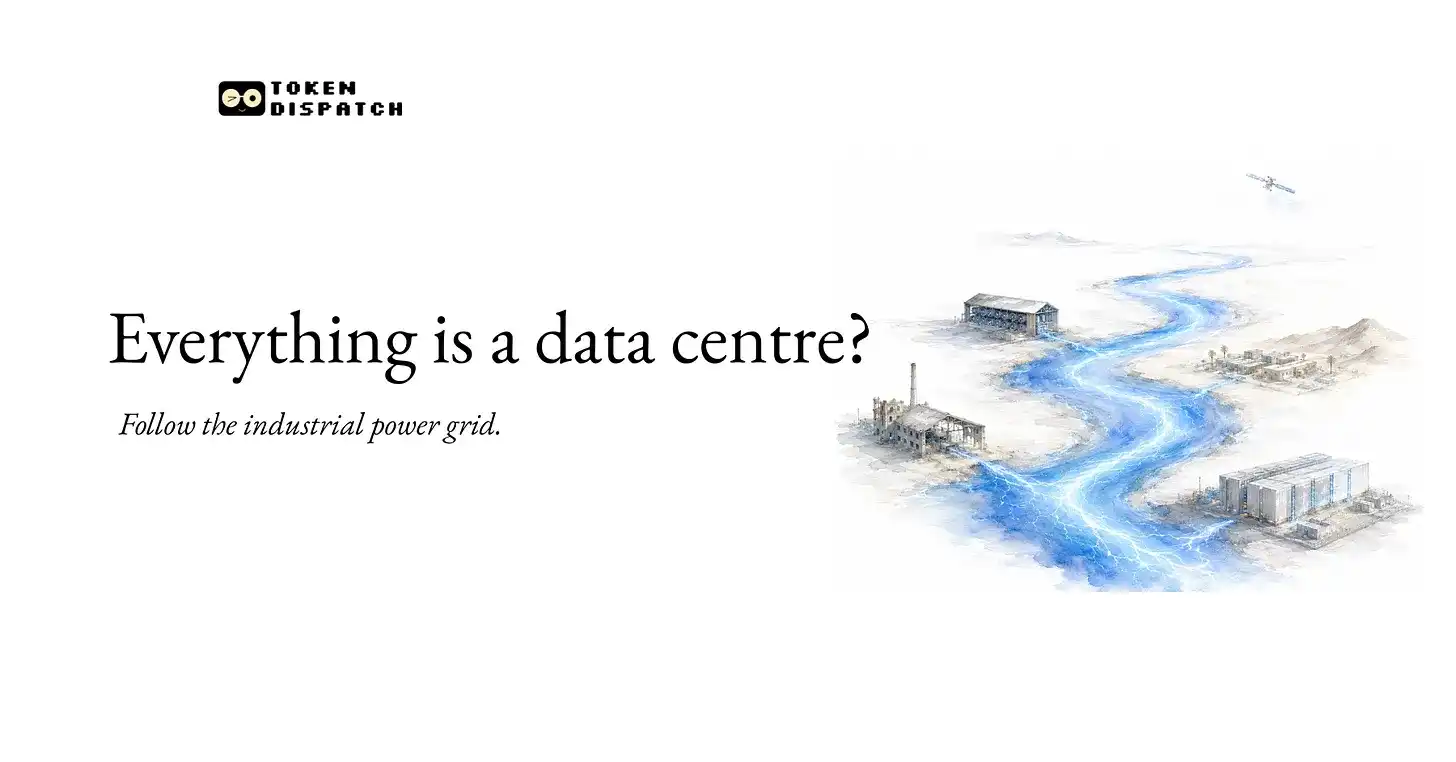
The journey from the Rockdale aluminum smelter in Texas to space-based data centers illustrates a core economic principle: whoever controls the cheapest electricity dictates the use of computing power. The evolution is clear. Old industrial sites with pre-existing, high-capacity power grids are being repurposed. In Rockdale, a former Alcoa plant now houses vast Bitcoin mining rigs, which are increasingly being replaced by AMD chips for AI training. The logic is purely financial: while smelting aluminum yields $0.17–0.27 per kWh and Bitcoin mining $0.05–0.11, AI inference on H100 GPUs generates $1.27–3.67 per kWh. Recent deals confirm the rush for power infrastructure. Riot Platforms leases space to AMD; TeraWulf bought an old Kentucky aluminum plant for its grid; NYDIG secured a New York site for its cheap hydropower to mine Bitcoin. As AI giants like Anthropic, Microsoft, Google, and Amazon aggressively expand, they now directly compete with crypto miners for the same industrial power resources, often outbidding them. This has led to a decline in Bitcoin's global hash rate and a wave of miner conversions to AI data centers. This "digital resource curse" extends globally. Gulf nations, long offering subsidized power to attract heavy industry like aluminum, are now pivoting to become AI and cloud computing hubs—exporting computational power instead of physical commodities. Similarly, Bhutan halted its sovereign Bitcoin mining to sell hydropower directly to India for a steadier return. The frontier is space. Projects like Starcloud plan orbital solar-powered data centers, leveraging constant sunlight and natural cooling, with Bitcoin mining as a secondary use for surplus power. Even consumer brands are transforming; Allbirds shifted from footwear to AI infrastructure, causing its stock to surge. Meanwhile, crypto projects like Bittensor, Render, and Akash propose a decentralized alternative, creating markets to aggregate distributed, idle computing resources from individual hardware. The underlying infrastructure—the power grid—remains constant. As profit margins shift, the facilities built upon it will continue to evolve, from aluminum to Bitcoin to AI and beyond, always chasing the highest yield per kilowatt-hour, whether in Texas, Abu Dhabi, or low Earth orbit.

marsbit05/26 10:09

A History of Technological Evolution Powered by Electricity: Aluminum, Bitcoin, and AI

marsbit05/26 10:09

The Allbirds, the Internet-Famous Shoes That Took Silicon Valley by Storm, Are Now All in on AI

Allbirds, the once-popular sustainable shoe brand favored by Silicon Valley elites and celebrities, has announced a drastic pivot from footwear manufacturing to AI infrastructure. On April 15, 2026, the company revealed plans to abandon its shoe business entirely, rebrand as "NewBird AI," and focus on GPU-as-a-service and AI cloud solutions. The move caused its stock to surge over 800% in a single day. The brand, known for its wool-based eco-friendly shoes, had struggled financially in recent years. Revenue fell from a peak of $298 million in 2022 to $152 million in 2025, with cumulative losses of $419 million over five years. In March 2026, Allbirds sold its intellectual property and footwear assets for just $39 million—a fraction of its former $4.1 billion valuation. The company secured up to $50 million in convertible notes to fund the acquisition of GPU hardware for AI compute leasing. However, the announcement lacked details about technical capacity, clients, or infrastructure plans. Critics highlight the high execution risks in the competitive AI infrastructure market, dominated by major cloud providers. The shift reflects a broader trend of companies rebranding around AI to attract investor interest, despite uncertain fundamentals. Allbirds also removed its "public benefit" corporate mission, signaling a departure from its original sustainability ethos. The move underscores the power of AI narrative in today’s capital markets, where storytelling often precedes substance.

marsbit04/16 02:13

The Allbirds, the Internet-Famous Shoes That Took Silicon Valley by Storm, Are Now All in on AI

marsbit04/16 02:13

活动图片