Another Bitcoin Miner Shifts To AI: Core Scientific Offloads 1,900 BTC

bitcoinistPublished on 2026-03-04Last updated on 2026-03-04

Abstract

Core Scientific, one of the world's largest public Bitcoin miners, is accelerating its strategic pivot toward artificial intelligence (AI) and high-performance computing (HPC). According to its recent SEC filing, the company sold 1,900 BTC in January 2025 for $175 million, reducing its holdings from 2,537 BTC to just 630 BTC. It expects to sell substantially all remaining Bitcoin in Q1 2026. The firm has reduced its operational hashrate from 20.1 EH/s to 17.9 EH/s and does not plan further large-scale mining equipment purchases. Instead, capital is being redirected toward HPC infrastructure. This shift reflects a broader industry trend, with other major miners like Bitfarms and Bitdeer also transitioning toward data centers and AI compute services. Bitfarms’ CEO stated that converting even a small site to GPU-as-a-service could generate more income than its entire Bitcoin mining history. Despite the strategic shift, Core Scientific remains a top-10 public Bitcoin miner. Bitcoin is currently trading around $68,200.

Core Scientific is the latest in the line of Bitcoin miners accelerating a pivot toward AI, selling 1,900 BTC and signaling that more is coming.

Core Scientific Expects To Sell All Of Its Bitcoin Holdings In Q1 2026

Core Scientific has filed its annual report with the US Securities and Exchange Commission (SEC) and it reveals key insights about the direction that the company is taking right now.

Originally a Bitcoin mining-focused firm, Core Scientific is among the largest public miners in the world, but recently, the firm has been making a push into the AI compute business.

At the end of 2024, the company had a total computing power or “Hashrate” amounting to 20.1 exahashes per second (EH/s). The 2025 annual report suggests that this metric has dropped to 17.9 EH/s as the AI expansion has occurred.

Not just that, the report also noted that Core Scientific expects to monetize substantially all of its Bitcoin holdings during 2026, with the majority of sales occurring within the first quarter. This selling has already begun, as the firm announced in its Q4 2025 earnings call that it sold over 1,900 BTC for $175 million in January.

Before the sale, the firm held 2,537 BTC, but now, that figure has dropped to just 630 BTC. Considering the SEC filing, Core Scientific plans to eventually part with these remaining tokens as well.

So, where are the funds from the BTC sales going? Not mining, it seems. The company noted in the filing:

Aside from the miners received in 2025 and those expected from Block, we do not anticipate entering into new large-scale bitcoin mining equipment procurement agreements as we continue to shift capital allocation toward HDC infrastructure

While Core Scientific has pulled back on its Hashrate over the course of 2025, the firm remains among the top 10 public BTC miners, according to data from BitcoinMiningStock. With expansions stopping in favor of the AI pivot, though, it only remains to be seen how long the company will maintain relevance as a miner.
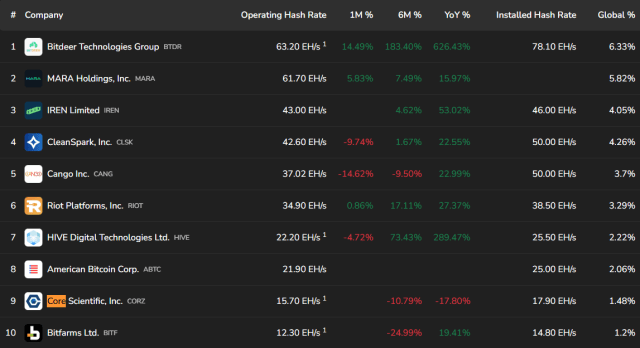
How the BTC mining firms compare against each other in terms of operating Hashrate | Source: BitcoinMiningStock

A push into the High-Performance Computing (HPC) business is actually something that’s being witnessed across the Bitcoin mining industry at the moment. Bitdeer, Cango, and Bitfarms, placed first, fifth, and tenth on the top 10 list, respectively, are all making a pivot to datacenters.

Bitfarms, in particular, plans to wind down its mining facilities over the course of 2026 and 2027, signaling a complete exit from the space. Ben Gagnon, the firm’s CEO, believes the pivot to be highly lucrative, explaining:

Despite being less than 1% of our total developable portfolio, we believe that the conversion of just our Washington site to GPU-as-a-Service could potentially produce more net operating income than we have ever generated with Bitcoin mining.

BTC Price

At the time of writing, Bitcoin is trading around $68,200, up more than 6% over the past week.

Looks like the price of the coin has overall moved sideways over the last few days | Source: BTCUSDT on TradingView


Related Questions

QWhat is the main strategic shift that Core Scientific is making, as detailed in its SEC filing?

ACore Scientific is shifting its focus from Bitcoin mining to the AI compute business, specifically High-Performance Computing (HDC) infrastructure.

QHow much Bitcoin did Core Scientific sell in January, and what was the value of that sale?

ACore Scientific sold 1,900 BTC in January for a total of $175 million.

QWhat does Core Scientific plan to do with the remainder of its Bitcoin holdings after the initial sale?

AThe company plans to monetize substantially all of its remaining Bitcoin holdings during 2026, with the majority of sales occurring in the first quarter.

QAccording to the article, which other Bitcoin mining companies are also making a pivot similar to Core Scientific's?

ABitdeer, Cango, and Bitfarms are also making a pivot to datacenters and the High-Performance Computing (HPC) business.

QWhat reason did Bitfarms' CEO give for the company's pivot away from Bitcoin mining?

ABitfarms' CEO, Ben Gagnon, believes that converting just one site to GPU-as-a-Service could potentially produce more net operating income than the company has ever generated with Bitcoin mining.

Related Reads

A Hair Dryer Blows Away $34,000 from Polymarket

A hairdryer was used to manipulate a temperature sensor at Paris Charles de Gaulle Airport (LFPG) on April 6 and 15, 2026, causing short-lived artificial temperature spikes. These false readings were used to exploit a prediction market on Polymarket, where users bet on Paris’s daily maximum temperature. The attacker targeted low-probability high-temperature outcomes, which settled as "Yes" based on the corrupted data, netting a total of $34,000 in profit. The attacker’s a newly created anonymous account funded just two days before the first incident. After the successful manipulations, the funds were quickly moved through mixers and decentralized exchanges to avoid tracing. French meteorological experts and authorities confirmed the anomalies were inconsistent with actual weather conditions and nearby station data, pointing to physical intervention. Legal action was initiated for "disrupting automated data processing systems," which carries severe penalties under French law. Polymarket’s market rules relied solely on a single, publicly accessible sensor and did not account for subsequent data revisions, making the system vulnerable to such physical oracle attacks. In response, Polymarket silently switched its data source to Paris-Le Bourget Airport (LFPB) without public explanation or refunding the exploited funds. The incident highlights the risks of single-point data dependencies in prediction markets and the low-cost, high-reward potential of real-world manipulation.

marsbit14m ago

A Hair Dryer Blows Away $34,000 from Polymarket

marsbit14m ago

In-Depth Report on the On-Chain Lending Market: When Off-Chain Credit Meets On-Chain Liquidation

The on-chain lending market has evolved from a peripheral DeFi niche into core financial infrastructure. As of early 2026, total value locked (TVL) in on-chain lending protocols has reached $64.3 billion, accounting for 53.54% of total DeFi TVL, making it the largest and most mature vertical within decentralized finance. Aave dominates the sector with approximately $32.9 billion in TVL, commanding nearly half of the market—a leadership position that is unlikely to be challenged in the foreseeable future. However, the path of on-chain lending forward is not without risk. Liquidation cascades, credit defaults, and cross-chain vulnerabilities remain systemic threats hanging over the industry. At the same time, a deeper structural transformation is underway: on-chain lending is shifting from a “leverage tool for crypto-native users” to a “compliant gateway for institutional capital”. The scale of RWA (Real World Asset) lending has surpassed $18.5 billion, with U.S. Treasuries and government securities increasingly serving as core collateral. Institutional capital inflows are reshaping both the user base and risk appetite of the sector. This report systematically analyzes the evolution of on-chain lending definitions, competitive dynamics, core risks, and future trends, providing a comprehensive industry outlook for investors and trade practitioners. Key findings suggest that the “one dominant player with several strong challengers” structure will persist in the short term, while fixed-rate lending, compliant collateral, and institutional credit underwriting will define the next phase of competition. For investors focused on DeFi infrastructure, three key opportunity tracks stand out, namely, the Aave ecosystem (Morpho, Spark), RWA lending protocols (Ondo, Maple) and fixed-rate innovation (Notional, Pendle).

HTX Learn1h ago

In-Depth Report on the On-Chain Lending Market: When Off-Chain Credit Meets On-Chain Liquidation

HTX Learn1h ago

Trading

Spot
Futures

Hot Articles

What is $BITCOIN

DIGITAL GOLD ($BITCOIN): A Comprehensive Analysis Introduction to DIGITAL GOLD ($BITCOIN) DIGITAL GOLD ($BITCOIN) is a blockchain-based project operating on the Solana network, which aims to combine the characteristics of traditional precious metals with the innovation of decentralized technologies. While it shares a name with Bitcoin, often referred to as “digital gold” due to its perception as a store of value, DIGITAL GOLD is a separate token designed to create a unique ecosystem within the Web3 landscape. Its goal is to position itself as a viable alternative digital asset, although specifics regarding its applications and functionalities are still developing. What is DIGITAL GOLD ($BITCOIN)? DIGITAL GOLD ($BITCOIN) is a cryptocurrency token explicitly designed for use on the Solana blockchain. In contrast to Bitcoin, which provides a widely recognized value storage role, this token appears to focus on broader applications and characteristics. Notable aspects include: Blockchain Infrastructure: The token is built on the Solana blockchain, known for its capacity to handle high-speed and low-cost transactions. Supply Dynamics: DIGITAL GOLD has a maximum supply capped at 100 quadrillion tokens (100P $BITCOIN), although details regarding its circulating supply are currently undisclosed. Utility: While precise functionalities are not explicitly outlined, there are indications that the token could be utilized for various applications, potentially involving decentralized applications (dApps) or asset tokenization strategies. Who is the Creator of DIGITAL GOLD ($BITCOIN)? At present, the identity of the creators and development team behind DIGITAL GOLD ($BITCOIN) remains unknown. This situation is typical among many innovative projects within the blockchain space, particularly those aligning with decentralized finance and meme coin phenomena. While such anonymity may foster a community-driven culture, it intensifies concerns about governance and accountability. Who are the Investors of DIGITAL GOLD ($BITCOIN)? The available information indicates that DIGITAL GOLD ($BITCOIN) does not have any known institutional backers or prominent venture capital investments. The project seems to operate on a peer-to-peer model focused on community support and adoption rather than traditional funding routes. Its activity and liquidity are primarily situated on decentralized exchanges (DEXs), such as PumpSwap, rather than established centralized trading platforms, further highlighting its grassroots approach. How DIGITAL GOLD ($BITCOIN) Works The operational mechanics of DIGITAL GOLD ($BITCOIN) can be elaborated on based on its blockchain design and network attributes: Consensus Mechanism: By leveraging Solana’s unique proof-of-history (PoH) combined with a proof-of-stake (PoS) model, the project ensures efficient transaction validation contributing to the network's high performance. Tokenomics: While specific deflationary mechanisms have not been extensively detailed, the vast maximum token supply implies that it may cater to microtransactions or niche use cases that are still to be defined. Interoperability: There exists the potential for integration with Solana’s broader ecosystem, including various decentralized finance (DeFi) platforms. However, the details regarding specific integrations remain unspecified. Timeline of Key Events Here is a timeline that highlights significant milestones concerning DIGITAL GOLD ($BITCOIN): 2023: The initial deployment of the token occurs on the Solana blockchain, marked by its contract address. 2024: DIGITAL GOLD gains visibility as it becomes available for trading on decentralized exchanges like PumpSwap, allowing users to trade it against SOL. 2025: The project witnesses sporadic trading activity and potential interest in community-led engagements, although no noteworthy partnerships or technical advancements have been documented as of yet. Critical Analysis Strengths Scalability: The underlying Solana infrastructure supports high transaction volumes, which could enhance the utility of $BITCOIN in various transaction scenarios. Accessibility: The potential low trading price per token could attract retail investors, facilitating wider participation due to fractional ownership opportunities. Risks Lack of Transparency: The absence of publicly known backers, developers, or an audit process may yield skepticism regarding the project's sustainability and trustworthiness. Market Volatility: The trading activity is heavily reliant on speculative behavior, which can result in significant price volatility and uncertainty for investors. Conclusion DIGITAL GOLD ($BITCOIN) emerges as an intriguing yet ambiguous project within the rapidly evolving Solana ecosystem. While it attempts to leverage the “digital gold” narrative, its departure from Bitcoin's established role as a store of value underscores the need for a clearer differentiation of its intended utility and governance structure. Future acceptance and adoption will likely depend on addressing the current opacity and defining its operational and economic strategies more explicitly. Note: This report encompasses synthesised information available as of October 2023, and developments may have transpired beyond the research period.

363 Total ViewsPublished 2025.05.13Updated 2025.05.13

What is $BITCOIN

Discussions

Welcome to the HTX Community. Here, you can stay informed about the latest platform developments and gain access to professional market insights. Users' opinions on the price of BTC (BTC) are presented below.

活动图片