Stargate Project Pivots: OpenAI Abandons Construction for Leasing, Wakes from 1.4 Trillion Compute Empire Dream

marsbitPublished on 2026-03-17Last updated on 2026-03-17

Abstract

OpenAI has significantly restructured its ambitious Stargate project, shifting from a plan to build its own data centers to leasing computing power from cloud providers like Microsoft Azure, Oracle, and Amazon AWS. Initially announced in January 2025 with a projected investment of up to $1.4 trillion, the project's budget has been reduced by 57% to around $600 billion through 2030. The change comes after more than a year of delays, with no employees hired and no construction started, largely due to lenders' reluctance to finance the project given OpenAI’s ongoing substantial operating losses. The restructured Stargate is now organized into three teams overseeing commercial partnerships, technical engineering, and physical operations, all managed by former Intel executive Sachin Katti. Despite the shift in strategy, OpenAI still aims to deploy nearly 7 gigawatts of server capacity over three years, with investments totaling over $400 billion. The company is also developing its own AI chips in collaboration with Broadcom to reduce inference costs. Annual spending is projected to reach about $120 billion, matching Microsoft's yearly capital expenditure, even as OpenAI's revenue remains significantly lower and profitability is not expected before 2030.

1.4 trillion dollars. This was the total value of the Stargate computing blueprint presented by OpenAI CEO Sam Altman to investors at the end of 2025. Fourteen months later, that number has been slashed to 600 billion.

According to a March 16th report by The Information, OpenAI has significantly restructured the Stargate computing infrastructure project, abandoning plans to build its own data centers and fully shifting to leasing computing power from cloud service providers like Microsoft Azure, Oracle, and Amazon AWS. Stargate has been split into three functional teams, all managed by former Intel Chief Technology and AI Officer Sachin Katti.

The reason for the pivot is straightforward. Stargate was announced with great fanfare at the White House in January 2025, revealing a joint venture with SoftBank and Oracle to build large data centers, with an initial investment of $100 billion and a total investment of $500 billion over four years. However, more than a year after the project's launch, not a single employee had been hired, and no substantive development of a data center had begun. According to CNBC, lenders were unwilling to provide billions in construction financing to a company still reporting massive operating losses. OpenAI also recently withdrew from negotiations to expand the Oracle Stargate facility in Abilene, Texas.

Over a year, zero employees, zero construction started. The "build-it-ourselves" path for Stargate never truly began.
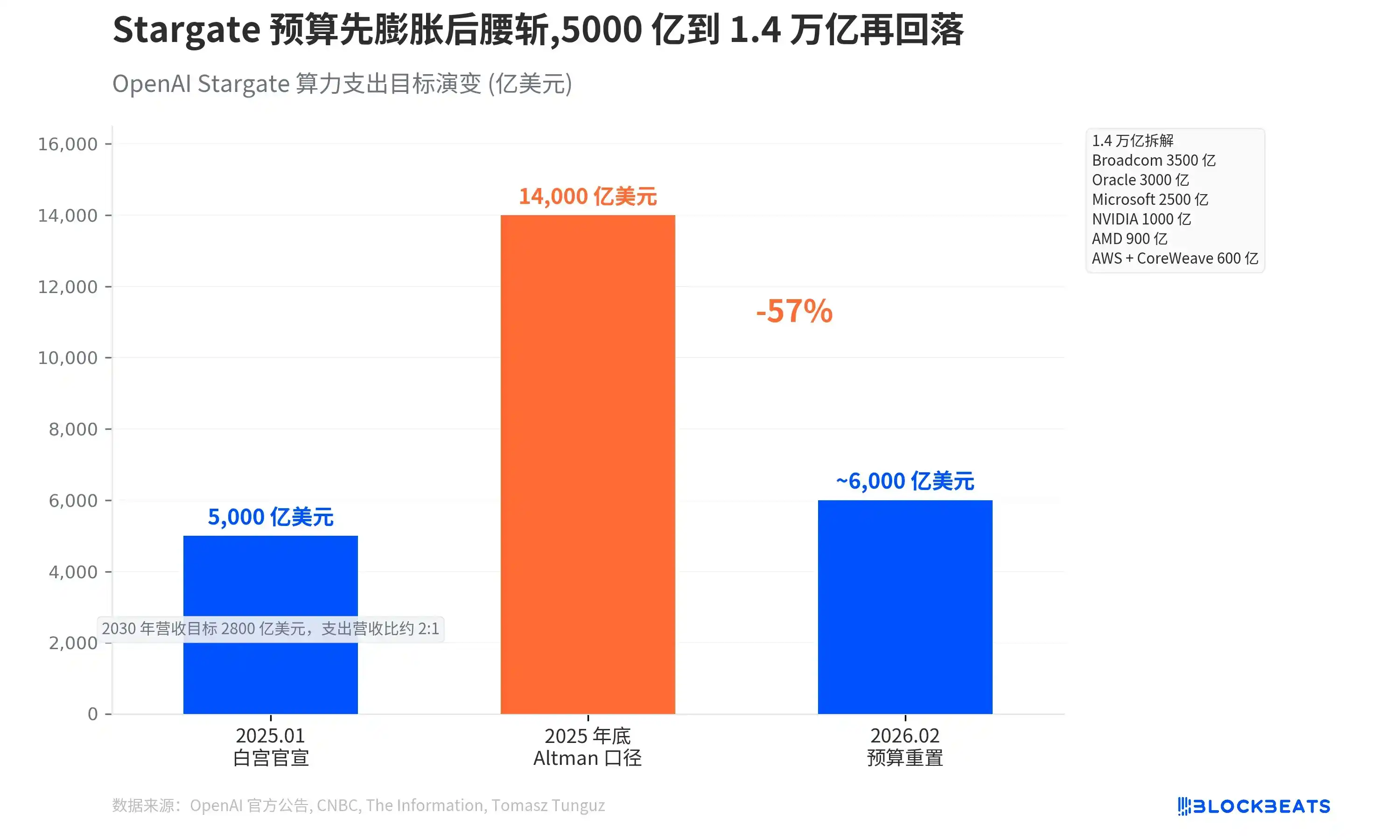
According to disassembled data from investor materials, the $1.4 trillion total commitment cited by Altman was distributed among seven suppliers. According to venture analyst Tomasz Tunguz's analysis of the investor materials, Broadcom accounted for $350 billion, Oracle $300 billion, Microsoft $250 billion, NVIDIA $100 billion, AMD $90 billion, with AWS and CoreWeave combining for $60 billion.

In February 2026, CNBC reported that this figure was reset to approximately $600 billion (by 2030), a 57% cut. The same report gave a slightly different but directionally consistent figure, with OpenAI expecting to spend $665 billion on cloud servers by 2030.

$600 billion is still a number that needs context. According to internal OpenAI forecasts, the company's revenue target for 2030 is $280 billion, meaning the cumulative spending-to-revenue ratio over five years is about 2:1. And according to internal financial data cited by ainvest, the company's projected loss for 2026 is $14 billion, with a gross margin of only 33% as reported by multiple media outlets (Note: Gross margin reflects the profitability of the product itself, while net loss is the final result after deducting all costs like R&D and management; the two can coexist).

Placing OpenAI's spending target within the panorama of the Big Tech computing arms race makes the proportions clearer.
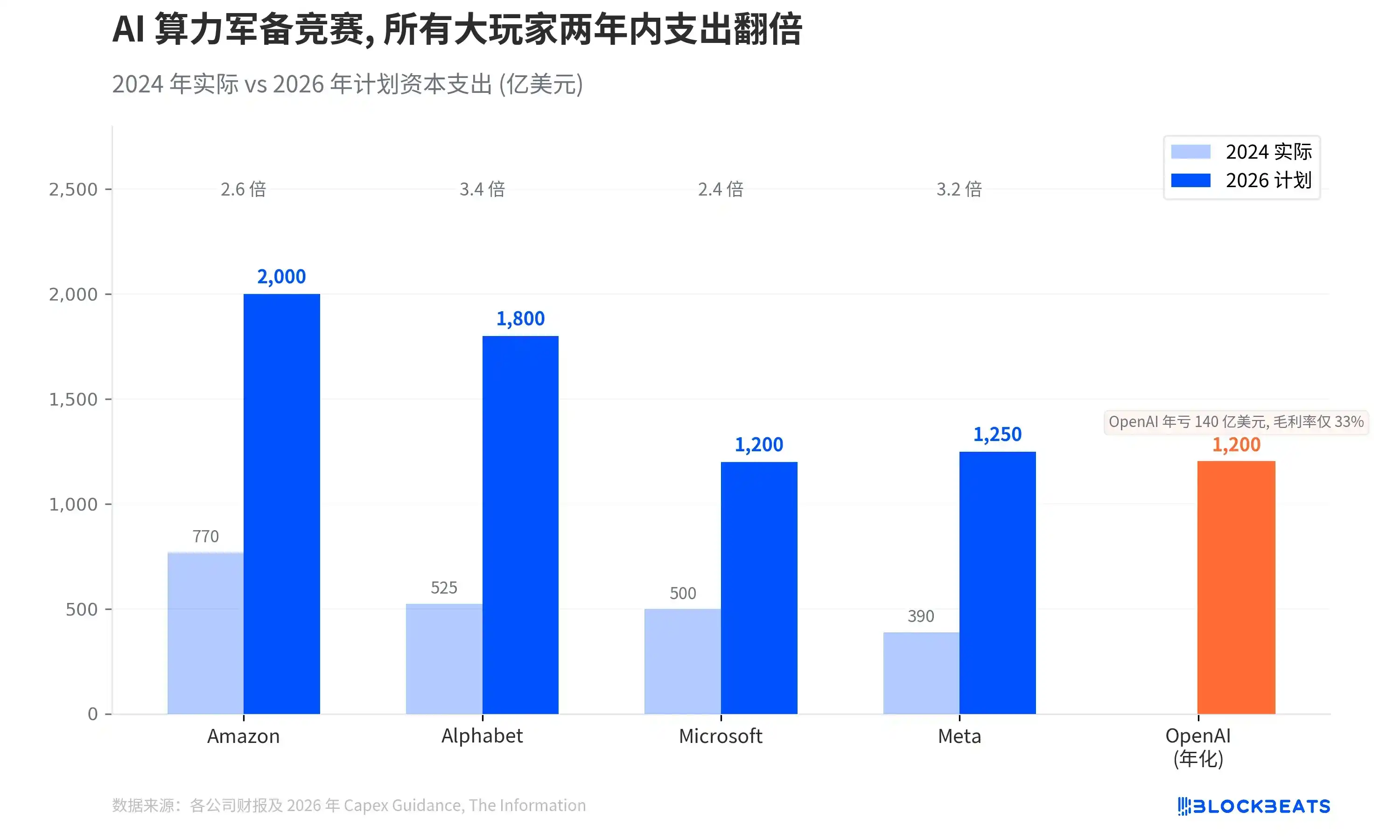
According to company financial reports and public Guidance, Amazon's planned capital expenditure for 2026 is $200 billion, Alphabet's is $180 billion, Meta's is $125 billion, and Microsoft's is approximately $120 billion. These four companies have seen their expenditures roughly double or triple within two years, totaling over $650 billion, with about three-quarters flowing into AI infrastructure.

OpenAI's $600 billion is a five-year cumulative target, annualized to about $120 billion, which is comparable to Microsoft's single-year capital expenditure. The difference is that Microsoft's annual revenue exceeds $240 billion, while OpenAI's annualized revenue has just reached $25 billion and is not expected to achieve positive cash flow before 2030.

The Stargate restructuring is more than just a change in budget numbers; the organizational adjustments reveal a deeper shift in direction.

The restructured Stargate is divided into three lines. The Epic business partnership group is led by longtime OpenAI employee and former Deloitte manager Peter Hoeschele, managing cloud contracts with Microsoft, Oracle, Amazon, and transactions with chip manufacturers. These deals include a multi-year contract with AMD (using up to 6 gigawatts of chips, costing up to 10% of AMD common stock) and an agreement with chip startup Cerebras Systems.
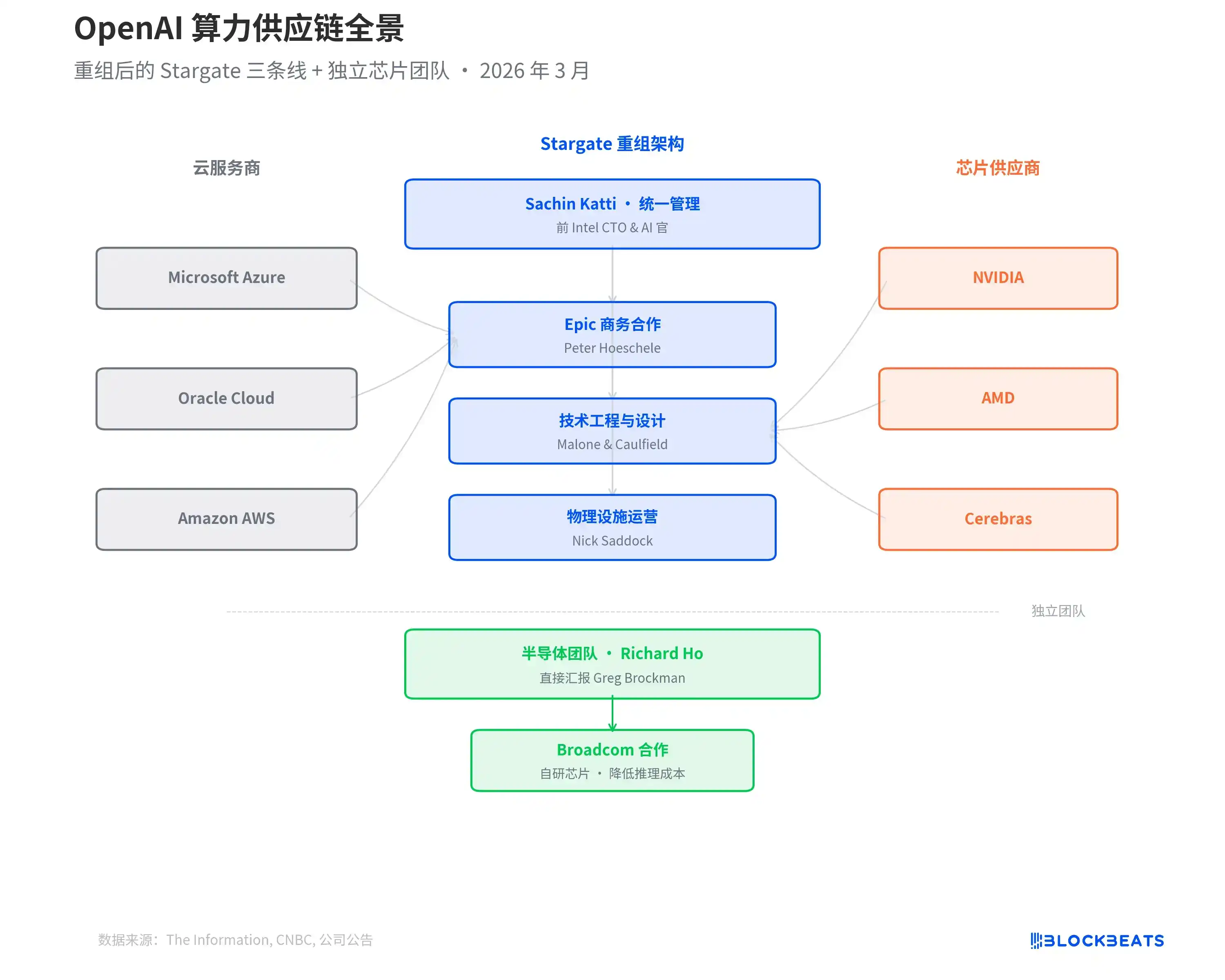
The technical engineering and design group is co-led by former Meta and Google engineer Chris Malone and former Microsoft engineering lead Adrian Caulfield, responsible for redesigning the AI server clusters used by OpenAI. The physical facilities operations group is led by former Google data center director Nick Saddock, replacing Keith Heyde who left weeks ago.

The semiconductor team led by former Google chip executive Richard Ho falls outside Katti's jurisdiction and reports directly to OpenAI President Greg Brockman. This team is collaborating with Broadcom to develop in-house chips, which OpenAI hopes will eventually reduce the inference costs of running products like ChatGPT.

The name "Stargate" remains, but what it refers to has completely changed. In January 2025, it was a joint venture with SoftBank and Oracle to build data centers. In March 2026, it is OpenAI's broad strategy for bringing gigawatt-scale server capacity online. It has gone from "I want to build my own power plant" to "I want to sign the best leases." The total planned capacity for all sites remains nearly 7 gigawatts, with a three-year investment total still exceeding $400 billion. OpenAI is shifting its computing direction towards NVIDIA's Vera Rubin platform, aiming to achieve the first gigawatt-scale capacity online in the second half of 2026.


Related Reads

As Consensus Accelerates, What Are Young Investors Betting On?

Title: As Consensus Forms Faster, What Are Young Investors Betting On? In the rapid evolution of tech investment, a new generation of young investors is navigating a landscape where AI, robotics, commercial aerospace, and quantum computing are advancing simultaneously. Traditional investment logic based on financial models is giving way to a need for deep technical understanding and the ability to act before industry consensus forms. An analysis of trends from the "WAIC FUTURE TECH" list of young investment leaders reveals key shifts in focus. The first major trend is the movement of AI from the digital screen into the physical world. Investment is shifting from large language models and chatbots towards embodied AI, robotics, AI hardware, and edge computing. While demonstrations generate excitement, the real challenge lies in achieving scalable, reliable, and cost-effective delivery in complex real-world environments like factories and logistics. Success depends not just on algorithms but on the integration of sensors, actuators, and control systems. Second, the competitive focus for large models is moving beyond raw capability toward building an "intelligence flywheel." The goal is to create self-reinforcing systems where user interaction generates data, improving the model, which in turn enhances the user experience and attracts more engagement. Companies that successfully embed AI into workflows to create these closed-loop systems can build lasting value that isn't easily erased by the next model upgrade. Third, facing a potential bottleneck in high-quality human-generated data, investors are looking at new underlying technologies. Reinforcement learning and self-play, as demonstrated by AlphaGo Zero, offer paths for AI to generate its own experience. Scientific foundation models, which aim to build general AI capabilities for fields like life sciences and materials discovery, represent a non-consensus direction that could unlock new frontiers of knowledge and data. Finally, in deep-tech areas like quantum computing, commercial aerospace, and space-based infrastructure, patient capital is essential. These fields have long, uncertain development and validation cycles involving complex engineering, supply chains, and regulations. Investment here requires a long-term view, focusing on foundational team capabilities and the eventual emergence of market demand, even if commercial returns are distant. Collectively, these trends illustrate how young investors are adapting to a new era. They are learning to make earlier, technically-informed judgments, balance hype with real-world viability, and provide the patient capital needed to build the deep-tech foundations of the future.

marsbit8m ago

As Consensus Accelerates, What Are Young Investors Betting On?

marsbit8m ago

Can Japan Buy Growth with AI? Will the Bond Market Believe It?

Japan's cabinet has introduced the 2026 Basic Policy on Economic and Fiscal Management and Reform, shifting its primary fiscal target. The new framework moves away from the traditional annual primary balance goal and instead prioritizes a stable reduction of the debt-to-GDP ratio. This change is tied to a strategy of increased "responsible proactive fiscal" spending, aiming to boost long-term growth through investments in strategic sectors like AI, semiconductors, energy, and robotics. The government estimates total public and private investment in 62 key technologies could exceed 370 trillion yen by 2040. The market reaction has been mixed and cautious. While equity markets may respond to policy signals, bond markets are focused on fiscal credibility. Concerns center on whether the weakening of the clear primary balance anchor could lead to looser fiscal discipline. If investors doubt that these strategic investments will generate sufficient productivity gains, tax revenue, and nominal growth to outpace rising interest costs, they may demand higher yields on Japanese Government Bonds (JGBs). Recent volatility in the yen and JGB yields, with the 10-year yield briefly reaching 2.9%, reflects this skepticism. The success of this new framework hinges on two factors: whether Japan can achieve a nominal growth rate consistently higher than its long-term interest rates, and whether future budgets demonstrate disciplined control over bond issuance. The government's narrative is that strategic investment is essential to break Japan's cycle of low growth, aging, and labor shortages. However, the bond market will continuously assess the credibility of this plan, pricing the risk that it may represent fiscal expansion rather than a viable growth strategy.

marsbit45m ago

Can Japan Buy Growth with AI? Will the Bond Market Believe It?

marsbit45m ago

Misjudged A-Shares: Resilience, Expectations, and Confidence

China's A-share market recently faced selling pressure, especially in tech sectors, initially triggered by a global tech sell-off that began in South Korea. However, the article argues this is a case of "mistaken injury" and highlights the market's underlying resilience. This resilience stems from three main pillars: **1) Tech Sector Fundamentals:** Unlike Korea's market dominated by a few memory chip stocks, China's tech sector is diversified across computing, communications, electronics, and semiconductors, supported by dual narratives of global AI supply chains and domestic substitution. Core areas like optical modules and fiber optics continue to show strong earnings growth. **2) "National Team" Support:** State-backed institutions and large corporations have made significant market purchases and announced buybacks, providing liquidity and signaling confidence. This is seen as a stabilizing policy signal, often associated with market bottoms. **3) Broader Market Pillars:** Other major sectors are showing endogenous recovery momentum. Consumer stocks benefit from stabilizing CPI and signs of sector recovery (e.g., liquor price hikes). Cyclical sectors like aluminum have high earnings, potential price increases due to tight supply, and low valuations. The financial sector offers stable dividends and low valuations. The conclusion is that the sell-off was driven by external contagion, not a collapse in fundamentals. With strong policy support and recovering momentum across key sectors, the A-share market possesses the toughness to regain stability.

marsbit1h ago

Misjudged A-Shares: Resilience, Expectations, and Confidence

marsbit1h ago

Trading

Spot
活动图片



