# Open Source Related Articles

HTX News Center provides the latest articles and in-depth analysis on "Open Source", covering market trends, project updates, tech developments, and regulatory policies in the crypto industry.

DeepSeek Funding: Liang Wenfeng's 'Realist' Pivot

DeepSeek, a leading Chinese AI company, has initiated its first external funding round, aiming to raise at least $300 million at a valuation of no less than $10 billion. This move marks a significant shift from its founder Liang Wenfeng’s previous idealistic stance of rejecting external capital to maintain independence. Despite strong financial backing from its parent company, quantitative trading firm幻方量化 (Huanfang Quant), which provided an estimated $700 million in revenue in 2025 alone, DeepSeek faces mounting challenges. Key issues include a 15-month gap in major model updates, delays in its flagship V4 release, and the loss of several core researchers to competitors offering significantly higher compensation. The company is also undergoing a strategic pivot by migrating its infrastructure from NVIDIA’s CUDA to Huawei’s Ascend platform, a move aligned with China’s push for technological self-reliance amid U.S. export controls. However, DeepSeek lags behind rivals like智谱AI and MiniMax—both now publicly listed—in areas such as product ecosystem, multimodal capabilities, and commercialization. The funding round, though relatively small in scale, is seen as a way to establish a market-validated valuation anchor, making employee stock options more competitive and facilitating talent retention. It also signals DeepSeek’s transition from a pure research-oriented organization to a commercially-driven player in the global AI ecosystem.

marsbit04/20 11:19

DeepSeek Funding: Liang Wenfeng's 'Realist' Pivot

marsbit04/20 11:19

a16z Founder: In the Agent Era, What Truly Matters Has Changed

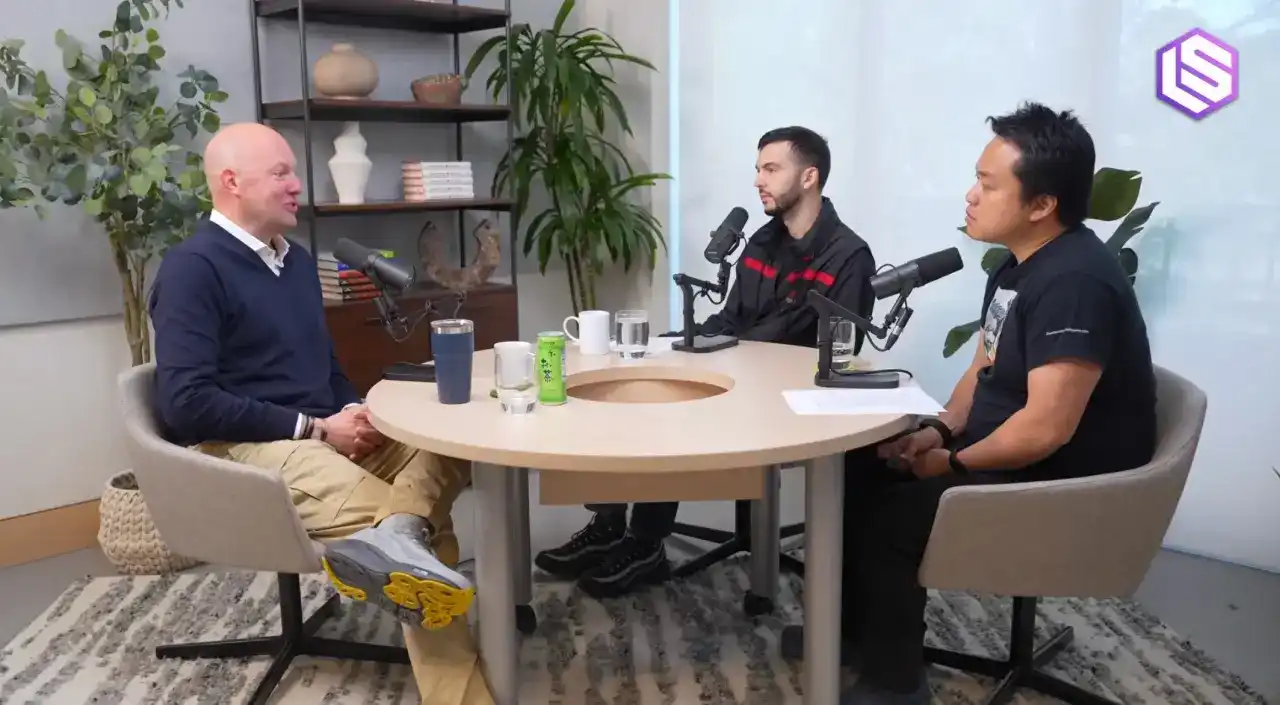
Marc Andreessen, co-founder of a16z, argues that the current AI boom is not an overnight success but the culmination of 80 years of research, now delivering practical results. He emphasizes that this era is defined by the convergence of four key capabilities: large language models (LLMs), reasoning, coding, and agents capable of recursive self-improvement. Andreessen describes the agent architecture—combining an LLM with a shell, file system, markdown, and cron/loop—as a fundamental shift beyond chatbots. This structure leverages existing software components, allowing agents to maintain state, introspect, and extend their own functionality. He predicts a move away from traditional GUI and browser-based interactions toward an "agent-first" world where software is primarily operated by bots, not humans, with people simply stating their goals. He draws parallels to the 2000 internet bubble but notes key differences: current AI infrastructure investments are led by cash-rich giants and quickly monetized. He highlights that scaling constraints involve not just GPUs but the entire chip ecosystem. Open source and edge inference are crucial for democratizing knowledge and enabling low-latency, cost-effective applications on local hardware. Finally, Andreessen identifies significant non-technical challenges: potential short-term cybersecurity crises, the need for "proof of human" identity solutions, financial infrastructure for agents, and institutional resistance from sectors like education and healthcare. He cautions that societal adoption will be slower than technological change.

marsbit04/20 00:02
a16z Founder: In the Agent Era, What Truly Matters Has Changed

marsbit04/20 00:02

Can Humans Control AI? Anthropic Conducted an Experiment Using Qwen

Can Humans Control Superintelligent AI? Anthropic’s Experiment with Qwen Models Anthropic conducted an experiment to explore whether humans can supervise AI systems smarter than themselves—a core challenge in AI safety known as scalable oversight. The study simulated a “weak human overseer” using a small model (Qwen1.5-0.5B-Chat) and a “strong AI” using a more powerful model (Qwen3-4B-Base). The goal was to see if the strong model could learn effectively despite imperfect supervision. The key metric was Performance Gap Recovered (PGR). A PGR of 1 means the strong model reached its full potential, while 0 means it was limited by the weak supervisor. Initially, human researchers achieved a PGR of 0.23 after a week of work. Then, nine AI agents (Automated Alignment Researchers, or AARs) based on Claude Opus took over. In five days, they improved PGR to 0.97 through iterative experimentation—proposing ideas, coding, training, and analyzing results. The findings suggest that, in well-defined and automatically scorable tasks, AI can help overcome the supervision gap. However, the methods didn’t generalize perfectly to unseen tasks, and applying them to a production model like Claude Sonnet didn’t yield significant improvements. The study highlights that while AI can automate parts of alignment research, human oversight remains essential to prevent “gaming” of evaluation systems and to handle more complex, real-world problems. Anthropic chose Qwen models for their open-source nature, performance, scalability, and reproducibility—key for rigorous and repeatable experiments. The research demonstrates progress toward automated alignment tools but also underscores that AI supervision remains a nuanced, human-AI collaborative effort.

marsbit04/15 09:28

Can Humans Control AI? Anthropic Conducted an Experiment Using Qwen

marsbit04/15 09:28

活动图片