# Liquidation Related Articles

HTX News Center provides the latest articles and in-depth analysis on "Liquidation", covering market trends, project updates, tech developments, and regulatory policies in the crypto industry.

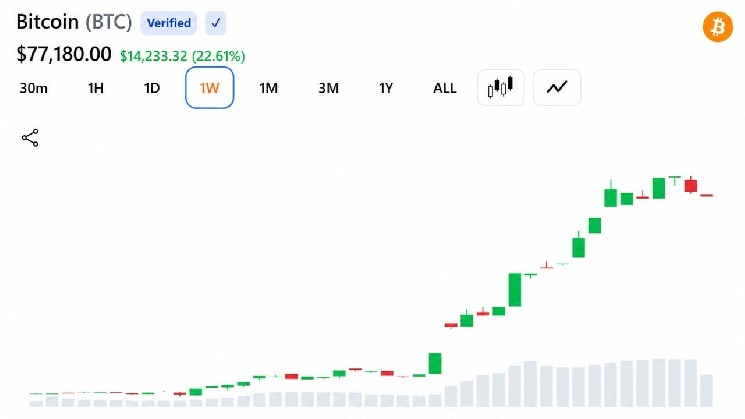
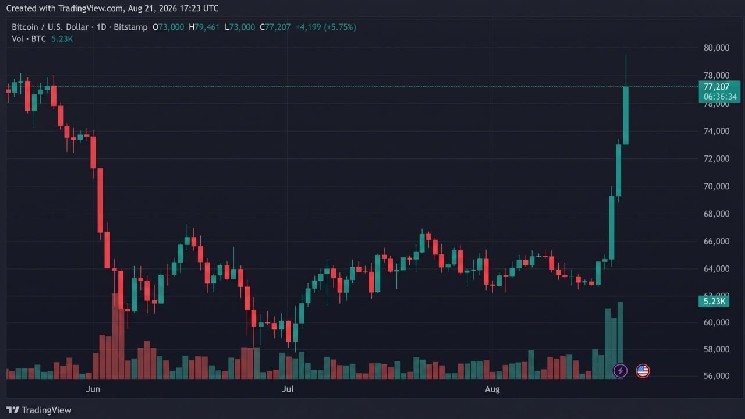
Bitcoin Soars Over 24% in a Week, Best Weekly K in Recent Years, $2.7B Short Squeeze Sets Record, Policy Tailwinds Ignite Rally

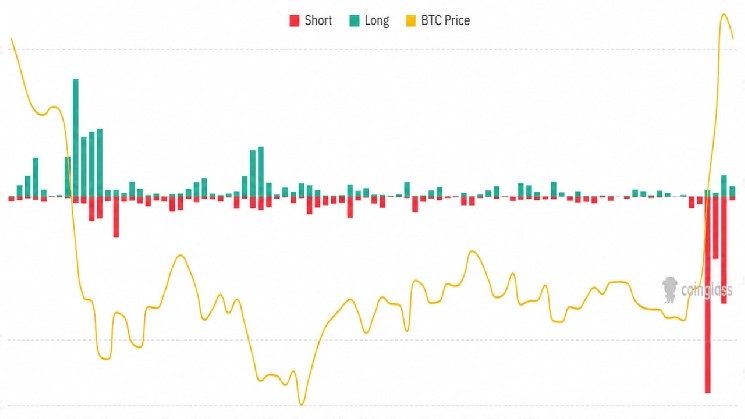
Bitcoin surged over 24% this week, breaking above $78,000 and marking its best weekly performance since March 2024. The rally accelerated following a series of crypto-friendly signals from Washington and was further amplified by a record wave of forced short liquidations. Data from CoinGlass shows approximately $27.4 billion in crypto short positions were liquidated within 24 hours, the largest such event since the platform's records began in 2021. Total liquidations neared $30 billion, with shorts accounting for about 92%. Key drivers included a new SEC proposal ("Regulation Crypto Assets") to simplify token offerings, progress on the stalled CLARITY法案, comments from CFTC Chairman Michael Selig about moving forward independently if Congress delays, and former President Trump's remarks regarding bringing the Hyperliquid exchange into the US compliantly. Macroscopically, the US Treasury's announcement to double its long-term bond buyback program helped lower yields, improving liquidity expectations for risk assets. The market, previously stagnant near $60,000 with high short positioning, saw a violent squeeze. This created a self-reinforcing cycle where rising prices triggered further short liquidations. The interplay between shifting policy expectations and this massive deleveraging event fueled the historic weekly gain.

marsbit08/24 04:16

Bitcoin Soars Over 24% in a Week, Best Weekly K in Recent Years, $2.7B Short Squeeze Sets Record, Policy Tailwinds Ignite Rally

marsbit08/24 04:16

Unpacking the Truth Behind On-chain Assets: Leverage, Liquidity, and Risk

The article analyzes the concept of "real-world asset" (RWA) tokenization, arguing that while tokenizing assets on-chain is a useful step, it is far from transformative on its own. The author compares it to placing a barcode on a shipping container—it enables identification but does not build the necessary market infrastructure. The core argument is that true value emerges not from tokenization, but from integrating these tokens into DeFi systems where they can be valued, financed, hedged, traded, and liquidated under stress. Key challenges identified include: 1. **Multiple Time Clocks**: A fundamental tension exists between blockchain's 24/7 settlement and the slower, business-hour-dependent processes of traditional markets, custody, and redemption. This "duration mismatch" can create dangerous liquidity gaps during crises. 2. **Liquidity Misconceptions**: True liquidity is not measured by Total Value Locked (TVL) or trading pairs, but by the ability to exit a position within a required timeframe at an acceptable price. It requires analyzing multiple exit paths and stress-testing scenarios. 3. **Leverage and Risk**: Leverage unlocks economic utility (e.g., using tokenized assets as collateral) but also introduces fragility. Risk models must account for more than asset volatility, incorporating factors like legal enforceability, oracle freshness, and market structure. Paradoxically, a "safer" asset like tokenized Treasury bonds could require a higher collateral discount than ETH due to slower, less-proven liquidation mechanisms. 4. **A Risk Graph**: RWA risk should be modeled as a network of interconnected dependencies (e.g., issuers, custodians, oracles, stablecoin pools), not a single score. Failures can propagate through this graph, turning operational issues into systemic liquidity crises. The article states that tokenized government bonds are merely an entry point, while more complex frontiers like computing power and energy assets present greater challenges and opportunities. It also examines the interplay and risks between tokenized stocks and perpetual futures contracts. The conclusion is that the future lies not in "tokenizing everything," but in building robust market layers where tokenized rights become resilient financial primitives within a programmable capital system. The token is just the barcode; the market is the machine.

marsbit08/24 01:11

Unpacking the Truth Behind On-chain Assets: Leverage, Liquidity, and Risk

marsbit08/24 01:11

Major Altcoin Market Players Did This During the Massive Rally!

As the cryptocurrency bull market intensifies, large-scale transactions by crypto 'whales' are drawing significant attention. Blockchain data reveals multi-million dollar positions opened and closed in Bitcoin ($BTC), Ethereum ($ETH), and Hyperliquid ($HYPE). A major investor, likely tied to Matrixport, closed a 40,000 $ETH long position worth ~$100.5M for a $9.9M profit. The investor still holds 80,000 $ETH (~$201M) and 500 $BTC (~$39M), with an unrealized profit of ~$22.9M. This turned their previous $92.5M total loss into an approximate $32.8M overall profit. On Hyperliquid, a trader known as loracle.hl reportedly lost over $70M trading $HYPE in the past three months. The investor currently holds ~$54.88M in $HYPE short positions, at risk of liquidation if $HYPE's price reaches $101.15. Notorious trader Machi Big Brother, who reportedly survived 500 liquidations, capitalized on the recent rally. He grew his portfolio from $152K to $12.72M in just three days, yielding over $12.5M in profit. While $HYPE hits a new all-time high, Multicoin Capital has deposited 427,422 $HYPE (~$31.74M) to Coinbase Prime over three days, raising speculation about a potential sale or portfolio rebalance. In Bitcoin markets, an anonymous whale stands out, selling ~2,700 $BTC (~$211.8M) in a recent transaction. Over three days, this whale sold a total of 7,700 $BTC, valued at approximately $576.6M.

cryptonews.ru08/22 16:40

Major Altcoin Market Players Did This During the Massive Rally!

cryptonews.ru08/22 16:40

活动图片