Bitcoin Could Reach a Turning Point This Week as a Solid Bottom Forms

cryptonews.ruPublished on 2026-08-23Last updated on 2026-08-23

Abstract

Bitcoin may be approaching a pivotal moment this week as a sustainable bottom forms, according to Grayscale. The asset manager noted that Bitcoin's rapid recovery from its latest bear market low, including a rally to around $79,500, could signal a turning point. Their analysis compared the current cycle's decline—roughly 50% from its peak—to historical drops of 70-80%, suggesting a potentially shallower correction. Grayscale's chart tracking Bitcoin's performance across cycles shows the current pullback is less severe than previous ones. This aligns with a VanEck report indicating that multiple "capitulation" signals were active, often associated with late-stage corrections and a transition into accumulation. Factors such as institutional ETF adoption, a broader holder base, and the absence of major leveraged lender blowups may be contributing to a more resilient market structure. Supporting the recovery, U.S. spot Bitcoin ETFs have seen significant net inflows, totaling approximately $1.92 billion over five consecutive sessions. While this indicates underlying demand beyond short-covering, risks remain from macroeconomic factors like rising interest rates or profit-taking. Grayscale concluded that while a Q4 2026 downturn is still possible, this week's rally suggests a more durable bottom may be forming.

A swift Bitcoin recovery could signal that its latest bear market has reached a turning point, crypto asset manager Grayscale noted in an Aug. 22 post on X. The post included a chart comparing Bitcoin’s current decline with four prior market cycles.

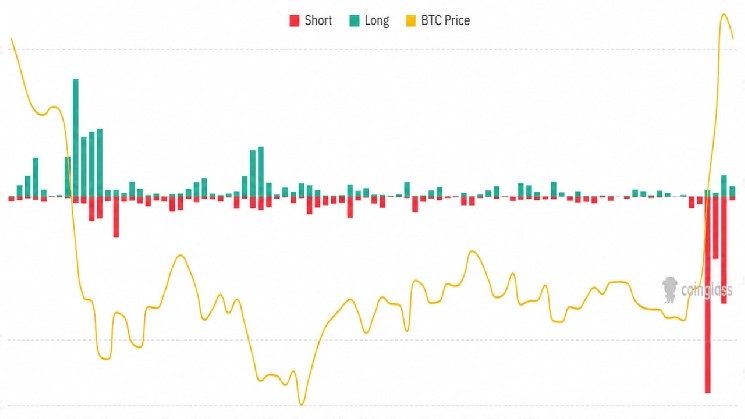
That assessment followed a weekly Bitcoin rally of roughly $10,000, which on Aug. 21 pushed the cryptocurrency to $79,500 — its highest price since May. The recovery broke a prolonged trading range and forced traders holding bearish derivative positions to close their bets.

While short position liquidations contributed to accelerating the rise, this movement also coincided with renewed spot demand and inflows into ETFs. Grayscale stated:

“This week could be a turning point for Bitcoin.”

The firm elaborated on market outlooks after publishing an assessment of whether current prices present a good time to buy Bitcoin. That analysis highlighted continued structural adoption, bear market maturity, and a potentially favorable macroeconomic backdrop as three factors for long-term investors to consider.

Grayscale Chart Shows a Shallower Bitcoin Decline

On the accompanying “Bitcoin Price by Cycle” chart, the Bitcoin index is set to 100 at each cycle peak, and its subsequent behavior is tracked by the number of days since that peak. The current cycle starts from the October 2025 high and runs through Aug. 20.
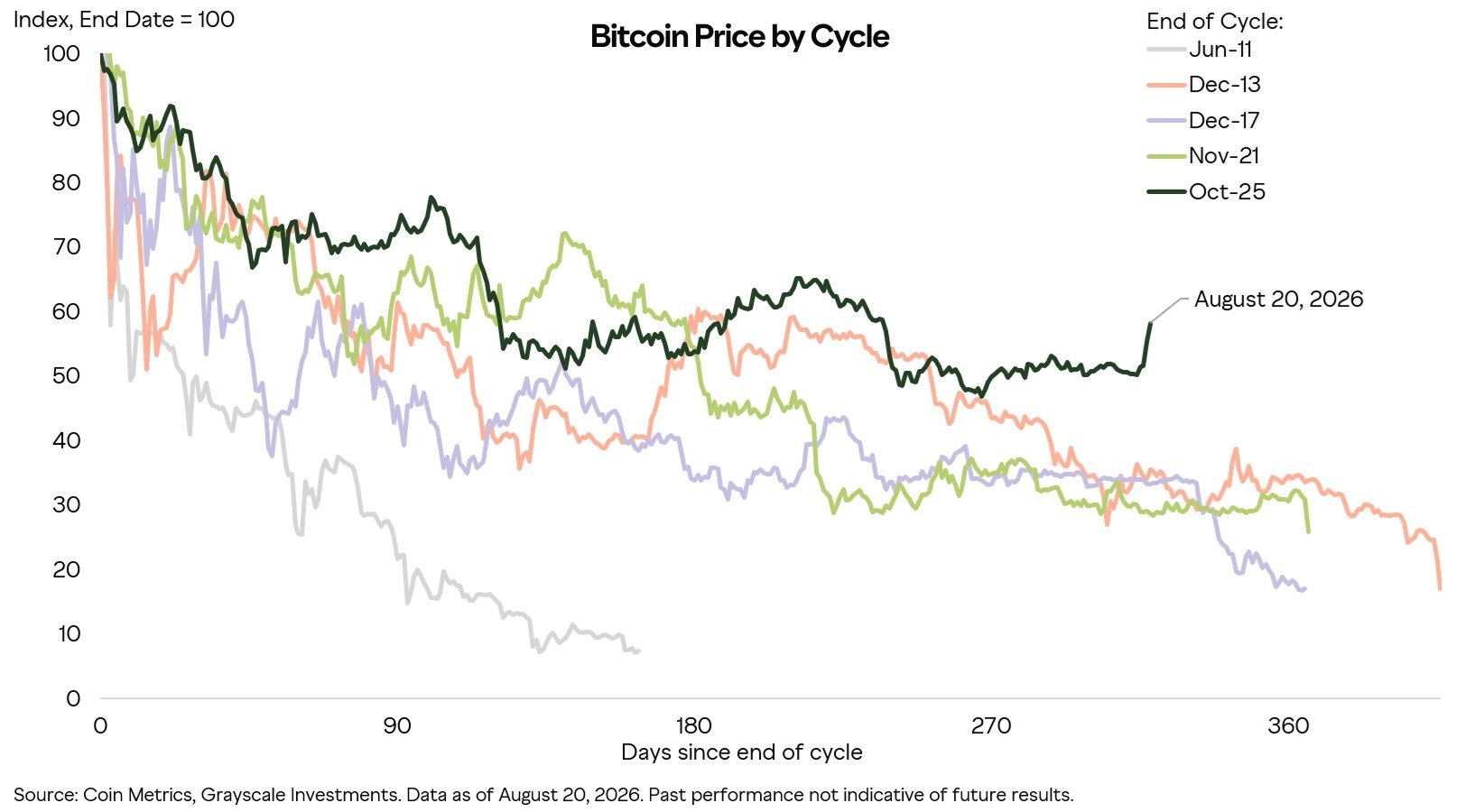
The visualization uses Coin Metrics historical Bitcoin price data to compare the current drop with four previous cycles that peaked in June 2011, December 2013, December 2017, and November 2021. Bitcoin’s current price decline is less severe than the four prior cyclical declines shown on the chart.

Grayscale said:

“Historically, Bitcoin has found a bottom at roughly 80% below the cycle’s peak price. On the latest bear market, Bitcoin fell about 50% from its peak, which is less than all prior cycles to date.”

This comparison does not prove the latest low will hold but indicates the market has weathered a downturn without repeating prior losses of around 80%.

Bitcoin’s periodic growth and correction phases have often followed a roughly four-year cycle linked to halvings, liquidity, and investor behavior. Prior Bitcoin market cycles included correction phases where prices fell roughly 78–94% from prior peaks, although changes in market structure may reduce the depth of future declines.

Other Market Signals Point to Accumulation

Separate research has also identified conditions associated with later-stage Bitcoin corrections. A VanEck analysis from Aug. 18 found that as of Aug. 12, eight of 12 capitulation signals were active, with all 12 having entered capitulation zones at some point during the prior three months.

VanEck’s “Bitcoin Chaincheck” analysis characterized the decline as potentially late-stage and noted that Bitcoin may be approaching or entering an accumulation phase. VanEck also expects the bottom to be shallower than in prior cycles, citing spot exchange-traded products, a broader base of institutional holders, and an absence of major leveraged lender bankruptcies.

These indicators do not provide reliable short-term confirmation of a bottom. VanEck found that comparable clusters of signals in the past delivered below-average returns over 90 and 180 days. Annualized returns exceeded Bitcoin’s typical performance, but that finding was based on a small set of observations with significant overlap.

ETF Demand Reinforces Recovery

The resumption of investments into U.S. spot Bitcoin exchange-traded funds (ETFs) serves as another indicator of demand underpinning the recovery. Over five trading sessions, these products recorded net inflows of approximately $1.92 billion, finishing Aug. 21 with five consecutive days of increases and total net assets of $96.07 billion.

These inflows suggest the rally has extended beyond forced buying from shorts closing their positions, yet they do not confirm another decline has been averted. Rising interest rates, decreasing liquidity, renewed ETF share redemptions, or profit-taking could still jeopardize the market’s recent gains.

Grayscale concluded:

“Market discussions have centered on whether Bitcoin will see another downturn in Q4 2026. While risks remain, this week’s rally may indicate we have reached a more sustainable bottom.”


end-content

Related Questions

QAccording to the article, why might this week be a turning point for Bitcoin?

AGrayscale suggests this week could be a turning point because Bitcoin's rapid recovery, which broke a prolonged trading range and forced bearish derivatives traders to close positions, may signal that the latest bear market has reached an inflection point. The recovery coincided with renewed spot demand and ETF inflows.

QHow does the current Bitcoin price decline compare to previous market cycles according to Grayscale's chart?

AAccording to Grayscale's chart comparing the current cycle to four previous ones, the current decline in Bitcoin's price is less severe. Historically, Bitcoin bottomed at roughly 80% below its cycle peak, but in the latest bear market, it fell only about 50% from its peak, which is shallower than all prior cycles at this point.

QWhat did VanEck's 'Bitcoin Chaincheck' analysis indicate about the state of the market?

AVanEck's 'Bitcoin Chaincheck' analysis indicated that as of August 12th, eight out of twelve capitulation signals were active, with all twelve having been in capitulation zones at some point in the prior three months. It characterized the downturn as potentially being in a late stage and noted Bitcoin may be approaching or entering an accumulation phase.

QWhat recent trend in U.S. spot Bitcoin ETFs is mentioned as supporting the recovery?

AThe article mentions that U.S. spot Bitcoin ETFs recorded approximately $1.92 billion in net inflows over five trading sessions, ending August 21st with five consecutive days of increases and total net assets of $96.07 billion. This trend indicates underlying demand beyond forced short-covering.

QWhat three factors did Grayscale highlight for long-term investors to consider in their analysis?

AIn their analysis, Grayscale highlighted three factors for long-term investors to consider: ongoing structural adoption, the maturity of the bear market, and a potentially favorable macroeconomic backdrop.

Related Reads

Hardware Wallet Owners Lose Money: The Nuances of Cold Bitcoin Storage in 2026

The article discusses a wave of distrust towards hardware wallets by the summer of 2026, primarily triggered by security incidents. The most significant involved Coldcard wallets from Coinkite, where a firmware bug dating back to 2021 drastically reduced the cryptographic entropy for seed phrase generation. This allowed attackers to brute-force private keys, leading to losses estimated between $115-$153 million in Bitcoin. While Coldcard issued a fixed firmware, the incident damaged the reputation of all hardware wallets. Other manufacturers like Trezor and Ledger issued statements assuring their devices' security, citing their use of secure hardware elements for true random number generation. However, separate data breaches affected SafePal (exposing personal data of ~40,000 users) and Trezor (via a logistics partner, compromising data for ~14,000 users), though no private keys or crypto assets were stolen in these cases. The article clarifies that hardware wallets themselves don't "hold" crypto but store the keys to access it on the blockchain. It argues against abandoning hardware wallets entirely, pointing out that alternatives like paper, memory, or custodial exchange storage have their own significant risks. It concludes that these incidents should be viewed as specific failures, not a condemnation of the entire category. A key underlying challenge highlighted is the dual role of advancing AI, which empowers both defenders to enhance security and attackers to find vulnerabilities more efficiently.

cryptonews.ru27m ago

Hardware Wallet Owners Lose Money: The Nuances of Cold Bitcoin Storage in 2026

cryptonews.ru27m ago

Trading

Spot
活动图片