# Hedging Related Articles

HTX News Center provides the latest articles and in-depth analysis on "Hedging", covering market trends, project updates, tech developments, and regulatory policies in the crypto industry.

Are Rising U.S. Stocks Getting More Dangerous? Goldman Sachs: Downside Protection Mechanisms Have Almost Failed

The US stock market rally is showing signs of becoming increasingly precarious as key downside protection mechanisms fail, according to Goldman Sachs. Derivatives strategist Brian Garrett notes that the S&P 500 options volatility skew has plunged to an 18-month low, indicating the market now prices an 8% probability for both a 10% drop and a 10% rise—a sign of "skew failure." Concurrently, Goldman's Panic Index hit a two-year low, reflecting minimal demand for tail-risk hedging. This complacency emerges amid a relentless market surge, with the S&P 500 setting new records frequently in 2024. Garrett highlights three major concerns: extreme concentration in the top ten stocks (40% of index weight), heavy reliance on AI-themed performance, and a price pattern eerily similar to the 1998-1999 period. Despite pervasive media pessimism, this fear is absent in options pricing. Downside hedge costs are historically low. Goldman suggests tactical trades: buying RSP outperformance options versus the SPX for a broadening rally, purchasing VIX calls for protection, and going long on Bitcoin ETF volatility. Hedge funds have been net buyers for two weeks, with sector rotation into financials and out of industrials. Notably, the global single-stock leveraged/ inverse ETF AUM has doubled to over $60 billion in two months, underscoring growing speculative activity.

marsbit06/01 09:45

Are Rising U.S. Stocks Getting More Dangerous? Goldman Sachs: Downside Protection Mechanisms Have Almost Failed

marsbit06/01 09:45

Investment Philosophy of Gavin Baker, an Early Nvidia Investor: Long AI Infrastructure Bottlenecks, Short Overall Market Risk

Gavin Baker, an early investor in Nvidia and founder of Atreides Management, outlines his investment philosophy: going long on AI infrastructure bottlenecks while hedging against broader market risk. He argues AI is not a bubble but a supercycle driven by constraints in power, wafers (semiconductors), and compute efficiency (tokens per watt). True alpha, he believes, lies not in application-layer companies like OpenAI but in "picks and shovels" providers—companies solving physical bottlenecks in GPU connectivity (e.g., Astera Labs), memory (Micron), inference chips (Cerebras, Positron), advanced manufacturing (TSMC, ASML), and energy supply. His portfolio reflects this barbell strategy: concentrated bets on key infrastructure players alongside a significant put position on the QQQ ETF to hedge overall market downside. Baker contends this cycle differs from the dot-com bubble because demand is fueled by the strong balance sheets of hyperscalers (Google, Meta, Amazon, Microsoft), not debt, and physical supply constraints (e.g., chip manufacturing capacity) prevent runaway overinvestment. He highlights the growing importance of inference (vs. pre-training), vertical/small language models, sovereign infrastructure deployment speed, and the convergence of energy and space (e.g., orbital compute). His long-term view is that performance-per-watt and token cost reduction will dictate winners as AI scaling hits fundamental physical limits.

marsbit05/30 03:23
Investment Philosophy of Gavin Baker, an Early Nvidia Investor: Long AI Infrastructure Bottlenecks, Short Overall Market Risk

marsbit05/30 03:23

I Tested with $10,000: Zero Wear, 8% APY, and Earn Points (Full Tutorial + Screenshots Included)

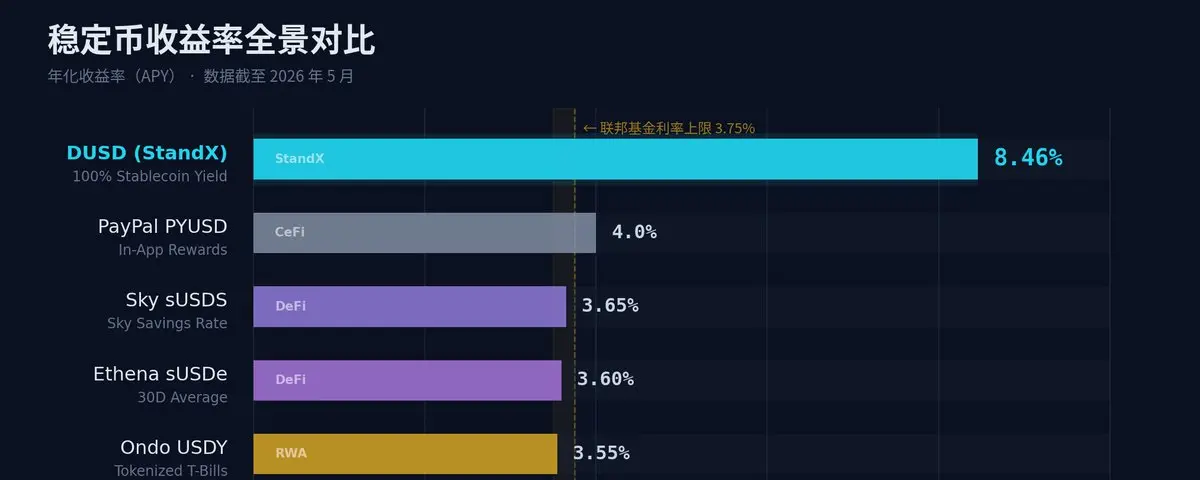
**Title:** My $10,000 Real-World Test: Zero Wear-and-Tear, ~8% APY, Plus Earning Points (Full Guide + Screenshots Included) **Summary:** This article details a personal experiment with $10,000 on the StandX platform to verify its advertised ~8% APY for its stablecoin, DUSD, while earning trading points. The author created two accounts, each depositing $5,000 worth of DUSD, and used StandX's unique "Block Trade" feature to open perfectly offsetting long and short BTC positions (2x leverage each). This neutralized directional market risk. **Key Results (Over 8 Days):** * **Total Profit:** $16.91 (~7.8% annualized). * **Zero Net Directional P&L:** BTC price movements canceled out. * **Zero Wear-and-Tear:** No losses from fees, slippage, or gas from frequent trading. * **Points Earned:** 380+ trading points. **Source of the ~8.46% APY:** The yield is composed of three layers, all paid in DUSD (real USD value, not governance tokens): 1. **DUSD Base (~1.27%):** Derived from funding rates (similar to Ethena's USDe). 2. **SIP-2 Position Boost (~2.27%):** A protocol revenue-sharing mechanism. Users providing liquidity (via open positions) earn a share of platform trading fees. Leverage acts as a multiplier on this yield. 3. **SIP-3 Universal Fee Share (~4.92%):** A portion of all platform trading fees is distributed to *every* DUSD holder, regardless of whether they trade. **Sustainability Claim:** The author argues this yield is more sustainable than pure funding-rate models (e.g., Ethena) because over 7% of it comes from transaction fees (SIP-2 + SIP-3), which are less dependent on market cycles. **Step-by-Step Strategy:** A concise 3-step guide is provided for replicating the zero-risk strategy using two wallets and StandX's Block Trade to create matched long/short positions. **Risk Disclosures:** The article notes standard DeFi risks: smart contract vulnerability and yield fluctuation (Base yield varies with funding rates; SIP-2/3 yields depend on platform trading volume). **Author's Note:** The author discloses their role in Growth at StandX. The piece is presented as personal testing and analysis, not investment advice.

链捕手05/22 09:41

I Tested with $10,000: Zero Wear, 8% APY, and Earn Points (Full Tutorial + Screenshots Included)

链捕手05/22 09:41

Base Native Leveraged Prediction Market OmenX Officially Launches on Mainnet

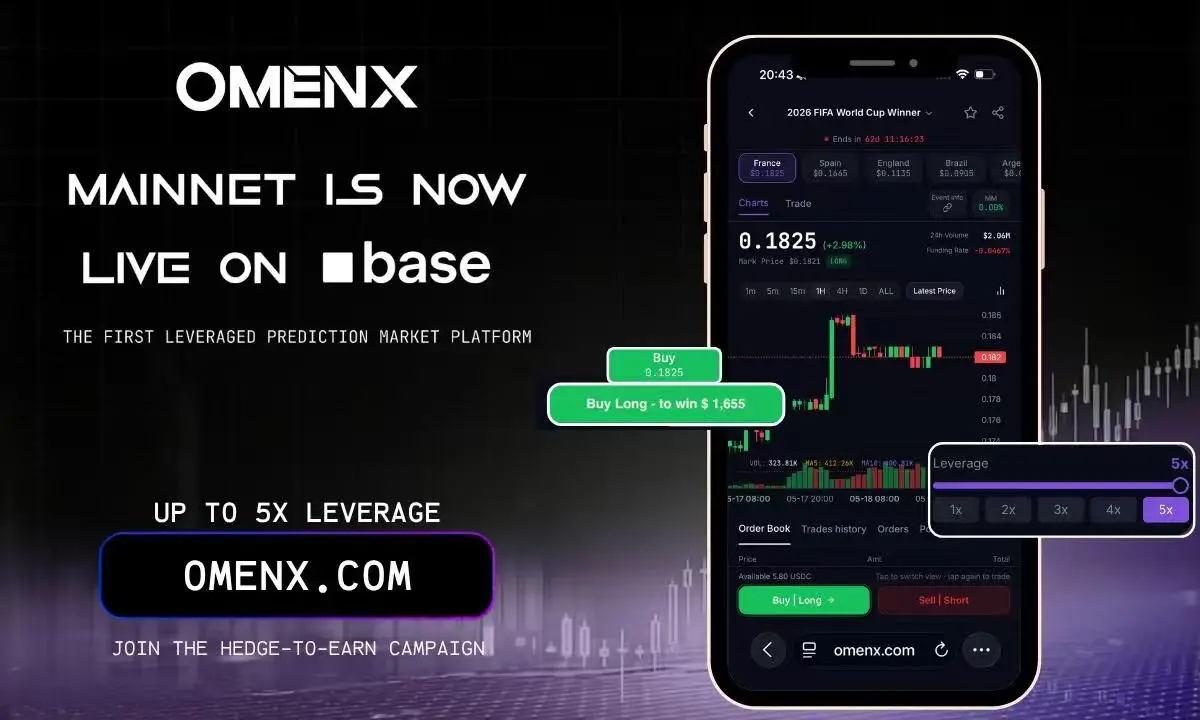
Base-native leveraged prediction market platform OmenX has officially launched on mainnet. It currently supports up to 5x leverage, with plans to increase to 10x based on platform liquidity and market conditions. Unlike traditional prediction markets where users fully collateralize YES/NO positions and wait for settlement, OmenX aims to create a trading platform-like experience. Users can open leveraged positions on event outcomes, and actively trade, adjust, or hedge these positions before the event concludes for greater capital efficiency. Alongside the mainnet launch, OmenX introduced a "Hedge-to-Earn" campaign targeting existing users of other prediction markets (initially Polymarket). This initiative allows users to claim incentives or hedging benefits on OmenX based on their existing positions, aiming to introduce them to leveraged trading and active risk management. OmenX positions itself as a derivatives trading platform for prediction market assets. The team believes that as platforms like Polymarket mainstream prediction markets, event outcomes are becoming a new tradable asset class. The next phase of demand will focus on leverage, liquidity, and advanced trading tools. Post-launch, OmenX plans to expand supported market types, optimize liquidity, and develop APIs and additional trading tools. The team is also in discussions with investors and partners to secure resources for further development.

链捕手05/19 13:35

Base Native Leveraged Prediction Market OmenX Officially Launches on Mainnet

链捕手05/19 13:35

When Computing Power Becomes Commoditized, How Long Until a GPU Futures Market Emerges?

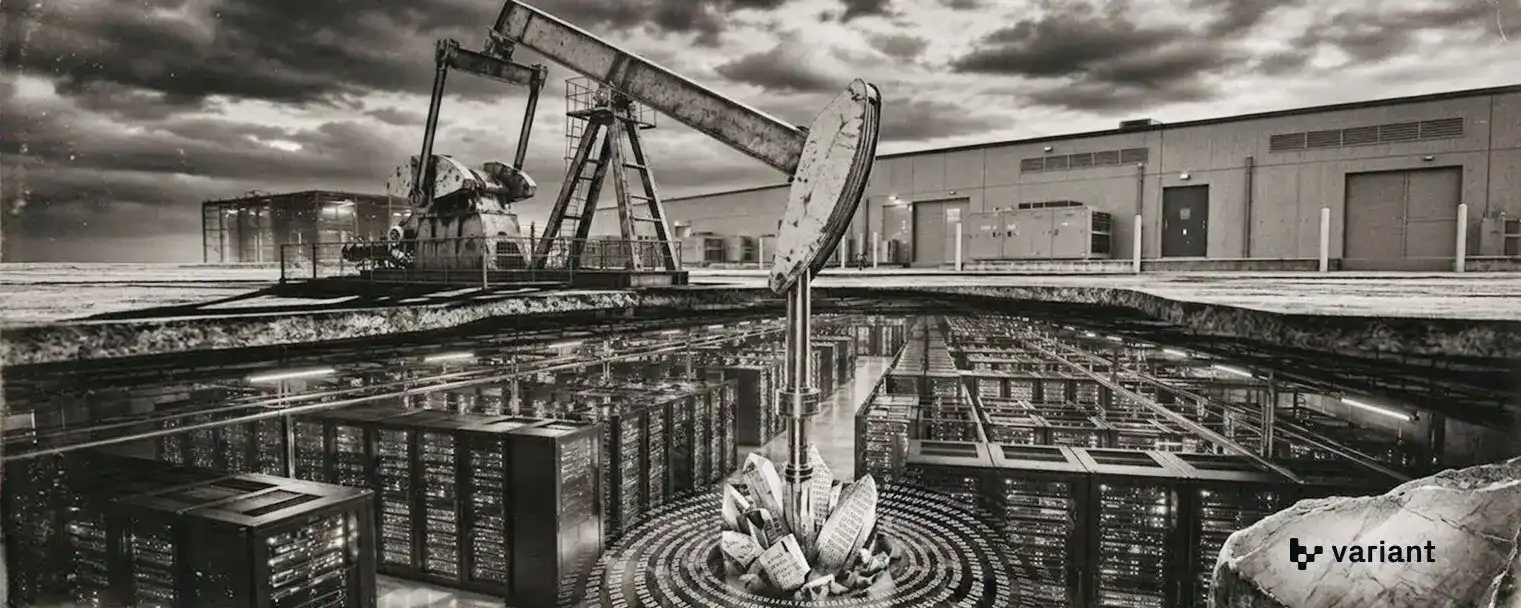
"When Will GPU Futures Arrive? A Framework for Assessing Compute as a Commodity" The article explores the potential for a robust futures market for compute power (GPUs), arguing that such a market is not yet mature but may emerge. It analyzes the landscape using a five-part framework developed for new commodity futures markets. The analysis scores the current state: * **Fragmented Supply (Red)**: Supply is highly concentrated among hyperscale cloud providers (AWS, Azure, GCP, Oracle), limiting the need for price discovery. * **Price Volatility (Green)**: GPU pricing is already highly volatile due to uncertain supply and surging demand. * **Physical Settlement Infrastructure (Green)**: Early infrastructure exists via OTC brokers and price indices (e.g., Ornn, Silicon Data) standardizing contracts. * **Standardized Unit (Red)**: A lack of standardized, tradable units hinders markets; a GPU instance hour varies by region, configuration, and contract terms. * **Lack of Alternatives (Yellow)**: Large players hedge internally via vertical integration, while smaller players bear spot market risk. Overall, the market shows promise (volatility, early infrastructure) but lacks the fragmented supply and standardization needed for large-scale futures trading. Most activity remains OTC. Key open questions and hypotheses: 1. Supply is expected to fragment moderately in 1-2 years, driven by new cloud providers, cheap power locations, and demand from non-frontier labs and AI startups using open-source models. 2. Standardization is most likely to emerge around inference workloads (forecast to be >65% of AI compute demand by 2029), which have simpler, more homogeneous hardware needs than training. Widespread adoption of open-source model weights could accelerate this by democratizing inference and creating demand for optimized, standardized infrastructure. 3. The primary traded unit will likely be the **"chip instance hour"** (akin to electricity, traded regionally), not the physical chip or the downstream AI output (tokens).

marsbit05/18 09:09

When Computing Power Becomes Commoditized, How Long Until a GPU Futures Market Emerges?

marsbit05/18 09:09

When Computing Power Becomes Commoditized, How Long Until a GPU Futures Market?

When Compute is Commoditized: How Far Away is a GPU Futures Market? The article explores the potential emergence of a futures market for computing power ("compute"), akin to markets for commodities like oil or electricity. It uses a five-dimension framework to assess the market's maturity for sustaining robust futures trading. **Current Market Assessment (Scorecard):** * **Supply Fragmentation:** 🔴 **Red.** Supply is highly concentrated, dominated by a few hyperscale cloud providers. * **Price Volatility:** 🟢 **Green.** GPU pricing is already highly volatile. * **Physical Settlement Infrastructure:** 🟢 **Green.** Early infrastructure exists at the OTC/broker level. * **Standardization:** 🔴 **Red.** Compute lacks a standardized, tradable unit (e.g., an H100 hour is not uniform). * **Lack of Substitutes:** 🟡 **Yellow.** Vertically integrated players can hedge internally, while others are forced to be long. **Conclusion:** The overall scorecard suggests a robust futures market is premature. The market has volatility and early settlement infrastructure but lacks the necessary supply fragmentation and standardization for large-scale price discovery. Most activity remains OTC. **Key Unanswered Questions & Hypotheses:** The article posits that the market could evolve in the next 1-2 years: 1. **Supply:** May become *moderately more fragmented* due to new cloud providers, cheaper power locations, and demand from long-tail users (e.g., startups running open-source model inference). 2. **Standardization:** Could emerge from the growing **inference** workload (expected to be >65% of AI compute demand by 2029), which has more homogeneous hardware requirements than custom training workloads. Widespread adoption of **open-source model weights** is seen as a key catalyst for democratizing inference and driving infrastructure standardization. 3. **Traded Unit:** The most viable layer for trading is likely the **"chip-instance-hour"** (powered, usable compute time), traded similarly to electricity in regional contracts with spot/futures overlays. Trading at the upstream "chip" layer is unlikely due to supply concentration, while the downstream "token" layer faces challenges due to lack of uniformity across AI models.

链捕手05/18 09:04

When Computing Power Becomes Commoditized, How Long Until a GPU Futures Market?

链捕手05/18 09:04

How Did Institutions Adjust Their Crypto Asset Holdings in Q1? Who Increased and Who Exited?

The Q1 2026 13F filings reveal a sharply divided picture of institutional activity in crypto assets. Sovereign wealth funds and bank capital increased exposure, while major endowment funds notably de-risked. The most significant buying came from the Abu Dhabi sovereign wealth fund Mubadala, which expanded its position in the iShares Bitcoin Trust (IBIT). JPMorgan Chase dramatically increased its IBIT exposure by 174%, with other global banks like RBC, Scotiabank, and Barclays also adding to Bitcoin ETF holdings, while using options for asymmetric protection. Conversely, the Harvard Management Company (Harvard University's endowment), once a major academic holder, cut its IBIT position by 43% and fully exited a BlackRock Ethereum ETF. The reallocated capital flowed into traditional assets like TSMC, Microsoft, and gold. Other Ivy League endowments showed varied strategies: Brown and Dartmouth maintained Bitcoin positions, with Dartmouth making a nuanced shift by moving Ethereum exposure to a staking ETF and adding a Solana staking ETF to capture yield. Hedge fund Jane Street significantly reduced Bitcoin ETF holdings, locking in profits, while Wells Fargo increased its Ethereum stake. Overall, institutions are deploying traditional capital market tactics—buying, selling, hedging, and rotating—within crypto via spot ETFs. The Q2 reports will be crucial to determine if Harvard's retreat is an outlier or the start of a broader trend among endowments.

marsbit05/18 02:55

How Did Institutions Adjust Their Crypto Asset Holdings in Q1? Who Increased and Who Exited?

marsbit05/18 02:55

Not Speculation but a Necessity: The 4 Unique Values of Prediction Markets

Polymarket's recent $4 billion funding round and soaring valuation of $15 billion highlight the explosive growth of prediction markets, with trading volume reaching $25.7 billion in March 2026—a 10.6% monthly increase. This analysis argues that prediction markets serve critical non-speculative functions, positioning them as essential tools rather than mere gambling platforms. Prediction markets offer four unique values: entertainment consumption, insurance-like protection, risk hedging, and truth discovery. Firstly, they stimulate economic activity by engaging users in event-based betting, similar to the broader sports industry. Secondly, they act as a form of decentralized insurance, allowing users to hedge against specific, well-defined risks (e.g., weather events) transparently and without traditional overhead costs. Thirdly, institutions and individuals use these markets to hedge against geopolitical and commodity price risks, as demonstrated during the U.S.-Iran conflict and the launch of 24/7 commodity markets on platforms like Kalshi. Finally, prediction markets counter media bias by aggregating crowd-sourced information, often achieving 30% higher accuracy than surveys due to users' vested interests. Experts like Bitwise’s Jeff Park and SIG’s Jeff Yass emphasize the markets' role in risk transfer and financial innovation. As these platforms evolve, they are poised to become trillion-dollar markets, offering more reliable, decentralized mechanisms for information pricing and risk management.

marsbit04/21 12:41

Not Speculation but a Necessity: The 4 Unique Values of Prediction Markets

marsbit04/21 12:41

活动图片