# Earnings Related Articles

HTX News Center provides the latest articles and in-depth analysis on "Earnings", covering market trends, project updates, tech developments, and regulatory policies in the crypto industry.

Rubin Takes the Reins: Can Nvidia Break the Curse of Post-Earnings Slumps?

NVIDIA is set to announce its FY2027 Q2 earnings after market close on August 26. As a bellwether for AI investments, market sentiment is unusually divided. While strong results are expected, investors are wary of a post-earnings stock drop, a pattern seen for the last four consecutive quarters. The key variable this time is the market debut of the new Vera Rubin platform. Despite beating expectations consistently, NVIDIA's stock has fallen after each of its last four earnings reports. This "sell the news" trend reflects diminishing "expectation gaps," where future growth is already priced in. The immediate focus is now on the company's Q3 revenue guidance, particularly its first quantitative outlook for Rubin platform sales. The Vera Rubin platform promises a generational leap, especially in inference workloads, reportedly delivering up to 10x lower token cost compared to the previous Blackwell generation. This significant efficiency gain is seen as NVIDIA's strategic defense against growing competition from custom AI chips developed by major cloud customers. Analysts project Rubin could contribute 12% of GPU revenue in Q3, potentially rising to over 40% in Q4, driven by faster ramp-up due to infrastructure compatibility with previous systems. However, risks remain. Supply chain checks indicate potential production delays, and initial bring-up and testing cycles could impact the rollout schedule. Furthermore, rising memory and component costs pose a threat to NVIDIA's industry-leading gross margins, which are a critical metric for investors. The company's financial involvement in funding customer data centers, as seen with OpenAI, also introduces a new variable regarding future capital allocation and risk. In summary, this earnings report hinges on three main points: 1) Q3 revenue guidance, specifically the contribution from Rubin, 2) the ability to maintain gross margins near 75% amidst cost pressures, and 3) management's commentary on the demand outlook, particularly for the Chinese market. A strong Rubin outlook coupled with stable margins could break the post-earnings decline pattern. Otherwise, the "sell the news" trend might continue for a fifth quarter.

marsbit08/26 00:56

Rubin Takes the Reins: Can Nvidia Break the Curse of Post-Earnings Slumps?

marsbit08/26 00:56

Goldman Sachs Research Report Analysis: 135% Profit Growth in Q2, APAC Valuations Fall to a Decade Low

Goldman Sachs Asia Pacific Market Report Summary (Aug 21, 2026) Earnings soared 135% YoY in Q2 for the MXAPJ index, with 46% of companies beating expectations, led by the Information Technology sector (+390% YoY). Despite this robust profit growth, the index's forward P/E of 11x sits 2 standard deviations below its 10-year average, indicating deep valuation discount. Market sentiment remains cautious, as seen in hedge fund leverage for Asian long/short funds dropping to a one-year low. While China saw net buying in August, its allocation remains near five-year lows, and foreign investors withdrew $1.5bn from EM Asia ex-China markets. The valuation gap is attributed to market pessimism on future growth, not aligning with consensus EPS growth forecasts of 71% for 2026 and 24% for 2027. The upcoming MSCI index rebalancing is expected to trigger approximately $42bn in total two-way passive fund flows. Leveraged ETF flows in Korea and Taiwan show signs of cooling, suggesting a reduction in crowded long positions. Goldman Sachs' core trades include long positions in stocks with strong earnings revisions and AI infrastructure/semiconductors. Key downside risks are rising long-term US bond yields, heightened geopolitical tensions, and a slower-than-expected Chinese economic recovery. The firm maintains a 12-month target of 1080 for MXAPJ, implying 21% upside.

marsbit08/24 06:01

Goldman Sachs Research Report Analysis: 135% Profit Growth in Q2, APAC Valuations Fall to a Decade Low

marsbit08/24 06:01

MSX US Stock Daily Observation: Alibaba FY2027 Q1 Earnings: AI Cloud Revenue Growth Hits Record High, AI Cloud Achieves Profitable Closed Loop

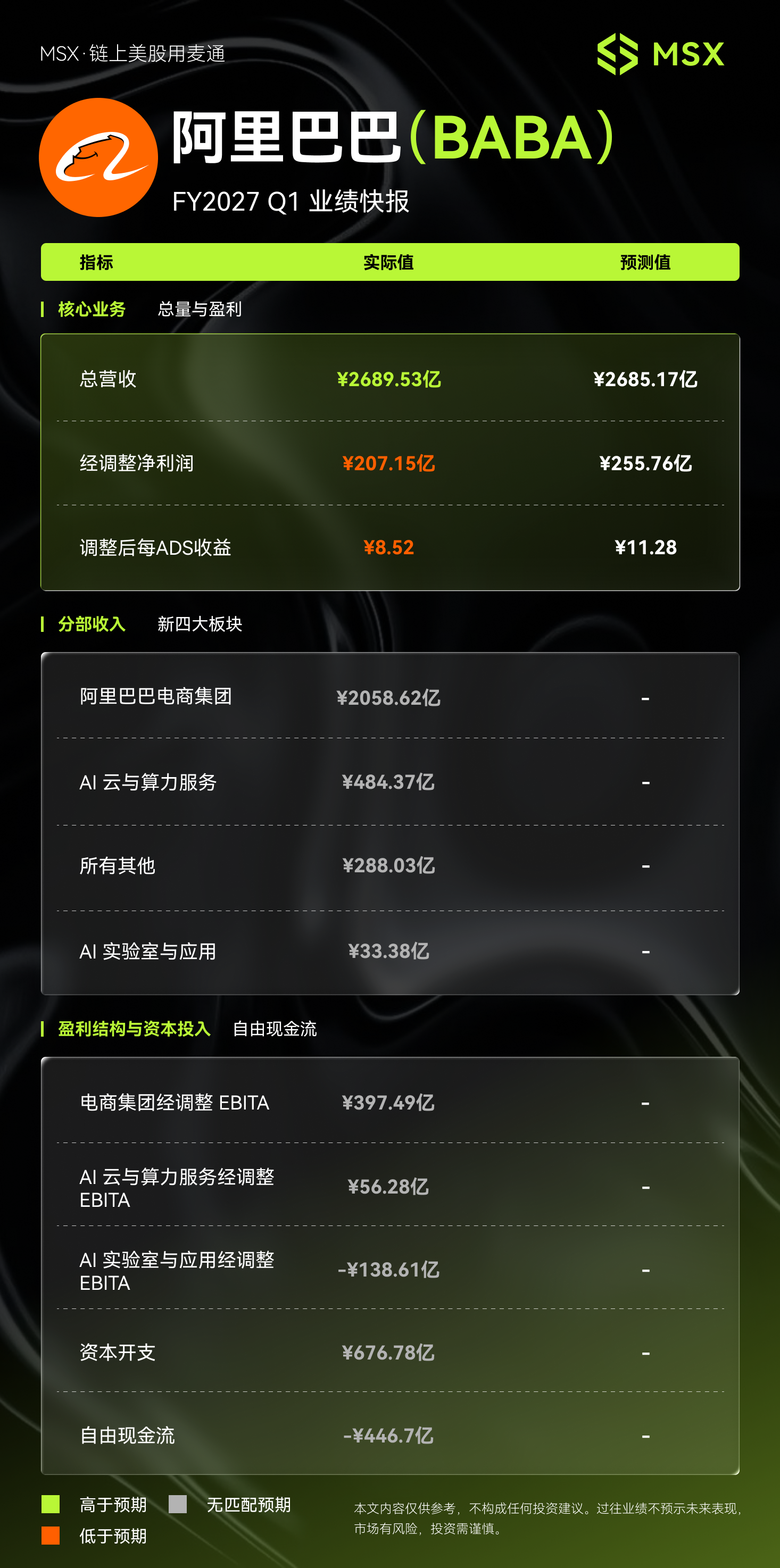
**MSX Daily US Stock Watch: Alibaba FY2027 Q1 Earnings – AI Cloud Revenue Hits Record Growth, Achieves Profitability Milestone** Alibaba's Q1 FY2027 revenue slightly exceeded expectations at 268.9B yuan (+9% YoY). However, adjusted net profit of 20.7B yuan (-38% YoY) and adjusted EPS missed consensus significantly. This shortfall was primarily driven by increased AI investments and two one-time items: a 5.5B euro provision for an EU Digital Services Act fine and 4.46B yuan in goodwill impairment. The restructured business segments showed clear divergence. The standout performer was the AI Cloud & Computing Services unit, with revenue surging 45% YoY to 48.44B yuan. Crucially, its adjusted EBITA jumped 133% YoY to 5.63B yuan, with margins expanding to 12%, signaling a profitable commercial loop for AI infrastructure. Within the Commerce Group, revenue growth was mixed: China Local Services (instant retail) grew 45% to 53.3B yuan, largely offsetting an 8% decline in Traditional China Commerce (110.9B yuan). International commerce revenue fell 1%. Despite this, the Commerce Group's adjusted EBITA dipped only 1% YoY to 39.75B yuan. A key area to watch is cash flow. Capital expenditures soared 75% YoY to 67.68B yuan, turning free cash flow to a net outflow of 44.67B yuan. However, operating cash flow remained positive and grew 11% YoY to 22.95B yuan, indicating the cash burn is a strategic choice for AI capacity build-out rather than operational weakness. In summary, while headline profits were pressured by heavy AI spending and one-off charges, the core takeaway is the emerging profitability of the AI Cloud business. The success of Alibaba's current investment cycle hinges on whether the profit improvement in AI Cloud can outpace the depreciation costs of its massive computing infrastructure expansion.

Odaily星球日报08/21 06:41

MSX US Stock Daily Observation: Alibaba FY2027 Q1 Earnings: AI Cloud Revenue Growth Hits Record High, AI Cloud Achieves Profitable Closed Loop

Odaily星球日报08/21 06:41

US Stock Market Trends (August 21): Long-Term Bond Repo Fails, Walmart's Warning Drags Dow Down 700 Points

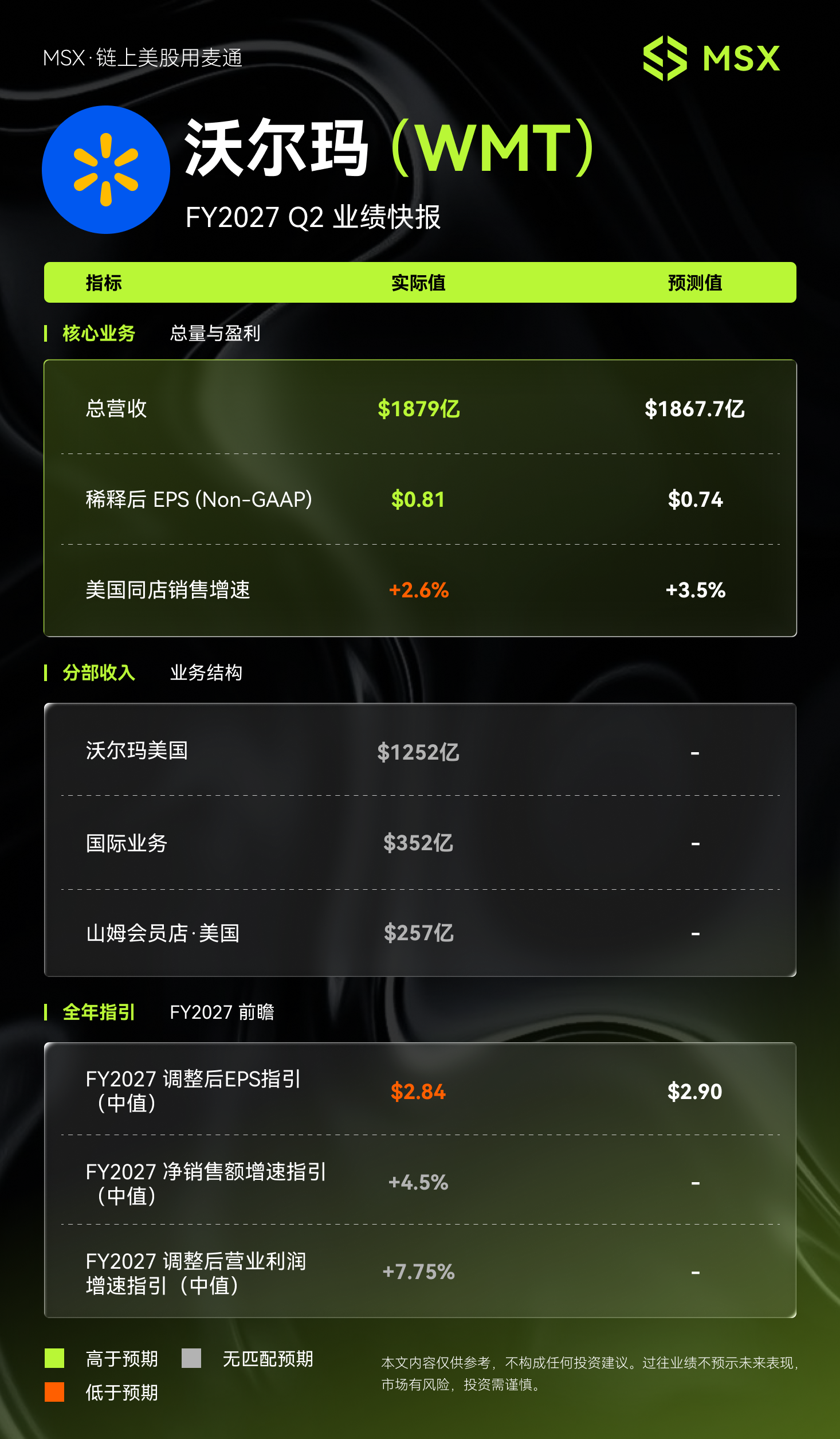
**U.S. Market Trends (Aug 21): Long-Term Bond Relief Fizzles, Walmart Drags Dow Down 700 Points** U.S. stocks fell sharply, with the Dow plunging over 700 points, as relief from the Treasury's long-term bond buyback plan proved fleeting. Major indexes declined as long-end Treasury yields and oil prices resumed their upward climb, reigniting inflation fears and pressure on high-valuation assets. The key catalyst was the rapid reversal in the bond market. The Treasury's expanded buyback program briefly calmed markets, but 30-year yields quickly rebounded near 5.26%, approaching recent 20-year highs. This signaled that liquidity interventions cannot overcome structural pressures from massive U.S. debt, fiscal deficits, and competing capital demands from AI infrastructure spending. Simultaneously, rising oil prices (WTI +2.3%) on geopolitical tensions renewed inflation concerns, squeezing consumer spending power. This pressure was highlighted by Walmart's 9% stock plunge. Despite beating earnings estimates, its weak U.S. same-store sales growth and lowered annual guidance exposed caution among lower-income consumers. Tech stocks faced broad pressure. The "Magnificent Seven" giants broadly declined, with Moderna crashing over 23% a day after a massive rally on vaccine trial news, exemplifying swift profit-taking. However, select semiconductor names (e.g., Marvell, Micron) gained on specific AI-related catalysts, indicating a more discerning market moving beyond hype to scrutinize real cash flows and capital expenditure sustainability. Bitcoin surged past $72,000, while gold seesawed near $4,500/oz. Alibaba's earnings showed strong AI cloud revenue growth but significant cash outflow due to infrastructure investments. The market's core takeaway is that Treasury actions provide only temporary relief, not a trend reversal. Focus now shifts to whether long-term yields can stabilize below 5.3% and to upcoming Federal Reserve commentary for clues on the rate path. Sustainable equity recovery hinges on the bond market calming and major tech stocks showing concurrent strength.

marsbit08/21 02:01

US Stock Market Trends (August 21): Long-Term Bond Repo Fails, Walmart's Warning Drags Dow Down 700 Points

marsbit08/21 02:01

活动图片