# Earnings Related Articles

HTX News Center provides the latest articles and in-depth analysis on "Earnings", covering market trends, project updates, tech developments, and regulatory policies in the crypto industry.

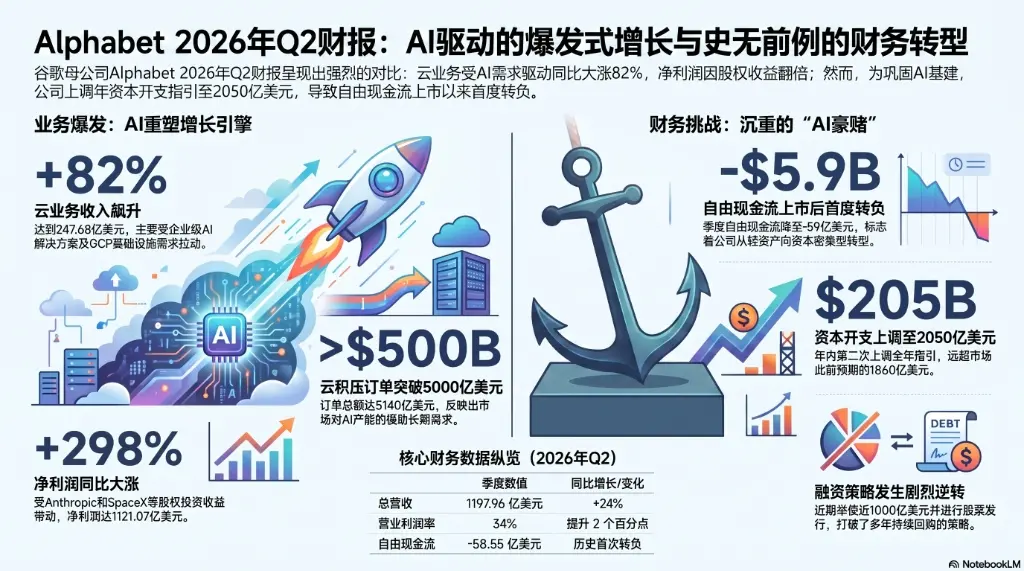
Google's earnings report is bright enough, so why isn't Wall Street buying it?

Google's parent company, Alphabet, reported strong Q2 2026 results with revenue of $119.8 billion (up 24% YoY) and operating profit of $40.8 billion (up 30% YoY). Its Google Cloud segment was a standout, with revenue surging 82% to $24.77 billion. However, despite these positive figures, the company's stock fell nearly 3% in after-hours trading. The market's negative reaction stems from concerns over the massive costs of competing in the AI era. Alphabet's capital expenditures hit $44.9 billion in Q2, and its full-year 2026 Capex guidance was raised to $195-$205 billion. This intense spending on AI infrastructure (servers, data centers) caused Alphabet's free cash flow to turn negative for the first time, at -$5.855 billion. While Google Cloud's rapid growth demonstrates some return on AI investments, its ~$100 billion annualized revenue is still overshadowed by the nearly $200 billion in annual Capex. Investors are questioning how long it will take for these enormous investments to translate into sustainable, profitable growth. Furthermore, doubts persist about the competitiveness of Google's core Gemini AI model, especially after reported delays. The market is shifting its focus from sheer AI spending to which company can most effectively monetize its investments. For Google, the challenge is to prove its "full-stack AI" strategy can deliver long-term value that justifies the current financial strain.

Odaily星球日报07/27 12:19

Google's earnings report is bright enough, so why isn't Wall Street buying it?

Odaily星球日报07/27 12:19

A 'Difficult Midsummer' for Stock Market Bulls: $100 Oil, AI Backlash, and Tariff Resumption

Global equities face a triple threat this summer: surging oil prices, a burgeoning AI capex crisis, and resurgent tariffs, pressuring the core pillars of the current bull market. Brent crude topped $100/barrel amid Middle East and Red Sea supply disruptions, while proposed U.S. tariffs fueled inflation fears, pushing the 10-year Treasury yield to 4.66%. Simultaneously, the tech rally faltered as Alphabet's steep AI capex hike sparked concerns over returns, dragging down mega-caps and contributing to a weekly S&P 500 decline. The "Goldilocks" narrative of resilient profits, controlled inflation, and endless AI expansion is cracking. Rising oil prices threaten to reignite persistent inflation, forcing a repricing of interest rate risks. In tech, massive debt-fueled AI investments are facing investor scrutiny as higher rates raise the required return threshold. Fears are growing that the AI spending boom may be unsustainable, especially with moves toward cheaper, open-source models. Next week brings a crucial test with key central bank meetings and earnings from major tech firms like Microsoft and Apple. Technical indicators are deteriorating, with selling pressure mounting and assets like gold and the dollar gaining on避险 sentiment. Analysts warn that elevated valuations and compressed risk premiums leave markets vulnerable, with significant potential downside if the current headwinds persist.

链捕手07/27 10:35

A 'Difficult Midsummer' for Stock Market Bulls: $100 Oil, AI Backlash, and Tariff Resumption

链捕手07/27 10:35

Intel Data Center Revenue Soars 59%, CEO Chan: CPU Demand 'Taking Off', Supply Can't Keep Up

Intel Reports Strong Q2 2026 Results, Led by Surging Data Center Revenue Intel demonstrated a robust recovery, posting second-quarter revenue of $16.1 billion, a 25% year-over-year increase—its highest growth rate since 2011. On a non-GAAP basis, net income was $2.2 billion, with earnings per share of $0.42, far exceeding analyst expectations. A key highlight was the performance of the Data Center and AI (DCAI) business, where revenue soared 59% to $6.3 billion, significantly outperforming overall company growth. CEO Patrick Gelsinger noted that "CPU demand is taking off" in the data center segment, with demand outpacing the company's growing supply capacity. This supply-demand dynamic has granted Intel renewed pricing power, with server CPU prices in China reportedly rising over 40% since the start of 2026. The company has secured ten long-term supply agreements with customers. The Client Computing Group (CCG), which includes PC chips, saw revenue grow 13% to $8.9 billion. Intel Foundry revenue grew 31% to $5.8 billion and achieved a milestone by signing its first named external customer, cybersecurity firm Fortinet. The company reported strong progress on its Intel 18A manufacturing process, with yields improving approximately 7% per month. To support future growth, Intel raised its full-year 2026 capital expenditure forecast from $18 billion to $20 billion, including a $5.7 billion investment to expand manufacturing capacity for its Xeon processors. For the third quarter, Intel provided optimistic guidance, projecting revenue between $15.8 billion and $16.8 billion and non-GAAP EPS of approximately $0.38, both above analyst estimates. Following the earnings release, Intel's stock rose about 11% in after-hours trading.

链捕手07/24 07:07

Intel Data Center Revenue Soars 59%, CEO Chan: CPU Demand 'Taking Off', Supply Can't Keep Up

链捕手07/24 07:07

BIT Trading Moment: BTC Still Suppressed by Weekly 200 EMA, Rejection May Restart Decline; Storage and Semiconductors that Surged Last Night Begin Falling in Evening Trading

**Crypto & Stock Market Wrap: Bitcoin Tests Resistance, Stocks Retreat After AI Surge** Bitcoin consolidates around $66,000, facing key resistance near $68,000—an area seen as a major psychological and technical hurdle where previous rallies have failed. Analysts note the cryptocurrency is caught between its 200-week moving average (~$63,333) and 200-week EMA (~$68,328). A clear break above $68k is needed to signal a stronger bullish trend, while a rejection could lead to a retest of $63k support. Market sentiment remains cautious, with low futures open interest pointing to a low-liquidity rebound rather than a full bull market. Bitcoin spot ETFs saw another $203 million inflow. US stock futures pointed lower after a strong Tuesday session led by a massive rebound in semiconductors and memory stocks. The rally was fueled by renewed optimism about AI-driven hardware demand, with Micron, SanDisk, and SK Hynix surging. However, those gains reversed in pre-market trading. Super Micro Computer (SMCI) soared over 20% after hours on strong guidance and a record backlog. Other standouts included Rocket Lab and nuclear energy plays Oklo and X-Energy. Rising oil prices (Brent above $91) and climbing Treasury yields (10-year near 4.64%), however, are reigniting inflation concerns and acting as a headwind for equities. In Asia, markets were mixed. South Korea's KOSPI pared early gains to close slightly higher as semiconductor stocks like SK Hynix gave back initial surges. Japan's Nikkei edged lower as the yen hit a fresh 38-year low against the dollar, raising fears of potential market intervention. Key events to watch include the Samsung Galaxy launch, AMD's AI event, and a slew of major tech earnings from Alphabet, Tesla, and IBM after the close on Wednesday, followed by the ECB meeting and Intel's earnings on Thursday.

marsbit07/22 08:28

BIT Trading Moment: BTC Still Suppressed by Weekly 200 EMA, Rejection May Restart Decline; Storage and Semiconductors that Surged Last Night Begin Falling in Evening Trading

marsbit07/22 08:28

U.S. Tech Momentum Stocks Record Largest Single-Day Gain Ever, but Has the Rout Ended?

U.S. tech momentum stocks staged a dramatic rebound on Tuesday, July 21st. Key momentum indices like the Morgan Stanley TMT Momentum Factor and Goldman Sachs' High Beta Momentum Long Index posted historic or near-historic single-day gains, fueled largely by semiconductor stocks. This sharp rally followed a severe three-day sell-off that saw momentum stocks plunge 33%, marking one of the steepest pullbacks since the dot-com bubble. Analysts attribute the bounce primarily to a short squeeze, as forced covering from over-leveraged traders, particularly in Asia, created a buying spiral. However, the rally's health is questioned due to weak market breadth—overall trading volume was low, and decliners outnumbered advancers in the S&P 500 despite the index's gain—suggesting a narrow, concentrated surge rather than broad recovery. Opinions on the sustainability diverge. BTIG strategists warn the rebound has hit key resistance levels, citing extreme volatility and historic stock dispersion as signs of an ongoing broader correction, and recommend selling into strength. Conversely, Goldman Sachs and UBS view the aggressive momentum unwinding as nearing its end, noting reduced positioning and a lack of new fundamental catalysts. They suggest the sell-off presents a selective opportunity to add exposure, albeit cautiously and gradually using defined-risk strategies. The immediate trajectory hinges on the ongoing earnings season, with market focus on Alphabet's capital expenditure guidance for AI investment clarity. Meanwhile, bond markets present a risk, with rising Treasury yields—potentially heading toward 5.5%—and widening credit spreads for mega-cap tech companies posing a threat to equity valuations. The combination of technical factors, earnings results, and macro conditions leaves the durability of the rebound in doubt.

链捕手07/22 01:05

U.S. Tech Momentum Stocks Record Largest Single-Day Gain Ever, but Has the Rout Ended?

链捕手07/22 01:05

Citi's Interpretation: Upgrading China, Downgrading South Korea, Is the Emerging Markets Rally Beginning to Broaden?

In its latest emerging markets strategy report, Citi has upgraded China to overweight from neutral, while downgrading South Korea to neutral from overweight. It maintains an overweight rating for China-Taiwan markets. The report sets MSCI EM index targets of 1870 by end-2026 and 2050 by mid-2027, implying further upside of approximately 12% and over 20% respectively from current levels. Citi's move reflects a search for "broadening" opportunities beyond the concentrated rally in AI hardware and tech, which has driven EM gains year-to-date, led by South Korea and China-Taiwan markets. The upgrade for China is based on factors including light investor positioning, potential benefits from lower oil prices, and relative attractiveness in a recovering global growth cycle. While maintaining a strong long-term view on South Korea, Citi notes its recent outperformance and elevated volatility prompted a tactical downgrade. The report highlights that EM earnings revisions remain narrow, with the IT sector contributing about 85% of 2026 EPS estimate upgrades. For a sustained rally, Citi argues that market gains need to broaden to other sectors and regions. China, South Africa, and Mexico rank highly as potential "broadening candidates" based on factors like sensitivity to a weaker dollar, lower bond yields, and oil prices. Key uncertainties include the sustainability of AI capital expenditure returns, geopolitical risks, and Federal Reserve policy. Citi's stance is cautiously optimistic, suggesting the rally has room to broaden rather than signaling a confirmed broad-based EM bull market. The path to higher index targets depends on whether non-tech earnings revisions improve and if capital rotates from concentrated winners into a wider set of markets.

marsbit07/20 10:12

Citi's Interpretation: Upgrading China, Downgrading South Korea, Is the Emerging Markets Rally Beginning to Broaden?

marsbit07/20 10:12

活动图片