Citi's Interpretation: Upgrading China, Downgrading South Korea, Is the Emerging Markets Rally Beginning to Broaden?

marsbitPublished on 2026-07-20Last updated on 2026-07-20

Abstract

In its latest emerging markets strategy report, Citi has upgraded China to overweight from neutral, while downgrading South Korea to neutral from overweight. It maintains an overweight rating for China-Taiwan markets. The report sets MSCI EM index targets of 1870 by end-2026 and 2050 by mid-2027, implying further upside of approximately 12% and over 20% respectively from current levels. Citi's move reflects a search for "broadening" opportunities beyond the concentrated rally in AI hardware and tech, which has driven EM gains year-to-date, led by South Korea and China-Taiwan markets. The upgrade for China is based on factors including light investor positioning, potential benefits from lower oil prices, and relative attractiveness in a recovering global growth cycle. While maintaining a strong long-term view on South Korea, Citi notes its recent outperformance and elevated volatility prompted a tactical downgrade. The report highlights that EM earnings revisions remain narrow, with the IT sector contributing about 85% of 2026 EPS estimate upgrades. For a sustained rally, Citi argues that market gains need to broaden to other sectors and regions. China, South Africa, and Mexico rank highly as potential "broadening candidates" based on factors like sensitivity to a weaker dollar, lower bond yields, and oil prices. Key uncertainties include the sustainability of AI capital expenditure returns, geopolitical risks, and Federal Reserve policy. Citi's stance is cautiously optimis...

According to Citi's latest Emerging Markets Strategy report, the bank has upgraded its stance on China equities from Neutral to Overweight, while tactically downgrading South Korea from Overweight to Neutral. It maintains an Overweight on Taiwan-China markets and sets target levels for the MSCI EM Index at 1870 by the end of 2026 and 2050 by mid-2027.

The most immediate market hook of this report is that despite the MSCI EM Index rising approximately 20% year-to-date, Citi still sees room for further upside. From the current level of around 1664 points, 1870 points implies about 12% upside, while the 2050 point target suggests around 20% potential gains by mid-2027.

However, Citi is not betting on a broad-based emerging markets bull run. Gains in EM have been highly concentrated in South Korea, Taiwan-China tech, and the AI hardware supply chain recently, with other countries and sectors not keeping pace. China's upgrade to Overweight stems from Citi beginning to look for 'broadening' candidates beyond the AI chain.
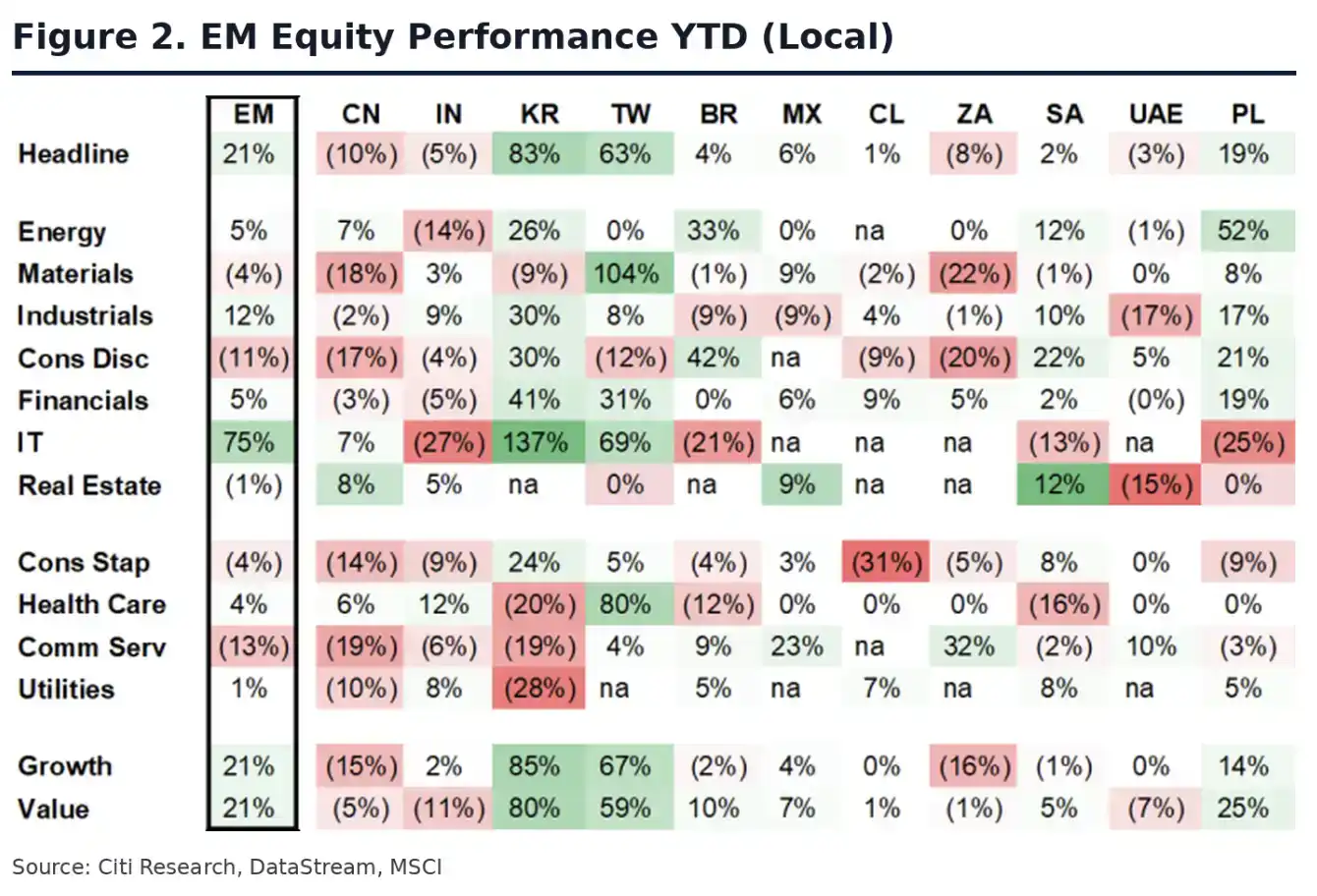
South Korea has delivered nearly 40% positive returns, and Taiwan-China markets over 30%, highlighting the high concentration of this year's EM rally.
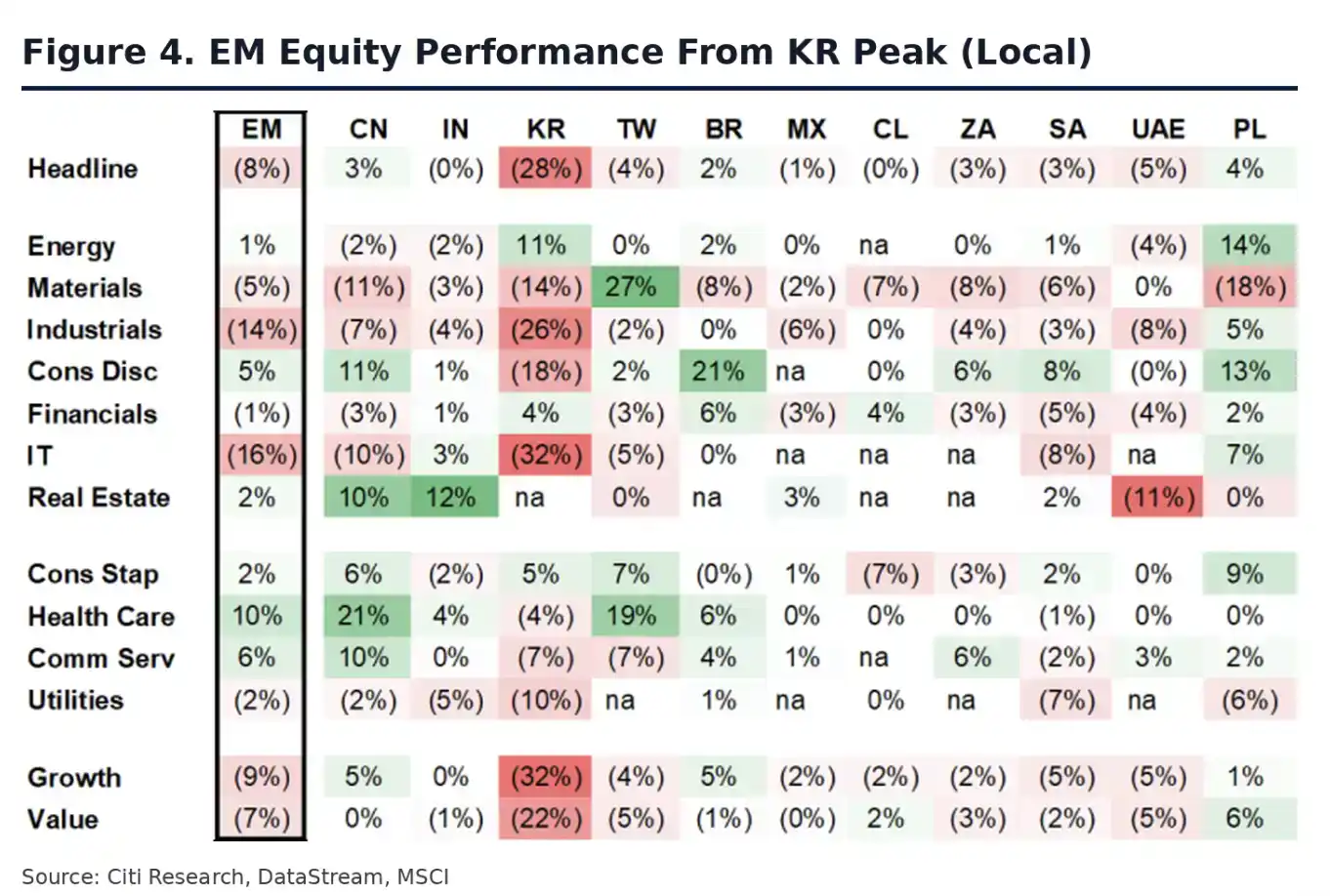
South Korea's pullback and the lack of comprehensive follow-through from other markets.

China Upgraded to Overweight, South Korea Cools Off First

In this round of allocation adjustments, China was upgraded from Neutral to Overweight, and Mexico was raised to Neutral. South Korea was downgraded from Overweight to Neutral, while Taiwan-China markets remain on the Overweight list.

China's appeal primarily stems from three factors. Global investors remain underweight on Chinese stocks, leaving significant room for capital inflows if global risk appetite improves. Falling oil prices benefit energy-importing markets like China. As global growth data improves, some cyclical assets regain support, with China ranking relatively high among macro-sensitive markets in this cycle.

This contrasts with the dominant theme in emerging markets over the past two years. The strongest trades were previously concentrated in the AI hardware supply chain, with South Korea and Taiwan-China markets being the biggest winners due to demand for semiconductors, memory, and AI servers. However, for the index to continue rising, relying solely on a few tech stocks becomes increasingly difficult, requiring funds to find more markets capable of sustaining the rally.

South Korea's downgrade does not equate to a weakening fundamental outlook. Public reports indicate that Citi retains a relatively strong long-term view on the South Korean equity market, with local strategists having previously set a KOSPI target of 10,000 points. According to the source report, the logic includes the potential for memory shortages to persist into 2027, and continued demand growth from AI tokens and customization supporting the memory upcycle. The near-term issue lies in South Korea's outsized prior gains, elevated implied volatility, and the amplification of fluctuations by retail leveraged products.

Taiwan-China markets remain one of the most direct beneficiaries within the AI hardware chain. According to the source report, local strategists have set a mid-2027 target for the Taiwan Weighted Index at 53,500 points. However, this market faces similar issues – trading has become crowded, and volatility often manifests first in these prior winners if greater skepticism emerges regarding the returns on AI capital expenditure.

EM Has Room to Run, Yet Earnings Revisions Remain Narrow

The two specific index targets set by Citi for MSCI EM are the clearest numerical calls in this report: 1870 by end-2026 and 2050 by mid-2027.

The support does not come from significant valuation expansion. The current 12-month forward P/E for MSCI EM is around 11.5x, roughly in line with its long-term average. Following this year's rally in emerging markets, valuations have not been pushed into a clear bubble zone; index gains have come more from improved earnings expectations.

The earnings numbers appear robust. The 2026 EPS growth forecast for MSCI EM reaches 63%, revised up by 28 percentage points cumulatively since late February. Growth is expected to moderate to 24% in 2027, but still remains above comparable assets in developed markets.

The issue is that the source of earnings improvement remains narrow. The Information Technology sector contributed about 85% of the 2026 EPS upward revisions, with South Korean and Taiwan-China AI supply chains still being the primary sources. Revisions for most non-tech sectors like Consumer, Real Estate, and Utilities remain weak. In other words, while the EM index appears supported by earnings on the surface, the upward earnings revisions have not yet broadened out to more industries.
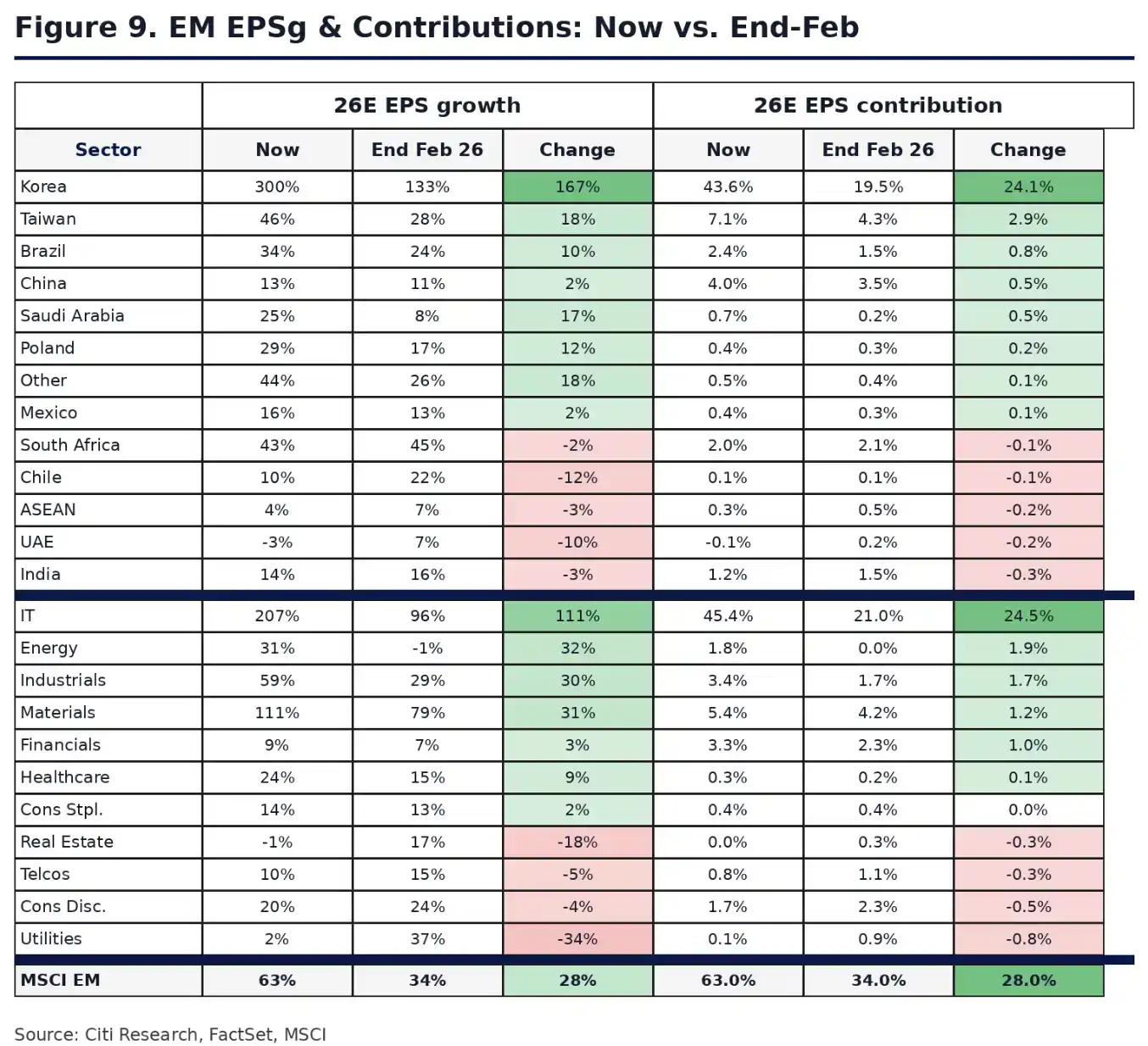
MSCI EM 2026E EPS growth of 63%, with the IT sector contributing roughly 85% of the upward revision magnitude.

This is also why Citi has not upgraded Emerging Markets to an Overweight stance within its global asset allocation framework. It can increase weights to markets like China within the region, but at the global asset allocation level, Emerging Markets remains Neutral. Citi's stance is closer to 'selectively adding exposure to broadening beneficiaries' rather than confirming a full-blown bull market.

The So-Called 'Broadening' Means Momentum Needs to Move Beyond a Few AI Winners

In plain terms, what Citi refers to as 'broadening trades' means this year's emerging market rally cannot continue to rely solely on gains in South Korea, Taiwan-China markets, and the AI chain. Funds either need to find new countries and sectors, or the index's further upside will be constrained.

This screening framework primarily looks at several conditions: whether a market benefits from a weaker US Dollar and declining US Treasury yields, whether it benefits from falling oil prices, its historical performance during improvements in global economic data, whether its near-term earnings revisions are turning positive, and whether its current trading is already too crowded.

Under this framework, China, South Africa, and Mexico rank high. According to the source report, their composite scores in the 'broadening candidate' screen are 4.2, 5.0, and 5.3 respectively. While South Korea and Taiwan-China markets remain recent winners, they face more pronounced issues of near-term crowding and volatility.

Oil prices present a real-world condition. Citi's baseline assumption is that oil averages around $75/barrel in Q3 2026, declining to around $65/barrel by early 2027. Falling oil prices typically benefit energy-importing markets like South Korea, Taiwan-China, India, and China, while posing challenges for some resource-heavy and oil-sensitive markets.
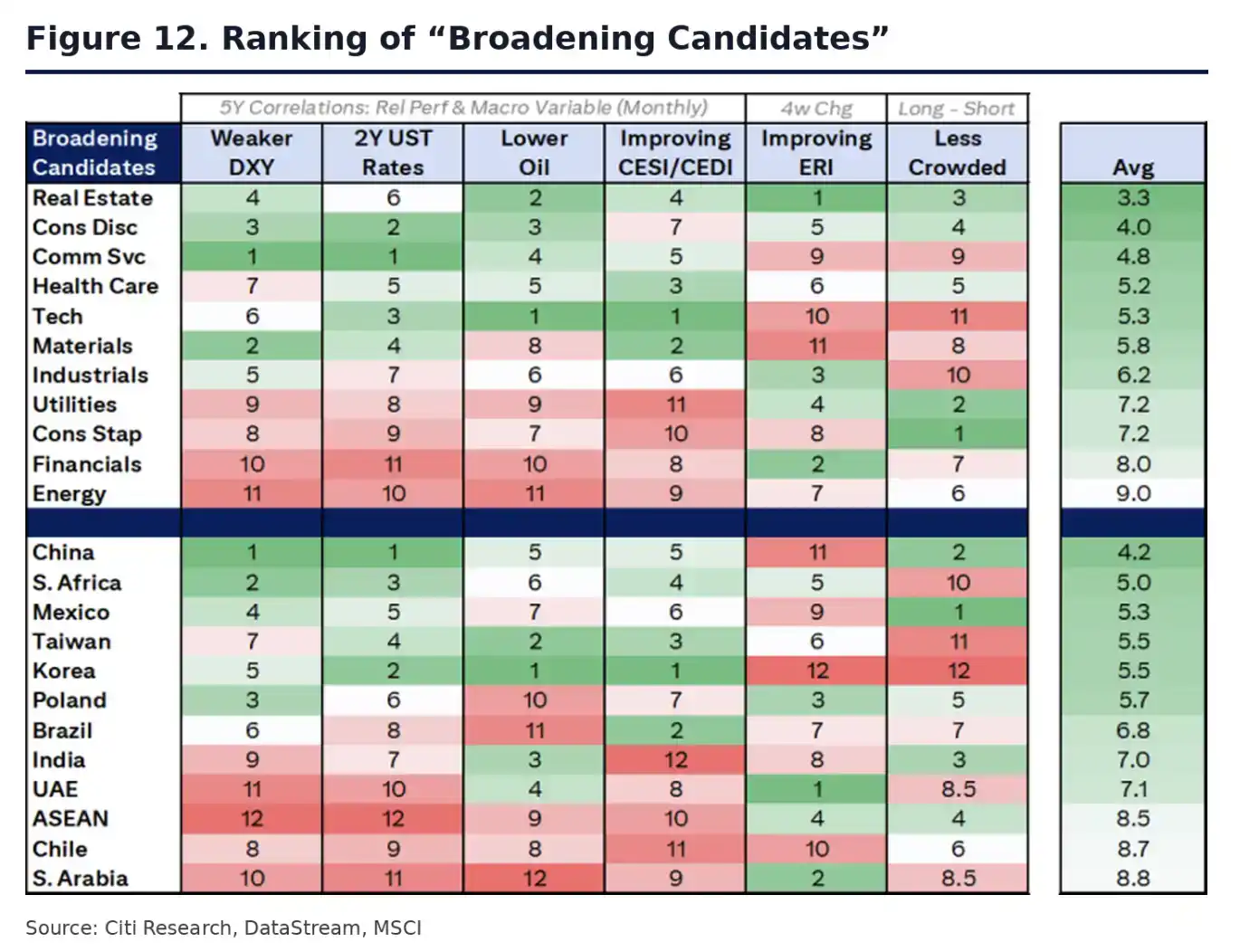
The 'Broadening Candidates' table shows China, South Africa, and Mexico ranking high across dimensions including weak USD, US Treasury yields, oil prices, and crowding.

This context is key to China's upgrade. It is neither this year's strongest performer nor the most crowded trade within the AI hardware chain. However, under the combination of improving global growth, declining oil prices, and room for positioning catch-up, it possesses the conditions to attract rotational flows.

Broadening Not Yet Complete; AI Chain Remains the Biggest Divergence

The cautious aspect of this report is that Citi does not present 'broadening' as an accomplished fact.

This year's EM gains are highly concentrated, with cross-market return dispersion reaching levels among the highest in the past 25 years. South Korean and Taiwan-China tech/AI sectors have contributed almost all the index-level returns. If future earnings revisions remain confined to the IT sector, the so-called broadening looks more like a short-term portfolio rotation rather than a broad-based fundamental improvement.

AI capital expenditure remains the greatest uncertainty. Previously, the market was willing to assign higher expectations to memory, semiconductors, and AI infrastructure due to sustained demand for training and inference pushing compute investment. However, if investors begin to question the returns on this capital expenditure, the prior winners like South Korea and Taiwan-China could face greater pressure.

Macro risks have not disappeared. Renewed geopolitical escalation could push oil prices away from the downward scenario. Fed policy remains a point of divergence; if rate cuts fall short of expectations, the US Dollar and Treasury yields could pressure emerging markets. A potential super El Niño could also bring new inflationary pressures.
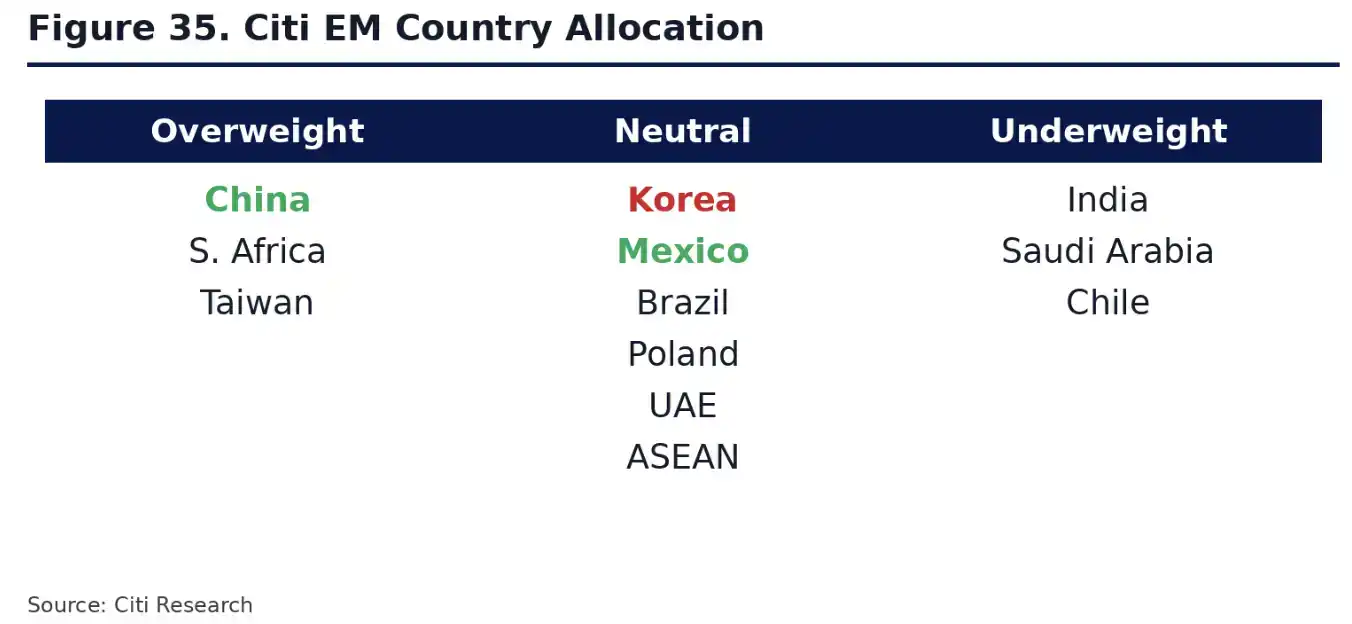
Citi's EM country allocation table shows Overweight positions in China, South Africa, and Taiwan-China markets, with South Korea downgraded to Neutral.

Citi's judgment on emerging markets is more akin to 'the rally has the potential to broaden' rather than 'a full-blown bull market is already confirmed.' China was upgraded because it offers better risk-reward in this potential broadening trade. South Korea was cooled off, indicating that prior winners are not necessarily incapable of further gains, but that their short-term gains and volatility have diminished their near-term appeal.

Whether MSCI EM can reach 1870 or even 2050 points depends not only on how much further the AI chain can rise but also on whether non-tech sector earnings can halt their downward revisions, whether the global cyclical improvement can be sustained, and whether funds are genuinely willing to flow from the few winners to a wider range of markets.


Trending Cryptos

Related Questions

QWhat were the main changes made by Citi in its emerging market strategy report regarding China and South Korea?

ACiti upgraded China from neutral to overweight and tactically downgraded South Korea from overweight to neutral.

QWhat are the two price targets set by Citi for the MSCI EM Index, and what do they imply in terms of upside?

ACiti set a target of 1870 points for the MSCI EM Index by the end of 2026 and 2050 points by mid-2027. From the current level of approximately 1664 points, this implies an upside of about 12% and 20% respectively.

QWhat is the 'broadening' trade that Citi refers to in the context of emerging markets?

AThe 'broadening' trade refers to the potential for market gains to spread beyond the concentrated winners of the AI hardware chain (like South Korea and Taiwan/China tech) to other countries and sectors, such as China, South Africa, and Mexico, to sustain the index's upward momentum.

QWhat are the primary reasons Citi cites for upgrading China to overweight?

ACiti's reasons for upgrading China include: 1) Overseas investors remain underweight on Chinese stocks, leaving room for reallocation if global risk appetite improves. 2) Falling oil prices benefit energy-importing markets like China. 3) China ranks high among macro-sensitive markets as global growth data improves, supporting some cyclical assets.

QWhy does Citi maintain a neutral stance on emerging markets at the global asset allocation level despite its positive internal adjustments?

ACiti maintains a neutral stance globally because the earnings recovery in emerging markets is still narrow, driven overwhelmingly by the IT sector (especially the AI chain). For a more bullish overweight call, improvements need to broaden to more non-tech sectors and countries beyond the current concentrated winners.

Related Reads

The Most Difficult Thing to Predict on Polymarket Is... When the POLY Airdrop Will Happen

During the recent World Cup, Polymarket saw record-breaking activity, with its "World Cup winner" market reaching $4.32 billion in volume, making it the platform's highest-volume single prediction event ever. Over the six-week tournament, football markets amassed $85 billion in nominal trading volume, cementing sports as a major growth driver. Capitalizing on this surge in traffic, Polymarket quietly increased fees for its sports markets in early July. The taker fee multiplier was raised from 0.03 to 0.05, effectively raising maximum costs per trade by nearly 70% and moving sports out of its lowest fee tier. This follows a broader trend of the platform gradually expanding fee structures across various market categories since the start of the year to boost revenue. However, community focus is increasingly shifting from trading volumes to the long-awaited POLY token airdrop. Despite a senior executive confirming in late 2025 that a token and airdrop were planned for after U.S. market re-entry, no timeline has been provided. Recent actions, like an affiliated account deleting a potentially suggestive tweet and official help pages stating "no airdrop or token generation event has been announced," have fueled speculation and frustration. The community is divided on the reasons for the delay. Some believe Polymarket is waiting for a more favorable regulatory window in the U.S., while others speculate that the platform's strong organic growth and rising fee revenue have reduced the urgency to issue a token, potentially following a path similar to OpenSea. The prolonged uncertainty has led users to question not the *if*, but the *when*, of the POLY airdrop, turning it into one of the platform's most unpredictable events.

Odaily星球日报10m ago

The Most Difficult Thing to Predict on Polymarket Is... When the POLY Airdrop Will Happen

Odaily星球日报10m ago

After Investing in Changxin, Hefei State Capital Makes Another Move

Two events unfolded within the same week. On July 13th, the Hefei Industrial Investment Xinzhi Xinyu Equity Investment Partnership with a pledged scale of 5 billion RMB was established. Three days later, ChangXin Technology launched its online and offline public offering at a price of 8.66 RMB per share, aiming to raise approximately 57.9 billion RMB. The link between these events is the Hefei Industrial Investment Group (Hefei ChanTou). Hefei ChanTou directly holds shares in ChangXin Technology through its wholly-owned subsidiary, ChangXin Integration, and is also behind the newly established 5 billion RMB fund. This highlights a strategic move: as ChangXin approaches its IPO, Hefei ChanTou establishes a new fund to prepare for the next round of industrial investment. Founded in 2015, Hefei ChanTou is a state-owned capital investment platform focused on industrial financing and innovation. Beyond direct equity holdings in major projects like ChangXin's 12-inch memory wafer manufacturing base, it manages various provincial and municipal government-guided funds. Its self-managed fund scale exceeds 100 billion RMB. ChangXin Technology, now China's leading DRAM manufacturer, exemplifies the classic "Hefei model." A decade ago, when founder Zhu Yiming sought entry into the capital-intensive DRAM sector, Hefei's state capital provided the crucial long-term support. Pre-IPO, entities within the Hefei ChanTou system hold significant direct and indirect stakes, with a theoretical combined value of roughly 116.2 billion RMB based on the IPO price. However, this long-cycle, concentrated investment model brings financial pressure. Hefei ChanTou's financials show significant liabilities, net outflows from investing activities, and reliance on investment income. The focus is now shifting alongside Hefei's broader "654X" industrial system, which encompasses six dominant industries, five emerging industries (like AI and biopharma), and four future industries (including quantum tech and nuclear fusion). The narrative is one of transition. As the ChangXin project reaches a major milestone with its IPO, the new 5 billion RMB fund symbolizes the beginning of the next investment chapter—targeting a more diverse and early-stage array of sectors within Hefei's expanded industrial vision.

marsbit20m ago

After Investing in Changxin, Hefei State Capital Makes Another Move

marsbit20m ago

Should Developers Build on Corporate Blockchains Like Base and Robinhood?

Should developers build on enterprise-backed public chains like Base, Robinhood, or Stripe's Tempo? While these chains offer enticing benefits—primarily access to the platform's existing user base for accelerated growth—they come with significant, well-documented risks stemming from the inherent conflict of interest when a company controls both the underlying chain and major on-chain applications. The core promise is traffic distribution: projects gain exposure through platforms like the Coinbase wallet or app. However, this model creates five major risks: 1. **Direct Competition**: The platform can leverage its data and position to launch and prioritize its own competing products, similar to Amazon creating private-label goods or Microsoft bundling Internet Explorer. 2. **Wallet Agnosticism**: Companion wallets (e.g., Coinbase Wallet) must support multiple chains and integrate top applications across the ecosystem to remain competitive, diluting the promised exclusive traffic advantage for the enterprise chain. 3. **Competitor Exclusion**: Rival platforms (e.g., Coinbase vs. Robinhood) have no incentive to promote applications built on a competitor's chain. 4. **Profit Extraction**: The party controlling end-users holds disproportionate bargaining power and can capture most of the value, squeezing protocol profits down to marginal cost. 5. **Unfulfilled Promises**: Promised traffic support can be deprioritized or withdrawn based on shifting corporate strategies. In contrast, neutral chains like Ethereum or Solana avoid these platform risks entirely. For developers considering enterprise chains, risk mitigation strategies include: evaluating substantial onboarding grants, seeking (though often weak) contractual guarantees, and, most crucially, pursuing a multi-chain strategy while building independent user acquisition channels. Enterprise chains may be useful for initial cold-start growth, but the ultimate goal should be cultivating a dedicated user base rather than long-term dependence on a single, conflicted platform.

marsbit21m ago

Should Developers Build on Corporate Blockchains Like Base and Robinhood?

marsbit21m ago

Trading

Spot

Hot Articles

What is $BANK

Bank AI: A Revolutionary Step in the Future of Banking Introduction In an era marked by rapid advancements in technology, Bank AI stands at the intersection of artificial intelligence (AI) and banking services. This innovative project seeks to redefine the financial landscape, enhancing operational efficiency, security measures, and customer experiences through the power of AI. As we embark on this exploration of Bank AI, we will delve into what the project entails, its operational dynamics, its historical context, and significant milestones. What is Bank AI? At its core, Bank AI represents a transformative initiative aimed at integrating artificial intelligence into various banking operations. This project harnesses the capabilities of AI to automate processes, improve risk management protocols, and enhance customer interaction through personalized services. The primary objectives of Bank AI include: Automation of Banking Functions: By leveraging AI technologies, Bank AI aims to automate routine tasks, reducing the burden on human resources and enhancing efficiency. Enhanced Risk Management: The project utilises AI algorithms to predict and identify risks, thereby fortifying security measures against fraud and other threats. Personalization of Banking Services: Bank AI focuses on offering tailored financial products and services by analysing customer data and behaviours. Improving Customer Experience: The implementation of AI-driven solutions, such as chatbots and virtual assistants, aims to provide users with more human-like interactions, revolutionising the way customers engage with banks. With these goals, Bank AI positions itself as a crucial player in rendering banking more efficient, secure, and user-centric. Who is the Creator of Bank AI? Details regarding the creator of Bank AI remain unknown. As such, no specific individual or organisation has been identified in the available information. The anonymity surrounding the project's inception raises questions but does not detract from its ambitious vision and objectives. Who are the Investors of Bank AI? Similar to the project's creator, specific information regarding the investors or supporting organisations of Bank AI has not been disclosed. Without this information, it is challenging to outline the financial backing and institutional support that might be propelling the project forward. Nevertheless, the importance of having a robust investment foundation is pivotal for sustaining development in such an innovative field. How Does Bank AI Work? Bank AI operates on several innovative fronts, focusing on unique factors that differentiate it from traditional banking frameworks. Below are key operational features: Automation: By applying machine learning algorithms, Bank AI automates various manual processes within banks. This results in reduced operational costs and allows human workers to redirect their efforts towards more strategic activities. Advanced Risk Management: The integration of AI into risk management practices equips banks with tools to accurately predict potential threats such as fraud, ensuring that customer information and assets remain secure. Tailored Financial Recommendations: Through continuous learning from customer interactions, the AI systems develop a nuanced understanding of user needs, enabling them to offer tailored advice on financial decisions. Enhanced Customer Interactions: Utilizing chatbots and virtual assistants powered by AI, Bank AI enables a more engaging customer experience, allowing users to have their queries resolved quickly, thus reducing wait times and improving satisfaction levels. Together, these operational features position Bank AI as a pioneer in the banking sector, establishing new benchmarks for service delivery and operational excellence. Timeline of Bank AI Understanding the trajectory of Bank AI requires a look at its historical context. Below is a timeline highlighting important milestones and developments: Early 2010s: The conceptualization of AI integration into banking services began to gain attention as banking institutions recognised the potential benefits. 2018: A marked increase in the implementation of AI technologies occurred when banks started using AI tools like chatbots for basic customer service and risk management systems for improved security handling. 2023: The sophistication of AI continued to advance, with generative AI being introduced for more complex tasks such as document processing and real-time investment analysis. This year marked a significant leap in the capabilities afforded to banks by AI technology. 2024-Current Status: As of this year, Bank AI is on an upward trajectory, with ongoing research and developments poised to further enhance capabilities in banking operations. Continued exploration of AI applications hints at exciting developments yet to come. Key Points About Bank AI Integration of AI in Banking: Bank AI focuses on adopting artificial intelligence to streamline banking processes and improve user experiences. Automation and Risk Management Focus: The project strongly emphasizes these areas, aiming to shift the burden of routine tasks while enhancing security frameworks through predictive analytics. Personalized Banking Solutions: By harnessing customer data, Bank AI enables tailored banking services that cater to individual user needs. Commitment to Development: Bank AI remains committed to ongoing research and development efforts, ensuring its adaptability and ongoing relevance as technology continues to evolve. Conclusion In summary, Bank AI exemplifies a crucial step forward in the banking industry, leveraging artificial intelligence to reshape operational paradigms, enhance security, and promote customer satisfaction. Despite gaps in information surrounding the creator and investors, the clear objectives and functional mechanisms of Bank AI provide a strong foundation for its ongoing evolution. As AI technology continues to advance and merge with the banking sector, Bank AI is well-positioned to significantly impact the future of financial services, enhancing the way we understand and interact with banking.

1.3k Total ViewsPublished 2024.04.05Updated 2024.12.03

What is $BANK

How to Buy BANK

Welcome to HTX.com! We've made purchasing Lorenzo Protocol (BANK) simple and convenient. Follow our step-by-step guide to embark on your crypto journey.Step 1: Create Your HTX AccountUse your email or phone number to sign up for a free account on HTX. Experience a hassle-free registration journey and unlock all features.Get My AccountStep 2: Go to Buy Crypto and Choose Your Payment MethodCredit/Debit Card: Use your Visa or Mastercard to buy Lorenzo Protocol (BANK) instantly.Balance: Use funds from your HTX account balance to trade seamlessly.Third Parties: We've added popular payment methods such as Google Pay and Apple Pay to enhance convenience.P2P: Trade directly with other users on HTX.Over-the-Counter (OTC): We offer tailor-made services and competitive exchange rates for traders.Step 3: Store Your Lorenzo Protocol (BANK)After purchasing your Lorenzo Protocol (BANK), store it in your HTX account. Alternatively, you can send it elsewhere via blockchain transfer or use it to trade other cryptocurrencies.Step 4: Trade Lorenzo Protocol (BANK)Easily trade Lorenzo Protocol (BANK) on HTX's spot market. Simply access your account, select your trading pair, execute your trades, and monitor in real-time. We offer a user-friendly experience for both beginners and seasoned traders.

5.6k Total ViewsPublished 2025.05.09Updated 2026.06.02

How to Buy BANK

Discussions

Welcome to the HTX Community. Here, you can stay informed about the latest platform developments and gain access to professional market insights. Users' opinions on the price of BANK (BANK) are presented below.

活动图片