# Collaboration Related Articles

HTX News Center provides the latest articles and in-depth analysis on "Collaboration", covering market trends, project updates, tech developments, and regulatory policies in the crypto industry.

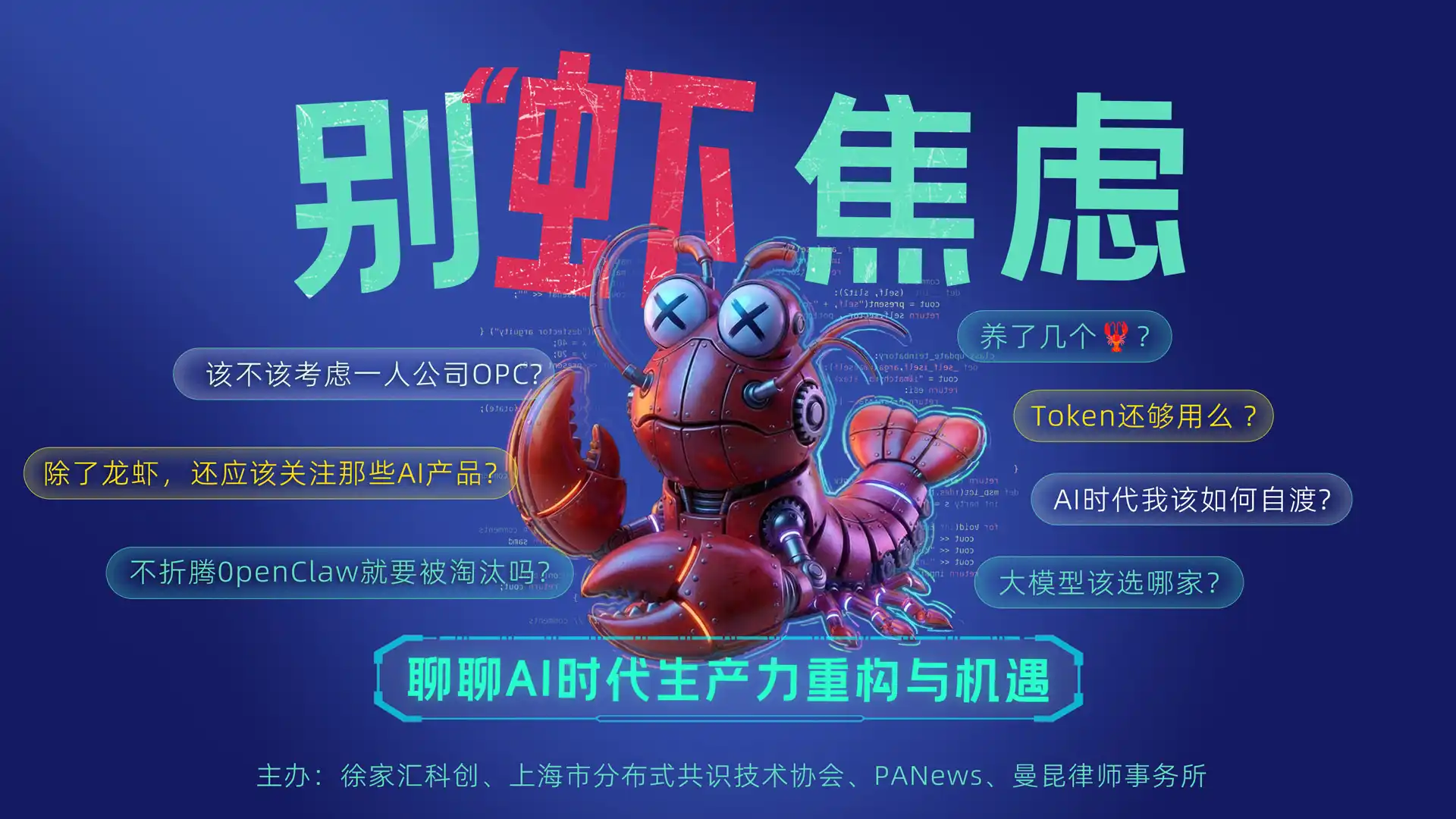
Industry Experts Gather, Reflections and Breakthroughs in the AI Agent Era

Industry experts gathered to discuss the challenges and opportunities in the AI Agent era. The event, co-hosted by several organizations, addressed key questions about model selection, token resource sustainability, and strategies for individuals and businesses to adapt. Conflux's Chief Architect highlighted the current trend of granting AI more autonomy, noting that its limitations in complex scenarios stem from difficulties in capturing and retaining key contextual constraints. Future advancements should focus on enhancing external memory, continuous learning, and domain-specific applications. Speakers from Tencent Cloud and Biteye shared practical insights. Tencent's WorkBuddy leverages multi-agent collaboration for tasks like resume screening and report generation, emphasizing enterprise-grade security. Biteye’s founder discussed mitigating AI hallucinations through rigorous code review processes, managing token consumption, and using platforms like Discord for agent coordination. Legal risks were also addressed, with a partner from Mankun Law advising on liability isolation, intellectual property protection, and mitigating platform dependency risks. Investors noted that AI is still in its early stages, with technology rapidly evolving. They emphasized investing in foundational layers like compute power and exploring AI-Web3 convergence. The discussion concluded that AI should be viewed as a productivity tool rather than a threat. Customizable agents can significantly enhance efficiency, but successful implementation requires careful engineering, security measures, and human oversight to integrate AI into complex workflows effectively.

marsbit04/08 05:51

Industry Experts Gather, Reflections and Breakthroughs in the AI Agent Era

marsbit04/08 05:51

Rhythm X Zhihu Hong Kong Event Skills Recruitment, Sign Up Now for a Chance to Showcase On-Site

Six months ago, "how to write good prompts" was the hottest topic in group chats. Now, that question is clearly outdated. It has been replaced by Skills. The shift was largely triggered by the emergence of OpenClaw, which brought the concept of AI agents into the mainstream. Unlike a smart search engine that answers questions in isolated interactions, an agent can plan, remember, and complete entire tasks autonomously, creating the novel feeling that it is genuinely working for you. This has led to the rise of Skills—specialized capabilities that equip agents to handle specific domains efficiently. Without Skills, an agent is like a smart but untrained newcomer; with them, it can execute complex, precision-sensitive workflows without constant guidance. Popular Skills currently spreading within communities focus on areas like workflow automation, domain-specific rule injection (e.g., for law, finance, or medicine), personalization, and even financial operations such as identifying arbitrage opportunities on Polymarket or executing quantitative trading strategies. This shifts the门槛 from requiring programming and financial expertise to simply installing a Skill. The underlying change is that people are starting to view agents as long-term collaborators, not just disposable tools. Now, with vibe coding, turning an idea into a functional Skill no longer requires a technical team, code, or infrastructure—it can be done over a weekend. The gap between a good idea and a working product has dramatically narrowed.

marsbit04/03 09:18

Rhythm X Zhihu Hong Kong Event Skills Recruitment, Sign Up Now for a Chance to Showcase On-Site

marsbit04/03 09:18

Apple Gains Full Access to Google's Gemini, Accelerates On-Device AI Model Development with Distillation Technology

Apple has secured full access to Google's Gemini model, aiming to accelerate the development of its on-device lightweight AI systems using advanced data distillation techniques. The company will utilize Gemini’s high-quality answers and chain-of-thought reasoning as training data to “feed” its own smaller, proprietary models. This approach, known as model distillation, enables compact models to achieve reasoning capabilities comparable to top-tier large models while maintaining computational efficiency. Although Gemini was originally designed for chatbots and enterprise applications—differing from Apple’s system-level integration vision for Siri—this collaboration significantly addresses Apple's need for high-quality synthetic data. In parallel, Apple continues its in-house development efforts through its Apple Foundation Models team. New AI features leveraging this distilled technology are expected to debut at Apple’s Worldwide Developers Conference (WWDC) in June. This partnership highlights a shift in the AI industry from pure computing power competition toward more efficient training strategies. By investing in access to leading model capabilities to enhance its edge computing advantages, Apple illustrates the ongoing balance between general-purpose large models and private on-device AI. This move also signals a future where edge devices will possess stronger local inference and complex task-handling abilities, further advancing the democratization of AI.

marsbit03/27 01:28

Apple Gains Full Access to Google's Gemini, Accelerates On-Device AI Model Development with Distillation Technology

marsbit03/27 01:28

OpenAI Bets on 'Robot Army': 23-Year-Old Prodigy Wins Favor from Sam Altman

While OpenAI adjusts its video strategy, Sam Altman is setting his sights on the more ambitious field of "multi-agent systems." According to The Wall Street Journal, OpenAI has secretly invested in Isara, an AI startup founded by 23-year-old researchers Eddie Zhang and Henry Gasztowtt. Despite being established only in June last year in San Francisco, Isara has already recruited over a dozen top researchers from Google, Meta, and OpenAI itself, forming a highly skilled technical team. Isara’s core vision is to develop a system that enables thousands of AI agents to collaborate efficiently. While individual AI assistants are powerful, they often struggle with large-scale industrial challenges such as biotech R&D or complex financial modeling. Isara aims to solve this by creating a framework where diverse AI agents can communicate, align goals, share data, and tackle interconnected problems—functioning like a coordinated "robot army." This multi-agent approach is seen as a critical step toward Artificial General Intelligence (AGI). OpenAI’s endorsement signals industry recognition of distributed intelligence. In biopharma, the system could simulate thousands of protein-folding pathways, with specialized agents identifying patterns. In finance, it could perform real-time stress tests using global market data. Led by young innovators, this shift suggests the next breakthrough in AI lies not in building larger models, but in enabling smarter collective intelligence.

marsbit03/26 02:32

OpenAI Bets on 'Robot Army': 23-Year-Old Prodigy Wins Favor from Sam Altman

marsbit03/26 02:32

Asia's Web3 Policy Landscape Reshaped: Justin Sun's GWDC Korea Speech Highlights Collaboration and Balance as the Most Scarce Competitiveness in the Next Phase

On March 23, the Hong Kong–Korea Web3 Policy Promotion Alliance Preparatory Committee was officially established, alongside the launch of the "2026 GWDC Global Developers Conference · Seoul (Korea Station)." The online launch event, hosted by Web3Labs, HYPAI Labs, and GWDC, featured key figures including Hong Kong Legislative Council Member Wu Jiezhuang, South Korean National Assembly Member Byung-deok Min, TRON founder Justin Sun, and Bithumb CEO Lee Jae-won. In his keynote speech titled "Asia’s New Web3 Era: Improving Regulatory Systems, Empowering Infrastructure, and Deepening International Collaboration," Justin Sun discussed global regulatory trends, TRON’s infrastructure strategy and AI developments, and the importance of cross-border policy cooperation in the Asia-Pacific region. He emphasized that global regulatory landscape is becoming clearer and more standardized, citing legislative progress in the U.S., E.U. MiCA enforcement, Hong Kong’s stablecoin framework, and pro-innovation environments in Singapore and the UAE. Sun highlighted that regulatory clarity has driven significant market growth, with the stablecoin market expanding from $206 billion to over $320 billion. However, he cautioned that excessive regulation could hinder innovation and stressed the need for balanced policies that foster both safety and growth. He also shared updates on TRON’s development, noting it has over 370 million registered accounts and processes $20–30 billion in daily transactions, making it a leading blockchain for stablecoin transfers, particularly USDT. TRON is also advancing in AI integration, having joined the Linux Foundation’s Agentic AI Council alongside major tech and financial institutions. Sun endorsed the newly formed Hong Kong–Korea alliance as a model for international regulatory coordination, which can prevent fragmentation and promote secure, innovation-friendly policies. He also mentioned TRON’s role in global financial security efforts, including the freezing of over $300 million in illicit funds through the T3 anti-financial crime task force. In closing, Sun expressed his commitment to supporting cross-regional collaboration for a secure, transparent, and thriving global Web3 ecosystem.

比推03/23 10:52

Asia's Web3 Policy Landscape Reshaped: Justin Sun's GWDC Korea Speech Highlights Collaboration and Balance as the Most Scarce Competitiveness in the Next Phase

比推03/23 10:52

活动图片