Asia's Web3 Policy Landscape Reshaped: Justin Sun's GWDC Korea Speech Highlights Collaboration and Balance as the Most Scarce Competitiveness in the Next Phase

比推Pubblicato 2026-03-23Pubblicato ultima volta 2026-03-23

Introduzione

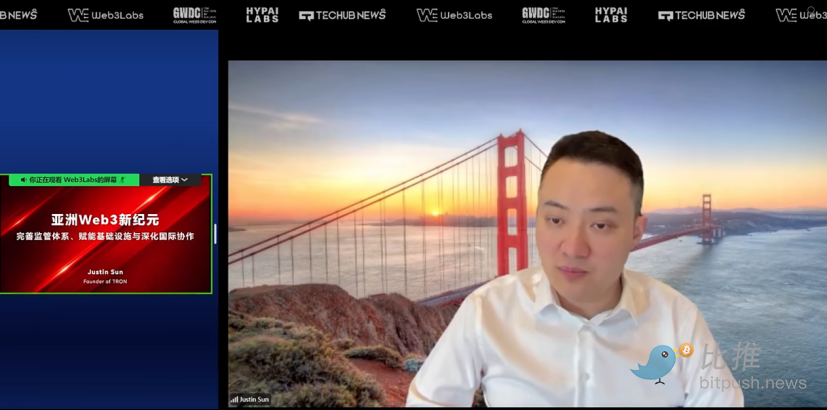
On March 23, the Hong Kong–Korea Web3 Policy Promotion Alliance Preparatory Committee was officially established, alongside the launch of the "2026 GWDC Global Developers Conference · Seoul (Korea Station)." The online launch event, hosted by Web3Labs, HYPAI Labs, and GWDC, featured key figures including Hong Kong Legislative Council Member Wu Jiezhuang, South Korean National Assembly Member Byung-deok Min, TRON founder Justin Sun, and Bithumb CEO Lee Jae-won. In his keynote speech titled "Asia’s New Web3 Era: Improving Regulatory Systems, Empowering Infrastructure, and Deepening International Collaboration," Justin Sun discussed global regulatory trends, TRON’s infrastructure strategy and AI developments, and the importance of cross-border policy cooperation in the Asia-Pacific region. He emphasized that global regulatory landscape is becoming clearer and more standardized, citing legislative progress in the U.S., E.U. MiCA enforcement, Hong Kong’s stablecoin framework, and pro-innovation environments in Singapore and the UAE. Sun highlighted that regulatory clarity has driven significant market growth, with the stablecoin market expanding from $206 billion to over $320 billion. However, he cautioned that excessive regulation could hinder innovation and stressed the need for balanced policies that foster both safety and growth. He also shared updates on TRON’s development, noting it has over 370 million registered accounts and processes $20–30 billion in daily transaction...

On March 23, the Hong Kong-Korea Web3 Policy Promotion Alliance Preparatory Committee was officially established, simultaneously launching the "2026 GWDC Global Developers Conference · Seoul Station (Korea Station)". This online event was jointly hosted by Web3Labs, HYPAI Labs, and GWDC, bringing together political and business leaders including Hong Kong Legislative Council member Wu Jiezhuang, South Korean National Assembly member Byung-deok Min, TRON founder Justin Sun, and Bithumb CEO Lee Jae-won. The event supported trilingual subtitles in Chinese, English, and Korean, and was broadcast globally via platforms like YouTube.

Justin Sun delivered a keynote speech titled "Asia's New Era of Web3: Perfecting the Regulatory System, Empowering Infrastructure, and Deepening International Collaboration". In his speech, he systematically elaborated on global regulatory trends, TRON's infrastructure strategy and AI frontier layout, as well as core propositions for promoting cross-border policy collaboration in the Asia-Pacific, demonstrating his forward-looking vision and global influence as a leading figure in Asia's Web3 industry, which has attracted high attention from the industry.
Global Regulatory Clarity Accelerates, Web3 Innovation Welcomes a Historic Window of Opportunity

In his speech, Sun pointed out that over the past year, global Web3 regulation has rapidly shifted from an "exploratory design" phase to an "implementation and landing" phase, showing an unprecedented trend towards clarity and convergence. The United States has successively passed a stablecoin bill and established a strategic Bitcoin reserve, with the new leadership of the SEC and CFTC generally holding an open attitude towards the crypto industry; the EU's MiCA regulation has entered a full enforcement phase, focusing on regulating stablecoins and custody businesses; Hong Kong, China has launched a stablecoin regulatory framework and entered the first batch of licensing issuance; Singapore and the UAE continue to be important hubs for crypto startup projects.

The improvement in the regulatory environment is releasing significant market dividends. Sun cited data showing that the stablecoin market size has surged from $206 billion to over $320 billion in the past year, and directions such as tokenized assets and the integration of AI and blockchain technology have also experienced explosive growth. He emphasized that regulatory certainty significantly reduces compliance costs, attracting large-scale entry from traditional financial institutions, and the integration between traditional industries and the Web3 industry is accelerating comprehensively.

However, Sun also cautioned that the impact of regulation on technological innovation is dual. Overly cautious and conservative regulatory policies can also stifle innovation, so regulation must seek "balance," and it is necessary to establish a benign interaction and communication channel between legislators and the industry. "If we only emphasize safety and ignore the momentum of innovation, I'm afraid the currently leading Asian Web3 industry will also lose its global competitiveness," he said.

It is worth noting that just earlier this month, the U.S. Securities and Exchange Commission (SEC) has asked the court to dismiss all charges it made in 2023 against Justin Sun personally, the TRON Foundation, and the BitTorrent Foundation. This development, following the SEC's previous dismissals of lawsuits against well-known crypto institutions such as Binance, Coinbase, and Uniswap, has again become an important milestone in the global crypto industry's compliance process. Sun stated that he will continue to focus on accelerating innovation globally, deepening cooperation with regulatory agencies in various countries, and contributing to the healthy development of the cryptocurrency industry.

TRON: Global Practice of Mature Blockchain Infrastructure and New AI Layout

In his speech, Sun systematically introduced the latest progress of TRON in blockchain infrastructure construction and the field of artificial intelligence.

Since its establishment in 2017, TRON has always been committed to promoting the maturity of the regional ecosystem and the actual application landing. Currently, the TRON network has over 370 million registered accounts, with a daily on-chain transfer volume between $20 billion and $30 billion, making it one of the public chains with the largest stablecoin circulation volume globally. The transaction share of USDT on TRON has long been among the top globally, providing low-cost, high-efficiency underlying support for cross-border payments, DeFi, and daily financial activities for users in the Asia-Pacific and globally.

In terms of infrastructure capabilities, TRON is known for its high throughput, ultra-low transaction fees, and 7×24 global settlement capability, and has become the preferred public chain platform for developers and enterprises in the Asia-Pacific region. In recent years, TRON has continued to increase its investment in the integration of AI and blockchain, launching innovative products such as AINFT; at the same time, through TRON DAO, it continues to support developer conferences, ecological funds, and stablecoin integration projects, helping Web3 projects in South Korea, Hong Kong China, Singapore, and other places to land quickly, and practically promoting ordinary users and small and medium-sized enterprises to enjoy the inclusive benefits of Web3.

Regarding the AI strategic layout, Sun announced that TRON has officially joined the Agentic AI Council hosted by the Linux Foundation, the world's largest open-source technology consortium, as a Gold Member, sitting on the council of this core international organization alongside global technology and financial giants such as OpenAI, Anthropic, Circle, and JPMorgan Chase. Sun commented on this: "The next wave of digital payments will be driven by machines. We are ready for it."

Cross-Border Collaboration is Key to Achieving "Balanced and Safe Regulation"

In the third part of his speech, Sun emphasized the strategic significance of cross-border policy collaboration for building a healthy Web3 ecosystem and expressed high recognition and full support for the establishment of the Hong Kong-Korea Web3 Policy Promotion Alliance.

He pointed out that Web3 is inherently borderless, and the regulatory framework of a single country can easily lead to "regulatory arbitrage" or ecosystem fragmentation risks. Only through cross-regional collaboration mechanisms like this alliance can legislators share best regulatory practices, coordinate stablecoin and custody standards, while fully listening to the voices from the industry front lines, ensuring that regulatory policies can effectively prevent risks, protect user rights, and not stifle innovation vitality.

He believes that Hong Kong, China's pragmatic regulatory framework and South Korea's open attitude towards Web3 are exemplary models of Asia-Pacific regional cooperation, and the synergy between the two will provide an important reference sample for global Web3 regulation.

Sun also specifically introduced TRON's practical achievements in the field of security and compliance. Since 2024, TRON and its partners have jointly established the T3 Task Force to combat financial crime. In nearly two years, it has successfully frozen over $300 million in funds involved in financial crimes across five continents globally, accumulating rich experience in enhancing collaboration with international security agencies and jointly addressing blockchain financial security threats, setting a successful example for industry security and compliance collaboration.

Sun concluded: "The future of Web3 belongs to those pioneers who dare to collaborate and courageously seek balance. The establishment of the alliance today is the starting point of this vision. I and TRON will, as always, contribute our strength, working hand in hand with everyone to promote the Web3 ecosystem in Asia-Pacific and globally towards a new era that is safer, more transparent, and more prosperous."


Twitter:https://twitter.com/BitpushNewsCN

Bitpush TG Communication Group:https://t.me/BitPushCommunity

Bitpush TG Subscription: https://t.me/bitpush

Original link:https://www.bitpush.news/articles/7622311

Crypto di tendenza

Domande pertinenti

QWhat was the main theme of Justin Sun's speech at the GWDC Korea event?

AThe main theme was 'Asia's Web3 New Era: Improving the Regulatory System, Empowering Infrastructure, and Deepening International Collaboration', focusing on global regulatory trends, TRON's infrastructure strategy, AI integration, and promoting cross-border policy cooperation in the Asia-Pacific region.

QWhat significant development did Justin Sun announce regarding TRON's involvement in AI?

AJustin Sun announced that TRON has joined the Agentic AI Council, hosted by the Linux Foundation, as a Gold Member, collaborating with major tech and financial giants like OpenAI, Anthropic, Circle, and JPMorgan to advance AI and blockchain integration.

QHow has the global regulatory environment for Web3 changed recently, according to Justin Sun?

AGlobal Web3 regulation has shifted from 'exploration and design' to 'implementation and enforcement', with increased clarity and convergence. Examples include the U.S. passing stablecoin laws, EU enforcing MiCA regulations, Hong Kong issuing stablecoin licenses, and Singapore and the UAE becoming crypto hubs.

QWhat is the purpose of the Hong Kong-Korea Web3 Policy Promotion Alliance mentioned in the article?

AThe alliance aims to foster cross-regional collaboration, share best regulatory practices, coordinate standards for stablecoins and custody, and ensure policies balance risk prevention and innovation, leveraging Hong Kong's pragmatic framework and Korea's open attitude toward Web3.

QWhat achievement did Justin Sun highlight regarding TRON's efforts in financial security?

ATRON, through the T3 task force, has successfully frozen over $300 million in funds involved in financial crimes across five continents, enhancing international collaboration to address blockchain security threats and setting a benchmark for industry compliance.

Letture associate

Manus Buyback Plan Emerges: Chinese Investors Plan to Repurchase Equity with $2 Billion, Path to Hong Kong IPO Becomes Clearer

According to a report by The Information, early Chinese investors of Manus, including Tencent, Sequoia Capital China, and ZhenFund, are planning to repurchase the company from Meta for $2 billion—the same price Meta paid in its acquisition last December. This move is a direct response to the Chinese government's prohibition of the foreign acquisition in April. As part of the repurchase plan, Manus is considering establishing a Sino-foreign joint venture within China. This structure is seen as a way to ensure regulatory compliance for its Chinese investors and to pave the way for a future IPO in Hong Kong. Notably, U.S. investor Benchmark will not participate in the buyback, which will concentrate ownership even more among Chinese capital. Since its acquisition by Meta, Manus's business has grown rapidly, with its annualized revenue run rate reportedly increasing four-to-fivefold to $400-$500 million in roughly six months. This strong growth underpins the investors' willingness to repurchase at the original price. Financially, the forced unwinding of the deal may benefit the early investors, allowing them to regain equity at a cost far below the company's current implied valuation, with the added prospect of an independent future listing. However, specific terms of the repurchase, including funding proportions and the joint venture's equity structure, are still under negotiation. This "repurchase-joint venture-Hong Kong IPO" approach could serve as a reference model for other Chinese AI startups navigating cross-border M&A regulations.

marsbit10 min fa

Manus Buyback Plan Emerges: Chinese Investors Plan to Repurchase Equity with $2 Billion, Path to Hong Kong IPO Becomes Clearer

marsbit10 min fa

STRC Loses Peg by 11%, Can Strategy's Perpetual Motion Machine Keep Running?

The article discusses the significant and concerning depegging of MicroStrategy's (MSTR) preferred stock, STRC. Designed to trade near its $100 target par value, STRC has recently fallen sharply, reaching a low of $83.26 and closing at $88.59, representing an over 11% discount. STRC is a core component of MicroStrategy's financial strategy. As a perpetual preferred stock, it allows the company to raise capital through an "at-the-market" (ATM) issuance program without diluting common shareholders (MSTR). This capital is primarily used to purchase Bitcoin, creating a "capital flywheel": issuing STRC → raising cash → buying BTC → increasing net assets → supporting STRC's value. The flywheel's operation depends on STRC maintaining its $100 price. To enforce this, MicroStrategy employs a dynamic dividend mechanism, recently raising the rate to 11.5% and increasing payout frequency. However, this has failed to halt the depegging, indicating market concerns extend beyond yield. Analysts cite two main reasons. First, technical factors like forced liquidations from leveraged arbitrage trades may have exacerbated the sell-off. Second, and more fundamentally, is waning confidence in MicroStrategy's financial resilience. A JPMorgan report highlighted the company's limited cash relative to its ~$1.7 billion annual dividend obligation, raising liquidity concerns. While MicroStrategy counters that its massive Bitcoin holdings provide decades of coverage, this argument relies on the potential need to sell BTC—a departure from its long-standing "never sell" narrative. The company's recent sale of a small amount of Bitcoin for "testing," despite being framed as minor, has intensified these fears. The persistent depegging threatens to cripple MicroStrategy's primary funding channel. If STRC remains discounted, the company's ability to fund further Bitcoin purchases weakens. Should cash reserves dwindle while financing is constrained, the market may increasingly price in the risk of MicroStrategy becoming a forced seller of Bitcoin to meet obligations. This shift from a major marginal buyer to a potential seller could pose significant downside risk to the broader Bitcoin market.

链捕手18 min fa

STRC Loses Peg by 11%, Can Strategy's Perpetual Motion Machine Keep Running?

链捕手18 min fa

Behind the AI Scorecards Lies a Chinese 'Question Setter'

Behind the AI scorecards that dominate industry discussions—benchmarks like MMLU-Pro, MMMU, and MMMU-Pro—stands a Chinese-Canadian researcher: Wenhu Chen. As an assistant professor at the University of Waterloo and founder of the TIGER Lab, Chen has become a key "exam-setter" for evaluating large language and multimodal models. Chen first gained broader recognition with MMLU-Pro, a more challenging and stable update to the popular MMLU benchmark. As top models like OpenAI’s o3 began achieving near-perfect scores on the original MMLU, it became difficult to distinguish their true capabilities. MMLU-Pro introduced more complex reasoning questions, expanded answer choices, and filtered out ambiguous or simple items, effectively reintroducing differentiation among state-of-the-art models. His work on MMMU addressed the evaluation of multimodal models, requiring them to integrate visual information (like charts, diagrams, or tables) with textual knowledge across diverse academic subjects. Even the strongest models initially scored only around 56-59%, highlighting significant room for improvement in genuine multimodal reasoning. MMMU-Pro further refined this by preventing models from bypassing visual cues. Chen’s research focus has long been on complex information understanding and reasoning. His background—including a PhD at UC Santa Barbara, research at Google/DeepMind on Gemini, and now a role in Meta’s superintelligence lab—provides deep insight into model development and their potential weaknesses. His TIGER Lab also builds models (e.g., for video understanding and generation), ensuring his evaluation benchmarks are grounded in practical challenges. While AI headlines often spotlight company leaders and product launches, Chen’s work exemplifies the critical, behind-the-scenes contributions of researchers crafting the rigorous standards that define and drive progress in AI capabilities.

marsbit1 h fa

Behind the AI Scorecards Lies a Chinese 'Question Setter'

marsbit1 h fa

STRC Unpegged by 11%, Can Strategy's Perpetual Motion Machine Keep Turning?

STRC, the perpetual preferred stock of MicroStrategy, is experiencing a persistent de-pegging from its target par value of $100, with the discount recently widening to over 11%. This de-anchoring challenges the core design of STRC, which was intended as a stable, income-oriented security operating near $100. As a crucial funding engine for MicroStrategy's Bitcoin acquisition strategy, STRC's price reflects market confidence in the company's entire capital model. The company's "capital flywheel" relies on issuing STRC at or above $100 via an At-the-Market (ATM) program to raise cash for buying Bitcoin, thereby boosting company equity and theoretically supporting STRC's value. A monthly adjustable dividend mechanism was designed to maintain this peg. Despite raising the dividend to 11.5% and increasing payment frequency, the de-pegging persists. Market concerns extend beyond technical factors like leveraged arbitrage unwinding. Analysts point to MicroStrategy's limited cash reserves relative to its ~$1.7 billion annual dividend obligation for preferred shares. While the company counters that its vast Bitcoin holdings could cover decades of payments, this argument hinges on the potential need to sell Bitcoin—a shift from its longstanding "hodl" narrative. The company's recent sale of a small amount of BTC, framed as a test, amplified these liquidity and strategy concerns. If STRC remains discounted, impairing MicroStrategy's ability to raise cheap capital, fears may grow that the company could sell more Bitcoin to meet obligations. This scenario could transform MicroStrategy from a major market buyer into a potential seller, posing significant downside risk for Bitcoin. The re-pegging of STRC is thus a key indicator for the health of MicroStrategy's capital structure and its market impact.

Odaily星球日报1 h fa

STRC Unpegged by 11%, Can Strategy's Perpetual Motion Machine Keep Turning?

Odaily星球日报1 h fa

Trading

Spot
Futures

Articoli Popolari

Come comprare SUN

Benvenuto in HTX.com! Abbiamo reso l'acquisto di SUN (SUN) semplice e conveniente. Segui la nostra guida passo passo per intraprendere il tuo viaggio nel mondo delle criptovalute.Step 1: Crea il tuo Account HTXUsa la tua email o numero di telefono per registrarti il tuo account gratuito su HTX. Vivi un'esperienza facile e sblocca tutte le funzionalità,Crea il mio accountStep 2: Vai in Acquista crypto e seleziona il tuo metodo di pagamentoCarta di credito/debito: utilizza la tua Visa o Mastercard per acquistare immediatamente SUNSUN.Bilancio: Usa i fondi dal bilancio del tuo account HTX per fare trading senza problemi.Terze parti: abbiamo aggiunto metodi di pagamento molto utilizzati come Google Pay e Apple Pay per maggiore comodità.P2P: Fai trading direttamente con altri utenti HTX.Over-the-Counter (OTC): Offriamo servizi su misura e tassi di cambio competitivi per i trader.Step 3: Conserva SUN (SUN)Dopo aver acquistato SUN (SUN), conserva nel tuo account HTX. In alternativa, puoi inviare tramite trasferimento blockchain o scambiare per altre criptovalute.Step 4: Scambia SUN (SUN)Scambia facilmente SUN (SUN) nel mercato spot di HTX. Accedi al tuo account, seleziona la tua coppia di trading, esegui le tue operazioni e monitora in tempo reale. Offriamo un'esperienza user-friendly sia per chi ha appena iniziato che per i trader più esperti.

867 Totale visualizzazioniPubblicato il 2024.12.12Aggiornato il 2025.03.21

Come comprare SUN

Discussioni

Benvenuto nella Community HTX. Qui puoi rimanere informato sugli ultimi sviluppi della piattaforma e accedere ad approfondimenti esperti sul mercato. Le opinioni degli utenti sul prezzo di SUN SUN sono presentate come di seguito.

活动图片