Supported by 20+ Institutions: How Does Sui's New Primitive Hashi Rewrite the Rules of Bitcoin Financial Trust?

marsbitPublished on 2026-04-15Last updated on 2026-04-15

Abstract

Sui has introduced Hashi, a new decentralized Bitcoin (BTC)抵押原语 (primitive) designed to enable trust-minimized and secure use of native BTC in DeFi on the Sui blockchain, backed by over 20 major institutions. Hashi allows users to抵押 Bitcoin without transferring custody to centralized entities. BTC remains on the Bitcoin network in a dedicated address, while a抵押凭证 is generated on Sui. This凭证, representing the locked BTC, can be used in Sui's smart contracts for lending, borrowing, and other DeFi activities. The system relies on Sui validators for security, with a Guardian Layer for additional protection against risks like validator collusion. Key to Hashi is its role as a "primitive"—a foundational building block for developers. It provides a standardized interface to integrate native BTC抵押 capabilities into applications like lending protocols, structured products, and RWA strategies, reducing development barriers. Institutional support spans custody (e.g., BitGo, Cobo), trading (e.g., FalconX, Bullish), security (e.g., OtterSec, Certora), and protocols (e.g., Suilend, Scallop). This ecosystem support aims to facilitate large-scale institutional BTC adoption into DeFi upon mainnet launch. Hashi addresses core trust issues in Bitcoin金融 by prioritizing non-custodial security, transparency, and composability, potentially unlocking Bitcoin's $1.4 trillion market cap for decentralized finance without sacrificing user control.

Author: Deep Tide TechFlow

While market attention is being drawn away by U.S. stocks, AI, and gold, Sui recently announced a new move:

Hashi, a Bitcoin collateral primitive based on Sui, is about to launch and has garnered support from top-tier institutions.

Bitcoin finance, a topic that has been discussed for a long time but remains unresolved:

As the largest on-chain asset treasury with a market cap exceeding $1.4 trillion, the proportion of Bitcoin used in DeFi is still less than 0.22%.

The core reason it remains unresolved is not due to insufficient functionality but the wrong premise of trust. In many past attempts, users were often misled—you thought your Bitcoin was in your hands, but it was actually on someone else’s ledger. The collapses of Celsius, Voyager, Genesis, and other projects have repeatedly sounded the alarm for the logic of "sacrificing trust for efficiency."

Especially synthetic Bitcoin, although it has attracted a considerable number of retail users, this structure has failed to convert a large amount of Bitcoin into DeFi capital and cannot attract institutions and large asset holders who require stronger guarantees.

This is precisely the important opportunity for the launch of Sui’s new developer primitive Hashi:

Reconstructing the most critical trust base for Bitcoin finance.

Enabling native BTC collateral to be organized more transparently in Sui’s smart contract environment—no wrapping, no synthesizing, no handing over keys to any centralized entity—and turning this capability into directly reusable interfaces.
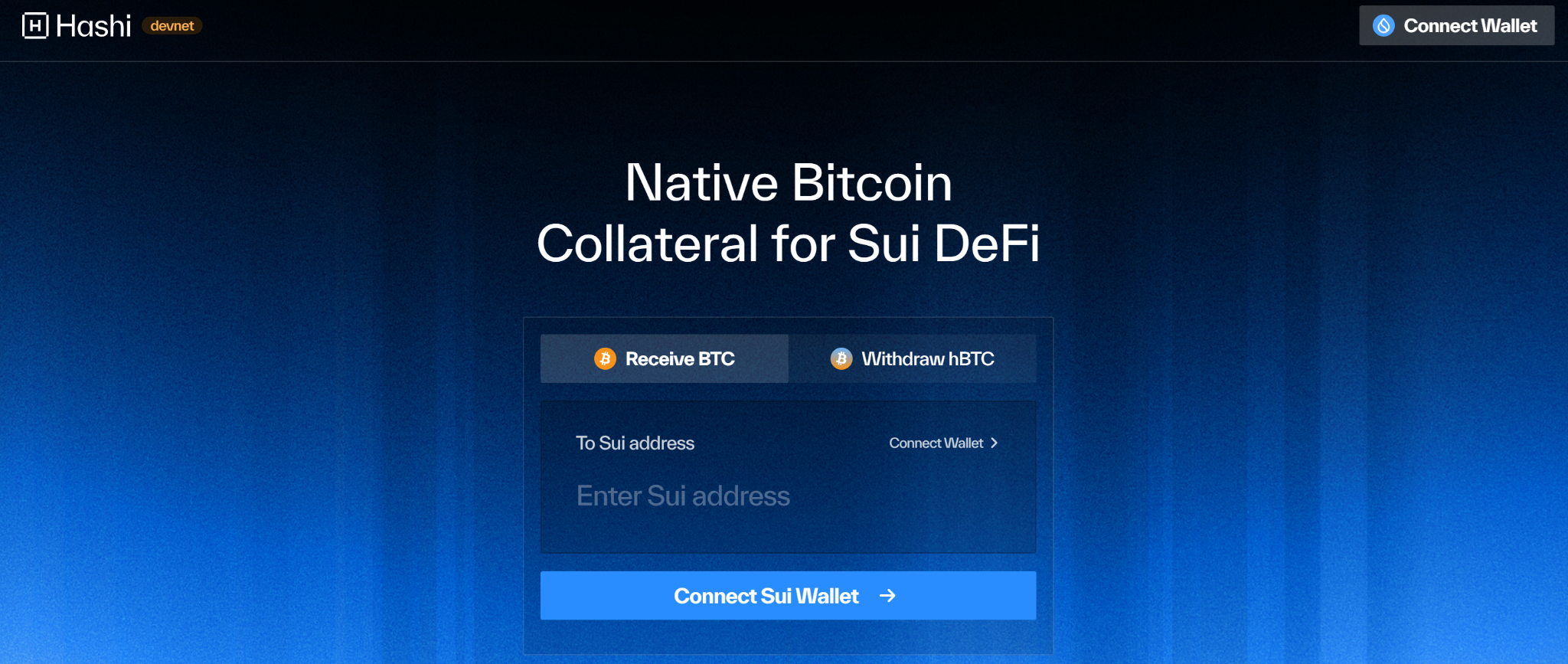
Hashi Native BTC Programmability: BTC Stays on the Chain, Collateral Rights Enter the Sui Network

The design philosophy of Hashi can be summarized in one sentence:

Assets remain on the Bitcoin network, rights exist on the Sui network—both occur simultaneously without interference.

Suppose you have one Bitcoin and want to use it as collateral to borrow some USDC.

In most past solutions:

You either deposit BTC into a centralized platform to obtain a borrowing limit or accept Wrapped BTC. Your Bitcoin, at some point, must be handed over to someone else, essentially trading "trust in an entity" for "programmability."

With Hashi:

  • Deposit: Users deposit BTC into a dedicated address (a unique Bitcoin deposit address generated by Hashi for their Sui address). The private key for this address does not belong to any single entity but is collectively managed by the validators on the Sui network. The BTC can only be moved if enough validators reach a consensus. This means no single entity can run away with your money unless they control more than one-third of the entire Sui validator network.
  • Proof Generation: Validators simultaneously monitor the Bitcoin network. Once they confirm your BTC is locked in, a corresponding collateral proof is generated on the Sui chain. This proof is not a newly issued token or a wrapped asset; it is an on-chain certificate proving that a real BTC is locked, and you are its owner.
  • As Collateral: With this proof, you can borrow money, participate in DeFi, or set up yield strategies in Sui’s smart contracts. All rules are written in code and executed automatically, with no room for interference.
  • Repayment and Withdrawal: After repayment, validators automatically release the native BTC on the Bitcoin mainnet through MPC threshold signatures, which can be withdrawn to any Bitcoin address without manual intervention.
  • Guardian Layer: To prevent extreme situations (such as validator collusion), Hashi additionally introduces a Guardian Layer as a secondary check and backup protection, primarily monitoring large withdrawals or abnormal thresholds to prevent potential systemic risks.
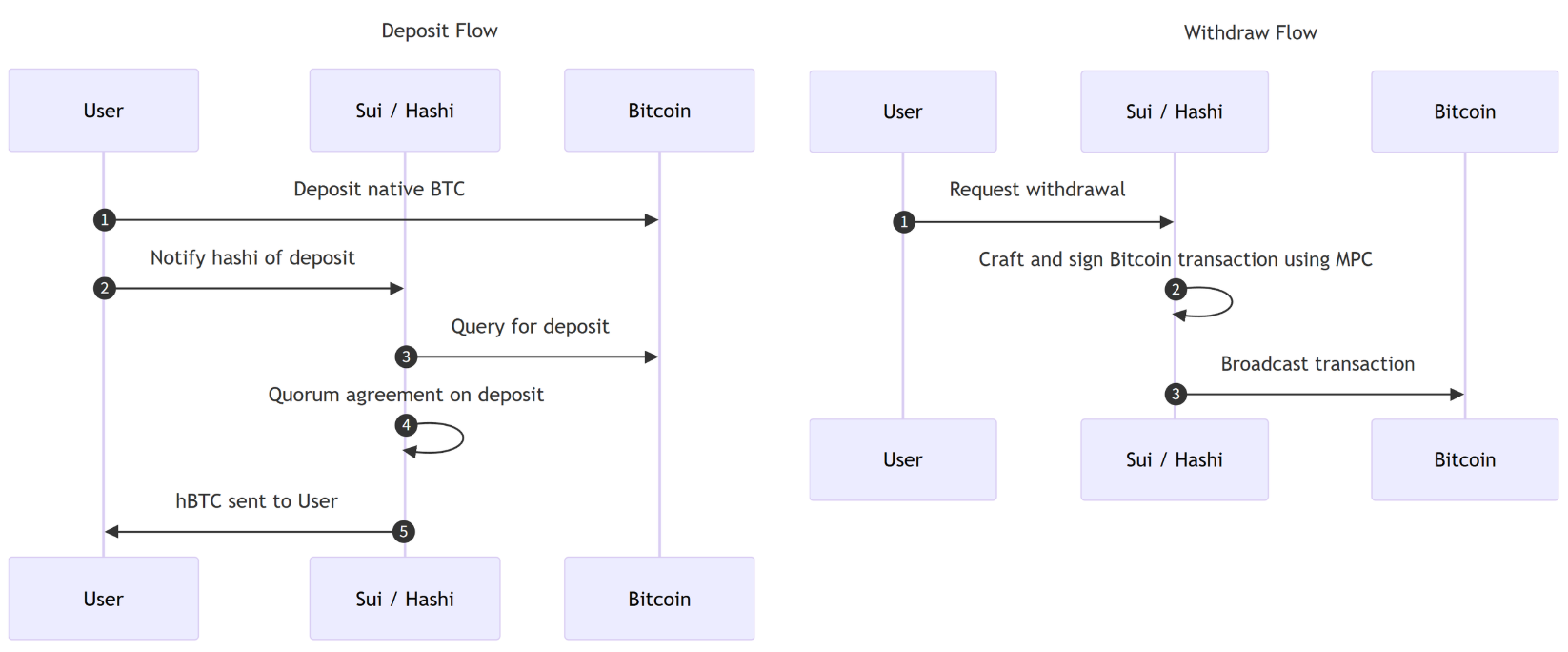
Throughout the entire lifecycle:

BTC always remains on the Bitcoin mainnet and is not moved into any platform’s internal account;

No single centralized entity has exclusive control of the private key;

What circulates on Sui is the collateral right backed by real BTC, reopening the programmability of native BTC;

And the only entities users need to trust are the validator network and the smart contract.
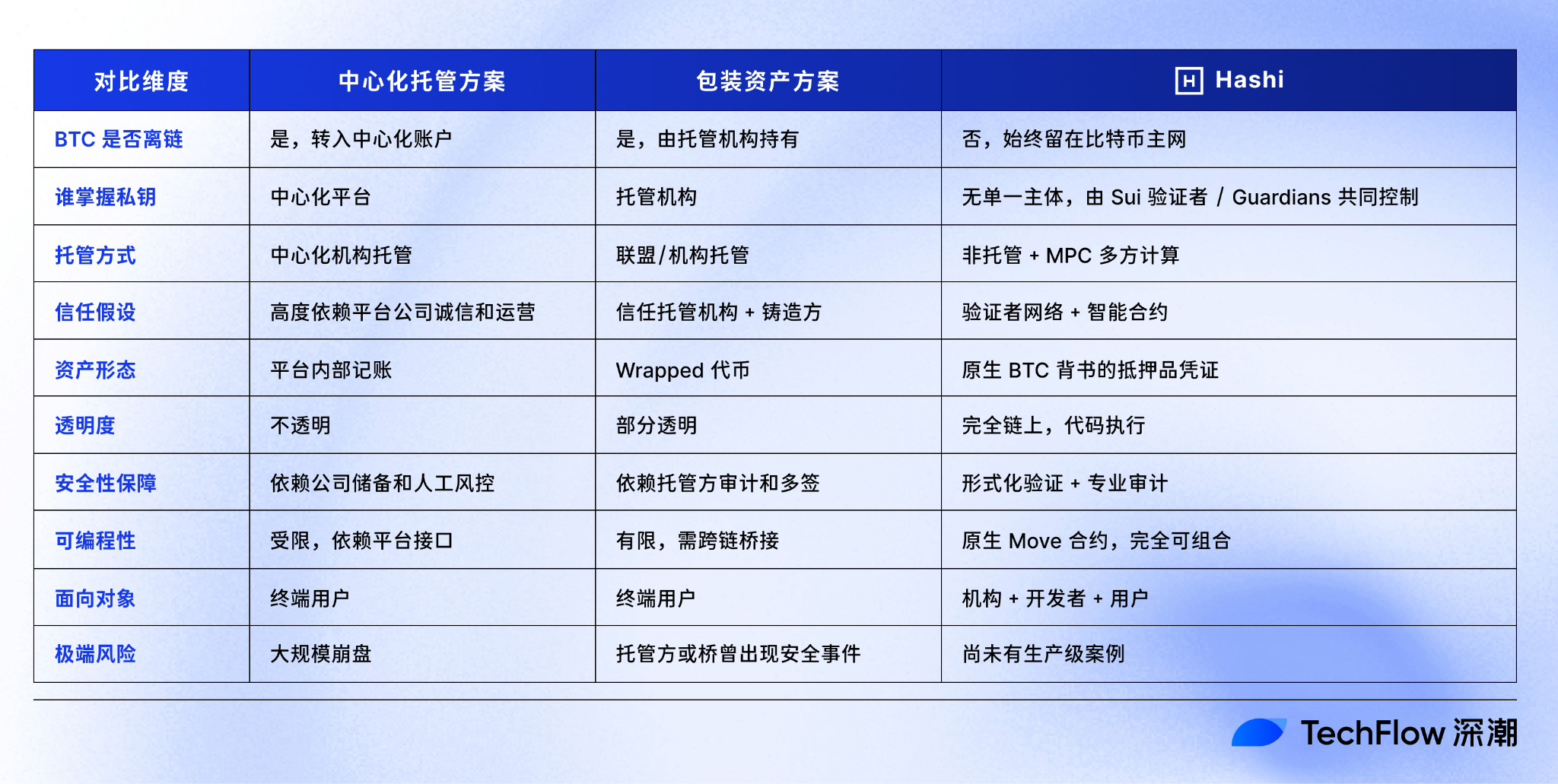
Simply put, Hashi is committed to enabling the collateral relationship of native BTC to be directly recognized by the on-chain financial system, with minimal trust placed in centralized entities.

During stable market conditions, users may perceive little difference, but in extreme situations like platform collapses or liquidity crises, it is the difference between whether your BTC is still there or not.

Not a Product, but a "Primitive": A Directly Reusable "Standard Brick"

From a design perspective, Hashi is a more decentralized, trust-minimized, and secure transparent Bitcoin financial solution.

However, if Hashi is understood solely as a single "solution," its most potential aspect might be missed.

It is important to note that for a long time, Sui has been striving to evolve from "a chain" to "a complete set of developer infrastructure." Whether it’s launching Walrus, Seal, or Nautilus, the goal has been to achieve full-stack nativity from execution, storage, permission control to off-chain computation, providing convenience for developers and building the necessary foundation for ecosystem prosperity.

This time, facing Bitcoin finance is no exception.

According to the official definition:

Hashi is the first decentralized Bitcoin collateral primitive developed by Mysten Labs, allowing developers to actively handle UTXOs from the Bitcoin network in Sui’s native smart contract language.

The key word is "primitive."

In the context of blockchain and DeFi, a primitive often refers to a fundamental building block or underlying infrastructure component. It is like a "standard brick" in Lego:

It is not an end product for ordinary users but a basic module for developers to build products.

Just as TCP/IP is not an app but all apps run on it; Hashi is not a product, but lending platforms, yield strategies, and structured products can all be built on it.

In other words, Hashi does not provide a closed financial service but an underlying capability, enabling native BTC to become collateral that Sui smart contracts can directly call.

As for what this collateral is used for, how it is used, and under what rules, Hashi does not interfere—it leaves it to the contracts, developers, and the market.
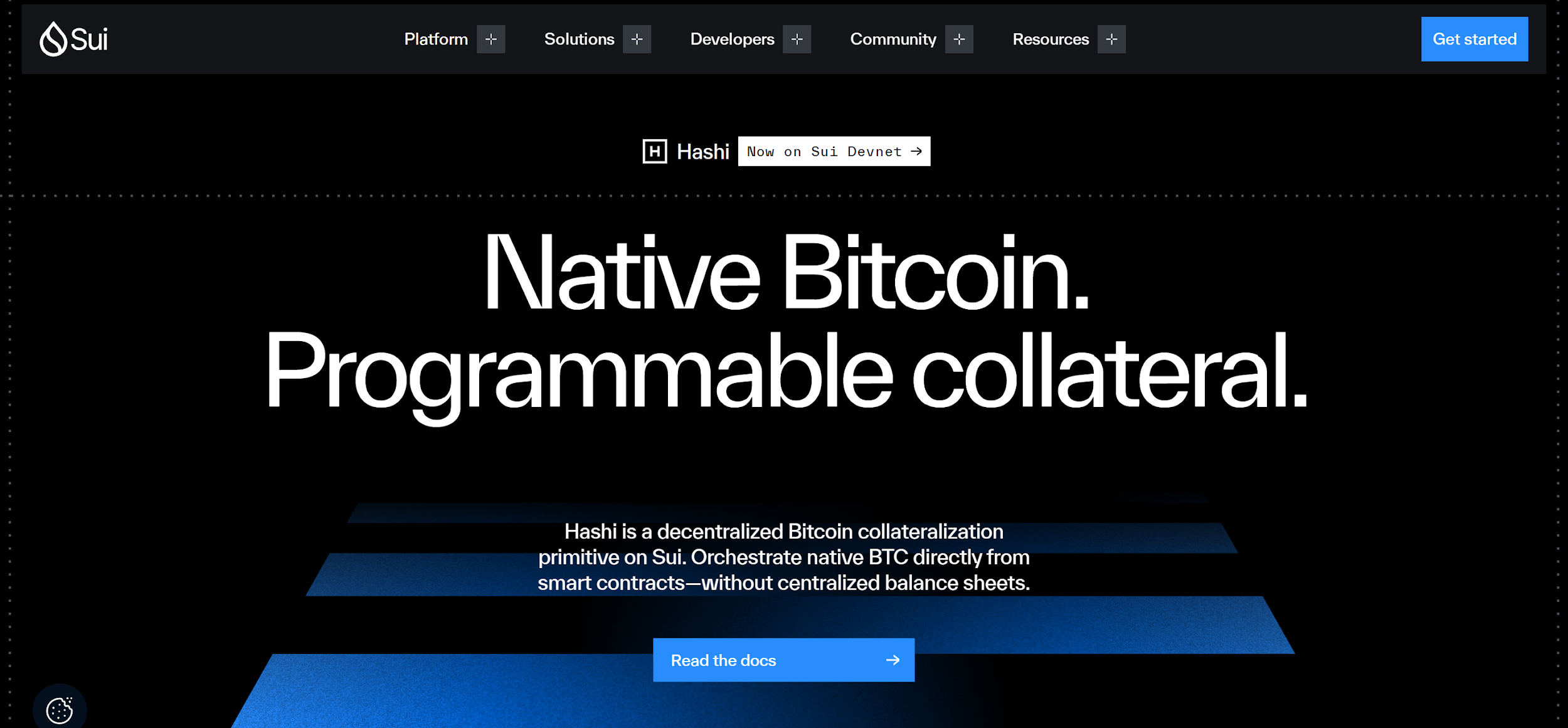
Before Hashi, if developers wanted to build a protocol with BTC as collateral, they faced numerous challenges: either accept the trust risks of centralized custody or implement the complex logic of native BTC collateral from scratch.

As a primitive, Hashi turns this difficult problem into a directly reusable interface.

Now, when building specific products, developers can directly call the mechanisms provided by Hashi, enabling their protocols to inherently possess native BTC collateral capabilities without having to solve underlying problems again, significantly reducing development barriers and time costs.

Users, whether institutional or retail, will, through products built on Hashi, for the first time truly gain the ability to earn yields with Bitcoin without giving up control over it. In the initial phase, lending will be the first use case for Hashi, allowing BTC to be lent out or used as collateral to borrow stablecoins. In the future, Hashi’s scenarios will gradually expand to vaults, insurance, structured products, credit derivatives, and RWA yield strategies.

Bitcoin is the asset with the broadest global consensus and deepest liquidity, but in the past, this wealth was almost invisible to the on-chain financial world: it is massive but not programmable; it is valuable but cannot be directly perceived and called by smart contracts.

Therefore, when Hashi turns the native BTC collateral capability into an interface that any developer can directly call, the upper-layer application space it can leverage far exceeds any specific product or protocol.

And the correctness of this judgment is already answered by the extensive institutional support Hashi has received.

Institutional Day One Support: Building a Complete Ecosystem Around Hashi

Currently, Hashi is live on Sui Devnet, primarily for developer testing and auditing, and has not yet entered the production environment. However, it has already received explicit support commitments from several leading industry institutions.

In terms of infrastructure: Including BitGo, Blockdaemon, Cobo, Ledger, and other major institutions, directly bridging institutional BTC from cold storage into on-chain collateral scenarios.

In terms of trading and liquidity: Including FalconX, Bullish, CF Benchmarks, and other major institutions, providing Hashi with reliable pricing, liquidity exits, and institutional-grade counterparty support.

In terms of security and compliance: Multiple teams, including security auditing firm OtterSec, smart contract formal verification security company Certora, and cryptography and zero-knowledge proof research and engineering team Asymptotic, have chosen to support Hashi and will conduct smart contract audits, formal verification, cryptography, and zero-knowledge proof research before Hashi’s mainnet launch.

At the same time, projects including Suilend, Scallop, NAVI Protocol, Matrixdock, and Bluefin have announced they will integrate Hashi to unleash on-chain financial potential, enabling retail and institutional users to quickly access BTC collateral lending experiences.

In addition, Soter Insure, a provider of institutional-grade insurance solutions, has announced a partnership with Hashi to bring built-in institutional-grade insurance mechanisms as a risk protection layer.

These institutions represent thousands of billions of dollars in Bitcoin nominal value and mature compliance infrastructure. Their commitment to integration at the Hashi Devnet stage means that once Hashi officially launches, large-scale institutional Bitcoin assets will have the practical conditions to enter on-chain scenarios.

At the same time, looking at these 20+ institutions together, an interesting fact emerges: they almost cover every环节 of a complete Bitcoin financial ecosystem:

From Bitcoin security custody, on-chain collateral, price pricing, liquidity support, lending protocols, yield strategies, RWA integration, to security audits and user entry, an end-to-end chain has already taken shape.

In other words, behind this list of supporters, a complete ecosystem map of Bitcoin finance围绕 the Hashi primitive will be ready from day one of Hashi’s mainnet launch.

Conclusion

Of course, Hashi is still in the Devnet stage. It has not yet undergone long-term testing in the mainnet environment, with real asset scale and extreme market fluctuations. Its production-level performance still needs time to verify. The path of Bitcoin finance will not immediately become smooth just because a new primitive emerges.

However, judging from the integration commitments of over 20 leading institutions in custody, liquidity, security, and protocol layers from day one, market recognition of this path is clear enough.

The story of Bitcoin finance has been told for many years, but the real breakthrough point has never been about "what can be done" but "why trust."

Past solutions, whether centralized custody or wrapped assets, essentially required users to make the same choice: either give up control for yield or hold the keys but be excluded from on-chain finance.

Hashi attempts to rewrite the question itself: making the collateral capability of native BTC an underlying interface that developers can directly call, enabling Bitcoin’s sleeping trillion-dollar treasury to be truly "seen" by the smart contract world in a non-custodial, verifiable, and composable way for the first time.

Reconstructing trust is often harder than stacking functions.

If the endgame of Bitcoin finance is to make Bitcoin truly the native collateral of on-chain finance, then what Hashi is doing may be laying the first pile for this bridge.


Related Questions

QWhat is Hashi and how does it aim to change Bitcoin financial trust rules?

AHashi is a decentralized Bitcoin collateral primitive developed on Sui that enables native BTC to be used as programmable collateral in DeFi without requiring users to relinquish custody to centralized entities. It reconstructs the trust foundation by allowing BTC to remain on the Bitcoin network while its collateral rights are represented on Sui, managed collectively by validators without single-point control.

QHow does Hashi's deposit and抵押 process work technically?

AUsers deposit BTC into a unique Bitcoin address generated by Hashi for their Sui address. The private key of this address is collectively managed by Sui validators, requiring consensus for any movement. Validators monitor the Bitcoin network, confirm the deposit, and issue a抵押凭证 on Sui, which serves as proof of locked BTC. This凭证 can then be used in Sui's smart contracts for DeFi activities like borrowing.

QWhy is Hashi described as a 'primitive' rather than a product?

AHashi is termed a 'primitive' because it functions as a foundational building block or底层 infrastructure component for developers, not an end-user product. It provides a reusable interface that allows developers to integrate native BTC collateral capabilities directly into their applications (e.g., lending platforms, yield strategies) without rebuilding the complex underlying logic, thereby reducing development barriers and costs.

QWhich types of institutions have supported Hashi, and what roles do they play?

AHashi has garnered support from over 20 institutions across custody and infrastructure (e.g., BitGo, Cobo), trading and liquidity (e.g., FalconX, Bullish), security and compliance (e.g., OtterSec, Certora), and DeFi protocols (e.g., Suilend, Scallop). These institutions provide essential services like secure custody, liquidity, auditing, and integration, forming a comprehensive ecosystem for Bitcoin financial services on Sui.

QWhat are the potential risks or limitations of Hashi mentioned in the article?

AHashi is still in the Devnet phase and has not yet been tested in a mainnet environment with real assets and extreme market conditions. Its production-level performance requires further validation. Additionally, while it minimizes trust in centralized entities, it still relies on Sui validators and smart contract security, with a Guardian Layer added as a secondary check for risks like validator collusion.

Related Reads

Why Do You Always Lose Money on Polymarket? Because You're Betting on News, While the Pros Read the Rules

Why do you always lose money on Polymarket? Because you bet on news, while the pros study the rules. This article explains how top traders ("che tou") profit by meticulously analyzing market rules, not just predicting events. Polymarket, a prediction market platform, often sees disputes over event outcomes due to ambiguous rule wording. For instance, a market asking "Who will be the leader of Venezuela by the end of 2026?" was misinterpreted by many who bet on Delcy Rodríguez, assuming she held power. However, the rules specified "officially holds" as the formally appointed, sworn-in individual. Since Nicolás Maduro was still recognized as president officially, he won the market—even being in prison. To resolve such disputes, Polymarket uses a decentralized arbitration system via UMA protocol. The process involves: 1. Proposal: Anyone can propose a market outcome by staking 750 USDC, earning 5 USDC if unchallenged. 2. Dispute: A 2-hour window allows challenges with a 750 USDC stake; successful challengers earn 250 USDC. 3. Discussion: A 48-hour period on UMA Discord for evidence and debate. 4. Voting: UMA token holders vote in two 24-hour phases (blind then public). Outcomes require >65% consensus and 5M tokens voted; otherwise, four re-votes occur before Polymarket intervention. 5. Settlement: Results are final and automatic. Unlike traditional courts, Polymarket’s system lacks separation between arbitrators and stakeholders—voters often hold market positions, creating conflicts of interest. This leads to herd mentality in discussions and non-transparent outcomes without explanatory rulings, preventing precedent formation. Thus, success on Polymarket hinges on deep rule interpretation, not just event prediction, exploiting gaps between reality and contractual wording.

marsbit1h ago

Why Do You Always Lose Money on Polymarket? Because You're Betting on News, While the Pros Read the Rules

marsbit1h ago

DeepSeek Funding: Liang Wenfeng's 'Realist' Pivot

DeepSeek, a leading Chinese AI company, has initiated its first external funding round, aiming to raise at least $300 million at a valuation of no less than $10 billion. This move marks a significant shift from its founder Liang Wenfeng’s previous idealistic stance of rejecting external capital to maintain independence. Despite strong financial backing from its parent company, quantitative trading firm幻方量化 (Huanfang Quant), which provided an estimated $700 million in revenue in 2025 alone, DeepSeek faces mounting challenges. Key issues include a 15-month gap in major model updates, delays in its flagship V4 release, and the loss of several core researchers to competitors offering significantly higher compensation. The company is also undergoing a strategic pivot by migrating its infrastructure from NVIDIA’s CUDA to Huawei’s Ascend platform, a move aligned with China’s push for technological self-reliance amid U.S. export controls. However, DeepSeek lags behind rivals like智谱AI and MiniMax—both now publicly listed—in areas such as product ecosystem, multimodal capabilities, and commercialization. The funding round, though relatively small in scale, is seen as a way to establish a market-validated valuation anchor, making employee stock options more competitive and facilitating talent retention. It also signals DeepSeek’s transition from a pure research-oriented organization to a commercially-driven player in the global AI ecosystem.

marsbit1h ago

DeepSeek Funding: Liang Wenfeng's 'Realist' Pivot

marsbit1h ago

Trading

Spot
Futures

Hot Articles

What is $BITCOIN

DIGITAL GOLD ($BITCOIN): A Comprehensive Analysis Introduction to DIGITAL GOLD ($BITCOIN) DIGITAL GOLD ($BITCOIN) is a blockchain-based project operating on the Solana network, which aims to combine the characteristics of traditional precious metals with the innovation of decentralized technologies. While it shares a name with Bitcoin, often referred to as “digital gold” due to its perception as a store of value, DIGITAL GOLD is a separate token designed to create a unique ecosystem within the Web3 landscape. Its goal is to position itself as a viable alternative digital asset, although specifics regarding its applications and functionalities are still developing. What is DIGITAL GOLD ($BITCOIN)? DIGITAL GOLD ($BITCOIN) is a cryptocurrency token explicitly designed for use on the Solana blockchain. In contrast to Bitcoin, which provides a widely recognized value storage role, this token appears to focus on broader applications and characteristics. Notable aspects include: Blockchain Infrastructure: The token is built on the Solana blockchain, known for its capacity to handle high-speed and low-cost transactions. Supply Dynamics: DIGITAL GOLD has a maximum supply capped at 100 quadrillion tokens (100P $BITCOIN), although details regarding its circulating supply are currently undisclosed. Utility: While precise functionalities are not explicitly outlined, there are indications that the token could be utilized for various applications, potentially involving decentralized applications (dApps) or asset tokenization strategies. Who is the Creator of DIGITAL GOLD ($BITCOIN)? At present, the identity of the creators and development team behind DIGITAL GOLD ($BITCOIN) remains unknown. This situation is typical among many innovative projects within the blockchain space, particularly those aligning with decentralized finance and meme coin phenomena. While such anonymity may foster a community-driven culture, it intensifies concerns about governance and accountability. Who are the Investors of DIGITAL GOLD ($BITCOIN)? The available information indicates that DIGITAL GOLD ($BITCOIN) does not have any known institutional backers or prominent venture capital investments. The project seems to operate on a peer-to-peer model focused on community support and adoption rather than traditional funding routes. Its activity and liquidity are primarily situated on decentralized exchanges (DEXs), such as PumpSwap, rather than established centralized trading platforms, further highlighting its grassroots approach. How DIGITAL GOLD ($BITCOIN) Works The operational mechanics of DIGITAL GOLD ($BITCOIN) can be elaborated on based on its blockchain design and network attributes: Consensus Mechanism: By leveraging Solana’s unique proof-of-history (PoH) combined with a proof-of-stake (PoS) model, the project ensures efficient transaction validation contributing to the network's high performance. Tokenomics: While specific deflationary mechanisms have not been extensively detailed, the vast maximum token supply implies that it may cater to microtransactions or niche use cases that are still to be defined. Interoperability: There exists the potential for integration with Solana’s broader ecosystem, including various decentralized finance (DeFi) platforms. However, the details regarding specific integrations remain unspecified. Timeline of Key Events Here is a timeline that highlights significant milestones concerning DIGITAL GOLD ($BITCOIN): 2023: The initial deployment of the token occurs on the Solana blockchain, marked by its contract address. 2024: DIGITAL GOLD gains visibility as it becomes available for trading on decentralized exchanges like PumpSwap, allowing users to trade it against SOL. 2025: The project witnesses sporadic trading activity and potential interest in community-led engagements, although no noteworthy partnerships or technical advancements have been documented as of yet. Critical Analysis Strengths Scalability: The underlying Solana infrastructure supports high transaction volumes, which could enhance the utility of $BITCOIN in various transaction scenarios. Accessibility: The potential low trading price per token could attract retail investors, facilitating wider participation due to fractional ownership opportunities. Risks Lack of Transparency: The absence of publicly known backers, developers, or an audit process may yield skepticism regarding the project's sustainability and trustworthiness. Market Volatility: The trading activity is heavily reliant on speculative behavior, which can result in significant price volatility and uncertainty for investors. Conclusion DIGITAL GOLD ($BITCOIN) emerges as an intriguing yet ambiguous project within the rapidly evolving Solana ecosystem. While it attempts to leverage the “digital gold” narrative, its departure from Bitcoin's established role as a store of value underscores the need for a clearer differentiation of its intended utility and governance structure. Future acceptance and adoption will likely depend on addressing the current opacity and defining its operational and economic strategies more explicitly. Note: This report encompasses synthesised information available as of October 2023, and developments may have transpired beyond the research period.

363 Total ViewsPublished 2025.05.13Updated 2025.05.13

What is $BITCOIN

Discussions

Welcome to the HTX Community. Here, you can stay informed about the latest platform developments and gain access to professional market insights. Users' opinions on the price of BTC (BTC) are presented below.

活动图片