Strive's Paper Loss Warning: Pressure from Strategy Preferred Shares Has Spread Across the Entire Bitcoin Treasury Track

Foresight NewsPublished on 2026-07-09Last updated on 2026-07-09

Abstract

Strive's disclosure that its holdings of Strategy's (STRC) preferred shares lost $7.08 million in value over eight days signals that credit risks are spreading across the Bitcoin reserve industry through cross-holdings. While not proof of insolvency, it shows how valuation pressure on one firm's securities can directly impact another's balance sheet. Strategy responded with a comprehensive credit management framework, including raising STRC dividends to 12%, authorizing share buybacks, and formalizing a plan to potentially sell Bitcoin to bolster its $2.55 billion cash reserve. However, third-party models value STRC at around $49.89 per share, far below its $100 face value, highlighting that its price depends critically on the sustainability of dividends and Strategy's financial health. The market now watches for two scenarios: either the risk is contained to Strategy, or it spreads industry-wide if STRC's discount deepens, dividends become unsustainable, and pressure spills over to securities like Strive's SATA. Key indicators to monitor are the discount rates of STRC and SATA, cash coverage for dividends, share issuance activity, and whether Bitcoin sales move from authorization to execution.


Author:Liam 'Akiba' Wright

Compile:Saoirse,Foresight News


The preferred shares issued by bitcoin reserve companies have long ceased to be purely income-generating assets; they have become a credit benchmark testing the balance sheet robustness of bitcoin enterprises. While market focus remains concentrated on Strategy, data disclosed by Strive, the seventh-largest bitcoin-holding listed company globally, directly demonstrates the real impact of risk spillover: another bitcoin reserve company holds Strategy preferred shares, and the value fluctuations of this holding have become a clear signal of market pressure.


In an update document released on June 29, Strive disclosed that between June 18 and June 26, the number of its held 505,000 STRC shares did not change, but the fair value of this holding fell from $44.738 million to $37.658 million.


In just 8 days, with no adjustment to the share count, the holding value evaporated by $7.08 million. Based on a simple calculation of the declared fair value, the market's valuation of Strive's STRC holdings dropped from approximately $88.59 per share to $74.57 per share.


This disclosure document does not prove the company is insolvent, forced to sell assets, or that its capital structure has completely failed. However, it reveals a more critical fact: even before a major crisis erupts, the risk associated with bitcoin reserve preferred shares can transmit to other companies' balance sheets through cross-shareholdings.


As of June 26, Strive still holds 19,864 bitcoins, possesses $141.7 million in cash and equivalents, and has 7,829,502 of its own SATA preferred shares outstanding. But the core signal released by this financial report is not its own asset scale, but rather that its exposure to Strategy preferred shares has fundamentally altered investors' judgment logic for the entire sector.


The market has long debated the STRC issued by Strategy: whether investors would treat this product as a stable income instrument or as a high-risk credit asset tied to bitcoin price action, market liquidity, and Strategy's dividend payment capability. Strive's disclosure makes this question even more pressing.


Different bitcoin reserve companies cross-holding each other's preferred shares establish a clear and visible cross-company risk transmission channel. Once STRC trades at a discount, Strive will reflect asset losses in its financial report's fair value. If Strive's subsequently issued SATA preferred shares also face market skepticism, the market can intuitively judge whether the current pressure is a single-company issue or has spread throughout the industry via the preferred share financing model.


The initial marketing points for these reserve preferred shares were stable yield, fixed par value, and regular dividends, which strongly appealed to investors preferring stable returns. However, when market focus shifts to discount-to-par ratios, cash reserve coverage, dividend adjustment mechanisms, share buybacks, and potential asset sales, the trading nature of these securities completely shifts towards credit-like risk assets.


The core question investors now care most about is: Does the issuer have sufficient cash, smooth financing channels, and adequate bitcoin liquidity to guarantee the credibility of dividend payments?
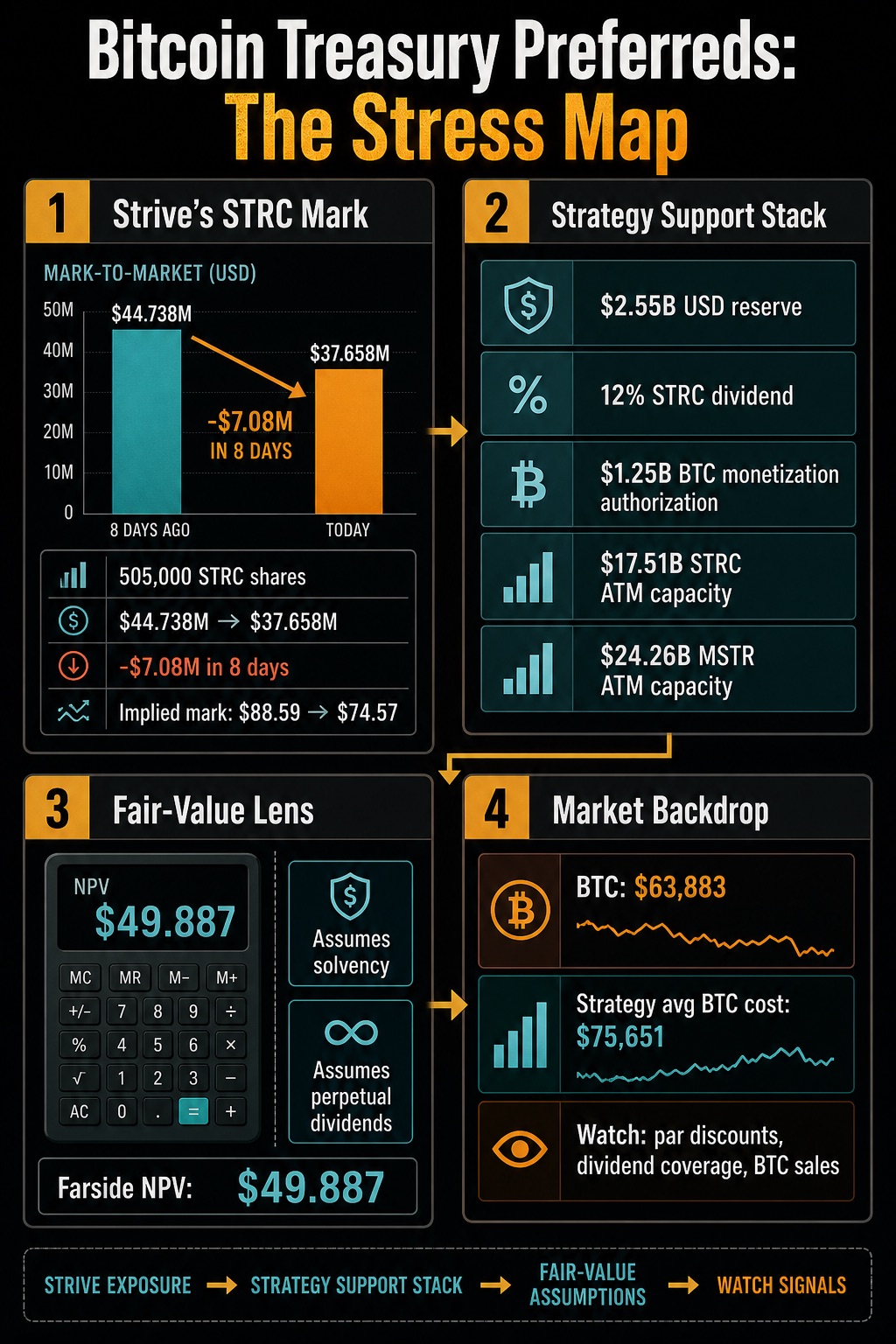

Strive's $7.08 million unrealized loss on its STRC preferred shares in 8 days exposes industry cross-holding risk. Simultaneously listing Strategy's full toolkit for stabilization—cash reserves, high dividends, coin sales, share issuance, etc.—alongside the third-party estimated STRC fair value of only $49.887 and the current bitcoin price far below the company's average cost basis, the article highlights the need to closely track preferred share discounts, dividend coverage capability, and bitcoin selling actions to judge industry risk trends.


Strategy's New Operational Framework: Essentially Credit Risk Management


The regulatory filing submitted by Strategy on June 29 further confirms the aforementioned shift in logic. The company introduced a Digital Credit Capital Framework, accompanied by policies including US Dollar Reserve Management Rules, a revised STRC dividend plan, a preferred share repurchase program, a common stock repurchase program, and a Bitcoin Monetization Plan. This combination of tools is specifically designed to address stressed capital structures.


Strategy disclosed that as of June 28, its US dollar reserve size reached $2.55 billion. The board mandated that management must retain cash reserves sufficient to cover at least the next 12 months of annual preferred share dividends and interest expenses, unless specifically authorized by the board to lower this threshold. The document also stated that reserve funds could be replenished through selling tokens under the Bitcoin Monetization Plan or via other capital market operations.


This reserve is crucial because Strategy increased the regular annualized dividend for STRC to 12%, payable monthly in two installments, applicable to record dates on or after July 1. The company has announced a $0.50 per share cash dividend for the settlement periods ending July 31 and August 15, with specific payment conditions subject to the STRC issuance agreement.


While raising dividends can support this income product in the short term, it also raises new questions: if the security continues to trade at a discount, can this high-dividend policy be sustained long-term?


Strategy clearly outlined the policy linkage logic: the STRC dividend plan will comprehensively consider the STRC secondary market price, overall market yields, credit spreads, bitcoin price and volatility, reserve coverage, capital market environment, and the company's overall capital structure. The document also emphasized that STRC dividends are not guaranteed obligations and will not be unilaterally increased simply because STRC's market price is below par value.


The entire policy system follows an active credit management approach. The company also authorized up to $1 billion for repurchasing its own digital credit securities. If management judges that repurchases can enhance enterprise value and optimize the capital structure, STRC will be the priority repurchase target. An additional $1 billion was authorized for repurchasing Class A common stock. These repurchase authorizations do not obligate the company to execute them but clearly demonstrate all the tools management can employ if discount risks continue to worsen.


Within the same capital framework, bitcoin sales were also formally incorporated as a response measure. The board approved the Bitcoin Monetization Plan, allowing the company to raise up to $1.25 billion by selling bitcoin to supplement US dollar reserves. If management determines this method is preferable to issuing additional common stock or other capital market operations, proceeds from coin sales can be used to cover preferred share dividends and interest expenses and also provide funds for share repurchases.


The company explicitly stated that this plan does not mandate forced bitcoin sales. However, this authorization fundamentally changes the market narrative: this company, originally built around hoarding bitcoin as its core business, now has a formal channel to utilize its bitcoin assets to stabilize its credit system.


Fair Value Calculations: The Core Test is Dividend Sustainability


The STRC fair value calculator publicly available from third-party firm Farside explains why the market discussion has long moved beyond surface-level yields. CryptoSlate queried the tool's data on July 7. Under preset calculation conditions, STRC's net present value per share was only $49.887. The calculation model defaults to an initial coupon rate of 11.50%, which steps down to 3.60% starting from month 33.


This calculation has a key prerequisite assumption: the enterprise continues normal operations and permanently pays dividends in full. This valuation is not the official pricing provided by Strategy, nor should it be conflated with Strategy's announced 12% annualized STRC dividend policy. However, it clearly reflects the core variable that preferred share investors truly focus on: valuation is highly dependent on dividend sustainability, the discount rate, and the issuer's ability to continue making interest payments amidst bitcoin price movements and capital market fluctuations.


The broader bitcoin market environment further amplifies this credit test. CryptoSlate bitcoin price data shows that on July 8, bitcoin was quoted around $62,000, with a 24-hour decline of 1.8%, a 7-day gain of 5.5%, a total market capitalization of $1.24 trillion, and bitcoin's market share of the total crypto market at 58%.


However, Strategy's June 28 bitcoin holdings data shows the company holds 847,363 bitcoins with an average cost basis of $75,651. While the current market price being far below the average cost won't force immediate sales, it also explains why the market is highly focused on reserve policies, at-the-market (ATM) issuance mechanisms, and terms related to bitcoin monetization.


Strategy's ATM issuance data intuitively shows this business model still possesses ample financing space. Between June 22 and 28, the company did not issue additional preferred shares via the ATM channel. It only sold 12,669,017 shares of MSTR common stock, raising net proceeds of $1.1524 billion. Remaining issuance capacity stands at: $17.5108 billion for STRC preferred shares and $24.2575 billion for MSTR common shares, alongside other preferred share issuance programs.


The entire business model still has multiple cushioning tools. But the key question is: What price must be paid to deploy these tools when investors demand higher yields, securities trade at significant discounts, or stronger collateral assets are required?


Two Scenarios: Judging Whether Risk Has Fully Spread


The market's current judgment on the subsequent trend is divided into two core logics:


Scenario One: Risk Contained, Affecting Only Strategy


STRC discount narrows. US dollar reserves and dividend policies stabilize market sentiment. The Bitcoin Monetization Plan remains only a backup option. Strive's asset impairment is merely a one-off, short-term shock from cross-holdings. The rest of the industry's reserve companies remain unaffected. Pressure remains concentrated solely on Strategy itself.


Scenario Two: Risk Fully Spreads


STRC remains deeply discounted long-term. Raising dividends fails to placate the market. The company increasingly relies on the common stock ATM issuance channel. The Bitcoin Monetization Plan transitions from authorization to actual selling. Simultaneously, Strive's own issued SATA preferred shares come under pressure. They are no longer viewed as independent products but are grouped with STRC by the market as high-risk assets. At that point, bitcoin reserve preferred shares evolve from a single-company issue into a systemic risk for the entire sector.


Existing disclosure documents do not prove the second scenario is occurring yet, but they sufficiently explain the root of market concern: Strive's holding of STRC directly translates Strategy's discount risk into a fair value loss on another company's financial report.


Strategy's introduced framework integrates dividends, cash reserves, share buybacks, ATM issuances, and potential bitcoin sales into a unified risk buffer system. Meanwhile, the Farside valuation tool highlights that corporate viability and the assumption of perpetual dividends are the core determinants of preferred share value.


The core indicators for subsequent market observation are clear: whether the discount-to-par for STRC and SATA widens, whether dividend cash coverage capability is credible, whether companies increase the intensity of common or preferred share issuance, and whether bitcoin sales remain only at the authorization stage.


Future financial reports disclosed by Strive will become a critical signal to judge whether the loss on its Strategy preferred shares is merely an isolated case or the first public sign of bitcoin reserve credit risk spreading industry-wide via the preferred share model.


Trending Cryptos

Related Questions

QWhat key risk did Strive's disclosure regarding its STRC holdings highlight for the entire Bitcoin reserve enterprise sector?

AIt highlighted the risk of cross-holdings, where market pressure or devaluation of one company's preferred shares (like Strategy's STRC) can directly cause mark-to-market losses on the balance sheets of other companies in the sector (like Strive). This creates a clear channel for risk contagion beyond a single firm's problems.

QWhat are the two potential scenarios for risk evolution in the Bitcoin reserve preferred share market described in the article?

AThe two scenarios are: 1) Contained Risk, where STRC's discount narrows, confidence in cash reserves and dividend policies is restored, and the pressure remains limited to Strategy. 2) System-wide Diffusion, where STRC remains deeply discounted, cash reserves and increased dividends fail to stabilize the market, leading to actual Bitcoin sales, and pressure spreads to other preferred shares like SATA, transforming it into a sector-wide systemic risk.

QAccording to the article, how has Strategy's recently announced framework fundamentally changed the nature of its business and the preferred shares?

AIt has shifted the framework from a pure Bitcoin accumulation business to an active credit risk management model. By formally integrating tools like a mandatory cash reserve for dividends, revised dividend policies, share buyback plans, and a potential Bitcoin monetization plan, it treats its preferred shares (STRC) as credit instruments whose value depends on the company's financial strength and ability to service its obligations.

QWhat is the core factor determining the fair value of Strategy's STRC preferred share, as illustrated by the third-party valuation tool mentioned in the article?

AThe core factor is the sustainability of the dividend payments. The valuation model heavily depends on the critical assumption that the company will continue to operate normally and fully pay dividends in perpetuity. Therefore, the share's value is tied to the issuer's long-term solvency and cash flow generation capacity.

QWhat specific metrics does the article suggest are crucial for monitoring to assess the spread of risk in the sector going forward?

AKey monitoring metrics include: the discount-to-par value of STRC and other preferred shares like SATA; the credibility of the cash coverage for dividend payments; whether companies increase the pace of issuing common or preferred shares via ATM programs; and whether authorized Bitcoin sales plans transition from a contingency into actual asset sales.

Related Reads

Are the Frantic Acquisitions of Crypto Companies by Giants Good or Bad?

In a bear market, giants are actively acquiring crypto companies. Recent months have seen at least five major deals: Samsung Securities bought a 2% stake in Upbit operator Dunamu; Robinhood acquired WonderFi for $180 million to enter the Canadian market; Figure purchased Kiavi for $717 million to expand into on-chain real estate credit; Franklin Templeton bought 250Digital to launch Franklin Crypto; and Blockworks acquired data platform Messari at a steep discount—over 90% less than its 2022 $300 million valuation. These moves highlight a strategic shift. Cash-rich giants are consolidating resources at low cost, targeting companies with established compliance frameworks to navigate tightening global regulations. Acquisitions like WonderFi and the Upbit stake provide immediate market access and licensed user bases. Figure's deal signals real-world asset (RWA) tokenization moving from concept to large-scale implementation, with Kiavi's $7+ billion annual transaction volume being integrated into on-chain capital markets. Franklin Crypto's launch targets institutional investors like pension funds, offering them tailored, compliant crypto strategies. For these strategic players, bear markets present an ideal entry point: valuations are depressed, speculative noise is minimized, and they can acquire robust technology and compliance infrastructure at a fraction of the cost. This acquisition wave marks a transitional phase for crypto—from a wild frontier toward an institutional, regulated financial system. Giants are positioning themselves to capture future growth when macroeconomic conditions and liquidity improve, leaving latecomers behind.

marsbit31m ago

Are the Frantic Acquisitions of Crypto Companies by Giants Good or Bad?

marsbit31m ago

In the MiCA Era, Europe's New Cryptography Landscape: Why is Germany Taking Center Stage?

With MiCA's transitional arrangements concluding, Europe's crypto industry has undergone a regulatory consolidation. Post-MiCA, platforms must secure CASP authorization to operate compliantly within the EU. As of July 1st, only about 12% of crypto firms have received authorization, with Germany emerging as a key player, holding 57 authorizations (roughly 23% of the EU total). This positions Germany as a primary compliance gateway to the EU's unified market. Germany's advantage stems from its established, function-based regulatory framework, which integrated crypto activities into existing banking, securities, and payment systems pre-MiCA. This allowed a smoother transition and attracted both domestic platforms (like Bitcoin.de, BISON) and international ones (like Coinbase Germany). A distinctive trend is German banks becoming direct retail entry points for crypto services. Examples include DZ Bank integrating "meinKrypto" into its VR Banking App and the Sparkassen savings bank network planning to offer crypto trading via DekaBank. This mainstreams crypto access for ordinary users. Beyond trading, Germany is evolving into a digital asset infrastructure hub. Deutsche Börse Group's Clearstream is developing a next-generation platform for issuing, settling, and servicing both traditional and tokenized securities. Furthermore, German banks like DekaBank and DZ Bank are key participants in the Qivalis project, a European initiative for a regulated euro stablecoin, positioning Germany at the intersection of critical future capabilities like custody, settlement, and cross-border services.

marsbit1h ago

In the MiCA Era, Europe's New Cryptography Landscape: Why is Germany Taking Center Stage?

marsbit1h ago

Trading

Spot

Hot Articles

What is $BITCOIN

DIGITAL GOLD ($BITCOIN): A Comprehensive Analysis Introduction to DIGITAL GOLD ($BITCOIN) DIGITAL GOLD ($BITCOIN) is a blockchain-based project operating on the Solana network, which aims to combine the characteristics of traditional precious metals with the innovation of decentralized technologies. While it shares a name with Bitcoin, often referred to as “digital gold” due to its perception as a store of value, DIGITAL GOLD is a separate token designed to create a unique ecosystem within the Web3 landscape. Its goal is to position itself as a viable alternative digital asset, although specifics regarding its applications and functionalities are still developing. What is DIGITAL GOLD ($BITCOIN)? DIGITAL GOLD ($BITCOIN) is a cryptocurrency token explicitly designed for use on the Solana blockchain. In contrast to Bitcoin, which provides a widely recognized value storage role, this token appears to focus on broader applications and characteristics. Notable aspects include: Blockchain Infrastructure: The token is built on the Solana blockchain, known for its capacity to handle high-speed and low-cost transactions. Supply Dynamics: DIGITAL GOLD has a maximum supply capped at 100 quadrillion tokens (100P $BITCOIN), although details regarding its circulating supply are currently undisclosed. Utility: While precise functionalities are not explicitly outlined, there are indications that the token could be utilized for various applications, potentially involving decentralized applications (dApps) or asset tokenization strategies. Who is the Creator of DIGITAL GOLD ($BITCOIN)? At present, the identity of the creators and development team behind DIGITAL GOLD ($BITCOIN) remains unknown. This situation is typical among many innovative projects within the blockchain space, particularly those aligning with decentralized finance and meme coin phenomena. While such anonymity may foster a community-driven culture, it intensifies concerns about governance and accountability. Who are the Investors of DIGITAL GOLD ($BITCOIN)? The available information indicates that DIGITAL GOLD ($BITCOIN) does not have any known institutional backers or prominent venture capital investments. The project seems to operate on a peer-to-peer model focused on community support and adoption rather than traditional funding routes. Its activity and liquidity are primarily situated on decentralized exchanges (DEXs), such as PumpSwap, rather than established centralized trading platforms, further highlighting its grassroots approach. How DIGITAL GOLD ($BITCOIN) Works The operational mechanics of DIGITAL GOLD ($BITCOIN) can be elaborated on based on its blockchain design and network attributes: Consensus Mechanism: By leveraging Solana’s unique proof-of-history (PoH) combined with a proof-of-stake (PoS) model, the project ensures efficient transaction validation contributing to the network's high performance. Tokenomics: While specific deflationary mechanisms have not been extensively detailed, the vast maximum token supply implies that it may cater to microtransactions or niche use cases that are still to be defined. Interoperability: There exists the potential for integration with Solana’s broader ecosystem, including various decentralized finance (DeFi) platforms. However, the details regarding specific integrations remain unspecified. Timeline of Key Events Here is a timeline that highlights significant milestones concerning DIGITAL GOLD ($BITCOIN): 2023: The initial deployment of the token occurs on the Solana blockchain, marked by its contract address. 2024: DIGITAL GOLD gains visibility as it becomes available for trading on decentralized exchanges like PumpSwap, allowing users to trade it against SOL. 2025: The project witnesses sporadic trading activity and potential interest in community-led engagements, although no noteworthy partnerships or technical advancements have been documented as of yet. Critical Analysis Strengths Scalability: The underlying Solana infrastructure supports high transaction volumes, which could enhance the utility of $BITCOIN in various transaction scenarios. Accessibility: The potential low trading price per token could attract retail investors, facilitating wider participation due to fractional ownership opportunities. Risks Lack of Transparency: The absence of publicly known backers, developers, or an audit process may yield skepticism regarding the project's sustainability and trustworthiness. Market Volatility: The trading activity is heavily reliant on speculative behavior, which can result in significant price volatility and uncertainty for investors. Conclusion DIGITAL GOLD ($BITCOIN) emerges as an intriguing yet ambiguous project within the rapidly evolving Solana ecosystem. While it attempts to leverage the “digital gold” narrative, its departure from Bitcoin's established role as a store of value underscores the need for a clearer differentiation of its intended utility and governance structure. Future acceptance and adoption will likely depend on addressing the current opacity and defining its operational and economic strategies more explicitly. Note: This report encompasses synthesised information available as of October 2023, and developments may have transpired beyond the research period.

684 Total ViewsPublished 2025.05.13Updated 2025.05.13

What is $BITCOIN

Discussions

Welcome to the HTX Community. Here, you can stay informed about the latest platform developments and gain access to professional market insights. Users' opinions on the price of BTC (BTC) are presented below.

活动图片