‘Stretch the orange dots’ – Saylor hints Strategy’s Bitcoin spree isn’t over

ambcryptoPublished on 2026-03-16Last updated on 2026-03-16

Abstract

Michael Saylor, through his recent social media post "Stretch the orange dots," has signaled that his company, MicroStrategy, plans to continue its aggressive accumulation of Bitcoin. The "orange dots" refer to the company's individual BTC purchases, which now total 102 events. MicroStrategy is the largest corporate Bitcoin holder, with 738,731 BTC (approx. 3.5% of total supply) acquired at an average price of ~$75,863. The company employs a leveraged financial strategy, raising capital by issuing new shares or convertible debt to fund further Bitcoin purchases. This approach is praised by supporters as visionary but criticized by others, including Peter Schiff, as a high-risk gamble dependent entirely on Bitcoin's long-term price appreciation. Analysts note that if the current pace continues, MicroStrategy's holdings could surpass the estimated coins belonging to Satoshi Nakamoto by 2027. The success or failure of this strategy is ultimately tied to the future value of Bitcoin.

Michael Saylor never misses a chance to talk about his firm, Strategy. In his latest post on X, he once again highlighted the company’s long-term plan of continuously buying Bitcoin [BTC].

He said,

Stretch the Orange Dots.
Source: Michael Saylor/X

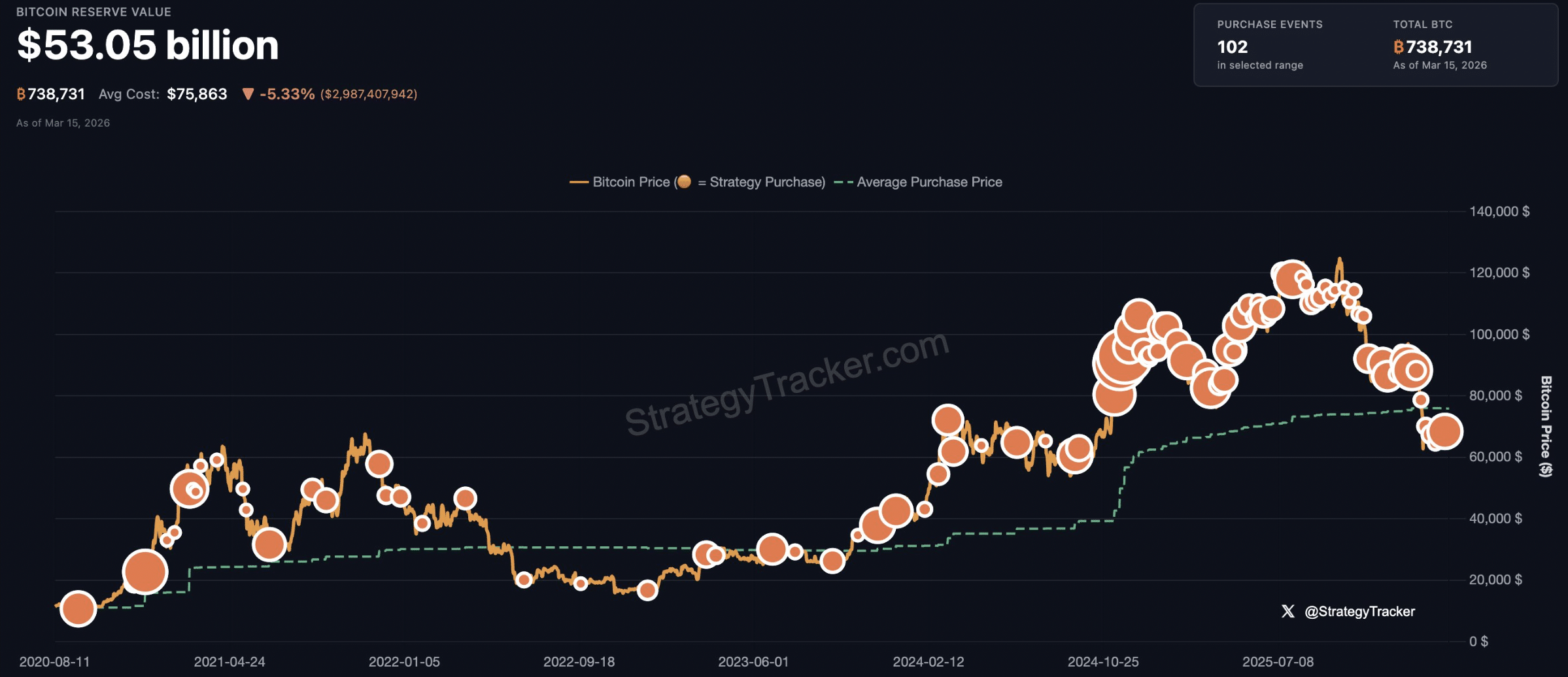
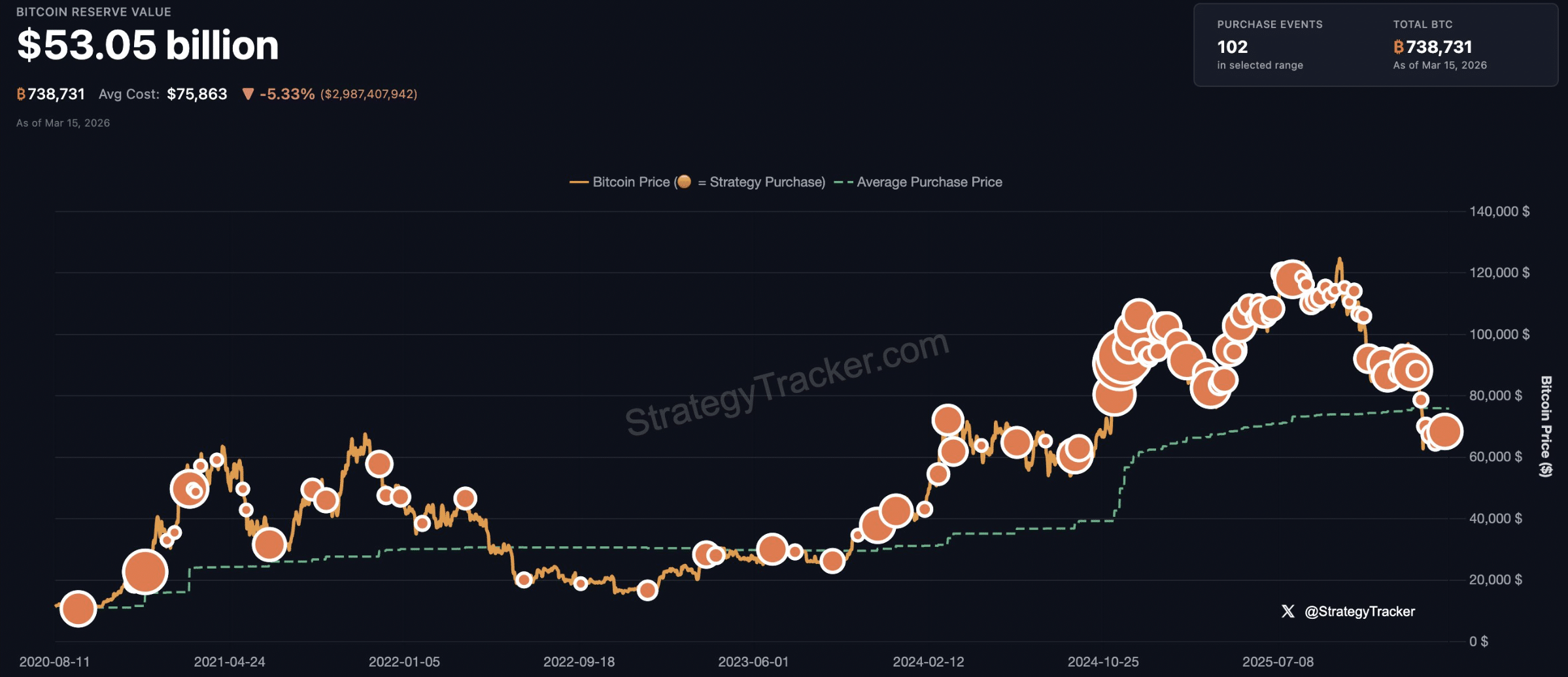
Saylor even added a chart highlighting the company’s Bitcoin purchases over several years, hinting that the buying is far from over. For context, every orange dot in the chart represents one Bitcoin purchase made by Strategy.

Strategy’s Bitcoin buying spree

So far, there have been 102 purchase events by mid-March 2026. The orange line shows how Bitcoin’s price has moved over time, while a green dashed line shows Strategy’s average buying price, which is around $75,863.

When Saylor says “stretch the orange dots,” he means people should zoom out and look at the bigger picture instead of focusing on short-term price changes.

That said, Strategy currently holds 738,731 BTC, which is about 3.5% of Bitcoin’s total supply of 21 million coins. With Bitcoin trading near $73,000, the message suggests that Strategy may continue buying more Bitcoin and adding more “orange dots” in the future.

Analysts are divided

Needless to say, the company’s strategy is not only based on spare cash. According to analyst Lark Davis, Strategy has created a financial loop to keep buying Bitcoin.

It raises money by selling new shares or issuing convertible debt, and then uses that money to buy more BTC. In simple terms, it turns its stock into a tool to accumulate Bitcoin.

Remarking on which, Davis added,

It only works if Bitcoin keeps going up. Which means it’s either the greatest trade in history... or the most transparent gamble ever run.

Investors appear to support this strategy, as the company’s stock MSTR recently rose to about $139.67, showing confidence in its Bitcoin-focused approach.

Strategy vs other Bitcoin DATs

While Strategy remains the largest corporate holder of Bitcoin, several other companies are beginning to adopt a similar strategy.

MARA Holdings ranks second with 53,822 BTC, followed by Twenty One Capital with 43,514 BTC, and Metaplanet with 35,102 BTC.

In fact, if Strategy continues buying Bitcoin at the same pace, analysts believe that by March 2027, it could even hold more Bitcoin than the estimated 1.1 million BTC believed to belong to Satoshi Nakamoto.

However, while some people support Strategy’s aggressive Bitcoin approach, others strongly criticize it. One of the loudest critics is Peter Schiff, who argues that the strategy is risky.

He recently noted that even after buying more Bitcoin at lower prices, the company is still about 5% down on its latest purchase.

Supporters understand Saylor’s plan

Supporters, however, say the strategy is more complex. Finance expert Rajat Soni explains that Strategy raises money by issuing financial products and then uses those funds to buy more Bitcoin.

One example is STRC (Variable Rate Perpetual Stretch Preferred Stock), which offers investors an 11.5% dividend, with the funds used to acquire additional BTC.

In simple terms, the company is using leverage, money from investors, to expand its Bitcoin holdings. STRC investors receive stable dividends and priority claims, while MSTR shareholders benefit from the potential upside of Bitcoin.

Because of this structure, critics sometimes compare the model to a risky financial scheme. However, Strategy’s goal remains the same – to keep accumulating Bitcoin.

Ultimately, whether the strategy succeeds or fails will depend on Bitcoin’s long-term price.


Final Summary

  • Saylor’s message suggests the company is focused on accumulation, not short-term market swings.
  • While supporters call it visionary, critics warn that heavy leverage could create risks.

Related Questions

QWhat does Michael Saylor mean by 'Stretch the Orange Dots' in his recent post?

AHe means that people should zoom out and look at the bigger, long-term picture of MicroStrategy's Bitcoin accumulation strategy instead of focusing on short-term price changes. Each orange dot on the chart represents a Bitcoin purchase by the company.

QWhat is MicroStrategy's current Bitcoin holding and its average purchase price?

AMicroStrategy currently holds 738,731 BTC, which is about 3.5% of Bitcoin's total supply. The company's average buying price is around $75,863.

QAccording to the article, how does MicroStrategy finance its continuous Bitcoin purchases?

AThe company raises money by selling new shares or issuing convertible debt and financial products like the STRC (Variable Rate Perpetual Stretch Preferred Stock). It then uses that capital to buy more Bitcoin, effectively turning its stock into a tool for accumulation.

QWhat is the main criticism of MicroStrategy's Bitcoin strategy, as mentioned in the article?

AThe main criticism, voiced by people like Peter Schiff, is that the strategy is highly risky because it relies heavily on leverage and is entirely dependent on Bitcoin's long-term price continuing to rise.

QHow does the article describe the potential future outcome if MicroStrategy continues its current pace of Bitcoin?

AAnalysts believe that if MicroStrategy continues buying Bitcoin at the same pace, by March 2027 it could hold more Bitcoin than the estimated 1.1 million BTC believed to belong to Satoshi Nakamoto.

Related Reads

You Bet on the News, the Pros Read the Rules: The True Cognitive Gap in Losing Money on Polymarket

The article explains that the key to profiting on Polymarket, a prediction market platform, lies not just predicting real-world events correctly, but in meticulously understanding the specific rules that govern how each market will be resolved. It illustrates this with examples, such as a market on Venezuela's 2026 leader, where the official rules defining "officially holds" the office overruled the intuitive answer of who was in practical control. Other examples include debates over the definition of a "token" or what constitutes an "agreement." The core argument is that a "reality vs. rules" gap creates pricing discrepancies that savvy traders ("车头" or "whales") exploit. The platform has a formal dispute resolution process managed by UMA token holders to settle ambiguous outcomes. This process involves proposal submission, a challenge window, a discussion period, and a final vote. However, the article highlights a critical flaw in this system compared to a traditional court: the lack of separation between the arbiters (UMA voters) and the interested parties (traders with financial stakes in the outcome). This conflict of interest undermines the discussion phase, leads to herd mentality, and results in opaque final decisions without explanatory rulings. Consequently, the system lacks a body of precedent, making it difficult for users to learn from past disputes. The ultimate takeaway is that success on Polymarket requires a lawyer-like scrutiny of the rules to identify and capitalize on the cognitive gap between how events appear and how they are contractually defined for settlement.

marsbit24m ago

You Bet on the News, the Pros Read the Rules: The True Cognitive Gap in Losing Money on Polymarket

marsbit24m ago

Will the Fed Still Cut Interest Rates? Tonight's Data Is Crucial

The core debate surrounding the Federal Reserve's potential interest rate cuts is intensifying amid geopolitical conflict and rebounding inflation. The key question is whether high energy prices will cause persistent inflation or weaken consumer demand enough to force the Fed to cut rates. Citigroup presents a bullish case for cuts, arguing that oil supply disruptions from the Strait of Hormuz are temporary and will not lead to lasting inflationary pressure. They point to receding bond yields and oil prices as evidence the market is pricing in a short-lived shock. Citi's data also shows tightening financial conditions, a stabilizing labor market, and healthy tax returns, supporting their view that the path to lower rates remains open. Conversely, Deutsche Bank offers a starkly contrasting, more hawkish outlook. They argue the Fed's current policy is already neutral and expect rates to remain unchanged indefinitely. Their view is based on stalled disinflation progress and a shift toward more hawkish rhetoric from key Fed officials like Waller, who cited risks from prolonged Middle East conflict and tariffs. Other officials, including Williams and Hammack, signaled rates would likely stay on hold for a "considerable time." The market pricing has shifted dramatically, now forecasting zero cuts in 2026. The imminent release of the March retail sales "control group" data is highlighted as a critical test. This metric, which excludes gas station sales, will reveal if high gasoline prices are eroding consumer spending in other areas. A weak reading could support the case for imminent rate cuts, while a strong one would bolster the argument for the Fed to hold steady. This data is pivotal for determining the near-term policy path.

marsbit45m ago

Will the Fed Still Cut Interest Rates? Tonight's Data Is Crucial

marsbit45m ago

Trading

Spot
Futures

Hot Articles

Discussions

Welcome to the HTX Community. Here, you can stay informed about the latest platform developments and gain access to professional market insights. Users' opinions on the price of S (S) are presented below.

活动图片