Strategy Sells Bitcoin Again to Support Its Stocks

cryptonews.ruPublished on 2026-08-03Last updated on 2026-08-03

Abstract

MicroStrategy, led by Michael Saylor, has sold 1,638 bitcoins for approximately $104.7 million, marking its second-largest sale this year. The proceeds were used to pay dividends on its Series A Preferred Stock (STRC) and to repurchase those same shares. Despite this sale, the company's core bitcoin holdings remain substantial at over 842,000 BTC, acquired at a total cost of $63.5 billion. Concurrently, MicroStrategy raised $290.6 million through an offering of its common stock (MSTR). Of this, $250 million bolstered the company's dollar reserves, bringing the total to $4 billion, with the remainder used for further STRC buybacks and general corporate purposes. The sale and offering are part of a strategy to support the STRC instrument, a key funding vehicle for MicroStrategy's bitcoin acquisitions. Currently trading below its $100 target price, maintaining STRC's value is crucial for the company's future capital-raising ability. Analysts suggest this transaction is a targeted balance sheet adjustment rather than a sign of depleted reserves. However, a persistent discount on STRC could pressure the company to rely more on MSTR share offerings or further bitcoin sales to finance its operations and dividends.

Michael Saylor's company, Strategy, sold 1,638 bitcoins — its second-largest sale volume this year. The proceeds were used to pay dividends on its preferred stock, STRC, and to repurchase those same shares from the market.

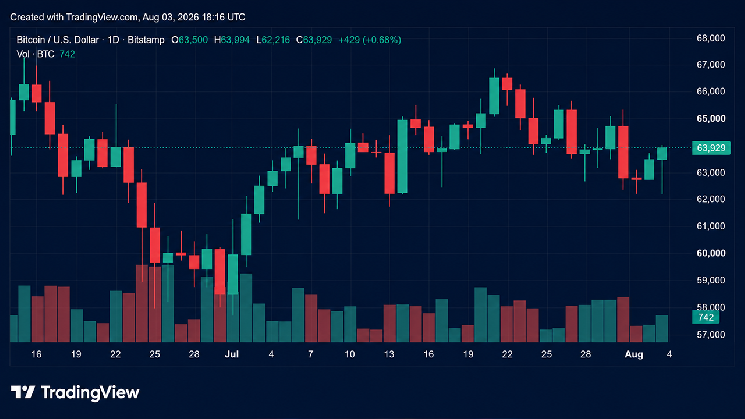
According to an 8-K form filed with the Securities and Exchange Commission (SEC), the bitcoins were sold between July 27 and August 2 at an average price of $63,957 per coin. The total transaction amounted to $104.7 million. Of this amount, $52.4 million was allocated for dividend payments to STRC holders, and another $52.3 million was used for the buyback of the preferred shares themselves.

After the sale, the company still holds 842,138 BTC, with a total purchase cost estimated at $63.5 billion.

Dollar Reserve Grows to $4 Billion

In addition to selling bitcoin, Strategy raised $290.6 million through an offering of MSTR shares. Of this amount, $250 million was used to replenish its dollar reserve, which reached $4 billion; another $28.9 million was allocated to repurchasing STRC; and $11.7 million remained on the company's balance sheet.

In a post on social media X, Saylor stated that the company repurchased $81.2 million worth of STRC shares and extended its dollar liquidity cushion by 57 days — it is now sufficient for 2.3 years.

During pre-market trading on August 3, STRC preferred shares traded at $89.40 — 10.6% below the target level of $100, according to Yahoo Finance data. MSTR shares also declined by 0.9% in pre-market trading on the same day, as indicated by exchange data.

Why the Company Uses This Scheme

STRC is one of the instruments through which Strategy finances its bitcoin purchases. Trading of the paper below par limits the company's ability to raise funds through STRC offerings. Furthermore, this may push Strategy to further increase the dividend rate to maintain buyer interest and support the share price closer to the target level.

Earlier, on June 24, CryptoQuant head Ki Young Ju stated that the company should pause bitcoin purchases and replenish its cash reserves after the dividend coverage ratio shrank from seven years to 14 months.

In an 8-K form filed on June 29, Strategy presented a new capital strategy that allows for the sale of bitcoin to fund dividends, increased the annual dividend rate on STRC to 12%, and reported that its dollar reserve at that time had grown to $2.55 billion.

The sale of 1,638 bitcoins marks Strategy's second-largest reduction of its reserve this year — while the company has preserved the main portion of its holdings, exceeding 842 thousand coins. At the same time, the company's dollar reserve is growing, and the repurchase of STRC continues, reflecting an attempt to keep the price of the preferred shares closer to par.

The performance of STRC and MSTR in the coming weeks will show how effective the chosen scheme of funding dividends through the sale of part of the bitcoin reserves is.

AI Perspective

From a macroeconomic analysis standpoint, the situation echoes an episode when Strategy's mNAV multiplier fell below one — a moment analysts have already compared to the dynamics of 2022, which preceded a rise in volatility. A technical aspect not covered in the article is STRC's dependence on the market's willingness to buy the paper above par: if the discount persists, the company will have to rely either on new MSTR offerings or further coin sales, not just on raising the dividend rate. Particular attention should be paid to the threshold outlined by analyst Willy Woo: according to his calculations, forced bitcoin sales would be required by Strategy only in the event of a significant and prolonged drop in the stock's market capitalization. For now, the current deal appears more as a targeted balance sheet adjustment rather than a sign of reserve depletion.

The question is different: how long will the market tolerate the discount of STRC to par before it affects the company's ability to attract new capital?


Trending Cryptos

Related Questions

QHow many bitcoins did Michael Saylor's company Strategy sell, and what was the main purpose of the proceeds?

AStrategy sold 1,638 bitcoins. The proceeds of $104.7 million were used to pay dividends on the STRC preferred shares and to buy back those same shares from the market.

QWhat is the current size of Strategy's Bitcoin reserve after this sale?

AAfter the sale, Strategy still owns 842,138 BTC. The total cost basis for this holding is estimated at $63.5 billion.

QHow did Strategy increase its dollar reserve to $4 billion?

AStrategy increased its dollar reserve to $4 billion by raising $290.6 million through an MSTR stock offering. Of this amount, $250 million was allocated to replenish the dollar reserve. Additional funds were used for buying back STRC shares and left on the company's balance sheet.

QWhy is Strategy selling Bitcoin according to the article's analysis of its capital strategy?

AStrategy's updated capital strategy allows for the sale of Bitcoin to finance dividends for its STRC preferred shares. This move, along with increasing the dividend rate and boosting the dollar reserve, is an attempt to support the price of STRC shares closer to their target par value and maintain the company's ability to raise capital.

QWhat is a key risk or challenge highlighted for Strategy regarding its STRC preferred shares?

AA key risk is the market discount of STRC shares below their $100 target par value. If this discount persists, it could limit Strategy's ability to raise new funds through STRC offerings. The company might then be forced to rely more heavily on MSTR stock sales or further Bitcoin sales, rather than just increasing the dividend rate, to finance its operations and Bitcoin purchases.

Related Reads

ZEC Price Just Surpassed $490 — Here's What Fueled the Rally

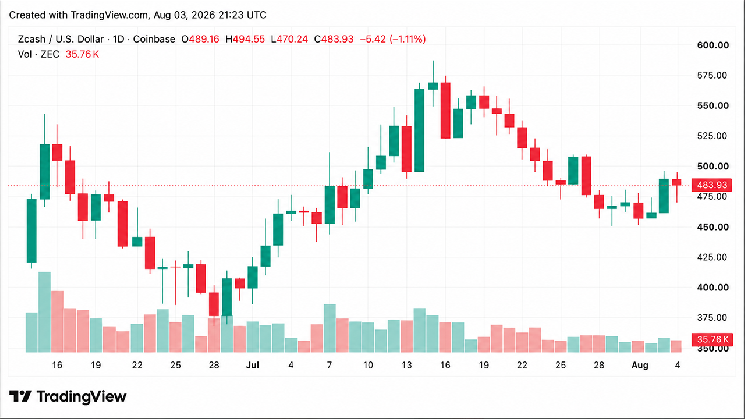
ZEC Surges Past $490, Key Drivers Behind the Rally On August 3, the privacy-focused cryptocurrency Zcash (ZEC) surged nearly 5%, climbing over $20 in a six-hour rally to a session high near $494. This move helped ZEC's market cap reclaim $8 billion, solidifying its position as the most valuable privacy coin and marking an almost 8% gain for the month. While benefiting from a broader market uptrend, ZEC's outperformance was driven by significant fundamental catalysts. The primary driver was the integration by privacy infrastructure project Nym of Zcash's new shielded pool, Ironwood. This enables direct, end-to-end private payments in ZEC for network services, a landmark development for privacy-first decentralized finance. The rally coincides with renewed industry focus on privacy as digital assets mature. Industry observers note privacy is becoming the "next frontier," evolving from Bitcoin's proof-of-concept to Ethereum's programmability and Solana's scalability. Commentary highlighted that true privacy, via zero-knowledge (ZK) technology which is now production-ready, was a foundational goal for early crypto pioneers. Further momentum came from Zcash's progress in decentralized governance, launching a retroactive grant funding (RetroPGF-like) program. This shifts treasury fund distribution from closed committees to direct coin holder voting, pioneering a privacy-native funding mechanism. ZEC's surge helped push the total market capitalization of privacy-focused coins above $30 billion. Other notable gainers included NEAR, ZK, and NOCK. However, losses in coins like ZANO, ZBT, and a significant drop in last week's leader COTI partially offset the sector's overall gains.

cryptonews.ru1m ago

ZEC Price Just Surpassed $490 — Here's What Fueled the Rally

cryptonews.ru1m ago

Jim Cramer Plans to Dump His Bitcoin, Warns Quantum Firm Will Crack Crypto Soon

CNBC's Jim Cramer announced plans to sell his Bitcoin holdings, citing warnings from IBM's CEO Arvind Krishna that commercially viable quantum computers could break Bitcoin's cryptography within three to four years. This statement triggered the popular "Inverse Cramer" reaction in crypto markets, with many traders viewing it as a bullish signal, and Bitcoin's price remained stable around $63,764. The specific quantum threat targets the ECDSA signature scheme, potentially exposing private keys from public ones for Bitcoin addresses that have been reused or are visible during transaction broadcasts. Researchers estimate around 30% of all BTC, or 6-7 million coins held in older "dormant" wallets, could be vulnerable. While a recent Google Quantum AI paper suggested such an attack might require fewer physical qubits than previously thought, current quantum systems are still orders of magnitude away from the reliable logical qubits needed. Expert timelines for a functional cryptographically relevant quantum computer vary widely, from Krishna's 2028-2029 estimate to more conservative predictions in the 2030s or 2040s. Cramer has a history of shifting his Bitcoin stance, and his latest warning was largely interpreted as a market sentiment indicator rather than a technical analysis. The focus now is on whether Bitcoin's development of quantum-resistant upgrades will outpace the advancement of quantum computing hardware.

cryptonews.ru1m ago

Jim Cramer Plans to Dump His Bitcoin, Warns Quantum Firm Will Crack Crypto Soon

cryptonews.ru1m ago

Trading

Spot

Hot Articles

What is $BITCOIN

DIGITAL GOLD ($BITCOIN): A Comprehensive Analysis Introduction to DIGITAL GOLD ($BITCOIN) DIGITAL GOLD ($BITCOIN) is a blockchain-based project operating on the Solana network, which aims to combine the characteristics of traditional precious metals with the innovation of decentralized technologies. While it shares a name with Bitcoin, often referred to as “digital gold” due to its perception as a store of value, DIGITAL GOLD is a separate token designed to create a unique ecosystem within the Web3 landscape. Its goal is to position itself as a viable alternative digital asset, although specifics regarding its applications and functionalities are still developing. What is DIGITAL GOLD ($BITCOIN)? DIGITAL GOLD ($BITCOIN) is a cryptocurrency token explicitly designed for use on the Solana blockchain. In contrast to Bitcoin, which provides a widely recognized value storage role, this token appears to focus on broader applications and characteristics. Notable aspects include: Blockchain Infrastructure: The token is built on the Solana blockchain, known for its capacity to handle high-speed and low-cost transactions. Supply Dynamics: DIGITAL GOLD has a maximum supply capped at 100 quadrillion tokens (100P $BITCOIN), although details regarding its circulating supply are currently undisclosed. Utility: While precise functionalities are not explicitly outlined, there are indications that the token could be utilized for various applications, potentially involving decentralized applications (dApps) or asset tokenization strategies. Who is the Creator of DIGITAL GOLD ($BITCOIN)? At present, the identity of the creators and development team behind DIGITAL GOLD ($BITCOIN) remains unknown. This situation is typical among many innovative projects within the blockchain space, particularly those aligning with decentralized finance and meme coin phenomena. While such anonymity may foster a community-driven culture, it intensifies concerns about governance and accountability. Who are the Investors of DIGITAL GOLD ($BITCOIN)? The available information indicates that DIGITAL GOLD ($BITCOIN) does not have any known institutional backers or prominent venture capital investments. The project seems to operate on a peer-to-peer model focused on community support and adoption rather than traditional funding routes. Its activity and liquidity are primarily situated on decentralized exchanges (DEXs), such as PumpSwap, rather than established centralized trading platforms, further highlighting its grassroots approach. How DIGITAL GOLD ($BITCOIN) Works The operational mechanics of DIGITAL GOLD ($BITCOIN) can be elaborated on based on its blockchain design and network attributes: Consensus Mechanism: By leveraging Solana’s unique proof-of-history (PoH) combined with a proof-of-stake (PoS) model, the project ensures efficient transaction validation contributing to the network's high performance. Tokenomics: While specific deflationary mechanisms have not been extensively detailed, the vast maximum token supply implies that it may cater to microtransactions or niche use cases that are still to be defined. Interoperability: There exists the potential for integration with Solana’s broader ecosystem, including various decentralized finance (DeFi) platforms. However, the details regarding specific integrations remain unspecified. Timeline of Key Events Here is a timeline that highlights significant milestones concerning DIGITAL GOLD ($BITCOIN): 2023: The initial deployment of the token occurs on the Solana blockchain, marked by its contract address. 2024: DIGITAL GOLD gains visibility as it becomes available for trading on decentralized exchanges like PumpSwap, allowing users to trade it against SOL. 2025: The project witnesses sporadic trading activity and potential interest in community-led engagements, although no noteworthy partnerships or technical advancements have been documented as of yet. Critical Analysis Strengths Scalability: The underlying Solana infrastructure supports high transaction volumes, which could enhance the utility of $BITCOIN in various transaction scenarios. Accessibility: The potential low trading price per token could attract retail investors, facilitating wider participation due to fractional ownership opportunities. Risks Lack of Transparency: The absence of publicly known backers, developers, or an audit process may yield skepticism regarding the project's sustainability and trustworthiness. Market Volatility: The trading activity is heavily reliant on speculative behavior, which can result in significant price volatility and uncertainty for investors. Conclusion DIGITAL GOLD ($BITCOIN) emerges as an intriguing yet ambiguous project within the rapidly evolving Solana ecosystem. While it attempts to leverage the “digital gold” narrative, its departure from Bitcoin's established role as a store of value underscores the need for a clearer differentiation of its intended utility and governance structure. Future acceptance and adoption will likely depend on addressing the current opacity and defining its operational and economic strategies more explicitly. Note: This report encompasses synthesised information available as of October 2023, and developments may have transpired beyond the research period.

1.4k Total ViewsPublished 2025.05.13Updated 2025.05.13

What is $BITCOIN

Discussions

Welcome to the HTX Community. Here, you can stay informed about the latest platform developments and gain access to professional market insights. Users' opinions on the price of BTC (BTC) are presented below.

活动图片