Stellar [XLM] hits a critical $0.261 wall – Breakout or rejection ahead?

ambcryptoPublished on 2026-01-07Last updated on 2026-01-07

Abstract

Stellar (XLM) is showing early signs of renewed momentum after months of consolidation, with a 7% price increase testing the critical $0.261 resistance level. This supply zone has historically triggered rejections, but a breakout could signal a trend shift and end the consolidation phase. Derivative data supports a bullish outlook, with long positions significantly outweighing shorts, reflecting strong buyer dominance. Liquidity clusters above the current price level further support potential upward movement. A decisive break above $0.261 may lead to a sustained bullish run, while failure could result in increased volatility.

Stellar’s price action is starting to show early signals of renewed momentum after spending months locked inside a tight flag consolidation.

At the time of writing, the token was up 7%, moving price action closer to the upper boundary of the long-standing flag channel and restarting bullish expectations among investors.

While the broader structure remains intact for now, the recent bullish move hints at the growing buyers’ activity and dominance at current levels.

Key supply zone at $0.261 comes into sight

At the heart of XLM’s near-term structure lies a familiar obstacle. The token is now testing the $0.261 supply zone, a level that has repeatedly capped upside attempts in recent months.

Historically, this price level triggered several rejection moves, and the chances of the situation repeating can be excluded.

However, a breakout above $0.261 would not only nullify the short-term supply threat but may also foretell a short-term trend shift, making it possible to break out of the phase of consolidation.
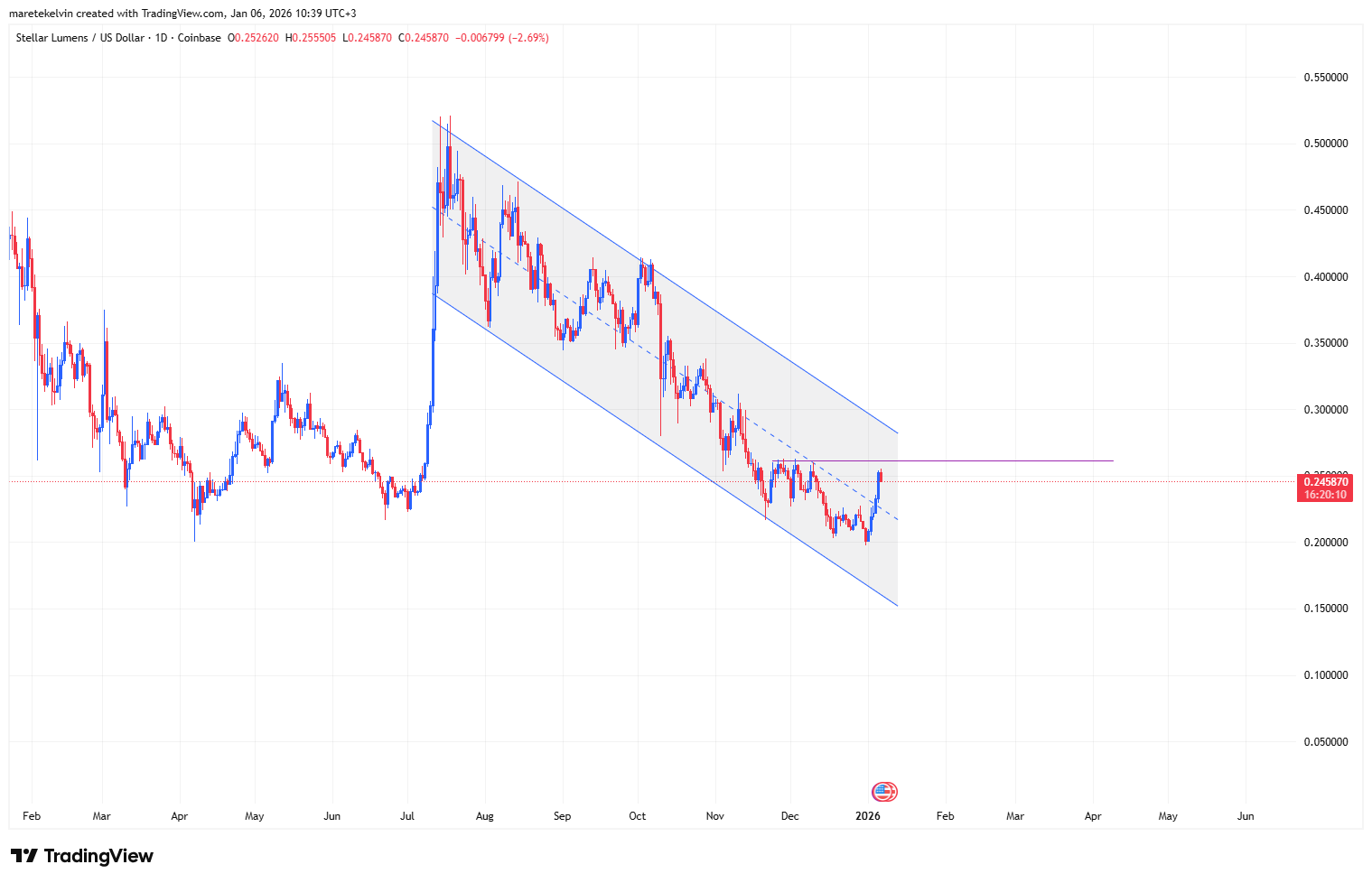
Source: TradingView

Market bias shifts

Stellar derivative data adds weight to the bullish narrative. At current prices, long positions are nearly tripling short positions.

In fact, at press time, the Long/Short Ratio stood at 2.769,  indicating a significant buyers’ dominance as position distribution tilts to the bulls’ favor.

Most XLM investors and traders are betting on further price surges. The resultant growing confidence from the imbalance could prolong the current momentum, more so if resistance gives way.

However, such positioning also raises the stakes. If price stalls at resistance, the market could see heightened volatility as leveraged traders adjust.
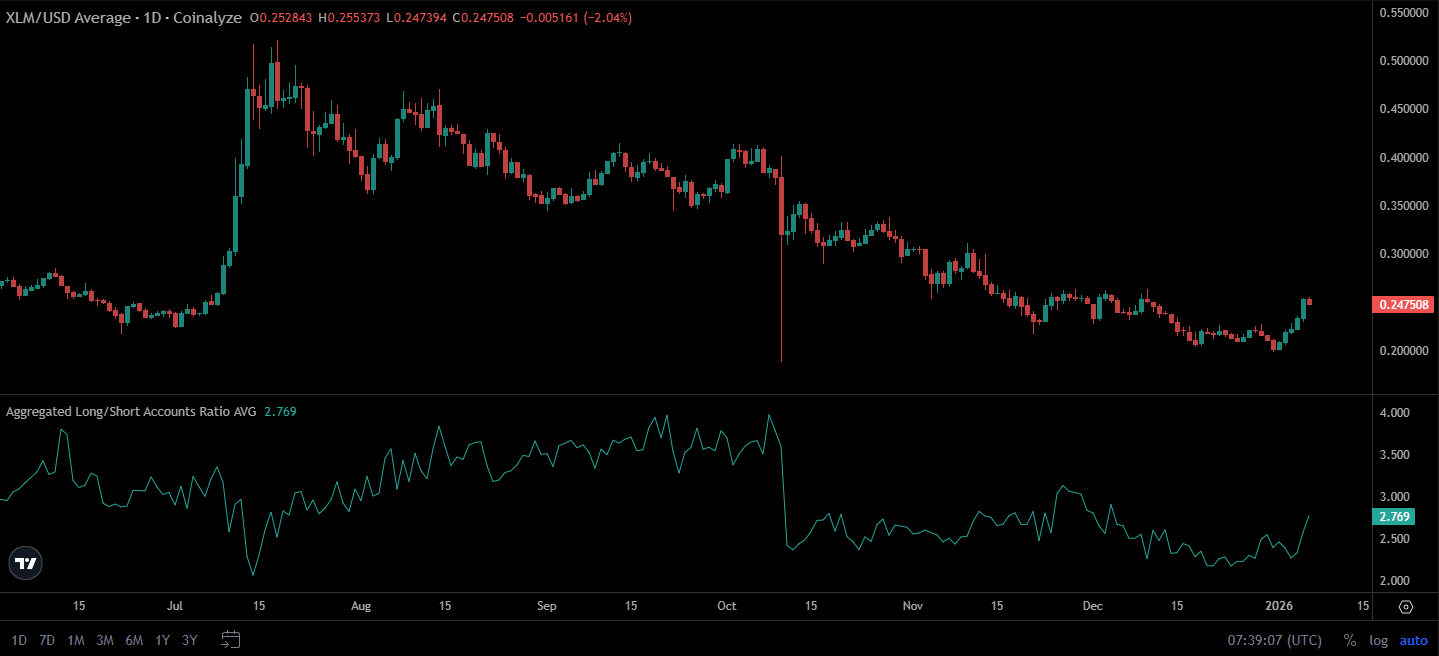
Source: Coinalyze

Potential momentum continuation?

Further supporting the breakout scenario, CoinGlass’s liquidity data revealed notable clusters sitting above the current trading range.

The 304.15K liquidity cluster at around 0.2683 affirmed the bullish bias, as traders logically aim at areas with higher stop and order concentration.
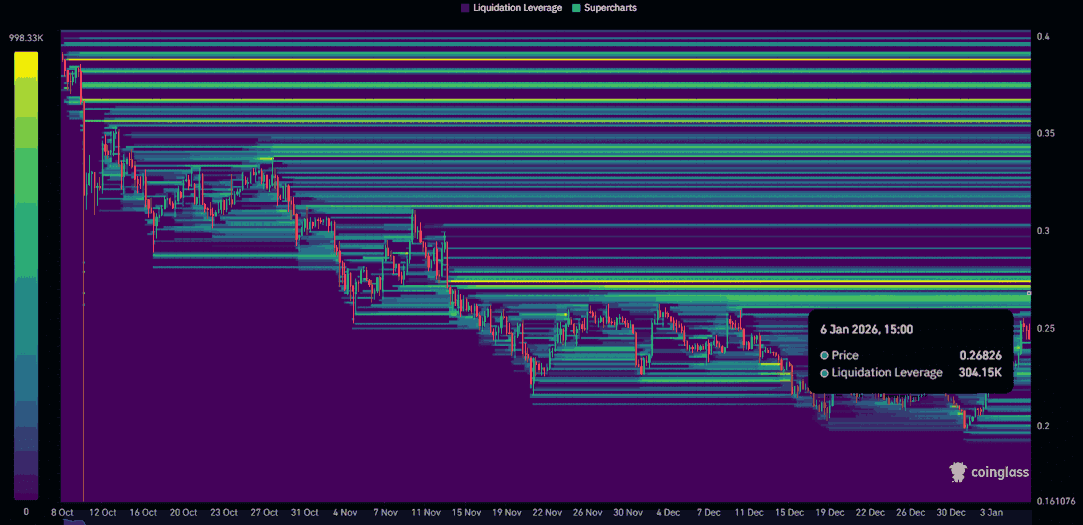
Source: CoinGlass

Cumulatively, the rising bullish positioning paired with proximity to key resistance and overhead liquidity suggests that XLM could be in for a more bullish run.

A decisive move past $0.261 resistance will be key in determining whether the token prices will surge further to mitigate the liquidity clusters above.


Final Thoughts

  • XLM is testing a critical $0.261 supply zone after a 7% daily surge.
  • Liquidity clusters above current price levels suggest that a breakout could trigger a further bullish run if resistance fails to hold.
Next: Bitmine’s $14B Ethereum empire – Is one company quietly taking over ETH?
Share
  • Share
  • Tweet

Trending Cryptos

Related Questions

QWhat is the critical resistance level that Stellar (XLM) is currently testing?

AThe critical resistance level that Stellar (XLM) is testing is $0.261.

QWhat does the Long/Short Ratio of 2.769 indicate about market sentiment?

AA Long/Short Ratio of 2.769 indicates significant buyer dominance, meaning long positions are nearly tripling short positions and showing that most traders are betting on further price increases.

QAccording to the article, what could a breakout above $0.261 potentially signal?

AA breakout above $0.261 could nullify the short-term supply threat and potentially signal a short-term trend shift, allowing the price to break out of its consolidation phase.

QWhat does the liquidity cluster at around $0.2683 suggest for price movement?

AThe liquidity cluster at around $0.2683 suggests a bullish bias, as traders often aim for areas with higher concentrations of stop orders and liquidity, which could attract further buying pressure.

QWhat are the two key factors mentioned in the 'Final Thoughts' that support a potential bullish run?

AThe two key factors are: 1) XLM is testing the critical $0.261 supply zone after a 7% daily surge, and 2) Liquidity clusters above current price levels suggest a breakout could trigger further bullish momentum if resistance is broken.

Related Reads

My Coding Betting Dashboard is Profiting, but Polymarket is Truly Not a Good Place for 'Arbitrage'

The author built a custom monitoring dashboard for Polymarket, a prediction market platform, and tested it with $1,600, achieving over 30% returns. However, the core argument is that Polymarket is not a good venue for traditional arbitrage. The dashboard has two main sections: a "Portfolio Dashboard" for tracking active positions with key metrics like total capital, P&L, and a risk-control module using a tier system (T1, T2, T3), and an "Opportunity Watchlist" for monitoring markets. The article details a critical structural trap in binary markets: a bet with a high perceived probability of success still carries a 100% loss risk if wrong. The author's T1/T2/T3 system is designed to manage this by limiting position sizes based on conviction and time horizon, emphasizing that high confidence should not equal high concentration. A key insight is the danger of "pseudo-diversification"—betting on different markets driven by the same underlying variable. The author concludes that Polymarket offers few true low-risk, arbitrage opportunities. It is instead a high-risk environment where wins can create a false sense of mastery, leading to large losses. The platform is better viewed as a training ground for honing judgment through disciplined, framework-driven betting rather than a reliable income source. The tools help transform intuition into structured, rule-based decisions to mitigate the risk of catastrophic errors.

marsbit59m ago

My Coding Betting Dashboard is Profiting, but Polymarket is Truly Not a Good Place for 'Arbitrage'

marsbit59m ago

WeChat AI Card Hands-On Guide: Has the AI Shopping Era Arrived?

**"WeChat AI Card" Practical Test Guide: Has the Era of AI Shopping Arrived?** WeChat has officially launched the "AI Exclusive Card," a feature integrated into its Workbuddy AI assistant. This card is designed to handle payments for AI-initiated purchases. Our hands-on test reveals it's not yet a tool for fully autonomous AI shopping, but rather a controlled payment layer for AI agents. The AI Card functions as an isolated sub-wallet within WeChat Pay. Users must bind the card and transfer funds into it from their main wallet. Crucially, every transaction requires explicit user confirmation via smartphone scan; AI cannot spend autonomously. Currently accessible through the Workbuddy agent, the card targets specific digital consumption scenarios: purchasing paid content (reports, data), calling paid APIs/tools, and subscribing to services. Its design prioritizes security and control by separating funds and mandating approval for each payment. We tested a real-world scenario: ordering bubble tea via Workbuddy using a "Meituan Life Assistant" skill. The process encountered multiple hurdles: high "skill" usage costs (exceeding daily free credits), and most importantly, while a payment was successfully initiated, the AI purchased an incorrect product (a mismatched group-buy coupon instead of the desired drink). This highlights the current limitation: the **AI Card only solves the payment step**. The broader challenge lies in the **AI agent's execution chain**—accurately understanding intent, navigating third-party platforms, selecting the right product, and ensuring proper fulfillment. The payment succeeded, but the purchase failed to meet the user's need. In conclusion, the WeChat AI Exclusive Card is a cautious, early-step experiment in AI commerce. It provides a secure, user-controlled payment method for agent interactions but is not yet capable of reliable, end-to-end complex purchases. For now, it's best used for low-value, low-risk digital services with careful user verification at each step. The vision of AI handling complete shopping tasks remains a work in progress.

marsbit3h ago

WeChat AI Card Hands-On Guide: Has the AI Shopping Era Arrived?

marsbit3h ago

Deconstructing Notion's Growth: From a Note-taking Tool to 100 Million Users—How Notion Built a Triple Growth Flywheel Through Product, Templates, and Community

Notion's growth from a niche note-taking tool to a platform with 100 million users is powered by three interconnected flywheels: Product-Led Growth (PLG), a Template Economy, and Community-Driven Growth. First, Notion's PLG strategy relies on a highly flexible, "plastic" product that users can adapt to countless personal and team workflows. Its freemium model lowers the barrier to entry, while features like page sharing and collaboration drive organic, usage-based viral growth as users naturally invite others. Second, the Template Economy solves the "blank page" problem. Templates, created by both Notion and its community, transform abstract product capabilities into concrete, copyable solutions for specific scenarios (e.g., project management, content calendars). This dramatically lowers activation costs for new users and fuels SEO-driven discovery. Third, a vibrant Community acts as a distributed growth engine. Users and official Ambassadors create tutorials, share use cases, and host local events. This community not only educates users but also fosters a sense of identity around pursuing "better ways of working," strengthening loyalty and enabling global, low-cost expansion. Together, these flywheels create a self-reinforcing ecosystem: a great product attracts users who create templates and community content, which in turn attracts more users and deepens engagement. This system allowed Notion to scale from individuals to teams and enterprises through a bottom-up adoption path. Looking ahead, AI integration promises to accelerate these flywheels further by making templates smarter and the platform a potential AI-native work operating system. Ultimately, Notion's defensible advantage is not just its features, but this deeply entrenched network of user assets, creators, and community trust.

marsbit3h ago

Deconstructing Notion's Growth: From a Note-taking Tool to 100 Million Users—How Notion Built a Triple Growth Flywheel Through Product, Templates, and Community

marsbit3h ago

$10 Billion, Qualcomm to Acquire Chip Legend Jim Keller's Company

Global mobile chip giant Qualcomm is in advanced talks to acquire AI chip startup Tenstorrent in a deal valued between $8-10 billion, according to media reports. This potential acquisition would be one of the largest in the AI chip sector in recent years. Tenstorrent, led by legendary chip architect Jim Keller, has gained prominence for its RISC-V architecture and AI accelerator designs. The move highlights Qualcomm's strategic push to diversify beyond its core smartphone chip business. As the smartphone market matures, Qualcomm is aggressively targeting growth in automotive, data center, and cloud AI. Acquiring Tenstorrent would allow Qualcomm to rapidly enter the high-end AI computing market, bypassing lengthy in-house development cycles. Tenstorrent's cost-effective system architecture, which avoids expensive HBM memory and relies on standard Ethernet for clustering, offers a potential alternative to Nvidia's costly solutions. Furthermore, Tenstorrent's high-performance RISC-V CPU technology and its focus on the automotive and edge computing segments align with Qualcomm's strategic goals, including its "Snapdragon Digital Chassis" platform. Despite the strategic rationale, the high valuation has sparked some investor caution. The successful integration of Tenstorrent's open-source culture and independent team into Qualcomm's organization, along with the commercialization of its technology, remains a key challenge.

marsbit4h ago

$10 Billion, Qualcomm to Acquire Chip Legend Jim Keller's Company

marsbit4h ago

Trading

Spot
Futures

Hot Articles

How to Buy XLM

Welcome to HTX.com! We've made purchasing Stellar (XLM) simple and convenient. Follow our step-by-step guide to embark on your crypto journey.Step 1: Create Your HTX AccountUse your email or phone number to sign up for a free account on HTX. Experience a hassle-free registration journey and unlock all features.Get My AccountStep 2: Go to Buy Crypto and Choose Your Payment MethodCredit/Debit Card: Use your Visa or Mastercard to buy Stellar (XLM) instantly.Balance: Use funds from your HTX account balance to trade seamlessly.Third Parties: We've added popular payment methods such as Google Pay and Apple Pay to enhance convenience.P2P: Trade directly with other users on HTX.Over-the-Counter (OTC): We offer tailor-made services and competitive exchange rates for traders.Step 3: Store Your Stellar (XLM)After purchasing your Stellar (XLM), store it in your HTX account. Alternatively, you can send it elsewhere via blockchain transfer or use it to trade other cryptocurrencies.Step 4: Trade Stellar (XLM)Easily trade Stellar (XLM) on HTX's spot market. Simply access your account, select your trading pair, execute your trades, and monitor in real-time. We offer a user-friendly experience for both beginners and seasoned traders.

4.4k Total ViewsPublished 2024.03.29Updated 2026.06.02

How to Buy XLM

Discussions

Welcome to the HTX Community. Here, you can stay informed about the latest platform developments and gain access to professional market insights. Users' opinions on the price of XLM (XLM) are presented below.

活动图片