Stablecoin Yield ‘Effectively Off The Table’: White House Narrows Rewards Debate In Latest Meeting

bitcoinistPublished on 2026-02-21Last updated on 2026-02-21

Abstract

The White House took a more active role in the latest meeting between the crypto industry and banking sector to resolve the stablecoin yield dispute that has stalled the CLARITY Act. The meeting included representatives from Coinbase, Ripple, a16z, and crypto trade associations, while banks were represented through their industry groups. The White House presented a draft text addressing banking concerns, effectively ruling out earning yield on idle stablecoin balances. The debate now focuses on whether crypto firms can offer rewards linked to specific activities. Banking representatives argued that competitive pressures, rather than deposit flight, are their main concern. The White House also proposed anti-evasion measures, including significant penalties for violations. Further discussions are expected as both sides assess potential compromises.

The White House reportedly took the lead during the latest Crypto Council meeting, narrowing the stablecoin rewards dispute that has delayed progress in the long-awaited crypto market structure bill.

White House Steps In On CLARITY Act Dispute

On Thursday, the White House held another meeting between the crypto industry and the banking sector to negotiate the stablecoin yield dispute that has stalled the crypto market structure bill, known as the CLARITY Act, over the past month.

According to a report from journalist Eleanor Terret, the meeting was smaller than previous ones, with only a few representatives from each side. From the crypto sector, participants included representatives from Coinbase, Ripple, a16z, the Blockchain Association, and Crypto Council for Innovation (CCI).

Meanwhile, no individual bank representatives attended; bank voices were represented through trade associations, such as the American Bankers Association, the Banking Policy Institute (BPI), and the Independent Community Bankers of America (ICBA).

Terret sources affirmed that there was a notable difference in yesterday’s meeting as the White House “took the lead in driving the discussion, rather than letting crypto firms and bank trades steer the discussion, as in prior meetings.”

For context, banks have heavily criticized the landmark stablecoin legislation, the GENIUS Act, due to “loopholes” that could pose risks to the financial system. The framework prohibits interest payments on the holding or use of payment-purpose stablecoins, but it only addresses issuers.

The banking side argues that allowing issuers and platforms to offer interest payments on stablecoins could distort market dynamics and affect credit creation in the country, hurting small- and medium-sized financial institutions in the sector.

To address these concerns, banking associations across the US urged senators to include language in the CLARITY Act that also bans digital asset exchanges, brokers, dealers, and related entities from offering yield on stablecoins.

The Senate Banking Committee’s draft proposed that issuers offer rewards for specific actions, such as account openings and cashback. However, it also prohibited issuers from providing interest payments to passive token holders.

The crypto side criticized the proposed measures, with some industry leaders publicly opposing the draft and withdrawing their support. As a result, a markup session on the Senate Banking Committee’s portion of the bill has been delayed.

Stablecoin Yield Out Of The Picture

At the Thursday meeting, Patrick Witt, executive director of the US President’s Council of Advisors on Digital Assets, reportedly brought a draft text that served as the anchor for the discussion. Sources in the room told Terret that the draft’s language acknowledged banks’ concerns raised in last week’s “Yield and Interest Prohibitions Principles” document.

Based on this, “earning yield on idle balances (...) is effectively off the table,” the journalist affirmed. The draft also clarified that any future restrictions on rewards would be narrow in scope. Therefore, the debate has now narrowed to whether crypto firms can offer rewards linked to specific activities.

An attendee from the crypto industry side reportedly said that banks’ concerns “appear to stem more from competitive pressures than from deposit flight.” Meanwhile, someone from the banking industry told Terret that they are still pushing to include a study examining the growth of payment stablecoins and their potential impact on bank deposits in the draft.

They also noted that the White House proposed anti-evasion language. The measure would give the Securities and Exchange Commission (SEC), the Commodity Futures Trading Commission (CFTC), and the Department of the Treasury authority to enforce a ban on paying yield on idle stablecoin balances, and penalties of up to $500,000 per violation, per day, against companies that breach the ban.

Now, the banking industry representatives “will brief their members on today’s discussions and gauge whether there’s room to compromise on allowing crypto firms to offer stablecoin rewards,” Terret noted, adding that some attendees believe an end-of-month deadline isn’t unrealistic as talks are set to continue in the coming days.
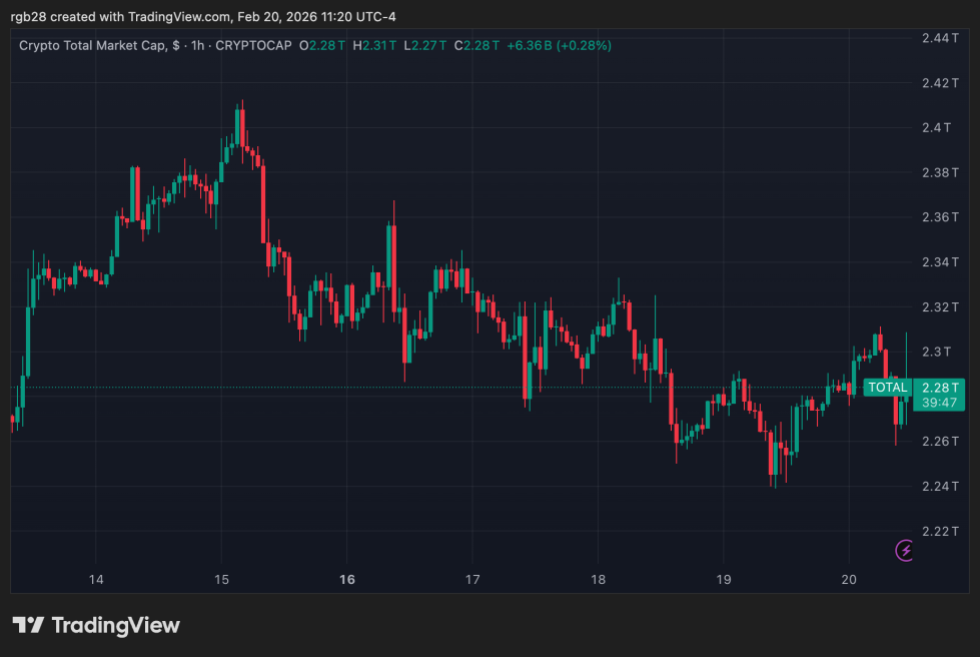
The total crypto market capitalization sits at $2.28 trillion on the one-week chart. Source: TOTAL on TradingView


Related Questions

QWhat was the main role of the White House in the latest Crypto Council meeting according to the article?

AThe White House took the lead in driving the discussion, rather than letting crypto firms and bank trades steer it as in prior meetings.

QWhich major crypto industry representatives attended the meeting?

ARepresentatives from Coinbase, Ripple, a16z, the Blockchain Association, and Crypto Council for Innovation (CCI) attended.

QWhat is the primary concern of the banking sector regarding stablecoin legislation?

ABanks argue that allowing interest payments on stablecoins could distort market dynamics, affect credit creation, and hurt small- and medium-sized financial institutions.

QWhat was the key outcome regarding 'yield on idle stablecoin balances' from the meeting?

AEarning yield on idle balances is effectively off the table, meaning it is prohibited.

QWhat enforcement measures did the White House propose for violations of the yield ban?

AThe White House proposed giving the SEC, CFTC, and Treasury the authority to enforce the ban with penalties of up to $500,000 per violation, per day.

Related Reads

70% of the Public Opposes AI, Americans Hope the U.S. Loses the AI War

70% of Americans believe AI development is moving too fast, with growing public resistance evolving from online criticism to real-world protests and violence. This widespread anti-AI sentiment stems from fears of job losses, rising utility costs, environmental damage, threats to democracy, and financial instability. Key incidents illustrate the backlash: Google's former CEO Eric Schmidt was loudly booed at a graduation for promoting AI; AI company ads are vandalized; protests and even violent attacks target AI firms and data centers. Polls show deep public pessimism and strong local opposition to data center construction, often surpassing resistance to nuclear power plants. The core grievances are economic and practical: AI is seen as automating jobs, concentrating wealth, and increasing household electricity and water bills due to massive data center resource demands. Environmentalists also oppose AI's high energy use and carbon emissions. This opposition has turned AI into a major political issue in the US. While the Trump administration prioritizes AI innovation for global competition, bipartisan pushback is growing. Democrats and factions within the MAGA movement are forming temporary alliances to support stricter regulations and local bans on new data centers, pressuring the administration to choose between its tech industry backers and its voter base. The situation highlights a profound national divide over AI's future.

marsbit22m ago

70% of the Public Opposes AI, Americans Hope the U.S. Loses the AI War

marsbit22m ago

Agents Take Over Traffic Distribution Power: What Are Tencent, ByteDance, and Alibaba Competing For?

In the race to dominate the AI era's entry point, China's tech giants—Tencent, ByteDance, and Alibaba—are aggressively deploying AI Agents to control the future of traffic distribution. Alibaba is pursuing a dual-track "closed loop + openness" strategy. Its Qianwen app is evolving into a super-Agent integrated across its ecosystem (Taobao, Alipay, etc.) to handle complex tasks like travel planning. Concurrently, it is opening its platform to external brands (Luckin Coffee, KFC) and has launched a B2B Agent platform, "Wukong," targeting enterprise automation. Its other flagship, Quark, aims to be an "AI super search box" for information and tasks. ByteDance is executing an omnipresent "sprawl strategy." Its Doubao app boasts over 300 million monthly active users and is evolving into a default AI entry point for daily life, with plans for paid versions and e-commerce integration. Its core weapon is the Kouzi platform, a visual "AI assembly factory" for developers to build custom Agents. ByteDance is also pushing hardware integration, collaborating on AI phones and developing smart glasses to embed Doubao everywhere. Tencent is playing its long-held "ultimate card" by quietly embedding an AI Agent directly into WeChat. This Agent, accessible via a swipe, can understand user commands and automatically execute tasks by calling upon WeChat's millions of mini-programs (e.g., finding and ordering coffee). This leverages WeChat's unparalleled 1.4-billion-user ecosystem to position the app as an AI-powered "service operating system," a move that could dramatically reshape the competitive landscape. The core battleground is shifting from competing for "user screen time" to competing to be the "default execution layer" for user intent. The business model is evolving from an "attention economy" to an "intent economy," where the Agent that can most efficiently fulfill a user's need gains control over service access and token flow. This represents a fundamental change in how users connect with digital services, making the fight for the Agent入口 (entry point) a pivotal moment for redefining industry leadership in the AI age.

marsbit2h ago

Agents Take Over Traffic Distribution Power: What Are Tencent, ByteDance, and Alibaba Competing For?

marsbit2h ago

Trading

Spot
Futures

Hot Articles

How to Buy HOUSE

Welcome to HTX.com! We've made purchasing Housecoin (HOUSE) simple and convenient. Follow our step-by-step guide to embark on your crypto journey.Step 1: Create Your HTX AccountUse your email or phone number to sign up for a free account on HTX. Experience a hassle-free registration journey and unlock all features.Get My AccountStep 2: Go to Buy Crypto and Choose Your Payment MethodCredit/Debit Card: Use your Visa or Mastercard to buy Housecoin (HOUSE) instantly.Balance: Use funds from your HTX account balance to trade seamlessly.Third Parties: We've added popular payment methods such as Google Pay and Apple Pay to enhance convenience.P2P: Trade directly with other users on HTX.Over-the-Counter (OTC): We offer tailor-made services and competitive exchange rates for traders.Step 3: Store Your Housecoin (HOUSE)After purchasing your Housecoin (HOUSE), store it in your HTX account. Alternatively, you can send it elsewhere via blockchain transfer or use it to trade other cryptocurrencies.Step 4: Trade Housecoin (HOUSE)Easily trade Housecoin (HOUSE) on HTX's spot market. Simply access your account, select your trading pair, execute your trades, and monitor in real-time. We offer a user-friendly experience for both beginners and seasoned traders.

4.6k Total ViewsPublished 2025.04.27Updated 2026.06.02

How to Buy HOUSE

Discussions

Welcome to the HTX Community. Here, you can stay informed about the latest platform developments and gain access to professional market insights. Users' opinions on the price of HOUSE (HOUSE) are presented below.

活动图片