S&P gives BlackRock tokenized reserve fund top stability rating

cointelegraphPublished on 2026-08-05Last updated on 2026-08-05

Abstract

S&P Global Ratings awarded its highest principal stability fund rating, "AAAm," to BlackRock's newly launched tokenized money market fund, the BlackRock Daily Reinvestment Stablecoin Reserve Vehicle (BRSRV). The rating reflects the fund's strong creditworthiness, short maturity structure, and robust management. S&P found no weaknesses in BlackRock's risk management and operational controls, noting the fund's permissioned blockchain architecture mitigates cyber and smart contract risks. The fund, designed to hold cash, short-term U.S. Treasuries, and repurchase agreements, aims to serve as an eligible reserve asset for payment stablecoin issuers. In a separate update on stablecoins, S&P maintained its assessments for 11 major stablecoins. Six were rated "adequate" or stronger, while Tether's USDT, TrueUSD, and Ethena's USDe remain at the lowest "weak" rating. USD Coin and Paxos USD were among those rated "strong." S&P's stablecoin assessment framework evaluates backing assets, liquidity, governance, and technology, and is distinct from its principal stability fund ratings.

S&P Global Ratings assigned its highest principal stability fund rating to BlackRock’s new tokenized money market fund.

The ratings provider assigned an “AAAm” rating to the BlackRock Daily Reinvestment Stablecoin Reserve Vehicle (BRSRV) on Monday, citing the creditworthiness of its investments and counterparties, its maturity structure and management’s ability to maintain a stable net asset value.

S&P said it identified “no weaknesses” in its qualitative assessment of BlackRock Advisors’ management and organization, credit research and analysis, risk management and compliance.

The ratings provider also described the fund’s tokenization framework as operationally resilient, citing controls intended to mitigate cyber, smart contract and blockchain network risks. The fund uses a permissioned architecture that restricts transactions to whitelisted wallets.

BRSRV launched on Monday as an open-end management investment company, which seeks to operate so that its shares qualify as eligible reserve assets for payment stablecoin issuers under the GENIUS Act.

The fund will hold cash, US Treasury securities maturing in 93 days or less and overnight repurchase agreements secured by Treasury instruments. It will maintain a weighted average maturity of no more than 60 days and a weighted average life of no more than 120 days.

Related: Jim Cramer plans to sell his Bitcoin over quantum fears as BTC rises 1.6%

USDT remains among S&P’s lowest-rated stablecoins

Separately, S&P Global on Tuesday published a summary of its current Stablecoin Stability Assessments, saying six of the 11 stablecoins it covers have an “adequate” or stronger ability to maintain their pegs to fiat currencies.

S&P said two assessments had been revised lower over the previous three quarters, while the other nine remained unchanged.

Tether’s USDt (USDT) remains at 5, or “weak,” after S&P lowered its assessment from 4, or “constrained,” in November 2025. TrueUSD (TUSD) and Ethena USD (USDe) are also assessed at 5.
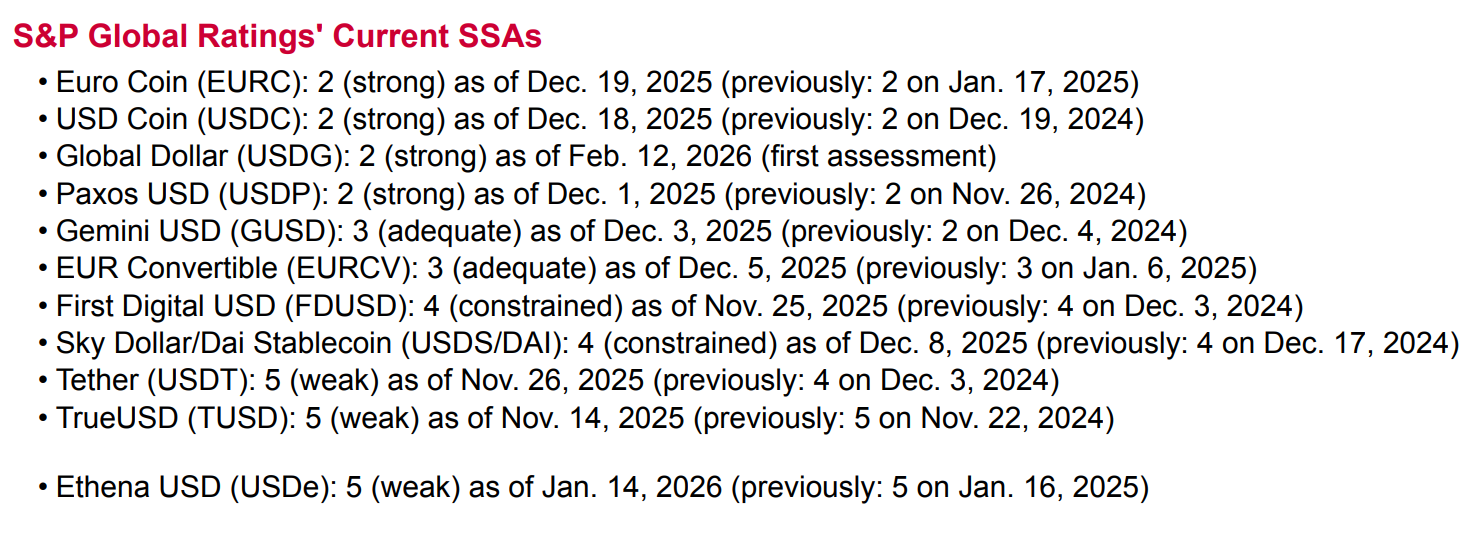
S&P Global Ratings’ current SSAs. Source: S&P Global Ratings

Euro Coin (EURC), USD Coin (USDC), Global Dollar (USDG) and Paxos USD (USDP) are assessed at 2, or “strong.” Gemini USD (GUSD) and EUR Convertible (EURCV) are assessed at 3, or “adequate.”

First Digital USD (FDUSD) and Sky Dollar/Dai (USDS/DAI) are assessed at 4, or “constrained.”

S&P launched the assessment framework in December 2023. Its analysis considers the assets backing a stablecoin, liquidity, governance, redemption arrangements, legal and regulatory protections, technology dependencies and the issuer’s track record. Assessments range from 1, or “very strong,” to 5, or “weak.”

The AAAm rating assigned to BlackRock’s fund is separate from S&P’s stablecoin assessments. Principal stability fund ratings measure a fixed-income fund’s capacity to maintain a stable net asset value and limit exposure to principal losses due to credit risk.

Magazine: Why Peter Thiel’s Founders Fund walked away from an Ether treasury bet

Trending Cryptos

Related Questions

QWhat is the highest principal stability fund rating assigned by S&P Global Ratings to BlackRock's tokenized fund, and what does it signify?

AS&P assigned its highest rating, 'AAAm', to BlackRock's Daily Reinvestment Stablecoin Reserve Vehicle (BRSRV). This rating signifies the fund's strong capacity to maintain a stable net asset value and limit exposure to principal losses due to credit risk, based on assessments of its investments, counterparties, maturity structure, and management.

QWhat is the primary investment objective of the BlackRock BRSRV, and which assets will it hold to achieve this?

AThe BlackRock BRSRV is an open-end management investment company that seeks to operate so its shares qualify as eligible reserve assets for payment stablecoin issuers under the proposed GENIUS Act. To achieve this stability, the fund will hold cash, US Treasury securities maturing in 93 days or less, and overnight repurchase agreements secured by Treasury instruments.

QAccording to S&P's separate Stablecoin Stability Assessments, which stablecoins are currently rated as 'strong' (rating 2)?

AAccording to S&P's current Stablecoin Stability Assessments, the stablecoins rated as 'strong' (rating 2) are Euro Coin (EURC), USD Coin (USDC), Global Dollar (USDG), and Paxos USD (USDP).

QWhich stablecoins received the lowest rating ('weak' or 5) in S&P's latest Stablecoin Stability Assessments?

AThe stablecoins receiving the lowest rating of 5 ('weak') are Tether's USDt (USDT), TrueUSD (TUSD), and Ethena USD (USDe). S&P lowered USDT's assessment from 4 to 5 in November 2025.

QHow does S&P describe the tokenization framework of the BlackRock BRSRV in terms of operational resilience?

AS&P described the BlackRock BRSRV's tokenization framework as operationally resilient, citing controls intended to mitigate cyber, smart contract, and blockchain network risks. The fund uses a permissioned architecture that restricts transactions to pre-approved, whitelisted wallets.

Related Reads

Playing the "Decoupling" Card Again? Domestic Optical Modules Face a Stress Test

The U.S. Federal Communications Commission (FCC) is reportedly drafting a ban on importing new models of Chinese-made optical transceiver modules, with a potential implementation target of 2026. This "decoupling" move comes as Chinese firms, led by industry leaders like Zhongji Innolight and Eoptolink, dominate the global optical module market with over 60% share, and hold an even larger position in the high-speed 800G and 1.6T segments critical for AI data centers. Market reactions were mixed: U.S. optical module stocks initially rose, while Chinese A-shares opened lower but largely recovered by the close. Analysis suggests a complete U.S. decoupling from Chinese modules faces significant hurdles. North American cloud giants (Meta, Google, Microsoft, Amazon) and NVIDIA have massive demand for high-speed modules, estimated at around 40 million units in 2026. U.S. manufacturers' combined monthly production capacity for these modules is less than one-fifth that of a single major Chinese player like Zhongji Innolight, which reported production of 23.76 million units in 2025. Chinese companies are heavily reliant on the U.S. market, with over 90% of revenue for top firms coming from overseas, primarily the U.S. However, they have begun mitigating risks by establishing assembly plants in Southeast Asia and Mexico. Industry observers note the final impact depends on whether any potential U.S. restrictions target specific companies or products based on origin. Past U.S. sanctions on Chinese tech firms have often spurred increased domestic R&D and market diversification. Despite initial stock volatility, shares of major Chinese optical module companies pared losses, indicating market belief in the sector's resilience and the practical difficulties of abruptly replacing Chinese supply.

marsbit8m ago

Playing the "Decoupling" Card Again? Domestic Optical Modules Face a Stress Test

marsbit8m ago

When the Competition in Chip Manufacturing Equipment Stops Being Just About Who Is More Advanced

The competition in chip manufacturing equipment is no longer solely about who has the most advanced technology. While performance, yield, and cost remain key, U.S. export controls are adding a critical new dimension: long-term supply chain reliability. Major chipmakers like Samsung and SK Hynix, despite having mature supply chains with leading American and European vendors, are reportedly evaluating etching equipment from China's AMEC for their Chinese factories. This move is not primarily about immediate replacement or AMEC's current capabilities. Instead, it's a risk mitigation strategy. Companies are concerned that future U.S. policies could disrupt their access to spare parts, software updates, and maintenance for existing equipment over its decade-long lifespan. For chipmakers investing billions in fabs with long planning cycles, this policy-induced uncertainty is a significant new risk. The U.S., through its controls, is inadvertently eroding the very reliability and certainty that were foundational strengths of its equipment suppliers. This creates a pivotal shift for Chinese semiconductor equipment. Previously seen largely as a "domestic replacement" option when foreign gear was unavailable, they are now being assessed as potential "contingency suppliers" by global players—even before a supply disruption occurs. This provides a crucial entry point for validation in real production lines, which is essential for iterative improvement. Chinese equipment, particularly in areas like etching, has progressed from prototypes to participating in mass production within China, gaining valuable experience. However, this does not signify full global competitiveness. Gaps remain in advanced lithography, metrology, and other key tools. The current evaluations are largely confined to foreign firms' China-based fabs, not their global procurement networks. The core change is in the decision-making framework. Efficiency-driven globalization favored single, optimal suppliers. An era of heightened geopolitical risk is forcing companies to value "replaceability." While technical prowess remains paramount, supply chain certainty is now being factored into a device's competitive equation. Ultimately, U.S. policies have not made Chinese equipment more advanced, but they have given global customers a compelling reason to start testing it. The competition has expanded: it's no longer just about who is more advanced, but also about who can be relied upon to stay.

marsbit9m ago

When the Competition in Chip Manufacturing Equipment Stops Being Just About Who Is More Advanced

marsbit9m ago

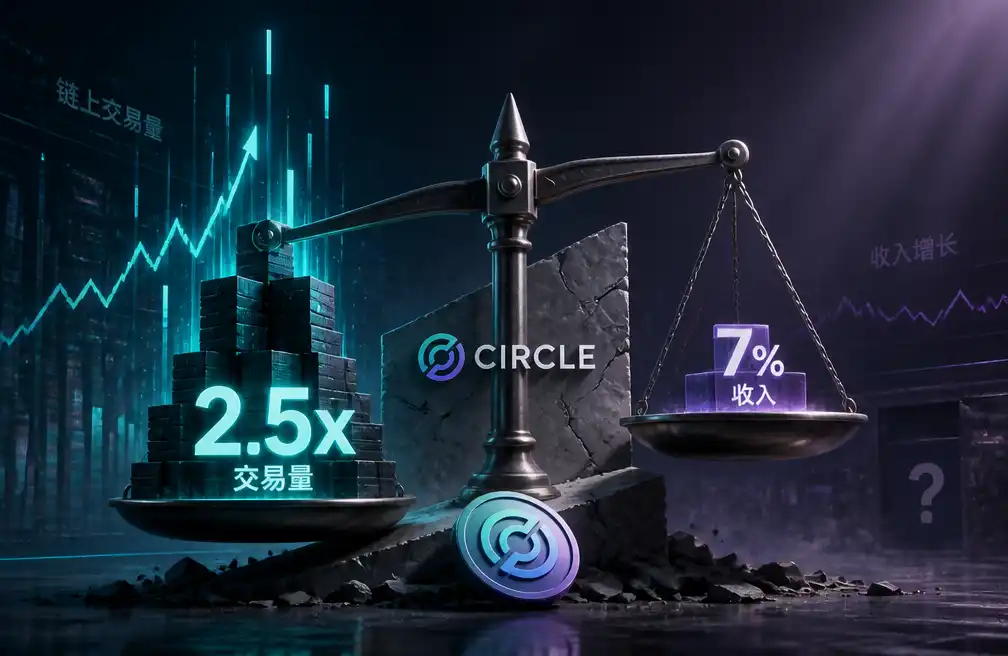
Trading Volume Increased by 2.5x, Why Did Circle's Revenue Only Grow by 7%?

Circle's Q2 performance presents a seemingly contradictory picture: the transaction volume of its stablecoin USDC surged 151% year-over-year to $14.8 trillion, while its "Total Revenue & Reserve Revenue" grew by only 7% to $701 million. This discrepancy highlights the core of Circle's business model. Revenue is primarily driven not by transaction volume, but by the average amount of USDC in circulation and the yield generated from its reserves. Key points: 1. **Revenue Drivers:** Over 90% of revenue comes from "reserve income," which is a function of average USDC circulation (up 25% YoY) and the reserve yield (which fell by 66 basis points). The net effect was a mere ~5% increase in reserve income. 2. **Transaction vs. Revenue:** High transaction volume indicates robust usage of USDC for payments and settlements, but does not translate directly to revenue. It must first convert into a sustained, average circulating balance. 3. **Cost Structure:** After accounting for distribution and other costs, the metric "Revenue Less Direct Costs" (RLDC) grew faster than total revenue, with its margin improving. However, rising operating expenses (up 23% YoY) meant that Adjusted EBITDA growth was limited to 8%. 4. **New Initiatives:** Circle reported progress on new networks like the Circle Payments Network and upcoming products (Arc, Agent Stack), but these are currently measured by adoption metrics (e.g., transaction run-rate, number of services) rather than material revenue contribution this quarter. In summary, the financial results are determined by the interplay of USDC circulation, reserve yields, and cost structures, while high transaction volume signals underlying network strength that has not yet fully flowed through to the income statement.

marsbit26m ago

Trading Volume Increased by 2.5x, Why Did Circle's Revenue Only Grow by 7%?

marsbit26m ago

Samsung China, Another Step Back

Samsung China Takes Another Step Back Samsung Electronics is further retreating from the Chinese consumer market. Following the exit of its home appliance business in May, its mobile phone division is now reportedly scaling down. Stores with monthly sales below 300,000 RMB are being closed in several cities. Data shows Samsung's smartphone market share in China has plummeted to 0.1% in Q2 2026, a stark contrast to its 22% global leadership. The decline is attributed to intense competition from domestic brands offering better value, higher specs (like faster charging), and superior localization in software and services. Samsung's premium pricing and less adapted One UI system have struggled against rivals like Huawei, Xiaomi, and Honor. This consumer electronics retreat coincides with Samsung's record-breaking semiconductor profits, driven by the AI boom. In Q2 2026, the chip division contributed nearly all operating profit, while the mobile and home appliance unit posted its first-ever operating loss. Internal dynamics, like the chip division charging market prices to the mobile unit, have increased cost pressures. Samsung's strategy now appears to be a focused retreat towards the ultra-premium segment in China, similar to its global push in high-end foldables like the Galaxy Z Fold8. The company is likely to retain only key stores in major cities to serve a niche, high-end clientele. While its deep semiconductor reserves offer a cushion, this shift away from mass-market consumer electronics reduces business diversification. The move is pragmatic but signifies a fundamental transformation; Samsung is ceding mass-market influence and betting heavily on its semiconductor strength and a narrowed premium product focus.

marsbit30m ago

Samsung China, Another Step Back

marsbit30m ago

Helium, Naphtha, and Photoresist: The Three Critical Vulnerabilities of Semiconductor Fabs

The article "Helium, Naphtha, Photoresist: The Three Achilles' Heels of Semiconductor Fabs" analyzes a hypothetical 2026 supply crisis triggered by geopolitical conflict in the Middle East, focusing on three critical materials for semiconductor manufacturing: helium, naphtha, and photoresist. A key attack on a Qatari LNG facility and the blockade of the Strait of Hormuz threaten the global supply of helium (a byproduct of LNG) and naphtha (a petroleum product). This creates a triple threat of shortages that could halt chip production. Helium is essential, particularly for precise wafer temperature control in dry etching processes; a shortage would cause an immediate "instant failure" in these steps. Naphtha is the foundational raw material for numerous equipment consumables and, crucially, for photoresist chemicals. Japan dominates the photoresist market, relying on a single key supplier for intermediates. The analysis shows the impacts would differ. The tiny fraction of global naphtha used for semiconductors (under 0.1%) makes securing supply for photoresist relatively easier. Helium is the greater vulnerability. Qatar supplies about one-third of the world's helium, exceeding the total annual consumption of the semiconductor industry (21-24% of global supply). While short-term buffers like corporate reserves, recycling, and prioritization (e.g., cutting balloon use first) can delay the crisis, helium cannot be stored long-term due to boil-off. Fabs typically hold only days to weeks of inventory. The consequences would be severe and tiered. Advanced logic nodes (e.g., 2nm, 3nm) using complex processes like GAA would be hit hardest, potentially stopping within three months. Mature nodes for automotive and power semiconductors would also eventually halt (within 6-12 months), which could be catastrophic for the auto industry due to stringent certification requirements. The crisis would unfold not as a sudden global stop, but through a sequence of allocation, severe price spikes, reduced output of low-margin products, and partial fab shutdowns by region and company if the shortage persists beyond a year.

marsbit32m ago

Helium, Naphtha, and Photoresist: The Three Critical Vulnerabilities of Semiconductor Fabs

marsbit32m ago

Trading

Spot

Hot Articles

Discussions

Welcome to the HTX Community. Here, you can stay informed about the latest platform developments and gain access to professional market insights. Users' opinions on the price of S (S) are presented below.

活动图片