After C罗's Farewell Tears, Polymarket Stages a 'Tear Verification' Drama

marsbitPublished on 2026-07-08Last updated on 2026-07-08

Abstract

After Portugal's 1-0 loss to Spain in the 2026 World Cup Round of 16, 41-year-old Cristiano Ronaldo was seen visibly emotional on the pitch, with media widely reporting he was in tears. On the prediction market platform Polymarket, however, this event triggered a major settlement debate. The market for "Will Ronaldo cry at the World Cup?" had strict rules requiring clear, identifiable tears on his face in photos/videos taken on the pitch or bench. Following the match, the outcome was disputed as traders argued whether the visible moisture was tears or sweat/other factors, sending the "Yes" probability below 20% and the event into arbitration. The dispute centered on interpreting the evidence against precise market rules. However, in a reversal, Polymarket later issued a clarification stating that qualified photo and video evidence from the pitch showed Ronaldo with "visible tears on his face." This official ruling resolved the ambiguity, causing the "Yes" probability to surge above 99%. With over $22 million in volume, the event highlighted how Polymarket's arbitration can align outcomes with mainstream perception, rather than allowing rule technicalities to solely determine results.

Author | Asher(@Asher_ 0210)
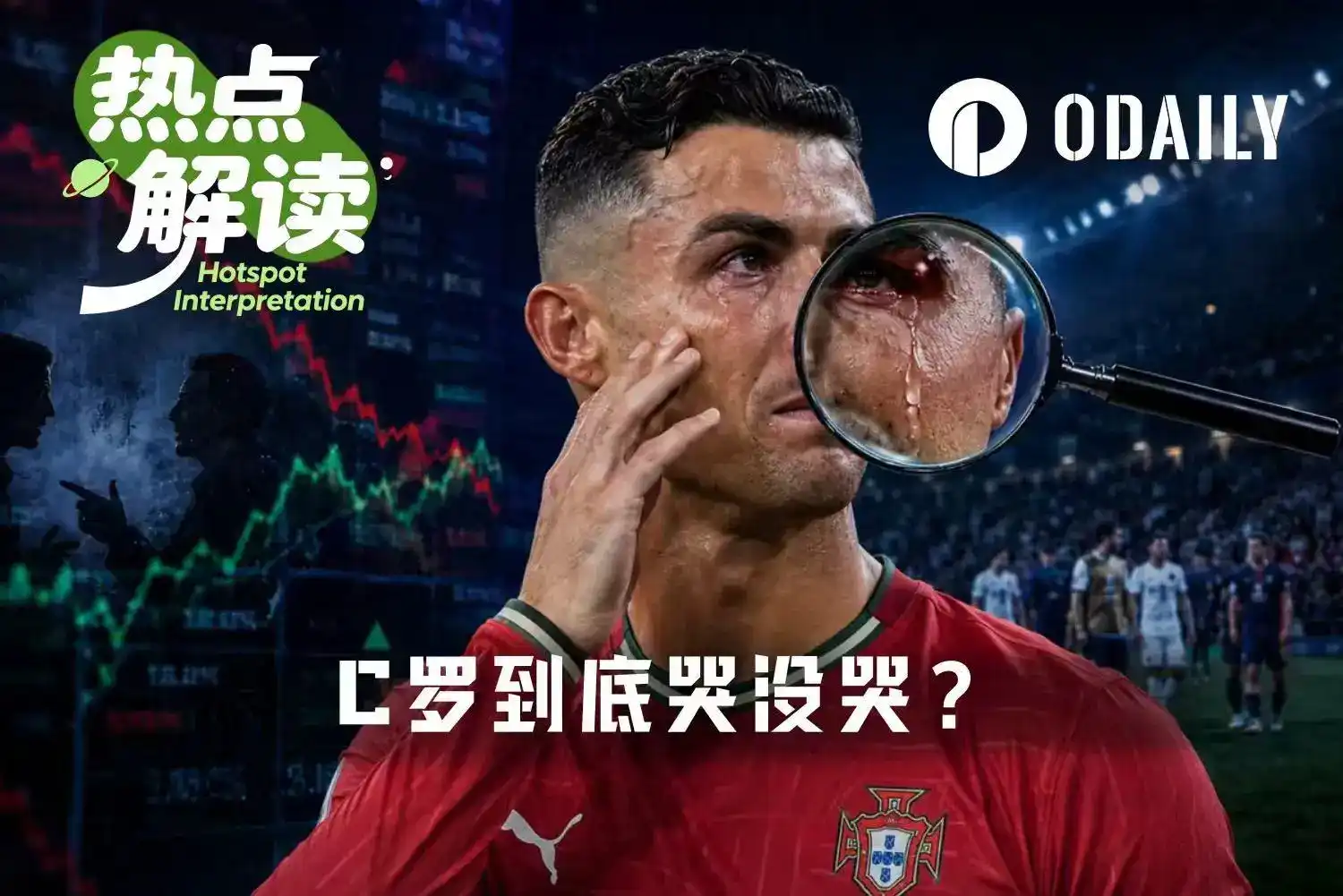
Yesterday, Portugal lost 0-1 to Spain in the Round of 16 of the 2026 World Cup. In stoppage time, a header from Merino sealed the win, eliminating the 41-year-old C罗 and Portugal from the quarter-finals. Before the match, C罗 had just confirmed this would be his last World Cup; after the game, he stood on the pitch, applauding the fans, wiping his eyes, and hugging the young Spanish player Yamal.

"Farewell Youth! 41-year-old C罗 Sheds Tears After Match, Final World Cup Ends in Round of 16." Headlines like this flooded media and social platforms. For most people, the fact that C罗 cried was almost beyond dispute.

C罗 covering his face post-match, clearly emotional

However, under Polymarket's settlement rules, whether "C罗 cried" is not necessarily a settled matter.

Did C罗 Cry? The Market Scrutinizes Frame by Frame

For Polymarket, where everything is predictable, this World Cup naturally featured a storyline involving C罗. Long before the match started, the platform launched a prediction event — "Will Ronaldo cry at the World Cup?" (Link: https://polymarket.com/event/will-ronaldo-cry-at-the-world-cup-20260604013616610).

Common sense would suggest that the images of C罗 "teary-eyed" after Portugal's elimination provide a clear answer. But on Polymarket, media reports and audience perceptions are not enough; the outcome must ultimately adhere to the rules themselves.

According to the settlement rules for this event on Polymarket, it will be considered "Yes" only if a real photo or video clearly shows recognizable tears on C罗's face; the crying must occur on the pitch or in the substitute bench area (dressing rooms, tunnels, etc., do not count); merely being emotional, having red eyes, wiping eyes, or eyes glistening may not necessarily count.
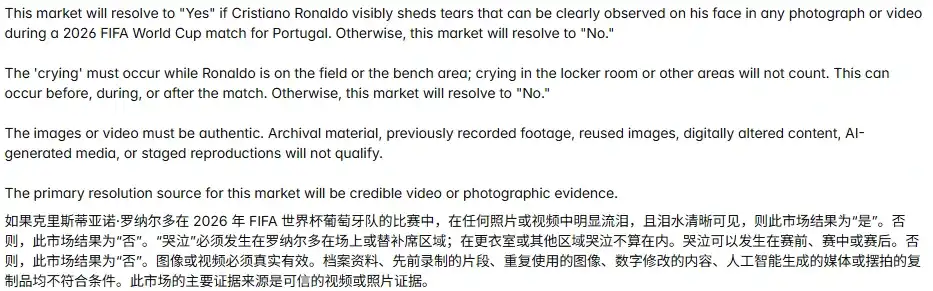
Settlement details for "Will Ronaldo cry at the World Cup?" on Polymarket

Thus, the debate quickly shifted from "Did C罗 cry?" to "Does that drop of liquid count as a tear?"

Some argued that photos and videos were clear enough, showing tear streaks on C罗's face; others insisted it could just be sweat, light reflection, or residual water from exertion. The pitch is hardly an ideal place for "tear verification" — with sweat, camera cuts, and glare making the judgment even more difficult.

Discussion among major traders on Polymarket about whether C罗 shed tears

This isn't the first time Polymarket has been caught up in rule definitions. Similar events in the past, like whether a U.S. government "partial shutdown" counts as a shutdown, have sparked controversy among traders due to grey areas between reality and market rules. This time, the controversy centers on that streak of moisture on C罗's face.

As a result, the event failed to settle twice yesterday and entered a dispute phase. As the dispute heated up, the probability of "Yes" once dropped below 20%.

The "Will Ronaldo cry at the World Cup?" event failed settlement twice, under dispute

At this stage, the market price reflects not just whether C罗 cried, but traders' bets on rule interpretation, evidence quality, and the final arbitration outcome. Based on the history of many disputed markets on Polymarket, once an event reaches this stage of nitpicking rules and evidence, the final outcome often deviates from public intuition.

A Clarification Brings a Major Reversal

Just as "Yes" holders were almost resigned to their positions being wiped out, supplementary rules updated by Polymarket this morning dramatically reversed the situation leaning towards "No".

The clarification explicitly stated, "At the time of this clarification, there exists qualifying photo and video evidence, taken on the pitch after the Portugal vs. Spain match, showing Cristiano Ronaldo crying, including visible tears on his face."
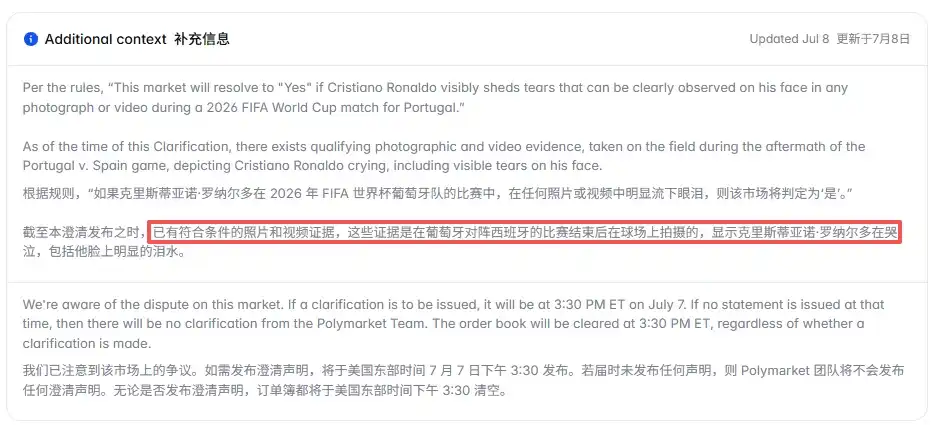
Supplementary settlement rules updated by Polymarket this morning

In other words, for this disputed event, Polymarket officially gave a clear stance: that streak of moisture on C罗's face counts as tears. Market sentiment instantly reversed. The "Yes" probability, which had previously dropped below 20%, surged rapidly, skyrocketing above 99%. The total trading volume for the event exceeded $22 million.
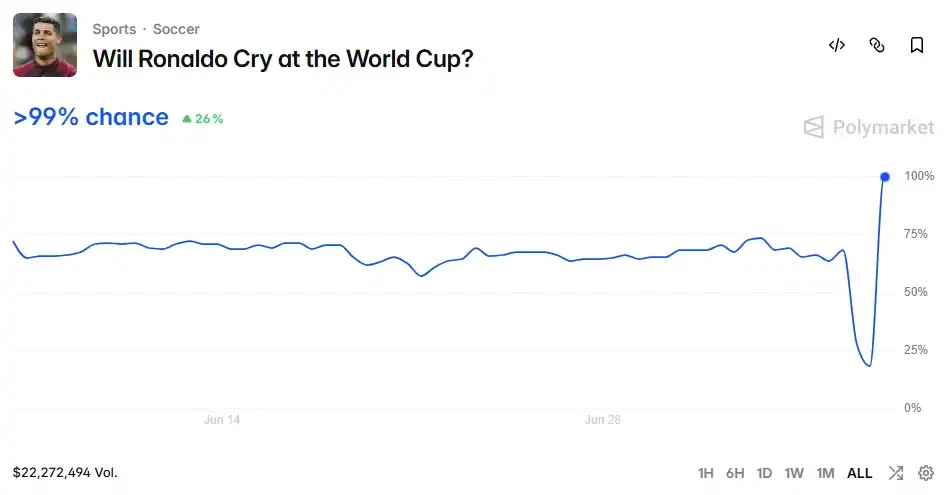
After the supplementary rules were released, the probability for "Ronaldo will cry at this World Cup" briefly surged to 99%

This controversial market witnessed a reversal with the release of Polymarket team's supplementary clarification. More importantly, this clarification sends a signal — when the rules themselves still have room for reasonable interpretation, the Polymarket team now seems more willing to align the outcome with public perception, rather than letting the market be hijacked by rule-lawyers fixated on technicalities.

In the past, the outcomes of many disputed markets on Polymarket often depended on who was better at exploiting rule loopholes or finding favorable interpretations in grey areas. But this time, with on-field footage, media reports, and supplementary evidence all pointing to C罗 indeed shedding tears, the officials did not let the detailed debate over "sweat or tears" dictate the settlement result.


Trending Cryptos

Related Questions

QWhat was the outcome of Portugal's match in the 2026 World Cup round of 16, and what was the significance for Cristiano Ronaldo?

APortugal lost 0-1 to Spain in the 2026 World Cup round of 16, eliminated by a stoppage-time header from Mikel Merino. This was Cristiano Ronaldo's final World Cup match, confirming his elimination from the tournament at 41 years old.

QWhat specific criteria did Polymarket's settlement rules require to resolve the 'Will Ronaldo cry at the World Cup?' market?

APolymarket's settlement rules required 'clear, identifiable tears' on Ronaldo's face in a real photo or video. The crying had to occur on the field or the team bench (dressing rooms, tunnels didn't count). Merely showing emotion, red eyes, wiping eyes, or watery eyes was not sufficient on its own.

QWhy did the Polymarket event 'Will Ronaldo cry at the World Cup?' initially fail to settle and enter a dispute phase?

AThe event entered a dispute phase because there was disagreement over whether the moisture visible on Ronaldo's face in post-match footage constituted 'tears' as defined by the rules. Traders debated if it was tears, sweat, water from cooling, or light reflection.

QHow did Polymarket's official clarification change the outcome of the market, and what was the market reaction?

APolymarket's official clarification stated that eligible photo and video evidence existed showing Ronaldo crying with visible tears on the field after the match. This definitively resolved the dispute in favor of 'Yes.' The market probability for 'Yes' surged from below 20% to over 99%.

QAccording to the article, what potential shift in Polymarket's approach does the resolution of this market signal?

AThe resolution signals that Polymarket's team may now be more willing to align market outcomes with common public perception and available evidence when rules have reasonable interpretive flexibility, rather than letting the outcome be solely determined by traders exploiting technical rule loopholes or ambiguous definitions.

Related Reads

Pacific 'Fever': How Extreme Weather Becomes Wall Street's Cash Machine?

"Pacific Fever": How Extreme Weather Becomes Wall Street's ATM? The summer of 2026 sees unusually fierce weather across China and globally. The common driver behind this global pattern is a powerful El Niño event, potentially the strongest since 1950, as declared by NOAA. This phenomenon, characterized by warming central/eastern Pacific waters, disrupts global atmospheric circulation, raising risks of floods, droughts, and heatwaves, further intensified by climate change. For financial markets, especially commodities, El Niño is not just weather but a major trading theme. History shows its price impact is profound. In the 1970s, El Niño-driven anchovy collapse in Peru fueled a soybean boom, giving Richard Dennis his first million. Anthony Ward's cocoa empire was built on superior weather intelligence. Most recently in 2024, West African droughts caused cocoa prices to soar over 400%, delivering huge gains for trend-following hedge funds. In 2026, markets are again pricing in future El Niño-induced supply shocks. Despite high current inventories, prices for palm oil, rubber, and sugar have rallied on anticipation of upcoming Southeast Asian droughts and weak Indian monsoons. Analysts identify key indicators to watch: the Niño3.4 index, Indian monsoon rainfall, Malaysian palm oil stocks, and the fundraising scale of specialized weather funds like Moreton Capital. Beyond trading opportunities, a concerning narrative is gaining traction online, linking El Niño with fertilizer shortages and energy supply disruptions to warn of potential global food crises within months. While alarmist, it highlights a deeper truth: the cascading effects of climate-driven weather extremes ultimately translate into higher costs of living for everyone, far beyond the trading floor.

marsbit2m ago

Pacific 'Fever': How Extreme Weather Becomes Wall Street's Cash Machine?

marsbit2m ago

Pacific 'Fever': How Extreme Weather Becomes Wall Street's ATM?

"Pacific 'Fever': How Extreme Weather Becomes Wall Street's Piggy Bank" The article examines how the 2026-2027 El Niño, potentially the strongest since 1950, is not only disrupting global weather but also creating major financial opportunities. It links recent extreme events in China and worldwide to this climate phenomenon, which alters atmospheric patterns, increasing risks of floods, droughts, and heatwaves. The core narrative explores how financial markets capitalize on these disruptions. A hedge fund is raising $500 million specifically to bet on El Niño-affected crops like South African corn and Malaysian palm oil. Historically, such strategies have yielded massive profits. Examples include Richard Dennis ("Turtle Trader") making his first fortune in the 1970s soy boom triggered by El Niño's impact on Peruvian anchovies (a key fishmeal source), and Anthony Ward's cocoa empire built on superior weather intelligence. The 2024 cocoa price surge, driven by West African drought, enriched quantitative trend-following funds. Currently, markets are preemptively bidding up palm oil, rubber, and sugar futures based on anticipated future supply shocks, despite high current inventories. The article details El Niño's asymmetric global impacts: causing drought in Southeast Asia (hurting palm oil/rubber) and India (affecting sugar/cotton), but bringing beneficial rains to South American soy and sugarcane. Key metrics to watch include the Niño3.4 index, Indian monsoon data, and Malaysian palm oil stocks. The true price effects often materialize *after* the El Niño peaks, suggesting 2027 may see the real volatility. The conclusion warns that beyond trading gains, the convergence of El Niño, energy shortages, and fertilizer scarcity poses a systemic risk, potentially raising the cost of living for everyone, turning a climate event into a global economic story.

链捕手11m ago

Pacific 'Fever': How Extreme Weather Becomes Wall Street's ATM?

链捕手11m ago

Just Now, OpenAI's Chief Futurist Departed, Once Called a Jackass by Musk

Just now, OpenAI's Chief Futurist, Joshua Achiam, announced his departure from the company via X. Having joined as a 25-year-old intern in 2017, he spent nine years at OpenAI, evolving from an AI safety research scientist to leading the Mission Alignment team. Earlier this year, that team was dissolved, and Achiam transitioned to the newly created role of Chief Futurist, positioned at the intersection of AI safety and policy to study AGI's long-term risks and opportunities. In his departure statement, Achiam called his time a "graduation," reflecting on the immense progress from AI that couldn't converse to systems solving scientific problems. He expressed optimism about a future of peace, prosperity, and possibility, closing with "To safe AGI." His tenure was notably marked by a 2018 incident where he publicly challenged Elon Musk—then still with OpenAI—on safety compromises if Musk pursued AGI at Tesla, leading Musk to call him a "jackass." This became an internal legend, with colleagues later giving him a trophy inscribed, "To safety, never stop being that jackass." Achiam's exit follows a pattern of prominent safety and alignment experts leaving OpenAI, including Jan Leike and others who joined rivals like Anthropic or started non-profits. His departure coincides with OpenAI's internal efforts to more tightly integrate its research and policy teams, and the recent hiring of former White House AI advisor Dean Ball. Achiam did not cite a specific reason for leaving but indicated it was a long-considered decision, stating the mission to ensure AGI benefits humanity can now be advanced beyond the "frontier lab's" walls.

marsbit12m ago

Just Now, OpenAI's Chief Futurist Departed, Once Called a Jackass by Musk

marsbit12m ago

Anthropic Drops $19 Billion to 'Sponsor' a Bitcoin Miner

On July 6, 2026, Bitcoin mining company TeraWulf (NASDAQ: WULF) saw its stock surge 15% pre-market following the announcement of a landmark 20-year agreement with AI giant Anthropic. The deal grants Anthropic 401 MW of IT load capacity at TeraWulf's "Justified Data" campus in Kentucky and is projected to generate approximately $19 billion in contracted revenue for the miner over its duration. On the same day, TeraWulf also sold its 50.1% stake in a Texas joint venture for about $530 million. This dual move signals a strategic pivot: divesting non-core assets to fund its fully-owned Kentucky project and shifting focus from cryptocurrency mining to becoming a specialized infrastructure provider for AI. The agreement highlights a key advantage for Bitcoin miners transitioning to AI: their pre-existing access to land and critical power grid capacity, which is becoming a major bottleneck for data center expansion. Unlike peers who operate AI clouds, TeraWulf is adopting a "landlord" model, leasing only the physical space and power for clients' own servers. However, a significant gap exists between the deal's announcement and revenue generation, with the first phase of the Kentucky site not operational until late 2027. The $19 billion figure represents a long-term bet on both TeraWulf's execution and Anthropic's financial durability in the capital-intensive AI race. The market's positive reaction reflects the growing value of fundamental infrastructure—secured land and reliable electricity—in the era of AI compute scarcity.

marsbit16m ago

Anthropic Drops $19 Billion to 'Sponsor' a Bitcoin Miner

marsbit16m ago

Securitize Drops 40% in First Week of Trading as Tokenization Industry Enters Patent Wars

The article discusses the recent stock performance of Securitize (NYSE: SECZ) and a looming patent war in the tokenization industry. Securitize, a leading tokenization platform and transfer agent for BlackRock's BUIDL fund, debuted on the NYSE via a SPAC merger on July 2. After an initial rise, its stock plummeted nearly 40% within a week, closing at $8.06 on July 7. Analysts attribute the sharp decline largely to typical post-SPAC investor turnover and broader pressure on crypto-related stocks, rather than fundamental business deterioration. Concurrently, Securitize faces significant legal challenges. On June 15, infrastructure rival tZERO accused Securitize of patent infringement concerning its core DS Protocol and Vault Registrar products. Securitize preemptively filed a lawsuit on June 22 seeking a declaratory judgment of non-infringement. tZERO, holding 105 patents, has indicated it has identified at least six other market participants for potential infringement actions, signaling a broader industry-wide patent conflict. A separate lawsuit was also filed by Liquid Rarity Exchange. The article concludes that while Securitize's stock drop may be a temporary SPAC-related correction, the patent disputes initiated by tZERO represent a more profound, long-term risk for the entire tokenization sector, potentially shifting competitive dynamics from business execution to intellectual property litigation.

Foresight News45m ago

Securitize Drops 40% in First Week of Trading as Tokenization Industry Enters Patent Wars

Foresight News45m ago

Trading

Spot

Hot Articles

Discussions

Welcome to the HTX Community. Here, you can stay informed about the latest platform developments and gain access to professional market insights. Users' opinions on the price of S (S) are presented below.

活动图片