South Korean Stocks Plunge Again, Latest Response from the Blue House

marsbitPublished on 2026-08-06Last updated on 2026-08-06

Abstract

Korean Stock Market Plummets Amid Global Sell-Off, Presidential Office Responds South Korea's stock market experienced a sharp decline on Thursday. The benchmark KOSPI index fell over 4%, with major components SK Hynix and Samsung Electronics dropping over 8% and 5%, respectively. The sell-off quickly spread to related Hong Kong ETFs. The trigger was weak forward guidance from U.S. memory chip giants SanDisk and Western Digital, whose revenue forecasts fell short of lofty market expectations despite strong prior-quarter results. Their subsequent stock plunge led to a sell-off in Asian semiconductor stocks, highlighting the region's dependence on U.S. market sentiment. Since hitting a record high in mid-June, the KOSPI has fallen over 21% in about a month. In response to market volatility, the South Korean government has implemented measures, including raising cash margin requirements for single-stock leveraged ETFs. This led to a significant drop in their trading volume. A senior presidential official stated the focus is on closely monitoring the situation and formulating appropriate countermeasures. Analyst views on the market outlook diverge: while Morgan Stanley sees the sell-off as a buying opportunity due to low valuations, others like China Securities warn of continued high volatility as leverage unwinds. Looking ahead, analysts expect the global memory chip sector to remain in a high-sensitivity phase. However, Goldman Sachs maintains a long-term bullish target of...

Thursday, South Korean stock markets fell sharply.

At the time of writing, the KOSPI index dropped over 4%, currently at 6322.55 points. Among individual stocks, SK Hynix fell over 8% and Samsung Electronics dropped over 5%.
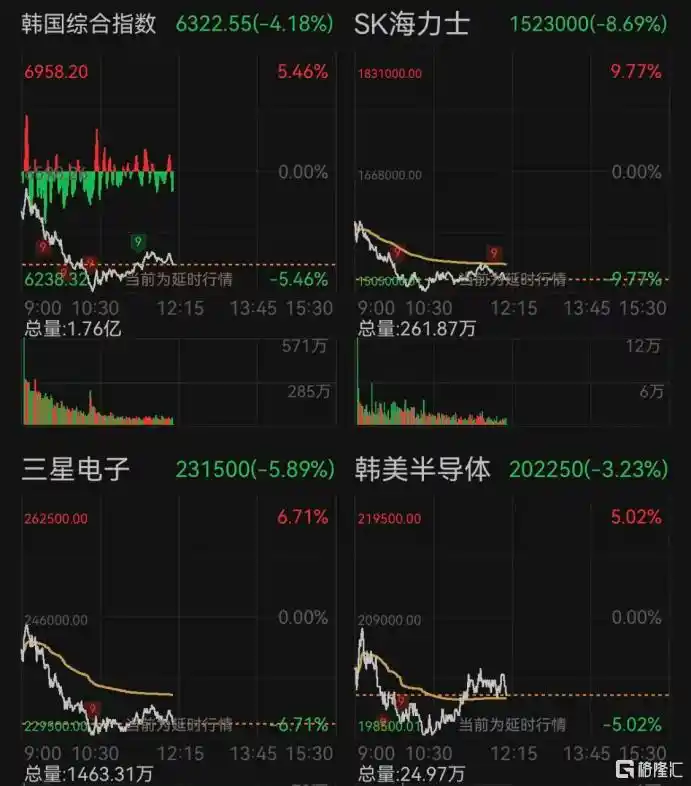
In the Hong Kong market, the Direxion Daily CSI 300 China A Share Bull 2X Shares ETF linked to Hynix fell over 15%, and the 2X leveraged ETF on Samsung dropped over 11%.

Guidance Shock from U.S. Memory Giants

The trigger for this round of selling points directly to the "guidance shock" from the U.S. memory chip sector overnight.

After the U.S. market closed on Wednesday Eastern Time, SanDisk and Western Digital both released their latest financial reports.

The reports showed that these two memory giants delivered unexpectedly strong results for the previous quarter, but their current-quarter guidance both failed to meet Wall Street's higher growth expectations.

Specifically, SanDisk expects next quarter revenue to be between $10.3 billion and $10.8 billion, below analysts' expectation of $11.16 billion. Western Digital expects next quarter revenue between $4.0 billion and $4.2 billion, slightly above the analyst consensus of $4.04 billion.

The "better-than-expected past" was not enough to fully offset the "slightly-below-expectations future."

Following the earnings release, both memory giants were heavily sold off, with SanDisk falling over 8% and Western Digital dropping over 11%.

The pessimistic guidance from the memory giants quickly transmitted through the supply chain to Asian markets.

On Thursday, after the South Korean stock market opened, SK Hynix and Samsung Electronics faced heavy selling pressure.

Data shows that up to the previous trading session, foreign investors had accumulated a net purchase of 1.4513 trillion won in Korean stocks, but on the 6th, they net sold over 500 billion won in the market.

Analysts pointed out that Asian markets ultimately still need to watch the U.S. market's movements and lack pricing power.

Mirae Asset Securities researcher Han Ji-young stated that despite improvements in geopolitics and the macro environment, influenced by the weakening Philadelphia Semiconductor Index and profit-taking after the recent rapid short-term stock price gains, the market is likely to enter a phase of consolidation and sector rotation.

"The exceptionally amplified volatility seen during the July crash has passed its peak."

Latest Response from the Blue House

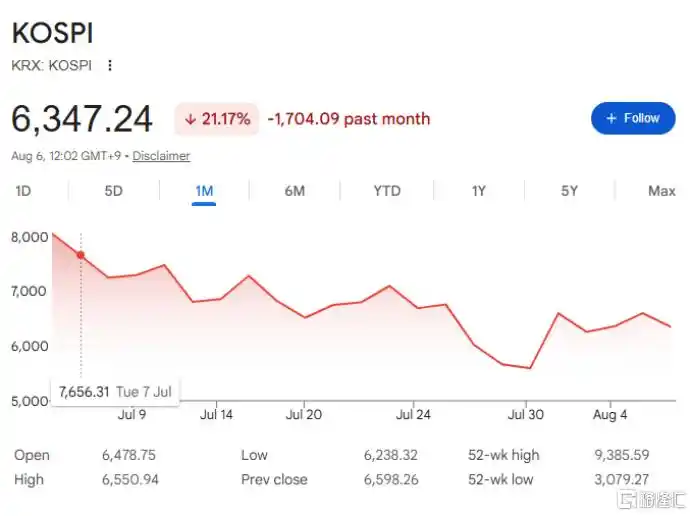
It is noteworthy that since surging to an all-time high on June 19, the South Korean stock market has been fluctuating downwards. Over the past month, the KOSPI index has accumulated a loss of 21.17%.
Facing the sharply volatile market, the South Korean government is urgently "rescuing the market."

Earlier, Kim Yong-beom, the head of the Office for Government Policy Coordination under the President's Office, faced criminal charges for "rushing the introduction of leveraged ETFs."

In response, Seong Gi-hong, Senior Presidential Secretary for Public Relations and Communication, stated in the latest response that the current priority is to closely monitor market conditions and formulate corresponding countermeasures.

"All relevant officials in the presidential office are carefully examining each situation and very prudently studying how to formulate related measures."

Last Friday, South Korea's financial regulator raised the minimum cash margin requirement for investing in single-stock leveraged ETFs.

After the regulator introduced these restrictive measures, trading volume in South Korean single-stock leveraged ETFs plummeted.

Latest data released by the Korea Exchange showed that the average daily trading volume of 16 single-stock leveraged ETFs fell to 919.8 billion won on Wednesday, dropping below 1 trillion won for the first time since their listing on May 27.

Morgan Stanley noted that the previous intense leverage unwinding is nearing its end, and KOSPI valuations have fallen to historically low levels, providing investors with a more attractive entry point.

However, China Securities (CITIC Securities) holds a different view on this matter.

The institution believes that while leverage among South Korean retail investors has been rapidly reduced, margin balances are still shrinking at the fastest pace this year, and the liquidation rate remains far above normal levels. It expects subsequent market volatility to remain relatively high.

Looking ahead, analysts stated that after a prolonged bull market, the global memory semiconductor sector has entered a phase of high sensitivity and high volatility, and short-term sentiment shocks need time to digest.

From a medium to long-term perspective, Goldman Sachs firmly maintains its target of 12,000 points for the KOSPI index, expecting the market still has about 80% to 90% upside potential.

The bank believes that current market pricing does not reflect the potential severe shortage of memory chips, which could persist until 2030. As AI computing demand accelerates, the semiconductor industry, which accounts for over 50% of the KOSPI's weight, will become a global profit engine.

J.P. Morgan similarly maintains its optimistic outlook on SK Hynix and the memory chip industry, viewing this pullback as an opportunity to increase positions.

This article is from the WeChat public account "Gelonghui APP" (ID: hkguruclub), author: Gelonghui Editor.


Trending Cryptos

Related Questions

QWhat triggered the sharp decline in the South Korean stock market?

AThe sell-off was primarily triggered by disappointing future revenue guidance from U.S. memory storage giants SanDisk and Western Digital, which led to a sharp drop in their stock prices and caused the negative sentiment to spread to Asian markets.

QHow did the South Korean government respond to the market volatility?

AThe South Korean government is implementing emergency measures to stabilize the market. This includes raising the minimum cash margin requirement for single-stock leveraged ETFs, which has led to a significant drop in their trading volume. The Blue House stated that officials are closely monitoring the situation and carefully formulating corresponding measures.

QWhat was the performance of key South Korean semiconductor stocks like Samsung and SK Hynix?

AKey South Korean semiconductor stocks experienced significant declines. SK Hynix fell over 8% and Samsung Electronics dropped over 5%, contributing to the KOSPI index's decline of over 4%.

QWhat are the differing views from major financial institutions on the future of the South Korean market?

AFinancial institutions hold differing views. Morgan Stanley believes the severe leverage unwinding is nearly over and valuations are attractive. Goldman Sachs maintains a long-term bullish target of 12,000 points for the KOSPI, citing potential chip shortages. However, CITIC Securities warns that while retail leverage has decreased, margin debt is still shrinking rapidly and market volatility will remain high.

QWhat is the main reason cited for the lack of pricing power in Asian markets according to the article?

AAccording to analysts in the article, Asian markets ultimately have to follow the lead of the U.S. stock market and lack independent pricing power. The negative guidance from U.S. tech giants quickly transmitted through the supply chain, impacting related stocks in Asia.

Related Reads

Arthur Hayes Steps Up Purchases of This Altcoin, Investing $2 Million Over the Past Five Days!

Arthur Hayes, the founder of BitMEX, has significantly increased his investment in $ENA, the native token of the Ethena ecosystem, by purchasing approximately 2 million dollars' worth over the past five days. His most recent transaction involved acquiring 10.9 million $ENA tokens, valued at around $985,000, bringing his total recent purchases to 22.64 million tokens. This buying activity has drawn renewed investor attention to Ethereum-based projects and the DeFi sector. Hayes is known for his macroeconomic analyses and positive outlook on the crypto market. His substantial investment in $ENA is being interpreted as a sign of his confidence in the long-term prospects of Ethereum and specific DeFi projects. Ethena is noted for developing synthetic dollar products on the blockchain, with its $ENA token used for governance and within its ecosystem. While such large-scale purchases by prominent figures are seen as a key market indicator, experts caution that they alone are insufficient to drive price increases. Multiple factors, including overall market conditions, liquidity, investor demand, and macroeconomic events, continue to influence price movements. Analysts suggest Hayes's actions may reflect sustained interest from institutional and large investors in Ethena, but they emphasize that investment decisions should not rely solely on whale activity. A thorough evaluation of a project's fundamentals, utility, and broader market trends remains essential.

cryptonews.ru16m ago

Arthur Hayes Steps Up Purchases of This Altcoin, Investing $2 Million Over the Past Five Days!

cryptonews.ru16m ago

AI Takes Over the Lab? Latest Research from USTC Puts It to the Test in the Real Physical World

This study from the University of Science and Technology of China presents a real-world stress test for AI in scientific research. Researchers developed a machine-readable, modular laboratory for catalysis, consisting of 45 automated workstations. They evaluated 48 configurations combining 6 agent frameworks and 9 large language models (LLMs) across 32 expert-defined research tasks, conducting 4,608 tests. The key findings reveal a significant gap between AI's planning ability and reliable physical execution. Only 3.3% of all generated workflows (151 out of 4,608) could be executed without human correction. The best-performing agent/LLM combination achieved a 28.1% success rate. In a five-round closed-loop experiment, the AI could adjust local parameters based on results but failed at higher-level scientific replanning, such as redesigning analytical methods or correcting persistent critical omissions. Maintaining logical integrity for long-sequence workflows (over 30 steps) also proved challenging. The research distinguishes three often-conflated AI capabilities: generating plausible experimental plans, creating physically executable workflows, and performing evidence-driven strategic replanning. Results show the first does not guarantee the second, and parameter tuning is not equivalent to scientific reasoning. The platform serves as both a "testing ground" to quantify AI's scientific aptitude and a potential "training ground." By forming a "plan-execute-feedback-replan" loop with real-world feedback, it can expose AI shortcomings and generate data for iterative improvement, moving toward true end-to-end autonomous discovery.

marsbit21m ago

AI Takes Over the Lab? Latest Research from USTC Puts It to the Test in the Real Physical World

marsbit21m ago

Trading

Spot

Hot Articles

What is VRJAM(BLUE)

VRJAM(BLUE): Revolutionizing Live Experiences in the Virtual World Introduction to VRJAM(BLUE), $vrjam(blue) In an age where virtual experiences are becoming increasingly prevalent, VRJAM(BLUE), represented by the token $vrjam(blue), emerges as a pioneering project within the cryptocurrency space. Launched in 2022, VRJAM(BLUE) seeks to transform how live events are conducted in the digital realm by utilizing the power of blockchain technology and the Hedera Hashgraph platform. As a unique blend of immersive social gaming and interactive virtual events, VRJAM(BLUE) strives to create a comprehensive, engaging experience that resonates with users worldwide. What is VRJAM(BLUE), $vrjam(blue)? At its core, VRJAM(BLUE) is a live experience platform harnessing blockchain to facilitate immersive interactions during virtual events. It stands out as a futuristic solution that allows users to engage with one another in real time, bridging the gap between the physical and digital worlds. The platform leverages advanced technologies, including AI-powered virtual humans, which introduce customizable digital representations of users. These entities serve as avatars that enhance the social dynamics of virtual gatherings. Coupling these virtual beings with the use of non-fungible tokens (NFTs) introduces a layer of security and authenticity, ensuring that unique digital assets can be traded and valued properly within the platform's ecosystem. Moreover, VRJAM(BLUE) integrates a native cryptocurrency, the VRJAM Coin, which acts as the medium of exchange within its virtual world. This digital currency facilitates transactions for services, content, and assets while enabling users to participate seamlessly in live events and interactive experiences. Creator of VRJAM(BLUE), $vrjam(blue) The specific identity of the creator of VRJAM(BLUE) remains undisclosed, though the project is under the leadership of CEO Sam Speaight. His vision for the platform aims at leveraging innovative technology and strategic partnerships to expand the reach and impact of VRJAM(BLUE) in the rapidly evolving web3 ecosystem. Investors of VRJAM(BLUE), $vrjam(blue) VRJAM(BLUE) has garnered considerable interest from various investors and funding rounds, successfully raising a total of $5.34 million throughout 12 funding events. These various initiatives, including Initial DEX Offerings (IDO) and token launches, have provided the necessary capital to propel the project forward. However, specific details regarding the individual investors or organizations backing VRJAM(BLUE) have not been disclosed. How Does VRJAM(BLUE), $vrjam(blue) Work? The innovative approach of VRJAM(BLUE) revolves around multiple cutting-edge technologies, notably artificial intelligence, virtual reality, and blockchain. AI-Powered Virtual Humans A distinguishing feature of VRJAM(BLUE) is its integration of AI-powered virtual humans. These customizable characters respond dynamically to user interactions, enriching the overall experience of virtual events. This personalization allows users to create unique identities and facilitating more meaningful connections within the community. NFT Technology By incorporating NFT technology into its framework, VRJAM(BLUE) provides users with enhanced security and ownership of digital assets. Users can purchase, sell, or trade NFTs that represent virtual tickets, memorabilia, or other digital creations linked to live events, ensuring that ownership is verifiable and protected. Native Cryptocurrency The VRJAM Coin serves as the platform's native currency, allowing users to transact seamlessly within the virtual environment. This cryptocurrency not only supports traditional user activities but also bolsters a larger economic ecosystem tailored to the needs of VRJAM’s community. DeFi Solutions The project also embraces decentralized finance (DeFi) by incorporating trustless protocols. These solutions aim to stabilize token prices and enhance liquidity, allowing users to engage in financial transactions without intermediary restrictions. Timeline of VRJAM(BLUE), $vrjam(blue) To fully understand the evolution of VRJAM(BLUE), it's essential to take a closer look at its timeline: 2022: Launch of VRJAM(BLUE) – The platform made its debut, ushering in a new era for virtual event experiences. November 30, 2022: Completion of the Token Generation Event (TGE) – This marked a significant milestone, as the platform's native cryptocurrency became available for investor engagement. Post-TGE: Following the TGE, the distribution of tokens initiated, featuring a 20% immediate release, followed by a linear vesting phase of the remaining 80% over a period of six months. Key Features and Partnerships The success of VRJAM(BLUE) can also be attributed to its strategic partnerships and innovative features. Partnerships In its quest to bring life to the metaverse, VRJAM(BLUE) has formed alliances with prominent entities in the industry. Notably, its collaboration with Polygon aims to enhance the efficiency and reach of live events. Additional partnerships with organizations such as Agora and Enjin further bolster content distribution and the utilization of NFT technology. These collaborations are enhancing VRJAM(BLUE)'s capabilities and expanding its influence in the web3 ecosystem. Token Liquidity Protocol Operating on the Hedera Hashgraph, VRJAM(BLUE) employs a token liquidity protocol that aggregates liquidity across various trading platforms. This initiative is designed to unify token pricing, thus enhancing user confidence in the VRJAM Coin and promoting stability within the ecosystem. Web3 Economy With the overarching aim of fostering a sustainable web3 economy, VRJAM(BLUE) is diligently working on its DeFi product suite. By providing users with tools for financial engagement, such as yield farming or staking, the project is paving the way for broader participation in its virtual economy. Conclusion VRJAM(BLUE), with its token $vrjam(blue), stands at the forefront of the revolution in virtual experiences and live interactions within the digital space. By intertwining advanced technologies such as AI, virtual reality, and blockchain, the project has developed a platform that not only facilitates immersive experiences but also builds a vibrant, interactive community. As the landscape of the crypto and web3 industries continues to evolve, VRJAM(BLUE) aims to play a critical role in shaping the future of virtual events and experiences. With its commitment to innovation and community engagement, VRJAM(BLUE) is well-positioned to pave a prosperous path for digital interactions in the years to come.

998 Total ViewsPublished 2024.12.03Updated 2024.12.03

What is VRJAM(BLUE)

How to Buy BLUE

Welcome to HTX.com! We've made purchasing Bluefin (BLUE) simple and convenient. Follow our step-by-step guide to embark on your crypto journey.Step 1: Create Your HTX AccountUse your email or phone number to sign up for a free account on HTX. Experience a hassle-free registration journey and unlock all features.Get My AccountStep 2: Go to Buy Crypto and Choose Your Payment MethodCredit/Debit Card: Use your Visa or Mastercard to buy Bluefin (BLUE) instantly.Balance: Use funds from your HTX account balance to trade seamlessly.Third Parties: We've added popular payment methods such as Google Pay and Apple Pay to enhance convenience.P2P: Trade directly with other users on HTX.Over-the-Counter (OTC): We offer tailor-made services and competitive exchange rates for traders.Step 3: Store Your Bluefin (BLUE)After purchasing your Bluefin (BLUE), store it in your HTX account. Alternatively, you can send it elsewhere via blockchain transfer or use it to trade other cryptocurrencies.Step 4: Trade Bluefin (BLUE)Easily trade Bluefin (BLUE) on HTX's spot market. Simply access your account, select your trading pair, execute your trades, and monitor in real-time. We offer a user-friendly experience for both beginners and seasoned traders.

4.7k Total ViewsPublished 2024.12.11Updated 2026.06.02

How to Buy BLUE

Discussions

Welcome to the HTX Community. Here, you can stay informed about the latest platform developments and gain access to professional market insights. Users' opinions on the price of BLUE (BLUE) are presented below.

活动图片