South Korea Plans Cap On Crypto Exchange Ownership Despite Industry Concerns

bitcoinistPublished on 2026-01-29Last updated on 2026-01-29

Abstract

South Korea's Financial Services Commission (FSC) is proceeding with a proposal to cap major shareholders' stakes in cryptocurrency exchanges at 15%-20%, despite opposition from industry players and the ruling Democratic Party of Korea (DPK). FSC Chairman Lee Eog-weon argued the measure is necessary to align governance standards with exchanges' expanding public role and to prevent conflicts of interest. The cap would be part of the upcoming Digital Asset Basic Act, which would also transition exchanges from a renewable notification system to a permanent authorization system. Major exchanges like Upbit and Coinone oppose the move, warning it could hinder industry growth. Meanwhile, lawmakers aim to introduce the comprehensive digital asset framework before the Lunar New Year. The legislation also addresses stablecoin regulation, setting a minimum capital requirement of 5 billion won ($3.48 million) for issuers, though no agreement has been reached on won-pegged stablecoins.

South Korea’s Financial Services Commission (FSC) has shared its intention to move forward with the proposed cap on crypto exchange ownership despite concerns from industry players and the ruling Democratic Party of Korea (DPK).

FSC Backs Ownership Cap For Crypto Exchanges

On Wednesday, Financial Services Commission Chairman Lee Eog-weon revealed that the regulatory agency is reviewing a proposal to cap major shareholders’ stakes in crypto exchanges at around 15%-20%.

According to The Korea Times, Lee stressed the need to limit the ownership stakes of controlling shareholders in crypto exchanges, claiming that the move is necessary to “align governance standards with the exchanges’ increasing public role.”

He argued that “excessive concentration of ownership” could increase the risk of conflicts of interest while undermining market integrity, noting that securities exchanges and other trading systems are subject to similar limits.

The chairman highlighted that existing regulations mainly focus on anti-money laundering and investor protection. The ownership cap proposal would be included in the upcoming Digital Asset Basic Act, also known as the Second Phase of the Virtual Asset User Protection Act, which is expected to serve as a comprehensive framework for the entire industry.

“Under the current system, virtual asset exchanges operate under a notification system that requires renewal every three years. The proposed shift to an authorization system would effectively grant exchanges permanent operating status,” Lee explained.

He emphasized that “this higher status means exchanges need governance rules that match their larger role and greater responsibilities.” As a result, exchanges would assume characteristics similar to public infrastructure.

A joint council representing domestic crypto exchanges, including Upbit, Bithumb, and Coinone, has opposed the proposed cap, warning that it could hinder the development of South Korea’s digital asset sector.

Notably, major players like Song Chi-hyung, the chairman of Dunamu, the company that operates Upbit, and Cha Myung-hoon, the founder of Coinone, would be forced to sell significant portions of their holdings if the law is enacted.

The Democratic Party of Korea also expressed its concerns, observing that similar ownership caps are uncommon worldwide and could make South Korea’s framework inconsistent with global regulatory trends.

Lawmakers Set New Deadline For Digital Assets Framework

ChosunBiz reported that the DPK’s Digital Assets Task Force (TF) discussed key details of the Digital Asset Basic Act in a Wednesday meeting at the National Assembly members’ office building, attended by government officials.

According to the report, the ruling party’s members did not discuss the cap on crypto exchange ownership. Still, they revealed that they will introduce the framework before the Lunar New Year holiday on February 17.

DPK’s Lawmaker Ahn Do-geol said, “We plan to introduce the Digital Asset Basic Act before the Lunar New Year, and we hope that by then a plan agreed upon with the government as much as possible will be put together.”

Instead of the “unanimous consent system” proposed by the Bank of Korea (BOK), the task force settled on a consultative body to discuss stablecoin authorizations, comprised of the BOK, the FSC, the Ministry of Economy and Finance, and the Financial Supervisory Service.

The task force considered that requiring unanimity for stablecoin authorization would slow issuance, while observers believe that the central bank’s proposal was “a way to control stablecoins.”

In addition, the minimum statutory capital for stablecoin issuers was set at 5 billion won, approximately $3.48 million. Nonetheless, the report affirmed that there has not been an agreement on the issuance of won-pegged stablecoins.

As reported by Bitcoinist, the BOK and the FSC have been clashing over the extent of banks’ role in stablecoin issuance. While the central bank has been pushing for a consortium of banks owning at least 51% of any stablecoin issuer seeking approval in the country, the FSC has expressed concerns about this proposal.

Lee Kang-il, a DPK lawmaker on the task force, asserted that “the 50%+1 share rule remains contentious because there is still no willingness to concede among government ministries,” but added that they have prepared a mediation plan and will “make decisions in a direction that serves the national interest overall and benefits the public.”
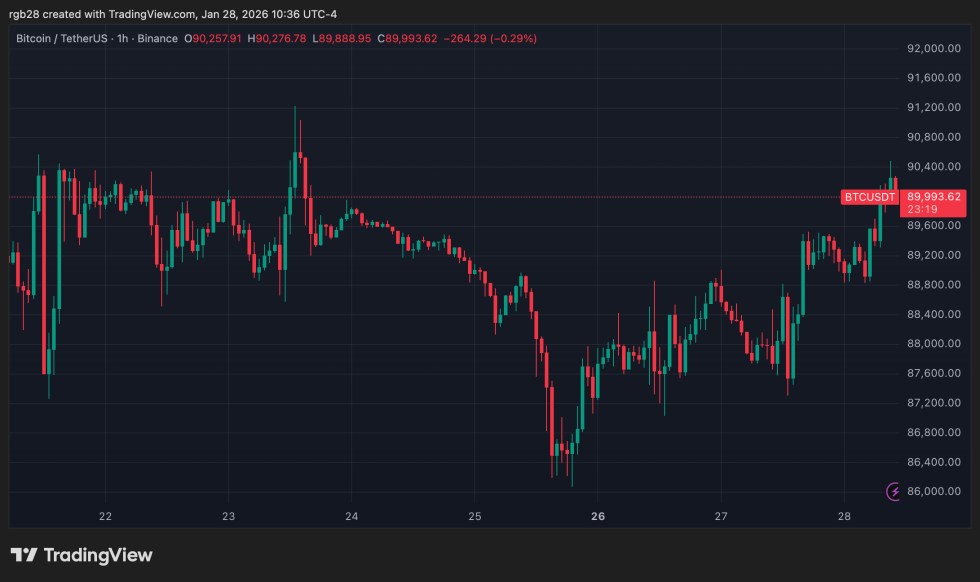
Bitcoin (BTC) trades at $89,993 in the one-week chart. Source: BTCUSDT on TradingView


Trending Cryptos

Related Questions

QWhat is the proposed ownership cap for major shareholders in crypto exchanges by South Korea's FSC?

AThe Financial Services Commission (FSC) is reviewing a proposal to cap major shareholders’ stakes in crypto exchanges at around 15%-20%.

QWhy does the FSC believe an ownership cap is necessary for crypto exchanges?

AThe FSC argues that an 'excessive concentration of ownership' could increase the risk of conflicts of interest and undermine market integrity, and that exchanges need governance rules that match their larger public role and greater responsibilities.

QWhich major industry players have opposed the proposed ownership cap?

AA joint council representing domestic crypto exchanges, including Upbit, Bithumb, and Coinone, has opposed the cap. Key individuals like Dunamu's chairman Song Chi-hyung and Coinone founder Cha Myung-hoon would be forced to sell significant portions of their holdings.

QWhat is the new deadline for introducing the Digital Asset Basic Act, as set by lawmakers?

AThe ruling Democratic Party of Korea (DPK) plans to introduce the Digital Asset Basic Act before the Lunar New Year holiday on February 17.

QWhat was the minimum statutory capital set for stablecoin issuers, and what is its approximate value in US dollars?

AThe minimum statutory capital for stablecoin issuers was set at 5 billion won, which is approximately $3.48 million.

Related Reads

Has Bitcoin Bottomed, or Is a 'Shakeout' Approaching? What's the Situation with XRP?

Cryptocurrency analytics platform Santiment shared key insights on Bitcoin and altcoin markets, highlighting significant signals from on-chain data. Analysis shows Bitcoin's 365-day MVRV ratio has fallen to -26%, indicating substantial losses for long-term holders, a level historically associated with market bottom formations and long-term buying opportunities. While short-term MVRV is near breakeven, suggesting no clear directional signal, the annual perspective points to a bottom before bullish cycles. On-chain data reveals divergent behavior: large wallets (10-10,000 BTC) have been accumulating, adding ~18,500 BTC in 10 days, while smaller retail investors continue buying dips. Analysts caution that high retail demand can sometimes create a risk of a final market shakeout or correction. The altcoin market shows a mixed picture. Ethereum's 365-day MVRV is around -33%, but recent monthly gains combined with overly optimistic social sentiment pose a short-term correction risk. XRP is in oversold territory with 30-day and 365-day MVRVs at -57.5% and -45.5% respectively, signaling potential for a strong mid-to-long term rebound. Social activity and optimism are rising for Solana, while investor sentiment remains calmer towards Cardano. Future direction for Bitcoin and altcoins depends not only on on-chain metrics but also on macroeconomic and regulatory developments. The Federal Reserve's interest rate decision and upcoming policy rulings are increasing market volatility expectations, while uncertainty around the U.S. Congressional clarity process continues to pressure pricing. *This is not investment advice.

cryptonews.ru11m ago

Has Bitcoin Bottomed, or Is a 'Shakeout' Approaching? What's the Situation with XRP?

cryptonews.ru11m ago

Bank of Korea Reveals Results of Tokenized Deposit Testing

The Bank of Korea has announced the results of its pilot test for tokenized deposits. Involving 28 central banks and international financial organizations, the project saw participation from major South Korean banks including KB Kookmin Bank, NH NongHyup Bank, Shinhan Bank, Woori Bank, and Hana Bank. Transactions, from payment orders to final settlement, were completed in real time, averaging just 80 seconds. The test involved 30 transactions across 17 different scenarios—such as corporate and interbank transfers—and was conducted in six currencies, including the Korean won, US dollar, and euro, with a total transaction value reaching approximately $995,000. The central bank reported that the platform operated stably throughout, despite being only partially connected to the existing banking infrastructure. Settlements using tokenized deposits were executed seamlessly, quickly, and transparently. An internal transfer of 20 million won (about $13,890) between NH NongHyup Bank and Shinhan Bank was also successfully processed via the Project Agora platform, which involved connecting to the Bank of Korea's CBDC test platform, Project Hangang. Additionally, KB Kookmin Bank and Japan's MUFG Bank tested cross-border payments using these deposit tokens—digital certificates issued by commercial banks within the pilot, not directly by the central bank. The Bank of Korea plans to continue testing payments with tokenized deposits. This follows last year's pledge by South Korean authorities to tighten regulations for won-based stablecoins, which will require approval from both the central bank and the Financial Services Commission.

cryptonews.ru2h ago

Bank of Korea Reveals Results of Tokenized Deposit Testing

cryptonews.ru2h ago

Trading

Spot

Hot Articles

Discussions

Welcome to the HTX Community. Here, you can stay informed about the latest platform developments and gain access to professional market insights. Users' opinions on the price of S (S) are presented below.

活动图片