Solana’s 755% Surge Shows That Users Are Coming Back To The Table

bitcoinistPublished on 2026-03-08Last updated on 2026-03-08

Abstract

A new Messari report highlights Solana's remarkable resurgence, with its Total Payment Volume (TPV) surging 755% year-over-year, far outpacing competitors like Ethereum and traditional fintech giants. This growth signals a strong return of users and developers to the ecosystem, driven by Solana's high-speed, low-cost infrastructure that settles transactions in milliseconds for a fraction of a cent. The network is seeing renewed institutional interest as well, with Solana Spot ETFs recording nearly $40 million in inflows over a week, led by Bitwise's fund. Despite broader market pressures, these metrics indicate that Solana is aggressively positioning itself as a backbone for global payments.

After months of bearish pressure and fading market enthusiasm, Solana (SOL) appears to be finding its footing again. A new report by Messari, a crypto market intelligence platform, shows the network’s payment volume has surged dramatically by 755%, indicating that users are finally flooding back into the blockchain. Amid this surge, Solana has also seen a significant spike in its exchange-traded fund (ETF) despite its low price, indicating that users and institutional investors are returning to the market.

Solana 755% TPV Surge Point To User Comeback

In its new report, titled ‘State of Solana Payments,’ Messari reveals that the cryptocurrency is aggressively positioning itself as the backbone of global payment infrastructure. As of February 11, 2026, the report shows that Solana’s Total Payment Volume (TPV) recorded a 755.3% year-over-year growth rate, nearly tripling the median of 268.24% across traditional fintech giants and peer layer-1 blockchains.

The figures place Solana ahead of every competitor measured, including Ethereum at 625.2%, BNB Chain at 648.3%, and legacy processors like PayPal and Fiserv, which posted modest growth rates of 6% and 7.5%, respectively. Notably, the scale of Solana’s TPV growth points to a clear return of users to the ecosystem. Volume at this level does not occur without real on-chain activity, and the data shows that both developers and end users may be actively engaging with SOL’s payment infrastructure again.
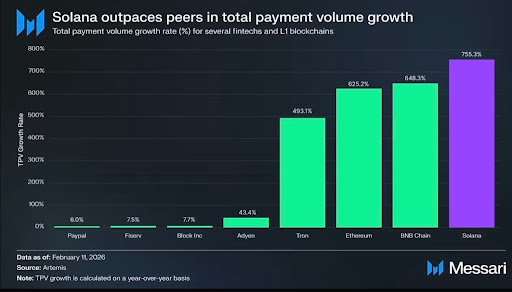
Source: Chart from Messari

In its report, Messari argues that most of SOL’s edge comes from the structural failures of traditional financial infrastructure. The current global system still relies heavily on legacy rails built for the internet. Because of this, payments are often expensive and slow. Transactions can take several days to complete as funds must pass through banks in different countries, placing a heavy burden on cross-border payments.

Messari notes that Solana addresses these issues by unifying “messaging and settlement into a single atomic operation.” Due to its high throughput and parallel architecture, the blockchain network is said to settle transactions in milliseconds, avoiding intermediaries from correspondent banks and the typical delays seen in legacy systems. Historically, SOL has also reportedly maintained a median block time of 392 milliseconds and a median transaction fee of $0.0004.

Institutional Investors Quietly Pile Into Solana ETFs

While SOL’s 755% TVL spike indicates that users are finally getting back into the network, institutional investors appear to be making similar moves, as new reports reveal a surge in Solana Spot ETFs.

According to LookOnChain data, Solana ETFs recorded 447,694 SOL in seven-day inflows, equivalent to approximately $40 million. The ETF surge comes as institutional demand surges despite broader bearish pressures on the SOL price.

Among the four Solana funds currently available for trading, Bitwise’s (BSOL) has attracted the largest net inflow by a wide margin. Daily flows into BSOL recently reached 205,287 SOL, bringing its seven-day total to 409,402 SOL. Fidelity (FSOL) ranked second in weekly inflows, recording 15,627 SOL over the past seven days, despite its daily inflow reaching just 4 SOL. By comparison, Grayscale’s (GSOL) daily inflow reached 361 SOL, and its seven-day total was 12,530 SOL.

SOL trading at $84 on the 1D chart | Source: SOLUSDT on Tradingview.com

Related Questions

QWhat is the percentage surge in Solana's Total Payment Volume (TPV) according to Messari's report?

ASolana's Total Payment Volume (TPV) recorded a 755.3% year-over-year growth rate.

QHow does Messari explain Solana network's advantage over traditional financial systems?

AMessari states that Solana addresses the issues of traditional systems by unifying 'messaging and settlement into a single atomic operation,' settling transactions in milliseconds and avoiding intermediaries and delays.

QWhat does the 755% surge in TPV indicate about user activity on the Solana network?

AThe 755% surge in TPV indicates a clear return of users to the ecosystem, showing that real on-chain activity is happening and that both developers and end users are actively engaging with SOL's payment infrastructure.

QWhich Solana ETF attracted the largest net inflow according to LookOnChain data?

ABitwise’s Solana ETF (BSOL) attracted the largest net inflow by a wide margin, with a seven-day total of 409,402 SOL.

QWhat are Solana's reported median block time and median transaction fee?

ASolana has reportedly maintained a median block time of 392 milliseconds and a median transaction fee of $0.0004.

Related Reads

Why Do You Always Lose Money on Polymarket? Because You're Betting on News, While the Pros Read the Rules

Why do you always lose money on Polymarket? Because you bet on news, while the pros study the rules. This article explains how top traders ("che tou") profit by meticulously analyzing market rules, not just predicting events. Polymarket, a prediction market platform, often sees disputes over event outcomes due to ambiguous rule wording. For instance, a market asking "Who will be the leader of Venezuela by the end of 2026?" was misinterpreted by many who bet on Delcy Rodríguez, assuming she held power. However, the rules specified "officially holds" as the formally appointed, sworn-in individual. Since Nicolás Maduro was still recognized as president officially, he won the market—even being in prison. To resolve such disputes, Polymarket uses a decentralized arbitration system via UMA protocol. The process involves: 1. Proposal: Anyone can propose a market outcome by staking 750 USDC, earning 5 USDC if unchallenged. 2. Dispute: A 2-hour window allows challenges with a 750 USDC stake; successful challengers earn 250 USDC. 3. Discussion: A 48-hour period on UMA Discord for evidence and debate. 4. Voting: UMA token holders vote in two 24-hour phases (blind then public). Outcomes require >65% consensus and 5M tokens voted; otherwise, four re-votes occur before Polymarket intervention. 5. Settlement: Results are final and automatic. Unlike traditional courts, Polymarket’s system lacks separation between arbitrators and stakeholders—voters often hold market positions, creating conflicts of interest. This leads to herd mentality in discussions and non-transparent outcomes without explanatory rulings, preventing precedent formation. Thus, success on Polymarket hinges on deep rule interpretation, not just event prediction, exploiting gaps between reality and contractual wording.

marsbit34m ago

Why Do You Always Lose Money on Polymarket? Because You're Betting on News, While the Pros Read the Rules

marsbit34m ago

DeepSeek Funding: Liang Wenfeng's 'Realist' Pivot

DeepSeek, a leading Chinese AI company, has initiated its first external funding round, aiming to raise at least $300 million at a valuation of no less than $10 billion. This move marks a significant shift from its founder Liang Wenfeng’s previous idealistic stance of rejecting external capital to maintain independence. Despite strong financial backing from its parent company, quantitative trading firm幻方量化 (Huanfang Quant), which provided an estimated $700 million in revenue in 2025 alone, DeepSeek faces mounting challenges. Key issues include a 15-month gap in major model updates, delays in its flagship V4 release, and the loss of several core researchers to competitors offering significantly higher compensation. The company is also undergoing a strategic pivot by migrating its infrastructure from NVIDIA’s CUDA to Huawei’s Ascend platform, a move aligned with China’s push for technological self-reliance amid U.S. export controls. However, DeepSeek lags behind rivals like智谱AI and MiniMax—both now publicly listed—in areas such as product ecosystem, multimodal capabilities, and commercialization. The funding round, though relatively small in scale, is seen as a way to establish a market-validated valuation anchor, making employee stock options more competitive and facilitating talent retention. It also signals DeepSeek’s transition from a pure research-oriented organization to a commercially-driven player in the global AI ecosystem.

marsbit1h ago

DeepSeek Funding: Liang Wenfeng's 'Realist' Pivot

marsbit1h ago

Trading

Spot
Futures

Hot Articles

Discussions

Welcome to the HTX Community. Here, you can stay informed about the latest platform developments and gain access to professional market insights. Users' opinions on the price of SOL (SOL) are presented below.

活动图片