Solana Under Pressure At $75–$78, But Bulls Eye Massive Upside Ahead

bitcoinistPublished on 2026-04-05Last updated on 2026-04-05

Abstract

Solana is currently facing significant pressure at the $75–$78 support zone, a critical level determining its next major price movement. Short-term momentum has weakened, and the bullish structure is showing signs of breaking down. A failure to hold this support could lead to accelerated downside movement. However, if buyers defend the zone, a sharp upside reaction—potentially including a short squeeze—may follow. Despite near-term uncertainty, the broader outlook remains bullish. Solana has been classified as a commodity and is still 77% below its all-time high. Historical patterns, such as the 2022 crash and subsequent 2,000% rally, suggest significant long-term potential, with technical analysis indicating a possible move toward $1,000 if key supports hold.

Solana is under pressure around the $75–$78 zone, a key level where buyers and sellers are currently battling for control. Short-term momentum has weakened, but this area also serves as critical support that could trigger a strong reaction if defended. Despite the downside risk, the broader outlook still holds significant upside potential, with this level likely to decide the next major move.

Pressure Intensifies, SOL Structure Breaks

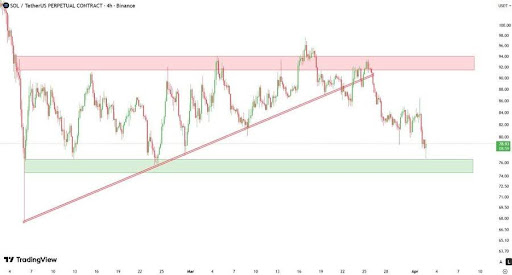
SOL pressure is building, according to Marcus Corvinus, with recent price action reflecting a noticeable shift in momentum. Losing the key trendline signals that the bullish structure is beginning to weaken, raising concerns that sellers are gradually taking control of the market.

The $92–$95 zone previously acted as a strong area of defense, but this time, sellers stepped in with clear intent, rejecting prices from that region. That rejection has now pushed SOL down into the $75–$78 range, where the market is currently consolidating.

Source: Chart from Marcus Corvinus on X

This level is more than just support; it represents a critical decision zone. Price is compressing here, and the market is essentially waiting for a catalyst. The reaction at this level will likely determine the next major move.

If buyers manage to defend this zone, a sharp upside reaction could follow, potentially triggering a quick bounce and even a short squeeze as trapped sellers are forced to cover. However, if this support fails to hold, downside pressure could accelerate quickly, with little structural support below. For now, sentiment appears heavy, with momentum gradually tilting away from the bulls, making this level one of the most important areas to watch.

Solana’s Classification As A Commodity Changes The Narrative

In an update, Crypto Patel highlighted that Solana has now been classified as a commodity, even while it remains about 77% below its all-time high. This places the asset in a unique position, still significantly discounted, yet gaining stronger recognition and positioning in the broader market.

The current situation draws comparisons to earlier cycles, where SOL experienced sharp drawdowns before staging massive recoveries. Reflecting on 2022, when prices dipped as low as around $8, the sentiment then was equally bearish. However, that move ultimately led to an explosive rally, with SOL proving its ability to rebound with over 2,000% gains from the bottom.

From a technical standpoint, the long-term chart shows that Solana is holding firmly within the Fibonacci golden zone on the 2-week timeframe. This area has historically acted as a strong accumulation region in past cycles. With this structure in place, the outlook remains a move toward $1,000 and beyond is not just speculation, but a matter of time if the broader trend continues to play out.

SOL trading at $80 on the 1D chart | Source: SOLUSDT on Tradingview.com

Related Questions

QWhat is the key price zone where Solana is currently under pressure, and why is it significant?

ASolana is under pressure in the $75–$78 zone. This area is significant because it is a critical support level where buyers and sellers are battling for control. The market's reaction at this level will likely determine the next major price move.

QAccording to Marcus Corvinus, what does losing the key trendline signal for SOL's market structure?

AAccording to Marcus Corvinus, losing the key trendline signals that the bullish structure is beginning to weaken, raising concerns that sellers are gradually taking control of the market.

QWhat are the two potential outcomes if the $75–$78 support zone is either defended or broken?

AIf buyers defend the $75–$78 support zone, a sharp upside reaction could follow, potentially triggering a quick bounce and a short squeeze. If the support fails, downside pressure could accelerate quickly with little structural support below.

QHow has Solana's classification as a commodity changed its market narrative, according to Crypto Patel?

AAccording to Crypto Patel, Solana's classification as a commodity places the asset in a unique position, gaining stronger recognition and positioning in the broader market, even though it remains significantly discounted from its all-time high.

QWhat long-term price target is suggested for Solana based on its position within the Fibonacci golden zone on the 2-week chart?

ABased on its position within the Fibonacci golden zone on the 2-week chart, the long-term outlook suggests a move toward $1,000 and beyond, which is seen as a matter of time if the broader trend continues.

Related Reads

How to Do Research Well: Deliberately Practice the Real Skills That Matter

No one truly teaches you how to do research. You're often given a desk, a pre-selected problem, and vague instructions to "create something new." Consequently, many people reverse-engineer the job based on visible outputs—papers, posts, announcements—learning only how to *appear* like a researcher rather than how to *become* one. True research capability is built from stacking small, trainable skills, nearly all of which can be developed through deliberate practice. **Pick Your Own Problem:** Most researchers absorb problems from advisors or trends, lacking the underlying reasoning. Choosing a problem you genuinely care about, as John Schulman advises, leads to original work. Develop "taste" like a muscle: predict experiment outcomes, guess paper results from methods, and track which findings remain important over time. **Upgrade Your Inputs:** Relying on shared reading lists (arXiv hot lists, filtered group chats) leads to unoriginal conclusions. Undervalued old literature often holds crucial insights (e.g., MoE, LSTM, backpropagation). Richard Sutton's "The Bitter Lesson" or Claude Shannon's 1952 talk on creative thinking are more predictive than lengthy modern surveys. Breadth matters as much as depth: draw from neuroscience, mechanism design, hardware knowledge, and honest statistics. Read papers directly, especially appendices and limitations sections. **Write Everything Down:** As Paul Graham noted, writing exposes flaws in seemingly mature ideas. Writing is the cheapest defense against self-deception. Following Feynman's principle, Darwin programmatically wrote down facts contradicting his theory to combat memory bias. Maintain a detailed log of hypotheses, setups, predictions, results, and updated understandings. Reviewing past logs fosters essential humility.

marsbit1h ago

How to Do Research Well: Deliberately Practice the Real Skills That Matter

marsbit1h ago

Following US Ban on Fable 5, Zhipu AI's Stock Soars 47%

On June 15th, shares of Zhipu AI surged dramatically on the Hong Kong stock market, peaking at a 47.6% gain before closing 32.82% higher. This sharp increase was directly triggered by two recent industry events. On June 12th, Anthropic announced it was suspending global access to its latest flagship models, Claude Fable 5 and Claude Mythos 5, to comply with a U.S. government export control order. The next day, Zhipu AI announced it would open access to its latest open-source flagship model, GLM-5.2, under the permissive MIT license. The Anthropic incident highlighted a critical issue beyond raw model capability: the risk of sudden, unpredictable loss of access to advanced AI models, especially for developers and enterprises deeply integrated with them. This has shifted industry and market focus toward factors like stability, sustainable access, and controllability. Zhipu's move, promoting "frontier intelligence for all," positions its openly available model as a reliable and accessible alternative. The GLM-5.2 model emphasizes "Long Horizon Task" capabilities with a 1M context window, targeting complex, multi-step coding and engineering workflows where maintaining context is crucial. Analysts note this event exposes the risk of dependency on closed-source models subject to single jurisdictional controls, potentially accelerating a shift toward domestic base models and localized deployments. The market's reaction signals a new valuation dimension in AI: providers who can offer stable, long-term, and sustainably accessible AI capabilities are gaining strategic importance.

marsbit1h ago

Following US Ban on Fable 5, Zhipu AI's Stock Soars 47%

marsbit1h ago

Fully Entering the AI Era: Alipay Bets on Conversation, WeChat Holds Fast to Social

In May 2026, Alipay announced over 300 million AI payment transactions. Shortly after, WeChat opened its mini-programs for AI integration, sparking controversy by requiring developer source code access. This highlights their diverging approaches to AI integration. Alipay is testing "Project Treasure," an optional AI-native interface replacing traditional app grids with a conversational window. Users can command complex tasks (e.g., "book a ride and order coffee") handled end-to-end by AI. This shift follows an abandoned standalone AI app, focusing instead on enhancing its existing user base. For unmodified mini-programs, Alipay's AI uses "screen-reading" to simulate user interactions, bypassing the need for developer overhaul. It also introduced "Token Pay" for micro-transactions and "AI Wallets" for autonomous agent spending. WeChat, prioritizing its core social function, is taking an embedded approach. Its AI agent will operate within existing contexts like group chats and official accounts, assisting without a separate interface. To enable this, WeChat offers developers two paths: granting source code access for direct AI control ("Automatic Mode") or manually encapsulating services into standardized "Skills." Both place significant burden on developers. Key differences emerge in handling legacy services: WeChat demands developer cooperation (code or labor), while Alipay's screen-reading offers immediate, if potentially less stable, compatibility. Alipay's 3 billion AI transactions demonstrate user acceptance of AI-driven commercial actions. The divergent strategies may reshape mini-program ecosystems—Alipay passively "AI-fying" services, WeChat potentially favoring resource-rich developers—and set competing technical standards. Ultimately, the competition centers on where users entrust the command to "help me get things done."

marsbit1h ago

Fully Entering the AI Era: Alipay Bets on Conversation, WeChat Holds Fast to Social

marsbit1h ago

Trading

Spot
Futures

Hot Articles

Discussions

Welcome to the HTX Community. Here, you can stay informed about the latest platform developments and gain access to professional market insights. Users' opinions on the price of SOL (SOL) are presented below.

活动图片