Solana treasury Upexi slides 7.5% on $1B shelf registration filing

cointelegraphPublished on 2025-12-24Last updated on 2025-12-24

Abstract

Upexi shares fell 7.5% after filing a shelf registration to raise up to $1 billion, intended to expand its Solana treasury and pursue related opportunities. The company, which holds 2.1 million SOL worth $262.3 million, is the fourth-largest corporate holder of Solana. Proceeds will be used for general corporate purposes, including accumulating and staking SOL. However, Upexi hasn't purchased Solana since July, and its holdings have declined from a peak of $525 million amid a broader crypto market pullback. The company is currently facing a 19% paper loss on its Solana investments.

Shares in Upexi closed Tuesday down 7.5% after it filed to raise up to $1 billion to expand its Solana treasury and pursue other opportunities related to the token.

Upexi said in its shelf registration filing to the Securities and Exchange Commission on Tuesday, that the raise could cover common and preferred stock, debt securities, warrants and units, which may be issued over time.

It said net proceeds from the offering would be used for general corporate purposes. The company primarily focuses on accumulating as much Solana (SOL) as possible and staking it to be rewarded with additional tokens.

Upexi holds 2.1 million SOL worth $262.3 million, making it the fourth-largest corporate Solana treasury company, CoinGecko data shows.

Solana treasury purchases have slowed significantly in the back half of 2025 amid a broader crypto market pullback, along with waning confidence in the sustainability of crypto treasury strategies.

Shares in Upexi (UPXI) closed Tuesday down 7.54% to $1.84, but saw a small reprieve after the bell, gaining 4.34% to $1.92.
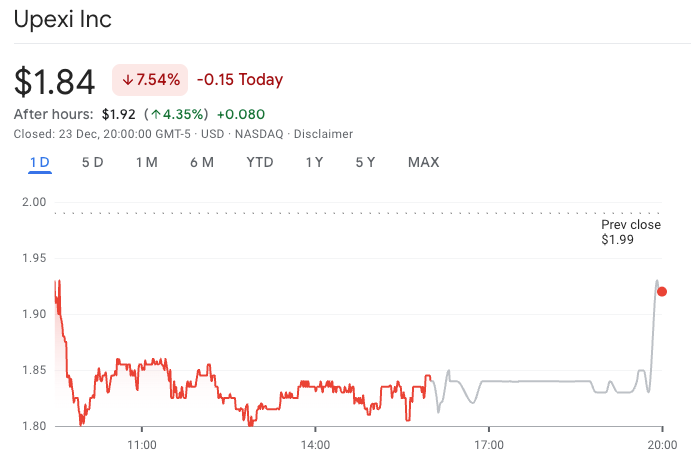
Upexi saw a small rally late in after-hours trading on Tuesday, gaining back the day’s losses. Source: Google Finance


Upexi's business was centered around consumer products and e‐commerce before pivoting to a Solana treasury company in late April.

Related: Eclipse brings Solana's parallel runtime to Ethereum

However, it hasn’t made a Solana purchase since July 23 and has seen the value of its SOL stash tumble from a peak of around $525 million in mid-September to $262.3 million at current prices.
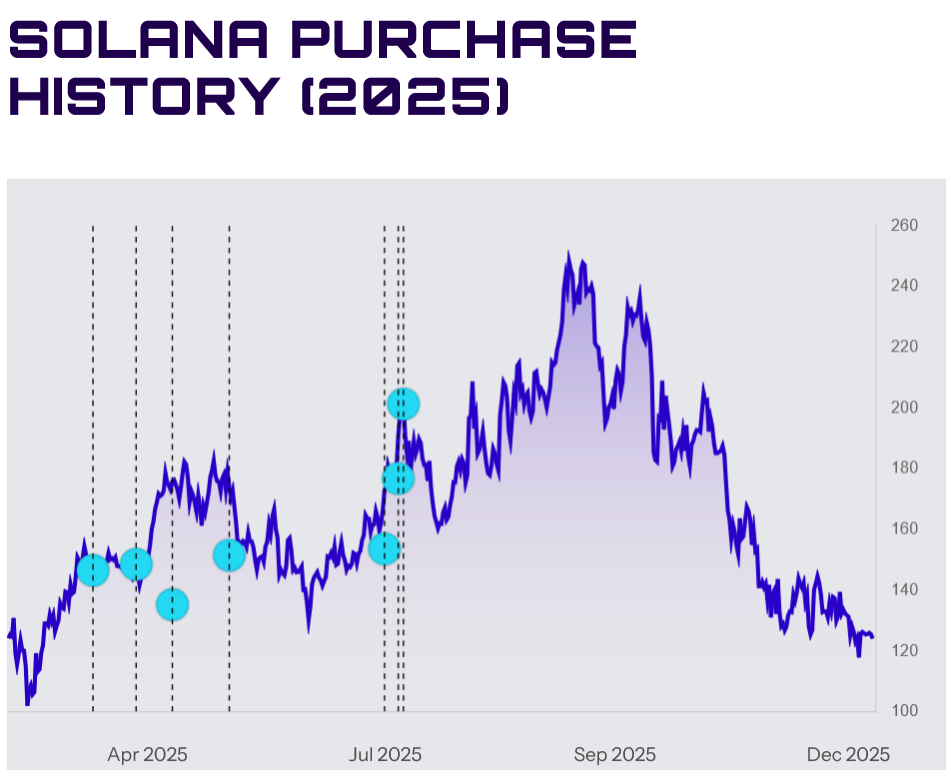
Timeline of Upexi’s SOL purchases since its first purchase in late April. Source: Upexi


The company is currently holding a 19% paper loss on its Solana treasury.

Solana is trading at $123.75, down 57.5% from its $293.31 all-time high set on Jan. 19, 2025, CoinGecko data shows.

Magazine: Sei wallets in Xiaomi, Bhutan’s gold on Solana: Asia Express

Trending Cryptos

Related Questions

QWhy did Upexi's shares drop 7.5% on Tuesday?

AUpexi's shares dropped 7.5% after the company filed a shelf registration with the SEC to raise up to $1 billion.

QWhat is the primary purpose of Upexi's $1 billion shelf registration?

AThe net proceeds are intended for general corporate purposes, primarily to expand its Solana (SOL) treasury and stake it to earn additional tokens.

QHow much Solana does Upexi currently hold, and what is its market value?

AUpexi holds 2.1 million SOL, which is currently worth $262.3 million.

QWhat was Upexi's original business focus before pivoting to a Solana treasury company?

AUpexi was originally centered around consumer products and e-commerce before pivoting to a Solana treasury strategy in late April.

QWhat is the current paper loss percentage on Upexi's Solana treasury holdings?

AUpexi is currently holding a 19% paper loss on its Solana treasury.

Related Reads

Analyst Forecasts Bitcoin's Movement in August

Analyst Forecasts Bitcoin Movement in August Bitcoin ends July under market caution due to a lack of new macroeconomic catalysts and regulatory uncertainty, according to Bitbanker analyst Andrey Poroshin. He forecasts that in August, BTC may first test the $60,000–$62,000 range before recovering to around $70,000. The analyst notes that the U.S. Federal Reserve's neutral stance provided no strong market signals, with inflation remaining above target. Currently, Bitcoin trades below the U.S. mining cost range of $73,000–$75,000, a key global profitability benchmark, though costs are lower in some countries like Russia. Significant July events include the bankruptcy of derivatives exchange BitMEX, which Poroshin views as a capitulation of weaker market participants, often preceding potential reversal zones. Retail investor activity has declined, with many placing stop orders in the $60,000–$62,000 range, where significant liquidity is concentrated and could be tested. While geopolitical factors like U.S.-Iran tensions are losing market impact, regulatory uncertainty persists as the U.S. CLARITY Act vote was postponed to September. Typically, August sees lower trading activity due to holidays, leading to more technical, less volatile price movements. Poroshin's base scenario for August is a test of $60,000–$62,000 followed by a recovery to $70,000, with more significant moves likely in September post-Fed signals and potential CLARITY Act developments. Separately, a Russian deputy finance minister stated that non-qualified investors in Russia will soon be allowed to legally purchase Bitcoin, Ethereum, and major stablecoins, with an annual limit of 300,000 rubles per intermediary.

cryptonews.ru7m ago

Analyst Forecasts Bitcoin's Movement in August

cryptonews.ru7m ago

The Blockchain Industry Enters a Phase of Mass Adoption and Efficiency

In Q2 2026, the blockchain industry demonstrated a divergence between market sentiment and fundamental network growth. While on-chain activity surged, network fee revenues declined due to protocol designs making block space cheaper and more abundant. Ethereum saw institutional staking reach an all-time high of 40.2 million ETH. Despite processing nearly double the transactions per second, its network revenue fell 51% YoY to $64 million, with staker yields driven primarily by consensus rewards. Solana processed nearly 10 billion transactions, but its economic value also dropped to $51 million due to reduced congestion. Notably, its real-world asset (RWA) sector boomed, with tokenized stock trading volume growing 2,479x YoY to $3.32 billion in June 2026. Hyperliquid emerged as an outlier, generating $175 million in revenue with 32% of its $652 billion trading volume from non-crypto markets like commodities. Avalanche saw transaction growth but a sharp drop in fee revenue, while focusing on sovereign L1s for enterprise use. The NEAR Protocol ecosystem shifted from gas-intensive apps to Intents-based trading and introduced a novel feature allowing users to pay for AI services via staked tokens. The Tempo network, backed by Stripe and Paradigm, processed $386 million in stablecoin transfers, including $30 million for contractor payouts by Deel. The report concludes that the industry is transitioning from high-fee speculation to a phase of mass adoption and infrastructure efficiency, where cheap block space fuels transaction growth and institutional entry.

cryptonews.ru7m ago

The Blockchain Industry Enters a Phase of Mass Adoption and Efficiency

cryptonews.ru7m ago

Trading

Spot

Hot Articles

Discussions

Welcome to the HTX Community. Here, you can stay informed about the latest platform developments and gain access to professional market insights. Users' opinions on the price of SOL (SOL) are presented below.

活动图片