Cryptocurrency Activity Recovered in July, but Influx of New Liquidity Remains Limited

cryptonews.ruPublished on 2026-07-31Last updated on 2026-07-31

Abstract

Cryptocurrency activity showed signs of recovery in July, with DeFi lending volumes increasing for the first time in months, rising 7.2% to $22.2 billion. The total value locked (TVL) in DeFi also grew from $68B to over $74.9B. Despite this rebound in on-chain activity, the market lacked new liquidity inflows. Stablecoin supply contracted slightly by 0.6% to around $312B, and inflows from ETF trading remained weak, indicating no fresh external capital. Trading activity was aggressive but driven by existing liquidity; DEX trading volume surpassed $169B, and perpetual futures open interest grew. Stablecoin velocity remained high, with liquidity shifting to networks like Solana, Base, and Ethereum. The recovery is characterized not by new risk-on sentiment but by leveraged, short-term profit-seeking within a cautious liquidity environment.

In June, crypto activity showed signs of recovery, although liquidity inflows remained weak. DeFi lending shows signs of returning, as the internal liquidity of stablecoins remains high.

July remained a month of stagnation for cryptocurrencies, where $BTC dominated over altcoins and tokens. Despite this, DeFi and other on-chain transactions showed signs of recovery.

DeFi demonstrated its first month of growth. After five months of decline, the volume of active DeFi loans increased from $20.7 billion to $22.2 billion, rising by 7.2% for the month, according to data. The total value locked in DeFi grew from $68 billion at the beginning of the month to over $74.9 billion as of July 31.
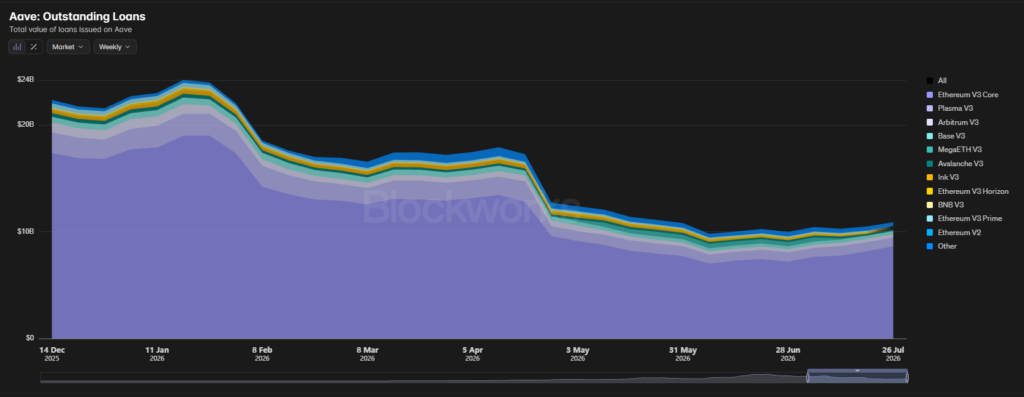
Lending activity on Aave increased, indicating a slow recovery in the crypto market. | Source: Blockworks

According to Cryptorank, Aave still dominates the lending market, with active loans worth $11 billion and a market share of 46.2%. About two-thirds of the loans are placed on Aave and Morpho platforms.

Partially, the recovery in July was driven by positive momentum in $ETH. The token ended the month with a net gain of 20.32%, while $BTC rose by 9.03% over the same period. $BTC still outperformed most altcoins and tokens.

Despite Active Cryptocurrency Activity, There is Caution in Liquidity Allocation

Although activity is recovering, the cryptocurrency market is moving without new sources of liquidity. This also applies to stablecoin issuance, which has been limited over the past month. The total stablecoin supply decreased by 0.6% in July, to approximately $312 billion.

Inflows from ETF trading also remained weak, indicating a lack of external capital entering cryptocurrency. Unlike 2025, inflows from treasury companies have completely ceased, even for $BTC. Treasury companies for SOL and $ETH have also abandoned aggressive expansion.

As Cryptopolitan reported, 2026 has been a year of liquidating non-viable projects and redistributing liquidity to the few remaining winners.

At the same time, DEX trading volume exceeded $169 billion, increasing by over 10% in the past week. Perpetual futures trading volumes continued to rise, adding more than 12% in the final week of July. The total open interest in 2026 also grew, reaching over $15 billion, according to DeFi Llama data.

Robinhood also sought to become part of the overall recovery of the cryptocurrency market, becoming one of the most active blockchain networks in the past month.

Cryptocurrency Activity is Becoming More Aggressive

In July, cryptocurrency activity did not receive a boost from easily accessible liquidity but continued to grow.

Over the past month, stablecoin velocity remained high as some liquidity redistribution occurred. Stablecoins flowed out of Arbitrum and Optimism but remained active on Solana, Base, and Ethereum.

Last month, Solana maintained the highest stablecoin velocity metric, supported by mixed trading of meme tokens and tokenized securities.

Large players are also taking aggressive positions using leverage on perpetual futures markets, recently shifting to stock trading. Even former major players in the crypto market have moved to making directional bets on the S&P 500 index and stocks like SK Hynix (SKHX).

The recent surge in activity is not a signal of increasing risk appetite, as liquidity levels remain cautious. Rather, it is a short-term risky investment of funds aimed at generating short-term profits through highly leveraged positions.

end-content
Related Questions

QAccording to the article, what were the key trends in DeFi and overall crypto market activity in July?

ADeFi activity showed signs of recovery in July. After five months of decline, active DeFi loans increased by 7.2% month-over-month, and Total Value Locked (TVL) grew from $68 billion to over $74.9 billion. Overall blockchain transactions also recovered. However, the market lacked new external liquidity, with stablecoin supply shrinking slightly and ETF inflows remaining weak.

QHow did the performance of Bitcoin (BTC) and Ethereum (ETH) compare in July?

AIn July, Ethereum (ETH) outperformed Bitcoin (BTC). ETH ended the month with a net gain of 20.32%, while BTC increased by 9.03% over the same period. Despite this, BTC still outperformed most altcoins and tokens.

QWhat does the article suggest about the source of the recent increase in crypto market activity?

AThe article suggests the recent activity increase is not fueled by new external capital or a broader rise in risk appetite. Instead, it is driven by a redistribution of existing liquidity, aggressive leveraged positions in perpetual futures markets, and short-term, high-risk bets aimed at quick profits, rather than long-term investment.

QWhich blockchain had the highest stablecoin velocity in July, and what contributed to this?

ASolana maintained the highest stablecoin velocity in July. This was driven by mixed trading activity involving meme tokens and tokenized securities on its network.

QWhat evidence does the article provide to support the claim that new liquidity inflow into crypto remains limited?

AThe article points to several pieces of evidence: the total supply of stablecoins contracted by 0.6% in July; inflows from ETF trading remained weak; treasury companies have completely halted their inflows into crypto, even for Bitcoin; and there is a general absence of external capital entering the market, unlike in 2025.

Related Reads

Solana Price Forecast for August 2026: Can $19 Million from Morgan Stanley and 330,000 Korean Merchants Break SOL's Triangle?

**Solana Price Forecast for August 2026: Key Catalysts and Technical Setup** As of July 31, Solana (SOL) trades at $73.59, consolidating within a triangle pattern formed between its May peak (~$98) and June low (~$60.29). A decisive breakout from this pattern is anticipated. Key resistance levels are clustered around $74.79 (0.382 Fib), $75.33 (20-day EMA), $76.01 (50-day EMA), and a critical zone near $79 (0.5 Fib & 100-day EMA). Support lies at $73.42, $69.25 (0.236 Fib), and the June low of $60.29. Two major institutional catalysts emerged recently: 1. **Morgan Stanley's MSOL ETF:** Launched July 28, it saw $19.06 million in inflows on its second day—the largest single-day inflow for any US SOL ETF since mid-May. 2. **KSNET Partnership:** The Solana Foundation signed an MoU with South Korean payment processor KSNET (serving 330,000 merchants) to explore integrating Solana Pay for domestic and AI-powered transactions. Historically, August has been volatile for SOL, marked by extreme gains in 2020 and 2021 but otherwise weak performance. The forecast for August 2026 is bifurcated: * **Bullish Case:** An upside triangle breakout, sustained MSOL inflows, and positive momentum from the KSNET news could propel SOL toward the $79 resistance cluster, especially if the CLARITY Act is passed by August 8. * **Bearish Case:** A downside break below $73.42, fading excitement around the new ETF, and stalled regulatory progress could see SOL retest support near $69.25, exacerbated by macro risks.

cryptonews.ru8m ago

Solana Price Forecast for August 2026: Can $19 Million from Morgan Stanley and 330,000 Korean Merchants Break SOL's Triangle?

cryptonews.ru8m ago

AFX Trade Promises to Present "Goodwill Plan" on August 3 Following $24 Million Loss Incident

AFX Trade, a cryptocurrency platform, announced it will present a "goodwill plan" on August 3rd, following a security incident on July 22nd that resulted in a loss of $24.15 million. The company's brief update offered no specific details on compensation for affected users, investors, and employees, only urging calm while the team formulates next steps. The theft occurred from a USDC custody account on Arbitrum, with the stolen funds converted to Ethereum. Blockchain analysts traced the funds to a single wallet. AFX Trade and Arbitrum clarified the exploit targeted a third-party bridge, not Arbitrum's native bridge. An investigation revealed the attack began on July 9th with a social engineering scheme targeting a developer. The attacker then deployed malicious code within AFX's internal JFrog repository and infrastructure, eventually compromising bridge validators to authorize the fraudulent withdrawal. The company stated the exploit leveraged a "trust vulnerability," not a smart contract bug. AFX Trade's head of business development made an offer to the attacker, proposing they keep 30% of the funds as a white hat bounty if 70% is returned. The incident fits a 2026 trend identified by TRM Labs: while the number of crypto hacks hit a record, total losses decreased. However, infrastructure and operational breaches, though fewer, accounted for the majority of financial losses. The AFX breach is classified as an infrastructure incident involving private key compromise.

cryptonews.ru19m ago

AFX Trade Promises to Present "Goodwill Plan" on August 3 Following $24 Million Loss Incident

cryptonews.ru19m ago

Trading

Spot
活动图片