Solana Takes Aim At Hyperliquid With Push For Fully Onchain Perps

bitcoinistPublished on 2026-06-02Last updated on 2026-06-02

Abstract

The Solana Foundation has announced a new initiative to actively support teams building fully onchain perpetual futures (perps) on Solana. This move directly challenges the current market structure, exemplified by platforms like Hyperliquid, where much of the derivatives volume still relies on centralized exchanges or hybrid models with offchain components. Solana argues that its high-performance blockchain makes fully onchain perps viable without sacrificing speed or user experience, aiming to shift a lucrative trading segment entirely onchain. The Foundation seeks to back projects that prioritize onchain price discovery (like order books or RFQ systems) over pool-based models, require projects to be "Solana-first" with revenue routed back to the chain, and mandate open-source development. The support includes distribution, technical assistance, and capital for core perps protocols as well as complementary infrastructure.

Solana Foundation is moving to back teams building fully onchain perpetual futures, setting up a clear challenge to the market structure that has powered Hyperliquid’s rapid rise. The initiative targets one of crypto’s most lucrative trading segments: perps, where volume still sits largely on centralized exchanges or hybrid venues.

Solana Vs. Hyperliquid

The Foundation framed the push as a bid to move derivatives execution more fully onto Solana, without relying on the offchain components that still underpin much of the sector. “Perpetuals are one of the most important financial primitives in crypto,” the Foundation wrote on X. “Solana makes it viable to run them fully onchain, without sacrificing the performance real participants and institutions require.”

The timing is notable. Hyperliquid has become the reference point for onchain derivatives, turning perpetual futures into one of the strongest product-market-fit stories in crypto. While Solana did not name Hyperliquid in its announcement, the competitive subtext is hard to miss.

In its post, the Foundation argued that most perp volume still flows through centralized exchanges or through hybrid architectures that use offchain sequencers and matching engines. “We view that as a transitional state, not a permanent one,” the Foundation said. “We want to support teams building onchain perps, other derivatives, and the applications around them, that prioritize price discovery infrastructure. Our support takes several forms: distribution, technical assistance, and above all, capital.”

That language matters because it draws a line between merely settling crypto trades onchain and running the entire execution path onchain. The foundation said it wants to support systems where every order submission, oracle update, match, cancellation and settlement happens onchain. For a chain that has long marketed itself around high throughput and low latency, perps are an obvious stress test: the product requires fast updates, deep liquidity, competitive market making and credible settlement.

The Foundation also made clear that it is not looking for pool-based pricing models as the center of this effort. It said it is interested in “models where price is set based on two-sided flow, not pool-based or as a function of deposits,” including orderbooks, RFQ systems with genuinely competing makers, or alternative designs where active participants set bids and offers against each other.

That is where the Hyperliquid comparison becomes especially relevant. Hyperliquid’s success has shown that crypto traders will use onchain or semi-onchain derivatives venues when the trading experience is fast, liquid and expressive enough.

Solana Wants Revenue Back Onchain

The announcement also included a more ecosystem-specific requirement: teams should build “Solana-first.” The Foundation said it wants projects optimized for SOL’s design and culture, with application revenue structurally routed back to the chain, preferably at the protocol level from launch rather than left to future governance decisions.

That is a pointed detail. In the current perps market, the battle is not only over where traders execute, but where fees, order flow and liquidity incentives accrue. A successful Solana-native perps venue would not merely add another DeFi app; it could become a recurring source of transaction activity, MEV-adjacent flow, validator economics and ecosystem-level liquidity.

The Foundation also said it is open to teams that have already built offchain or hybrid perps products and want to migrate to a fully onchain model. “We’ll support existing teams with a live product that are willing to explore a fully onchain, on-Solana model,” it said.

Open source is another filter. “Onchain integrity means little if the code behind it can’t be inspected,” Solana Foundation wrote. “Contributing to Solana culturally means contributing in the open.”

The initiative is not limited to core perps protocols. Solana said it also wants complementary infrastructure, including frontend integrations, vaults, structured products, aggregators, advanced trading interfaces, market making operations and social trading applications. Grants may be available through Solana Foundation funding channels or local Superteam chapters.

At press time, SOL traded at $79.54.
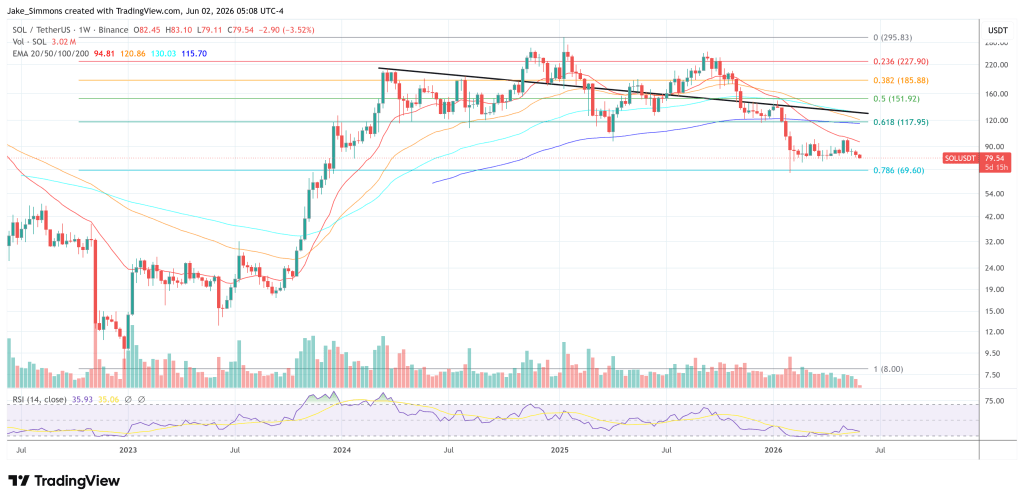
SOL remains in sideways trend, 1-week chart | Source: SOLUSDT on TradingView.com

Related Questions

QWhat is the primary goal of the Solana Foundation's new initiative as described in the article?

AThe primary goal of the Solana Foundation's initiative is to support teams building fully onchain perpetual futures and other derivatives on Solana. It aims to move derivatives execution more fully onto the blockchain without relying on offchain components, capturing revenue for the Solana ecosystem, and supporting models based on two-sided flow for price discovery.

QAccording to the article, which platform is positioned as the main competitive reference point for Solana's onchain perps push?

AThe main competitive reference point is Hyperliquid. The article states that Hyperliquid has become the reference point for onchain derivatives, and Solana's initiative sets up a clear challenge to the market structure that powered Hyperliquid's rapid rise.

QWhat specific type of pricing models is the Solana Foundation NOT interested in supporting for this initiative?

AThe Solana Foundation is not looking for pool-based pricing models as the center of this effort. It is interested in models where price is set based on two-sided flow, such as orderbooks, RFQ systems with competing makers, or designs where active participants set bids and offers against each other.

QBesides the core perps protocols, what other types of complementary infrastructure does Solana want to support through this initiative?

ASolana also wants to support complementary infrastructure including frontend integrations, vaults, structured products, aggregators, advanced trading interfaces, market making operations, and social trading applications.

QWhat are the key requirements or filters mentioned for teams interested in the Solana Foundation's support?

AKey requirements include building 'Solana-first' (optimized for SOL's design and culture), structuring application revenue to route back to the chain, being open to teams migrating from offchain/hybrid models, and committing to open-source development ('contributing in the open').

Related Reads

Should You Buy SpaceX Stock at $1.7 Trillion? Here's What the Market Is Worried About

SpaceX is preparing for a massive IPO aiming to raise around $75 billion at a valuation of approximately $1.75 trillion. While its achievements in reusable rockets and the profitable Starlink satellite internet service are clear, the market is concerned about the aggressive valuation. Key issues include: the current $1.75 trillion valuation, which is about 94 times 2025 revenue, seems to price in not just existing businesses but also unproven future ventures like AI infrastructure and orbital data centers. Financially, while Starlink is profitable, the AI division, bolstered by the acquisition of xAI, is incurring massive losses and consuming the majority of capital expenditures. This acquisition also introduced complex related-party financing arrangements and debt onto SpaceX's balance sheet. Furthermore, corporate governance poses a challenge. SpaceX's dual-class share structure ensures founder Elon Musk retains absolute control, limiting ordinary shareholders' influence over high-risk, long-term strategic decisions. The future success of ambitious projects like the Starship rocket—critical for lowering costs and enabling new services—remains a significant variable for the valuation. In summary, the market's apprehension (FUD) centers not on doubting SpaceX's past technological triumphs but on questioning how much premium public investors should pay for a future that combines proven profits with highly speculative and capital-intensive new ventures, all under a governance structure that offers limited shareholder oversight.

marsbit55m ago

Should You Buy SpaceX Stock at $1.7 Trillion? Here's What the Market Is Worried About

marsbit55m ago

Breaking the DeFi Cascading Liquidation Curse: Vitalik Proposes a New Solution

Vitalik Buterin has proposed a new DeFi design to eliminate the automatic liquidation mechanism that causes market instability during sharp downturns. The current system, used by protocols like Aave, triggers forced sales when collateral value falls below a threshold, often exacerbating price drops and creating systemic selling pressure. Buterin's alternative model is based on splitting an asset like ETH into two synthetic option-like tokens, P and N, pegged to a price index. Their combined value always equals one ETH. Instead of sudden liquidation, a position's value gradually drifts from its target peg if the market moves. Users must proactively rebalance their holdings to maintain their desired exposure, transferring the management burden from the protocol to the user or automated tools. A key advantage is the reduced reliance on real-time oracles. Pricing decisions are deferred until contract expiry, allowing for more robust, fault-tolerant oracle designs. This removes a clear liquidation threshold that speculators can target for manipulation or MEV extraction. However, significant challenges remain. Frequent rebalancing could incur high slippage and transaction costs, necessitating new liquidity provider models. The design is better suited for hedging instruments than for stablecoins requiring a rigid 1:1 peg. While not an immediate replacement for existing systems, the proposal challenges the foundational assumption that instantaneous forced liquidation is an unavoidable necessity in DeFi, opening the door for fundamentally different risk management architectures.

marsbit1h ago

Breaking the DeFi Cascading Liquidation Curse: Vitalik Proposes a New Solution

marsbit1h ago

The End of Single-Factor Cryptography

The article "The End of Single-Factor Crypto" posits a fundamental shift in the cryptocurrency ecosystem. It argues the era where crypto asset valuations were predominantly driven by, and correlated with, Bitcoin's price is ending. The space is bifurcating into two distinct economies: endogenous and exogenous. The endogenous economy represents traditional crypto, where token and project values are directly tied to crypto market prices. The emerging exogenous economy comprises projects and businesses that may utilize blockchain technology or tokens but derive their fundamental value from external, non-crypto factors like consumer demand, subscription revenue, or real-world utility. Examples include AI inference platforms like Venice, fintech lenders using blockchain for efficiency, and stablecoin/payment infrastructure companies acquired by giants like Mastercard and Stripe. This shift means investment analysis must change. For exogenous assets, evaluating traditional business fundamentals—such as revenue streams, unit economics, and competitive moats—becomes more critical than tracking Bitcoin charts. While endogenous assets like Bitcoin remain relevant, the growth of the exogenous category is driven by measurable demand independent of crypto price cycles, paving the way for a new, more diversified market phase. Consequently, crypto is evolving from a single-factor, reflexive asset class into a multifaceted ecosystem with varied drivers and investment theses.

marsbit1h ago

The End of Single-Factor Cryptography

marsbit1h ago

Morning Post | Bitmine Plans to Raise $300 Million Through Preferred Stock Issuance; Polymarket Accuses Kalshi of Commercial Espionage

ChainCatcher's Daily Crypto Brief: Key developments from the past 24 hours include significant funding moves, regulatory actions, and market predictions. Bitmine announced a $300 million preferred stock fundraising. Polymarket accused rival prediction platform Kalshi of corporate espionage, citing numerous suspicious coincidences in product launches, a claim Kalshi strongly denied. The U.S. Department of Justice, in a joint "Disruption Week" anti-fraud operation with companies like Coinbase and Meta, froze over $3.8 million in cryptocurrency linked to scams. In infrastructure news, Macau completed its integration with the multi-central bank digital currency bridge, mBridge, aiming to build efficient cross-border payment channels. Cosmos Labs acquired the block explorer Mintscan. Market-wise, Geoffrey Kendrick, Standard Chartered's Head of Digital Assets Research, stated Bitcoin is nearing a bottom around $63,000, maintaining a year-end target of $100,000. He noted stability in U.S. spot Bitcoin ETF holdings. Ahead of SpaceX's anticipated IPO, internal insiders at Rocket Lab (RKLB) sold over $18.41 million in stock. In tokenization, Goldman Sachs partnered with Apex and Archax to launch a tokenized real estate fund. The meme token tracker GMGN reported the top trending tokens: on Ethereum, HEX, SHIB, LINK, PEPE, mUSD; on Solana, TROLL, swarms, WORLDCUP, neet, Buttcoin; and on Base, PEPE, toby, ODDS, ELSA, SKI.

链捕手1h ago

Morning Post | Bitmine Plans to Raise $300 Million Through Preferred Stock Issuance; Polymarket Accuses Kalshi of Commercial Espionage

链捕手1h ago

Trading

Spot
Futures

Hot Articles

How to Buy PUSH

Welcome to HTX.com! We've made purchasing Push Protocol (PUSH) simple and convenient. Follow our step-by-step guide to embark on your crypto journey.Step 1: Create Your HTX AccountUse your email or phone number to sign up for a free account on HTX. Experience a hassle-free registration journey and unlock all features.Get My AccountStep 2: Go to Buy Crypto and Choose Your Payment MethodCredit/Debit Card: Use your Visa or Mastercard to buy Push Protocol (PUSH) instantly.Balance: Use funds from your HTX account balance to trade seamlessly.Third Parties: We've added popular payment methods such as Google Pay and Apple Pay to enhance convenience.P2P: Trade directly with other users on HTX.Over-the-Counter (OTC): We offer tailor-made services and competitive exchange rates for traders.Step 3: Store Your Push Protocol (PUSH)After purchasing your Push Protocol (PUSH), store it in your HTX account. Alternatively, you can send it elsewhere via blockchain transfer or use it to trade other cryptocurrencies.Step 4: Trade Push Protocol (PUSH)Easily trade Push Protocol (PUSH) on HTX's spot market. Simply access your account, select your trading pair, execute your trades, and monitor in real-time. We offer a user-friendly experience for both beginners and seasoned traders.

3.6k Total ViewsPublished 2024.03.29Updated 2026.06.02

How to Buy PUSH

Discussions

Welcome to the HTX Community. Here, you can stay informed about the latest platform developments and gain access to professional market insights. Users' opinions on the price of PUSH (PUSH) are presented below.

活动图片