After a period of heightened performance and adoption, the Solana network is starting to witness a slowdown in users’ activity and interest. A report has emerged showing that the active wallet addresses on the SOL network have fallen sharply, raising questions about its impact on prices.
A Steep Decline In Solana’s Active Wallet Addresses
Currently, a sudden cooldown has been observed across the Solana network even as the blockchain sector experiences continued growth. This reduced activity is a result of a significant drop in the number of active wallet addresses on SOL.
A glimpse into the recent report from Santiment, a leading market intelligence and on-chain data analytics platform, shows that these addresses have recently retreated sharply from their recent highs. The decrease points to a slowdown in participation, which may be due to changing market conditions or a pause after previous spikes.
Examining the activity in the weekly chart, the number of active addresses on the SOL network reached a high of 5.01 million in early February. However, this figure has now fallen to about 2.89 million in its most recent week.
Such a drop in active addresses triggers questions about the current price structure. Fewer wallet addresses are steadily transferring SOL, possibly for a sell-off, as the asset, which is presently number 7 in the crypto market, has been experiencing price stagnation.
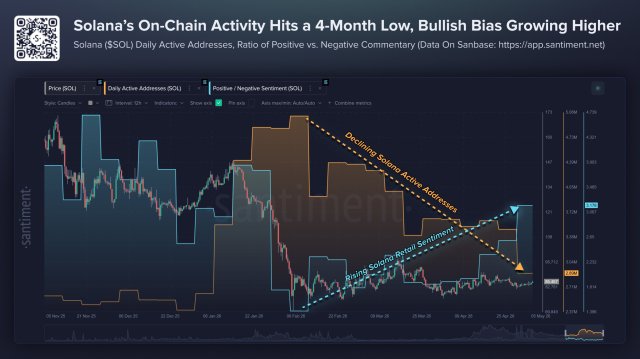
Santiment has also outlined a significant shift in sentiment across the community toward Solana to a multi-month high. At the time of the post, the sentiment, particularly on social media platforms, toward SOL had skyrocketed to its highest level since January. After the surge, there are now 3.2 bullish comments for every 1 bearish comment across X, Reddit, Telegram, and other platforms.
A particular narrative swelling in the community is the one that the asset is primed for a breakout after trailing Bitcoin and other large caps, and regressing to the mean. However, whether this narrative turns out to be true will largely depend on the network utility transitioning from its current downfall.
Why SOL Is Getting Quieter
Since the broader crypto market recovery, many assets have strongly regained bullish traction in price and network adoption. However, Rios, a market expert and DeFi researcher, has revealed that Solana is getting quieter after investigating several factors that could be fueling this move.
At first, the expert drew attention to SOL’s collapsing volatility to about 35.5%, which is considered one of the clearest signs that the market is being absorbed by stronger hands. Also, Spot SOL ETFs inflows are above $1 billion, and long-term holder supply has jumped from 524,000 to 2.58 million SOL, a trend that is slowly removing a lot of short-term chaos around the asset.
While this typically diminishes wild swings, it also implies that breakout speed is getting capped until momentum returns. In the expert’s view, this appears to be a calm accumulation beneath the surface rather than a sign of vulnerability. If volatility continues to rise, Rios is confident that SOL’s next move could be far more significant than most expect.















![Derive [DRV] gains 40% on Upbit news – THIS zone marks next major hurdle](https://d1x7dwosqaosdj.cloudfront.net/images/2026-07/eaae977149b14ebfb52e436d178595ee.jpg)