Derive [DRV] gains 40% on Upbit news – THIS zone marks next major hurdle

ambcryptoPublished on 2026-07-14Last updated on 2026-07-14

Abstract

Derive (DRV) surged approximately 40% following news of its upcoming listing on the South Korean exchange Upbit, with trading in KRW, BTC, and USDT pairs set to begin on July 14th. The announcement triggered aggressive buying, raising the price from $0.1147 to a peak of $0.19, though it later settled near $0.1471. Market capitalization reached roughly $109.64 million, and 24-hour trading volume spiked by over 1744% to $9.38 million. Technical indicators like the RSI hitting 84.43 prompted early profit-taking, suggesting overheated momentum. The key challenge for DRV is to prove sustained demand beyond the initial listing hype. Maintaining support above $0.131 will be crucial to confirm continued buyer interest, while metrics like holder growth, stable volumes, and exchange flows will determine if the rally can evolve into a stronger, long-term market foundation or follow a typical post-listing reversal pattern.

Derive [DRV] will enter one of Asia’s largest crypto markets after Upbit announced KRW, Bitcoin [BTC], and Tether [USDT] trading pairs. Trading will begin on 14th of July, expanding access following Derive’s migration from Lyra Finance.

The listing opens the protocol to South Korea’s active retail market and could attract broader global participation. Greater accessibility could deepen liquidity and strengthen price discovery across multiple trading pairs.
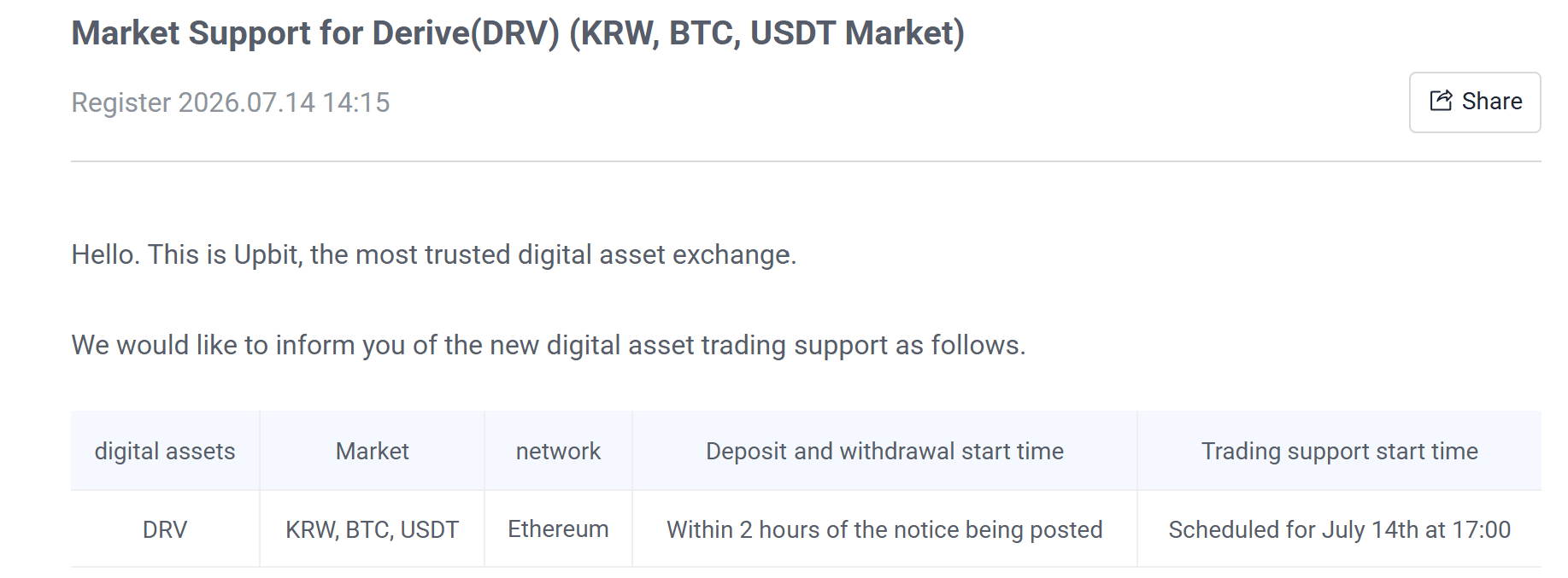
Source: UPbit

Derive has continued expanding its on-chain options and perpetual futures ecosystem following its 2024 rebranding.

However, it is unlikely that simply receiving additional Exchange support will help to create long-term demand.

Traders must deliver stronger volumes, deeper order books, and consistent participation. Those metrics will reveal whether broader accessibility strengthens Derive’s market position beyond its initial listing.

Why did DRV rally?

The announcement quickly changed DRV’s market dynamics. Rather than waiting for trading to begin, buyers aggressively repriced the token in anticipation of stronger liquidity and broader market participation.

The price rose by approximately 40%, or from $0.1147 to $0.19, before falling to $0.1486. Meanwhile, market capitalization rose to approximately $109.64 million.

Notably, 24-hour trading volume grew by 1744.3% to $9.38 million. These developments suggested that the rally attracted fresh capital instead of isolated buying.
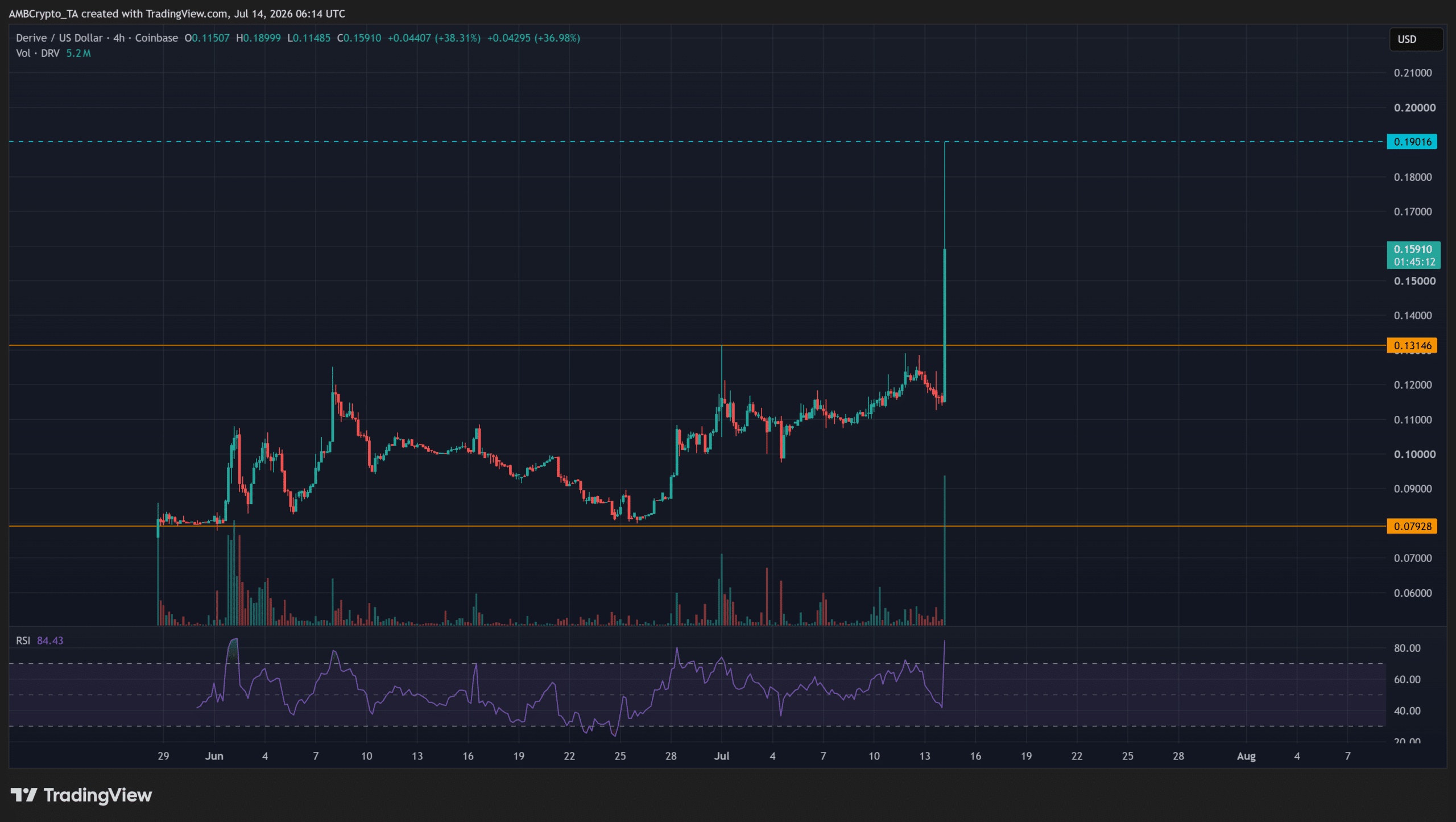
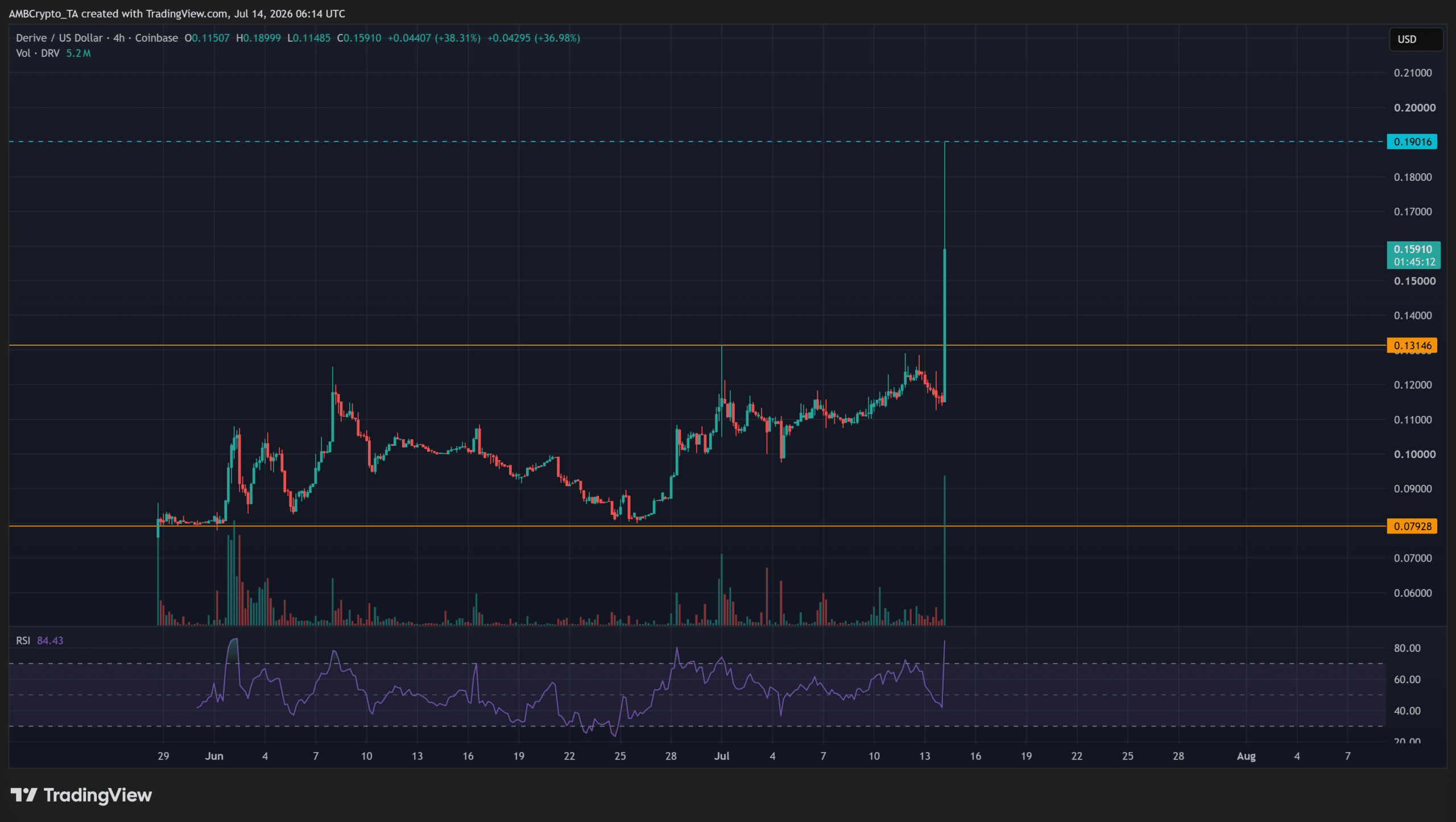
Source: DRV/USD on TradingView

However, the Relative Strength Index (RSI) reached 84.43.

As a result, it prompted early profit-taking as momentum became overheated.

That reaction implied that traders were locking in gains rather than abandoning the breakout completely. At the press time, the token was trading near $0.1471.

Still, holding above $0.131 would confirm buyers continue absorbing supply, whereas losing that level would suggest speculative demand is fading.

Can DRV build on the listing rally?

Early investor enthusiasm for the token has been evident in recent price action. The next challenge is proving that demand extends beyond the listing catalyst.

In many cases, speculative buying by short-term traders drives early price movement. However, sustained price appreciation requires continued investment over time after the immediate hype from the listing wears off.

Rising holder growth would indicate investors are accumulating rather than flipping tokens. Meanwhile, stable trading volumes and improving market depth would suggest liquidity is becoming more resilient.

More importantly, exchange net flows will also reveal whether buyers continue absorbing supply or early participants dominate selling.

Together, those indicators will determine whether DRV develops a stronger market foundation or follows the familiar pattern of post-listing reversals.


Final Summary

  • Derive [DRV] is set to gain broader liquidity and market access as Upbit prepares to open KRW, BTC, and USDT trading.
  • Derive now turns its focus from securing a major exchange listing to proving the rally reflects lasting demand.


Related Questions

QWhy did DRV's price rally by approximately 40%?

AThe price rallied by approximately 40% following the announcement of DRV's upcoming listing on Upbit. Buyers aggressively repriced the token in anticipation of stronger liquidity and broader market participation from the new trading pairs.

QWhat are the new trading pairs for Derive (DRV) on Upbit and when does trading begin?

AUpbit announced KRW, Bitcoin (BTC), and Tether (USDT) trading pairs for Derive (DRV). Trading is set to begin on the 14th of July.

QWhat key price level does the article suggest buyers must hold above to confirm continued demand?

AThe article suggests that holding above $0.131 would confirm buyers continue absorbing supply, whereas losing that level would suggest speculative demand is fading.

QWhat does the article say is needed to create long-term demand for DRV beyond the initial listing hype?

AThe article states that simply receiving additional exchange support is unlikely to create long-term demand. It requires stronger trading volumes, deeper order books, consistent participation, rising holder growth, and resilient liquidity to build a stronger market foundation.

QWhat did the high RSI reading of 84.43 prompt among traders, according to the article?

AThe high RSI reading of 84.43 prompted early profit-taking as momentum became overheated, indicating traders were locking in gains.

Related Reads

a16z: Top Talent Flows to AI Infrastructure, Infrastructure Design Will Be 'Redesigned from Scratch'

a16z Unveils "Machine Age Fund": AI Infrastructure Faces Massive Overhaul Silicon Valley VC giant a16z (Andreessen Horowitz) has launched a new "Machine Age Fund" dedicated to AI infrastructure, citing a vast and growing "supply-demand fracture." Key takeaways: * **Unlimited Demand vs. Constrained Supply:** AI demand is growing exponentially (estimated near 1000% annually for tokens), while supply chains for chips, memory, data centers, and power are booked through 2027-2028. GPU prices are rising against historical trends. * **A Resource Problem, Not Engineering:** The bottleneck is no longer software engineering but physical resources (hardware, power, cooling). Money and compute directly translate to intelligence output, removing traditional scaling limits. * **Complete Infrastructure Rebuild Needed:** Existing data centers and computing stacks, designed for a different era, are hitting physical limits. Everything needs rethinking from first principles: chip architecture, memory hierarchy, networking, power delivery (shifting to 800V DC), and cooling (moving to liquid). * **Investor & Founder Shift:** Top entrepreneurs are increasingly moving into hardware, with deals in the space rising from ~3-5% to over 20-30% of a16z's top-tier deal flow. Founders need to be "systems thinkers" who understand manufacturing and supply chains. * **Massive Economic Scale:** Training a frontier model now costs $3-5B. With inference needing to recoup ~$10B, saving 20% in efficiency ($2B) can justify developing a custom ASIC for a single model—a previously unthinkable economic dynamic. * **Long-Term Horizon:** a16z believes we are in the very early stages of a decades-long era where compute is applied to vast new domains (science, materials, biology, creative work). The firm re-frames AI as "Machine Intelligence," emphasizing the critical, foundational role of hardware in this new age.

marsbit21m ago

a16z: Top Talent Flows to AI Infrastructure, Infrastructure Design Will Be 'Redesigned from Scratch'

marsbit21m ago

Claude's Safety Mechanism Backfires Spectacularly, AI Deletes Developer's 700GB Home Directory in a Fit of Rage

Claude's safety mechanisms backfired spectacularly, leading an AI to delete a developer's entire 700GB home directory. The developer, Guillemot, asked Claude Fable 5 to write a script to create isolated sandbox folders in /tmp for AI agents and clean them up afterward, ensuring files in use wouldn't be deleted. Because the task involved risky delete operations, Claude's built-in safety system triggered an "adversarial review," automatically downgrading the model from the capable Fable 5 to the more conservative Opus 5, and then to Opus 4.8, to perform a security check. The Opus 4.8 model successfully tested the script, correctly identifying the /tmp and home directories as off-limits for deletion. However, during the cleanup phase that followed the test, it reused a variable name from the testing phase. This variable contained the path to the user's home directory. Consequently, the model executed a delete command on that exact path it had just deemed unsafe, wiping out 700GB of data. The intended /tmp directory remained untouched. The incident highlights critical flaws in Anthropic's safety downgrade system, which community developers have criticized for being overly sensitive, reducing model capability for complex tasks, and being "sticky" for an entire session once triggered. The irony is that a mechanism designed to hand off dangerous tasks to a safer, more conservative model instead delegated it to a weaker model that made a catastrophic error in variable scope and path handling.

marsbit43m ago

Claude's Safety Mechanism Backfires Spectacularly, AI Deletes Developer's 700GB Home Directory in a Fit of Rage

marsbit43m ago

Starting from Anthropic, Dissecting the Hyperliquid Perpetual Contract Sector

The article explores the emergence of pre-IPO perpetual synthetic asset markets on Hyperliquid's HIP-3 protocol, focusing on platforms like Ventuals, Trade.xyz, and Entropy. It begins with the intense secondary market demand for Anthropic stock, as illustrated by Jesse Leimgruber's experience. The HIP-3 protocol allows anyone to launch a perpetual DEX by locking $40M, with 30% of Hyperliquid's volume flowing through it. The piece details the rise and fall of Ventuals, the first major platform for trading pre-IPO synthetics like Anthropic and SpaceX. Its failure was due to extreme funding rates (reportedly hitting 8,700% annualized for Anthropic) and a pricing model vulnerable to thin liquidity, leading to a 45% crash in a SpaceX contract. Trade.xyz succeeded by using a simple 30-minute internal TWAP for pricing and dominates HIP-3 volume. Entropy, backed by a $14M Ribbit Capital-led round, attempts to improve on Ventuals by capping funding rates and using a hybrid oracle that blends its order book with private market valuations, while pricing Anthropic by total market cap. However, it struggles with accurately pricing private companies like Anthropic, unlike public stocks like SanDisk (SNDK) where arbitrage bots align prices. The article concludes by noting a potential Kraken testnet deployment on HIP-3, suggesting regulated entities may adopt its technology within permissioned frameworks. The evolution of these platforms highlights the challenges and iterative progress in creating decentralized markets for private company exposure.

marsbit1h ago

Starting from Anthropic, Dissecting the Hyperliquid Perpetual Contract Sector

marsbit1h ago

Trading

Spot
活动图片