Silicon Valley Observation: Seeking Certainty in the AI Wave

marsbitPublished on 2026-04-15Last updated on 2026-04-15

Abstract

Silicon Valley is experiencing a multi-polar AI boom, with San Francisco emerging as the hub for new model companies and narratives, while the South Bay remains a stronghold for established tech giants and engineering talent. This geographic distribution offers a sense of stability: both areas provide valuable opportunities, and the choice depends on whether one seeks cutting-edge innovation or mature infrastructure. In terms of sector dynamics, AI demonstrates stronger certainty than Web3. Almost every industry is actively integrating AI, while Web3 relies on AI for automation and analytics—not the other way around. Crypto, particularly stablecoins like USDC, is finding utility in micro-transactions between AI agents, but AI remains the foundational layer. The startup landscape is also shifted. Small teams can now achieve significant results with minimal capital by leveraging AI tools, reducing early dependence on VC funding. However, capital-intensive areas like compute and hardware still require venture support. The role of VCs is evolving from pure capital providers to resource enablers. Ultimately, the search for certainty in the AI era extends beyond geography or investment—it becomes a personal challenge: the willingness to adapt in a rapidly changing, often unsettling technological landscape.

Author: ChichiHong, ScalingX Labs Co-Founder

Amid the hills and sea fog of San Francisco, AI is visibly rewriting the rhythm of the Bay Area. For Chichi, co-founder of ScalingX, who has long been deeply involved in Web3 and has now come to North America, the strongest impression is not that one place is racing ahead alone, but rather: the Bay Area is forming a "multi-point blooming" pattern composed of San Francisco, the South Bay, and surrounding cities.

In her daily routine, San Francisco gathers large model and AI infrastructure companies, the South Bay still hosts traditional tech giants and engineering communities, while nodes like Palo Alto are filled with various Demo Days, incubators, and startup events. As everything accelerates, iterates, and rearranges, what she repeatedly ponders is not "where is the center," but rather: in such a multi-centered AI wave, what relatively certain things can people still grasp—whether it's geographical choices, sector judgments, entrepreneurial paths, or one's own life and mindset.

I. Geographical Choice: Multi-Point Growth

In recent years, San Francisco has been reshaped into one of the most concentrated stages for generative AI companies due to the headquarters and expansion of major model companies like OpenAI and Anthropic. New stories, new companies, and new AI narratives mostly emerge from here.

At the same time, the South Bay remains the base for large tech companies like Google and Meta, as well as numerous chip and cloud infrastructure enterprises, gathering a vast number of mature engineers and underlying technical teams, continuously attracting and exporting global talent.
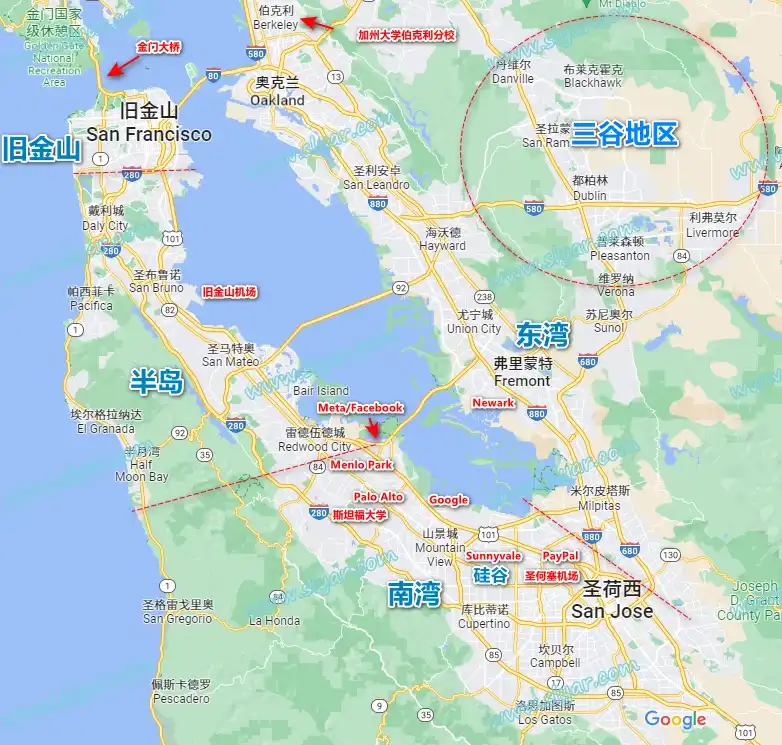
In the stories she hears, two sets of images often appear simultaneously: some sell their companies and buy multi-million-dollar homes in San Francisco, betting on AI and new wealth narratives; others, though affected by layoffs at their large companies, are quickly poached by other teams or new startups, and the housing prices and community atmosphere in the South Bay haven't noticeably cooled due to "AI stealing the show."

For her, this state of "both old and new growing" is itself a form of geographical certainty:

  • San Francisco represents new stories, new companies, new opportunities, and is the most densely packed stage for AI narratives;
  • The South Bay represents the old system, mature engineers, and stable infrastructure, still attracting and输送 talent;
  • Neither side is losing; they just play different roles.

In such a landscape, the question is no longer "should I leave the South Bay and move to San Francisco," but a more nuanced choice: which type of resource do you need to be closer to—new tech companies and capital networks, or mature giants and engineering ecosystems. For those wanting to gain a foothold in the AI wave, this reality of "both old and new booming simultaneously"反而 provides a kind of predictable geographical security: no matter which side you're on, there are people and things worth connecting with.

For her, the first layer of "certainty" is already quite clear:

  • The geographical center of gravity is shifting towards San Francisco;
  • The South Bay still carries the big companies and the存量工程师, but the话语权和想象力 are moving north.

For entrepreneurs and investors wanting to be close to the AI frontier, "being in San Francisco" itself is already the most basic geographical certainty choice.

II. Sector Choice: AI and Web3

Coming from a Web3 accelerator, Chichi is inevitably asked: is there really a new, sufficiently certain direction for the combination of AI and Web3. Her answer differs from many optimistic narratives—over the past year, she hasn't seen a new path that could be called a "paradigm shift"; most so-called "AI+Web3" projects still follow stories that were already told last year.

In her view, the most honest judgment at this moment is:

  • The certainty of AI is much stronger than that of Web3. Almost every industry is actively seeking applications for AI, from development and marketing to customer service; AI has become infrastructure;
  • Web3 has a clear need for AI—on-chain projects need AI for automated operations, content production, user outreach, and even in risk control and data analysis, AI has obvious advantages;
  • AI暂时 has no刚性 need for Web3. Proving that "AI can't run without blockchain" currently lacks sufficiently convincing cases.

She summarizes this asymmetric relationship with a memorable phrase: "Everyone needs AI, Web3 also needs AI, but AI doesn't need Web3."

This doesn't mean Crypto is completely marginalized. Over a longer cycle, many local US investors still believe the risk-reward ratio of crypto assets may not lose to any single AI track; what's truly intriguing is that stablecoins have quietly entered AI's "back-end system."

According to Circle's data, in the past 9 months, about 400,000 AI agents completed 140 million payments, totaling $43 million, with 98.6% settled via USDC, and an average transaction amount of only $0.31—this means that micro-transactions between machines are already continuously happening in a crypto-native way. In this sense, some AI practitioners aren't "believing in Crypto" verbally, but are using stablecoins as the default payment layer for agents, connecting the two tracks at the behavioral level.

However, at this point in time, if we're talking about "certainty in sectors," Chichi still prefers to view AI as the foundation for all industries, and Web3 / stablecoins as extremely suitable "infrastructure plugins" in certain scenarios, rather than强行 tying the two together and using a复合 narrative to explain all problems.

III. Certainty in the Entrepreneurial Path: Small Teams vs VC, Not an Either-Or

The impact of AI on the entrepreneurial path, Chichi概括 as "threshold reconstruction."

What impressed her most was the recent viral case of Medvi—a remote healthcare service company built around the weight-loss drug GLP‐1: founder Matthew Gallagher has an ordinary background, not a top-tier名校 graduate. In his home in Los Angeles, using about $20,000 and over a dozen AI tools, he spent two months building up the website, appointment process, consultation questionnaire, advertising materials, and customer service responses layer by layer.

The emergence of these "one-person companies" or "few-person companies" brings new certainty to the entrepreneurial path:

  • It is certain that: by using AI well, the上限 of small teams is greatly raised, and starting a business no longer necessarily means first assembling a team of a dozen people;
  • It is also certain that: not all projects therefore "no longer need VC."

Chichi emphasizes that she sees two coexisting realities:

  • On one side, there are more and more cases of "building good companies without relying on funding"—a few tens of thousands of dollars can generate revenue, develop sustainably through rolling development, not necessarily following the traditional funding节奏;
  • On the other side, there are directions that truly require heavy resources and investment: computing power, hardware, complex infrastructure, strong compliance scenarios—these projects很难切入 the window period without VC funding and resources.

This directly changes her understanding of "VC certainty." In the past, it might have been "money first, then talk about product," but now it's more like:

  • Trally excellent entrepreneurs who know how to use AI have lower dependence on money in the early stages,无需 compromising too much just to "make it";
  • If VCs want to maintain their own certainty, they must shift from "giving money" to "giving resources," such as GPU, talent networks, channels, and brand endorsement.

She describes the current Silicon Valley: "Demo Day is almost every day." Large and small incubators and event spaces provide almost unlimited对接 opportunities for founders and investors; investors can directly留言 under posts on X or Product Hunt saying "want to invest in you," some funds even deliberately seek out "high school geniuses" for early bets.

In such an extremely active, extremely disintermediated financing environment, her advice to founders is:

  • Don't rush to treat "whether to raise funds" as an either-or question;
  • First use AI to get the product running, then judge whether you need "money," or "resources + brand + ecosystem";
  • Treat VC as an amplifier, not a starting point.

IV. Conclusion: Amid Uncertainty, People Are Always Learning How to Adjust Themselves

Amid increasingly exciting technology and development, what Chichi sees is the same force refracted across different interfaces: AI is rewriting the existing order at an extremely high speed—company landscapes are shifting, sector boundaries are blurring, entrepreneurial paths are being compressed, and the relationship between people and the world is being renegotiated.

The more hidden layer has nothing to do with cities or valuations. The people she meets in HK and Silicon Valley—middle-aged finance professionals worried that "they're finished if they can't keep up with AI," big-tech engineers反复敲打 by layoff notices and visa deadlines—make her realize: insecurity has become the background noise of contemporary life. It doesn't disappear because you're at a big company or have stock options; instead, it's constantly amplified in an environment where information density is heightened and the pace is quickened.

Therefore, "seeking certainty in the AI wave" ultimately很难 remains solely at the level of discussing cities, sectors, or capital; it inevitably falls back to a more personal dimension: in such an environment, are people still willing, and still dare, to actively adjust themselves.



Trending Cryptos

Related Questions

QAccording to the article, what is the geographical distribution of AI companies and talent in the Bay Area, and how does it provide a sense of 'geographical certainty'?

AThe Bay Area has formed a multi-center pattern: San Francisco is the hub for new AI narratives, large model companies, and infrastructure firms, while the South Bay remains the base for established tech giants, chip companies, and a large pool of experienced engineers. This 'new and old growing simultaneously' offers geographical certainty—whether one is in San Francisco for new opportunities and capital or in the South Bay for mature ecosystems, there are valuable connections and roles available.

QWhat is the author's view on the relationship between AI and Web3, and which one is considered more certain in terms of demand and infrastructure?

AThe author states that AI has much stronger certainty than Web3. Almost every industry is actively seeking AI applications, making it a foundational infrastructure. While Web3 has clear needs for AI in areas like automation, content generation, and data analysis, AI does not currently have a刚性需求 (rigid demand) for Web3. The asymmetric relationship is summarized as: 'Everyone needs AI, Web3 also needs AI, but AI does not need Web3.'

QHow has AI impacted the startup path, particularly in terms of team size and venture capital (VC) funding, as illustrated by the Medvi case?

AAI has重构 (reconstructed) the barriers to entry for startups. Cases like Medvi show that small teams or even individuals can use AI tools to build functional companies with minimal capital (e.g., $20,000) without initially needing large teams or VC funding. This raises the ceiling for small teams. However, not all projects are VC-free; resource-intensive areas like compute, hardware, and complex infrastructure still require VC support. Thus, the确定性 (certainty) is that excellent AI-enabled entrepreneurs rely less on early funding, while VCs must shift from merely providing capital to offering resources like GPU access, talent networks, and branding.

QWhat role does the author suggest VC funding should play in the current AI startup environment, and how should founders approach financing?

AThe author suggests that VC should be viewed as an amplifier rather than a starting point. Founders are advised to first use AI to develop and validate their product, then determine whether they need just 'money' or additional 'resources + brand + ecosystem' support. The current highly active and decentralized funding environment (e.g., daily Demo Days, direct investor outreach on platforms like X) allows founders to avoid treating 'whether to raise funds' as a binary choice and instead strategically select VC based on specific needs.

QBeyond geography,赛道 (tracks), and capital, what is the deeper personal dimension of finding certainty in the AI wave, as observed by the author?

AThe author observes that insecurity has become a background noise for contemporary people, amplified in high-information, fast-paced environments. Finding certainty in the AI wave ultimately comes down to a personal dimension: whether individuals are willing and daring to actively adjust themselves—adapting to new technologies, roles, and realities—amidst the rapid changes and uncertainties brought by AI.

Related Reads

Stocks Fell Even More Violently Than Crypto, Where Did the Money Go?

From June to late July 2026, global stock markets, particularly technology and semiconductor stocks, experienced severe declines, with South Korea's KOSPI index facing historic circuit breakers and shedding 40% from its June peak. Key catalysts included SK Hynix's earnings miss despite record profits and competitive pressures from China's CXMT IPO. A global forced deleveraging event unfolded, devastating highly leveraged instruments like the 2x leveraged SK Hynix ETF, which lost over 80% of its value. Surprisingly, Bitcoin showed relative stability during this period, rising roughly 15% from its July low. The article clarifies this wasn't due to an inflow of equity flight capital but because Bitcoin had already undergone a significant correction in May and June, with U.S. spot Bitcoin ETFs seeing record outflows. True safe-haven flows went to gold, severing Bitcoin's short-term "digital gold" narrative. The sell-off is characterized not as an AI story collapse but a liquidity-driven清算 of crowded leveraged positions, potentially halfway through according to some analysts. For substantial capital to return to Bitcoin, the article cites necessary conditions: eased global liquidity pressure, a soft-landing Fed rate cut, and regulatory clarity from the stalled U.S. CLARITY Act. The conclusion is that Bitcoin is not a current safe haven but a pre-cleared asset. Its decoupling from tech stocks highlights its potential future role as a non-correlated asset for institutional portfolios, positioning it favorably for when global capital reallocates post-crisis.

marsbit6m ago

Stocks Fell Even More Violently Than Crypto, Where Did the Money Go?

marsbit6m ago

"The Final Phase Before the New Cycle". What Will Happen to Bitcoin in August

"Bitcoin Faces Crucial Test in August: Experts Predict Consolidation or Further Decline" The price of Bitcoin (BTC) is expected to remain under pressure in August, with experts anticipating either consolidation within a narrow range or a potential drop below $60,000. Despite a double-digit recovery from its July low near $58,000, BTC ended the month trading around $63,500, still roughly 50% below its October 2025 peak of $126,200. Analysts cite several headwinds: a challenging macroeconomic environment with high US interest rates and persistent inflation, which makes fixed-income assets more attractive than speculative ones like crypto. Furthermore, competition for capital is intense, with many investors favoring AI-related stocks. This is reflected in significant outflows from US spot Bitcoin ETFs, with a record $4.5 billion leaving in June and a net outflow of $5.4 billion for the first half of the year. Historically, August is a weak month for crypto, with a median return of -7.49% from 2013 to 2025. Experts also note regulatory uncertainty in the US, particularly the stalled CLARITY Act, as a dampening factor. Despite the bearish near-term outlook, several experts view the current phase as the "last phase before a new Bitcoin cycle" begins, potentially in Q4 2024. This makes it a favorable time for accumulating Bitcoin for the long term. Key price levels to watch are support at $60,000-$61,000, with a break below $58,000 potentially leading to $53,000-$55,000. A move above $67,000 could target $70,000-$75,000, though this is considered a lower probability scenario.

cryptonews.ru12m ago

"The Final Phase Before the New Cycle". What Will Happen to Bitcoin in August

cryptonews.ru12m ago

What Structural Changes Have Occurred in the Cryptocurrency Industry by 2026?

By 2026, the crypto industry is undergoing profound structural shifts, moving beyond price speculation towards deeper integration with the real-world economy. Major changes are driven by four key areas. First, stablecoins, now a $300B+ market, are evolving from crypto-native trading tools into real-world payment and B2B settlement backbones, extending business chains and creating complex accounting and tax obligations. Second, global regulation is maturing. Frameworks like the EU's MiCA are moving from legislation to active enforcement, determining market access. Anti-money laundering rules, such as the Travel Rule, see wider adoption but face enforcement and cross-border challenges. Third, AI Agents are emerging as autonomous transaction entities. Protocols like Coinbase's x402 enable machine-to-machine micropayments using stablecoins, necessitating new frameworks for transaction authorization, tax attribution, and audit trails. Finally, tax transparency is entering an implementation phase. Initiatives like the OECD's CARF, EU's DAC8, and the US Form 1099-DA are shifting reporting burdens to platforms, requiring them to reconcile on-chain data with user identity and tax residency information. Collectively, these trends signify that crypto compliance is becoming foundational infrastructure, requiring consistent data and control systems to meet cross-border operational, regulatory, and audit demands.

marsbit33m ago

What Structural Changes Have Occurred in the Cryptocurrency Industry by 2026?

marsbit33m ago

Trading

Spot

Hot Articles

Discussions

Welcome to the HTX Community. Here, you can stay informed about the latest platform developments and gain access to professional market insights. Users' opinions on the price of AI (AI) are presented below.

活动图片