Short Positions Have Been Squeezed Out: Will the Next Leg of the U.S. Stock AI Rally Continue in Seoul?

marsbitPublished on 2026-05-12Last updated on 2026-05-12

Abstract

"Short Squeeze Exhausted: Will the Next Leg of the AI Rally Continue in Seoul?" A Nomura report suggests the US AI stock rally, which saw the S&P 500 rise ~16.6% in 28 days largely driven by 10 key stocks, may be pausing. The fuel from short covering, CTA fund positioning, and volatility-control strategies is nearing its limit. For the rally to continue, new momentum from retail and sentiment-driven FOMO (Fear Of Missing Out) is needed. South Korea's market provided a potential answer on the very day the report was published. The KOSPI index surged 4.32%, triggering a buy-side circuit breaker, led by massive gains in chip giants SK Hynix (+11.98%) and Samsung. This surge is characterized by retail "hynix FOMO" and overseas funds precisely buying into AI themes via chip-focused ETFs, shifting from broad Korean market ETFs. The Korean rally is a high-beta extension of the US AI capital expenditure story, as major cloud providers plan massive infrastructure spending, directly benefiting memory chip leaders. However, this linkage also implies vulnerability. The sustainability of this next leg depends on whether US tech stocks correct, the trajectory of US inflation (with upcoming CPI data key), and geopolitical tensions around the Strait of Hormuz. Seoul has emerged as the new epicenter of the AI trade, but its fate remains tied to these broader macro and market dynamics.

Author: Claude, Deep Tide TechFlow

Deep Tide Introduction: A key judgment in Nomura's May 11th research report stated: "At least for U.S. stocks, the AI rally may be taking a breather." On the very same day, the KOSPI surged 4.32% in a single day to 7822.24 points, triggering a buy-side sidecar during the session. SK Hynix soared 11.98%, with its market cap surpassing Eli Lilly for the first time, becoming the 14th largest globally. The report's call that "the next leg depends on Korean FOMO" occurred almost simultaneously with the Korean stock surge. The driving force behind the U.S. stock AI trade is shifting from a "short squeeze" to "retail FOMO."

The U.S. stock AI rally is not over. The S&P 500 accumulated gains of about 16.6% over 28 trading days. However, the source of the funds lifting the index and the remaining fuel for the rally are undergoing subtle changes. Nomura's assessment is that the phase driven by short covering and institutional positioning is nearing its end. For the AI trade to continue, a new wave of capital must take the baton. The Korean market provided a sample case on the very day the report was released, with the KOSPI crossing the 7000, 7400, and 7800 levels within a week, retail investors falling into "hynix FOMO," and foreign capital concentrating on chip stocks via DRAM ETFs. The narrative is shifting from the Nasdaq to the KOSPI.

U.S. Stocks Appear Normal, But the Anomalous "Spot Up/Volatility Also Up" Combo is Flashing

The surface readings of the U.S. stock AI trade remain strong. Saxo's options briefing on May 11th showed the VIX closing at 17.19, up 0.64% for the day. This level is below its historical average, but the VIX rising while the index hits record highs is itself an anomalous signal. The CBOE SKEW Index rose to 138.21 (+1.54%), the VVIX (measuring VIX volatility) rose to 96.78 (+3.39%). The simultaneous rise of these three indicators suggests institutional investors have not abandoned hedging even as the index hits new highs.

Nomura's May 11th report described this combination as an "anomalous state" for U.S. tech stocks. The report noted the Nasdaq exhibited a pattern of "spot prices rising, but volatility also rising," with the VIX continuing its decline while the VXN (Nasdaq volatility) rebounded noticeably. The option skew for U.S. tech stocks (the difference between the implied volatility of 1-month 25-delta puts and 25-delta calls) has rapidly fallen to near historical lows, back to levels around October 2025. A declining skew means the premium for put protection relative to calls has been compressed, indicating more crowded pricing for tech stock upside.

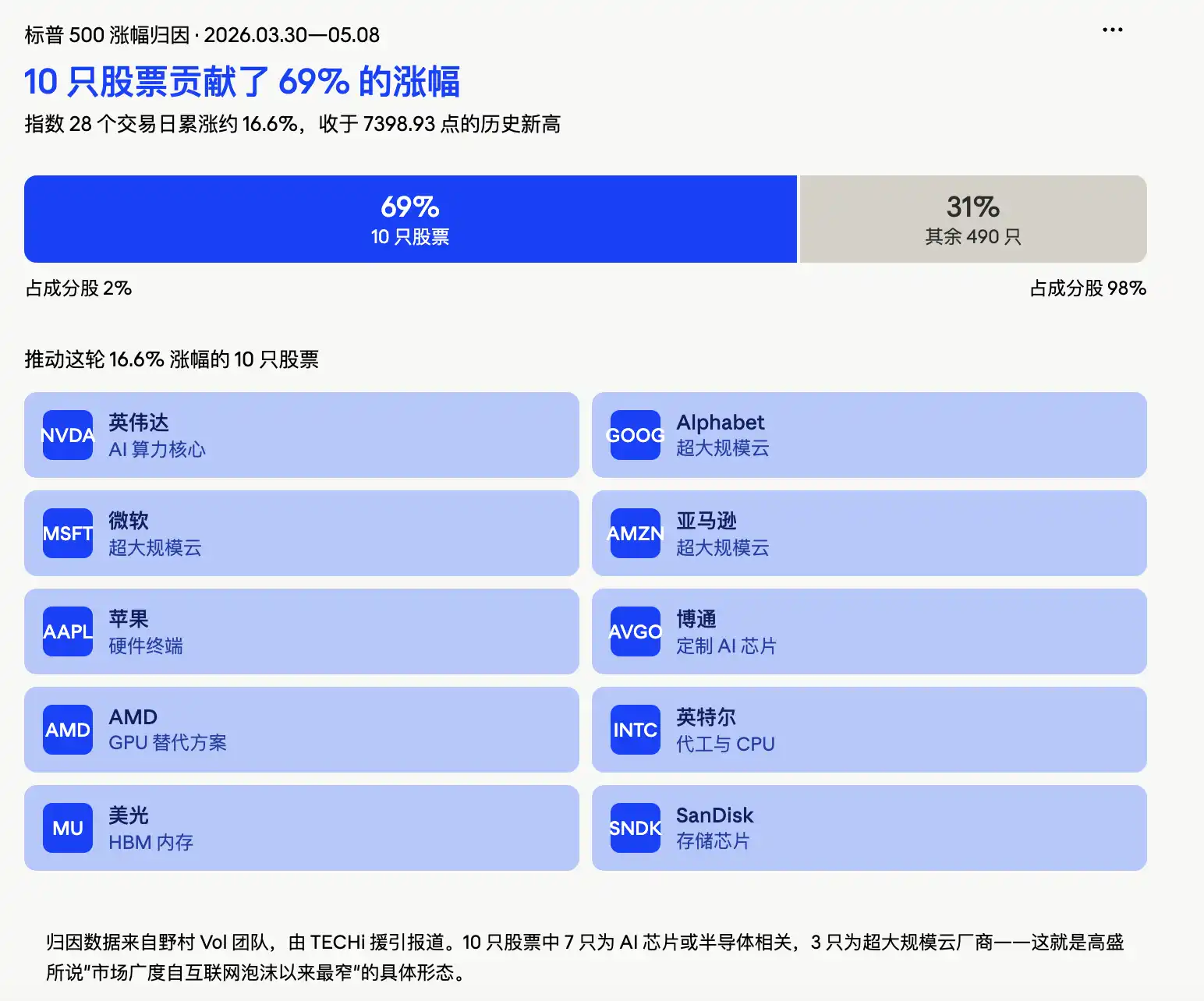
More concerning is the structure of this rally. According to a return attribution chart from Nomura's Vol team cited by TECHi, of the S&P 500's roughly 16% gain since March 30th, 10 stocks contributed 69%: Alphabet, Nvidia, Amazon, Broadcom, Intel, Micron, Apple, AMD, Microsoft, SanDisk. The remaining 490 constituents contributed only 31%. Goldman Sachs' U.S. equity strategy chief Ben Snider also pointed out that current market breadth has fallen to one of the narrowest levels since the dot-com bubble era. Goldman lists "AI Megaprojects" and "Iran Conflict" as the two clearest stock market risks for the coming weeks.
The Shorts Have Been Squeezed Out, Who Will Push the Next Leg?

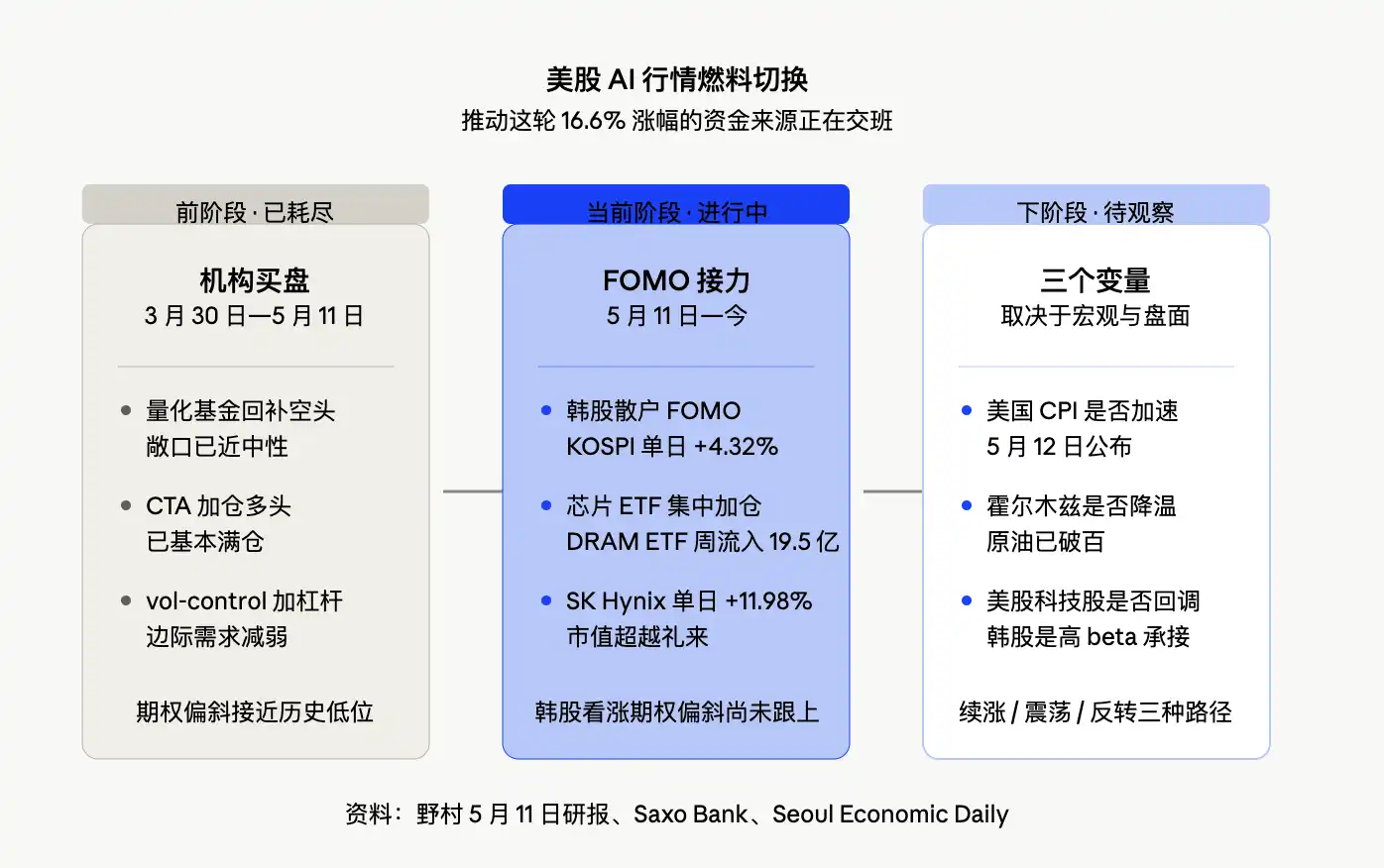
The real killer judgment in Nomura's report isn't the "anomalous combo" itself, but its dissection of fund flows: Quant funds' equity exposure has recovered to near neutral, and the process of forced buying and short covering is largely complete. CTA (Commodity Trading Advisor) funds have largely returned to full long positions, and the marginal incremental demand from volatility control strategies is also waning.

In other words, the three main buying forces that drove AI stocks higher in recent weeks—shorts being squeezed, CTAs adding positions, and declining volatility prompting vol-control funds to add leverage—are all nearing their limits. If AI stocks are to continue rising, they can no longer primarily rely on the "short squeeze" buying force.

It's important to note that Nomura's estimates of quant fund, CTA, and macro fund positioning are based on model calculations, not actual measured holdings. This makes them better suited as a temperature gauge for marginal changes rather than a precise positioning table. Even so, the direction is clear: Programmatic buying from the institutional side is nearing its limits, and subsequent upward momentum must rely more on retail and sentiment-driven capital.

Goldman's trading desk largely agrees with Nomura's assessment. Goldman's One-Delta trading desk head Rich Privorotsky recently described the current pace as "semi-irrational chasing," drawing a comparison to 1999, when overflowing telecom equipment orders provided a "physical bottleneck narrative," similar to the current logic of AI compute scarcity. Goldman's volatility trading desk characterized recent dynamics as "spot up, volatility up," which limits the space for systematic strategies to add further positions.

This assessment means the U.S. stock AI trade isn't breaking, but the script of "pushing higher by squeezing shorts" is nearing its end.

Korean Stocks Provide the Answer: On the Day of Nomura's Report, KOSPI Surges 4.32%, Triggering Buy-Side Sidecar

Another judgment in Nomura's report was: For the AI trade to have another leg, the true signal for continuation would be to watch for a resurgence of FOMO in Korea.

The Korean market responded with an extreme outburst on the very day the report was released. The KOSPI closed at 7822.24 points, up 4.32% for the day, touching 7899.32 points during the session, which triggered a buy-side sidecar. SK Hynix surged 11.98% to 1.888 million KRW, with its market cap surpassing Eli Lilly for the first time to become the 14th largest globally. Samsung Electronics rose 6.33% to 285,500 KRW. The combined market cap of the two companies exceeded 3,000 trillion KRW, accounting for nearly half of the KOSPI's total market cap. The combined market cap of the Korean stock market (KOSPI and KOSDAQ) exceeded 7,000 trillion KRW for the first time, just 8 trading days after breaking 6,000 trillion KRW on October 27th.

During the May 12th session, the KOSPI further broke above 3900 points (the 7900-point level), setting another new all-time high. However, data from the same day revealed the other side of FOMO: Of the 948 stocks on the KOSPI, only 186 rose while 696 fell; approximately 30% of the index constituents have fallen year-to-date. Gains were entirely concentrated in the two semiconductor heavyweights, Samsung and SK Hynix.

A retail FOMO has already spawned new market vocabulary. Korean financial media uses "hynix FOMO" to describe the psychological divide among retail investors: on one side, the regret of missing out ("I should have bought at 800,000 KRW"), and on the other, the anxiety of "should I jump in now?" and "a correction is coming soon." Retail communities are flooded with discussions about "Samjeon-nix" (a portmanteau of Samsung + Hynix). This is a typical retail-driven chasing pattern, highly consistent with the "FOMO signal" Nomura defined.

The flow of foreign capital is even more telling. According to a Seoul Economic Daily report on May 10th, the iShares MSCI Korea ETF (EWY) saw net outflows of $1.0145 billion between May 1st and 7th, a signal of passive fund withdrawal from the Korean market. However, during the same period, the Roundhill Active DRAM ETF saw net inflows of $1.9538 billion. This ETF has a 25.94% weighting in SK Hynix and 21.62% in Samsung Electronics, totaling about 48%. Foreign capital isn't selling Korea, they are selling broad-based ETFs and buying chips, a precise overweighting of the AI theme.

One detail warrants caution. Nomura's May 11th report pointed out that the KOSPI 200 also showed "spot up, volatility up," but the call skew didn't rise alongside it. This doesn't look like volatility expansion driven by call-buying chase demand. In other words, as of the report's release, the Korean market had not yet entered a typical "fear of missing out, scrambling for calls" state. Whether this signal reverses quickly after the KOSPI's surge that day will be key to judging the sustainability of the FOMO.
Korean Stocks are an Extension of the U.S. AI Capex Chain; How Long the Next Leg Lasts Depends on the "Pyramid's Apex"

The Korean FOMO is not an isolated event; it's essentially a high-beta extension of the U.S. stock AI capital expenditure story.

Data directly anchors this transmission chain. According to Bridgewater estimates, Alphabet, Amazon, Meta, and Microsoft are projected to collectively invest around $650 billion in AI-related infrastructure in 2026. Goldman Sachs cites data showing that the consensus estimate for the largest cloud infrastructure companies' 2026 capex jumped by $130 billion last quarter to $670 billion, equivalent to over 90% of these companies' projected operating cash flow. Microsoft's Q3 capex reached $31.9 billion, Alphabet's Q1 property and equipment purchases were $35.7 billion, and Meta raised its 2026 capex guidance to a range of $125-145 billion.

This money flows into data centers, GPUs, memory, networking, power systems, and cloud capacity. SK Hynix and Samsung sit at the core of this money flow, with HBM4 memory and high-bandwidth memory being snapped up by hyperscale cloud providers. According to a Reuters report, SK Hynix recently received "unprecedented" order proposals from major tech companies, with some customers proactively offering to help finance new production lines and ASML lithography machines. Chip capacity is essentially sold out. This is why the KOSPI's single-day 4.32% surge is narratively coherent—Korean stocks are essentially the "second derivative" of the U.S. AI story.

But this linkage also implies vulnerability. If U.S. tech stocks experience a full-scale reversal, Korean stocks would be the most direct high-beta asset to bear the selling pressure. Another risk path mentioned by Nomura is a resurgence of inflation forcing global central banks to be more hawkish. This week's (May 12th) U.S. CPI is a key event, yet the premium in options markets for this event remains low; the market hasn't paid a high insurance premium for this risk yet.

There's one more variable in the macro backdrop: The Strait of Hormuz. WTI crude closed at $100.09 on May 8th (+4.89%), Brent crude at $105.66 (+4.31%). Conflict near the Strait of Hormuz continues to escalate. Nomura's judgment is: As long as the Strait remains obstructed and the U.S. and Iran remain divided on ceasefire terms, the AI-dominated market environment may last longer than expected. Energy price shocks will lift inflation expectations but could also make the market even more reluctant to leave "the AI story that's making money."

Layering these clues together: The phase of the U.S. stock AI rally driven by "squeezing shorts" is nearing its end. Korean FOMO has been ignited, with retail and foreign chip ETFs adding positions in sync, but the option skew hasn't caught up yet. How long the next leg lasts depends on whether U.S. tech stocks correct, whether U.S. CPI signals accelerating inflation, and whether the Strait of Hormuz ultimately cools down. Nomura's report's judgment framework is being validated one by one by market action. Seoul is becoming the latest epicenter of this AI trade.

Related Questions

QAccording to Nomura's report, what are the three main forces behind the recent AI stock rally in the US market, and why is their influence now considered to be nearing its limit?

AThe three main forces identified are: 1) Short covering (shorts being squeezed), 2) CTA (Commodity Trading Advisors) funds adding long positions, and 3) Volatility-control strategies increasing leverage as volatility receded. Their influence is nearing its limit because quantitative fund equity exposure is back near neutral, CTAs are mostly back to full long positions, and the 'spot up, VIX up' dynamic has limited the room for further systematic buying from these strategies.

QWhy does the article suggest South Korea's stock market (KOSPI) has become a focal point for the next phase of the AI trade, and what evidence supports this?

AThe article suggests South Korea is the next focal point because its market exhibited classic FOMO (Fear Of Missing Out) behavior driven by retail investors, precisely as predicted by Nomura's report. Evidence includes: KOSPI's 4.32% single-day surge triggering a buy-side circuit breaker; SK Hynix rising nearly 12% and Samsung Electronics rising over 6%; massive inflows into the Roundhill Active DRAM ETF concentrated on chip stocks; and the emergence of 'hynix FOMO' sentiment among Korean retail investors.

QWhat does the 'spot up, volatility up' dynamic observed in US indices like the Nasdaq indicate, and why is it considered an 'abnormal signal'?

AThe 'spot up, volatility up' dynamic means that while stock indices are hitting record highs, the CBOE Volatility Index (VIX) and Nasdaq Volatility Index (VXN) are also rising. This is considered an abnormal or contrary signal because typically, when markets rally to new highs, investor fear subsides, leading to lower volatility (VIX down). The concurrent rise suggests institutional investors are still hedging against potential downside even as prices climb, indicating underlying caution and crowded positioning.

QHow is the Korean stock market's AI rally fundamentally linked to the AI capital expenditure story in the US?

AThe Korean stock market's AI rally is a high-beta extension of the US AI capital expenditure story. Massive AI infrastructure spending by US tech giants like Alphabet, Amazon, Meta, and Microsoft (estimated at hundreds of billions annually) flows directly into data center components, including high-bandwidth memory (HBM) and DRAM chips. South Korean firms SK Hynix and Samsung Electronics are dominant suppliers in this critical segment. Therefore, the surge in their stock prices reflects the intense demand and 'scarcity narrative' downstream from US tech capital spending.

QAccording to the article, what are the key risks that could determine how long the current phase of the AI trade, centered on Korea, can last?

AThe key risks are: 1) A significant correction or reversal in US tech stocks, which would directly pressure high-beta Korean chip stocks. 2) US CPI data showing accelerating inflation, which could force central banks into more hawkish policies and disrupt the low-rate environment favorable for growth stocks. 3) Escalation of conflict around the Strait of Hormuz, which could spike oil prices, increase inflation fears, and create broader market instability.

Related Reads

Raising Interest Rates Is Not a Tech Killer, EPS Is: A Strategy for Discarding the Weak and Retaining the Strong After the AI Theme's Sharp Decline

**Summary: Rising Interest Rates Are Not the Killer of Tech; EPS Is: The "Keep the Strong, Ditch the Weak" Strategy After the AI Theme Plunge** The author argues that the sharp sell-off in tech and AI-related stocks, triggered by a strong US jobs report that heightened Fed rate hike fears, represents a "pullback to pick up passengers" rather than a "car crash." The true end of a tech bull market is not determined by an extra 25 basis point hike, but by industry overcapacity and the disproval of earnings per share (EPS) expectations. Historical analysis shows that during past rate hike cycles, the Nasdaq-100 often outperformed, provided EPS growth remained strong. The current phase is seen as a shift from a "broad narrative-driven rally" to a "focused verification stage" for AI. The investment strategy should be to "keep the strong, ditch the weak." * **Retain exposure** to high-conviction AI infrastructure leaders with clear order visibility, stable margins, strong cash flow, and upward EPS revisions (e.g., AI servers, advanced packaging, optical modules, key cloud suppliers). * **Reduce exposure** to high-beta, narrative-driven stocks with unclear profit paths (e.g., some quantum computing, space, or speculative chip stocks), especially on rebounds. Valuation concerns should focus on whether earnings can catch up to high multiples, not on high P/E alone. Crowded positioning signals a concentration into quality assets, not necessarily a market top. The upcoming Q2 earnings season will be a key validation point. The core principle is to hold stocks with proven EPS, while using macro events (CPI data, central bank meetings) to manage timing and risk.

marsbit8m ago

Raising Interest Rates Is Not a Tech Killer, EPS Is: A Strategy for Discarding the Weak and Retaining the Strong After the AI Theme's Sharp Decline

marsbit8m ago

The Largest IPO in History Ignites Heated Debate: Is SpaceX Worth $1.77 Trillion?

SpaceX's potential IPO is priced at $135 per share, aiming to raise $75 billion and valuing the company at approximately $1.77 trillion, which would make it the largest IPO in history. This valuation has sparked intense debate among investors. Bullish analysts, including major underwriters Goldman Sachs and Morgan Stanley, argue the valuation is justified by SpaceX's long-term potential. They see it not just as a rocket company but as a future leader in space infrastructure, with key growth drivers being Starlink satellite internet, low-cost rocket launches, and future AI-related ventures. They project revenues reaching hundreds of billions to trillions of dollars by 2030-2040. ARK Invest's model suggests a 2030 enterprise value could reach $2.5 trillion. Bearish analysts from independent research firms like Morningstar, PitchBook, and New Constructs contend the IPO price is excessively high, already pricing in unrealistic future growth. Using DCF and sum-of-the-parts models, they estimate fair value between $780 billion and $1.7 trillion, significantly below the IPO target. They highlight risks such as the speculative nature of AI projections, over-dependence on Elon Musk, high growth expectations, and corporate governance concerns. Trefis set a target price of just $79 per share. While both sides acknowledge SpaceX's unique position in commercial space, the core disagreement centers on whether the $135 share price offers a reasonable margin of safety or is overly optimistic. Despite the valuation controversy, reported strong demand for the IPO indicates significant market interest.

marsbit1h ago

The Largest IPO in History Ignites Heated Debate: Is SpaceX Worth $1.77 Trillion?

marsbit1h ago

After the Passage of the GENIUS Act and the CLARITY Act, What Is the Correct Architecture for On-Chain Yield?

The article discusses the evolution of on-chain credit, distinguishing three markets: overcollateralized crypto lending, unsecured lending (largely unsuccessful), and asset-backed credit (ABC). ABC, backed by identifiable real-world collateral with legal recourse, is identified as the fastest-growing category and the only one credibly addressing adverse selection—the core problem in credit where the riskiest borrowers self-select. Current growth in on-chain Real World Assets (RWAs), particularly tokenized private credit funds (e.g., Maple Finance, Centrifuge), is substantial but often merely "wraps" existing fund structures, inheriting their risks rather than solving adverse selection at the protocol level. The regulatory landscape is a key driver, with the US GENIUS Act (prohibiting stablecoin issuers from paying yield) and the proposed CLARITY Act (closing loopholes on indirect yield) set to redefine permissible yield-bearing products. This makes vaults (like ERC-4626) the critical architecture—they become the primary compliant vehicle for delivering yield, functioning as issuance, disclosure, distribution, and recovery mechanisms. The author's thesis is that the correct post-GENIUS/CLARITY architecture involves building ABC solutions where credit assessment, structure, and recovery are encoded directly into the smart contract vault layer, moving beyond mere tokenized fund wrappers to solve adverse selection fundamentally and ensure regulatory compliance.

Foresight News2h ago

After the Passage of the GENIUS Act and the CLARITY Act, What Is the Correct Architecture for On-Chain Yield?

Foresight News2h ago

Trading

Spot
Futures

Hot Articles

How to Buy NOM

Welcome to HTX.com! We've made purchasing Nomina (NOM) simple and convenient. Follow our step-by-step guide to embark on your crypto journey.Step 1: Create Your HTX AccountUse your email or phone number to sign up for a free account on HTX. Experience a hassle-free registration journey and unlock all features.Get My AccountStep 2: Go to Buy Crypto and Choose Your Payment MethodCredit/Debit Card: Use your Visa or Mastercard to buy Nomina (NOM) instantly.Balance: Use funds from your HTX account balance to trade seamlessly.Third Parties: We've added popular payment methods such as Google Pay and Apple Pay to enhance convenience.P2P: Trade directly with other users on HTX.Over-the-Counter (OTC): We offer tailor-made services and competitive exchange rates for traders.Step 3: Store Your Nomina (NOM)After purchasing your Nomina (NOM), store it in your HTX account. Alternatively, you can send it elsewhere via blockchain transfer or use it to trade other cryptocurrencies.Step 4: Trade Nomina (NOM)Easily trade Nomina (NOM) on HTX's spot market. Simply access your account, select your trading pair, execute your trades, and monitor in real-time. We offer a user-friendly experience for both beginners and seasoned traders.

2.6k Total ViewsPublished 2025.09.30Updated 2026.06.02

How to Buy NOM

Discussions

Welcome to the HTX Community. Here, you can stay informed about the latest platform developments and gain access to professional market insights. Users' opinions on the price of NOM (NOM) are presented below.

活动图片