Research Report Analysis: MRVL's Optical AI Booming, Why High Valuation Keeps Morgan Stanley's Star Analyst Sidelined?

marsbitPublished on 2026-06-17Last updated on 2026-06-17

Abstract

Report Recap: MRVL Optical AI Boom - Why High Valuation Led Morgan Stanley's Star Analyst to Stay Neutral? Morgan Stanley analyst Joseph Moore maintained an "Equal-weight" (Neutral) rating on Marvell Technology (MRVL) on May 28, raising the price target from $172 to $195, below the trading price. This stance comes despite Marvell reporting a record quarter and significantly raising its full-year outlook (FY27 revenue ~$11.5B, up ~40%). Moore's neutral view is based on valuation. The $195 target implies ~40x CY2027 P/E. He contrasts MRVL with NVDA: both trade near ~$200, but Nvidia's forward EPS is more than double Marvell's. For MRVL's valuation to hold, it needs consistent earnings upgrades, proof of networking market share gains, or certainty on large-scale custom AI chip shipments—none of which are confirmed yet. Growth is driven by two pillars: **1) Optical Interconnect** (the faster runner): Moore raised FY27 growth expectations to >70%, with the optical module product line nearing a $1B annualized run rate. **2) Custom AI Chips** (the climber): Confidence in FY28 is growing, but a major new customer project only ramps in FY28, with no current revenue visibility. Key risks are the underperforming Storage, Enterprise, and legacy Networking segments. Moore acknowledges the real AI opportunity but believes the current price already reflects it. For the stock to work from here, investors need to see the optical business hit its targets, custom chips ramp as planned, and ...

Author: Rita

Tide Research Introduction

Morgan Stanley analyst Joseph Moore updated his research report on Marvell Technology (MRVL) on May 28. Marvell had just delivered a record-setting quarterly report, and management significantly raised its full-year outlook, with Wall Street nearly unanimously bullish. Moore was among the few who didn't follow suit, maintaining an Equal-Weight (Neutral) rating while raising the price target from $172 to $195 – both adjustments were below the stock price at the time. He believes the AI opportunity is real, but the current price already reflects it. Those holding MRVL or looking for targets in the AI chip and optical interconnect chain should listen to the contrarian logic. We've provided an edited summary and analysis.

Three Key Takeaways

1 Record quarterly results, management significantly raises full-year outlook. For the quarter ended April 2026 (Marvell's FY27 Q1), revenue was $2.418 billion, up about 28% year-over-year, slightly exceeding market expectations of $2.406 billion. EPS was $0.80, in line with expectations. More crucial is the forward view: management raised its FY27 full-year revenue outlook to approximately $11.5 billion, representing about 40% growth, and further raised FY28 expectations to around $16.5 billion, about 45% growth. The next quarter's revenue guidance midpoint is $2.7 billion, up 35% YoY, exceeding market expectations by about $100 million.

2 Moore assigns Neutral because the stock price already prices in the growth. The $195 price target corresponds to approximately 40x the calendar year 2027 estimated EPS (including stock-based compensation). Moore compared Marvell to his top pick, Nvidia: their stock prices are similar (~$198 vs. ~$212), but Nvidia's next fiscal year EPS is about $13, more than double Marvell's ~$6. Moore believes for Marvell to hold at this price level, it needs to consistently show earnings revisions upward, evidence of gaining network share, or certainty of large-scale custom chip shipments – none of which are concrete yet.

3 AI growth has two legs, one running, one climbing. The fast runner is optical interconnect. Moore raised his FY27 growth expectation for this segment from about 50% to over 70%, with the optical module product line expected to reach an annualized revenue run rate of $1 billion in the coming quarters. Still climbing the ramp is custom AI chips (ASICs designed specifically for cloud providers). Moore's confidence in FY28 is increasing, but a major new customer won't enter volume production until FY28, so this revenue stream isn't yet visible.
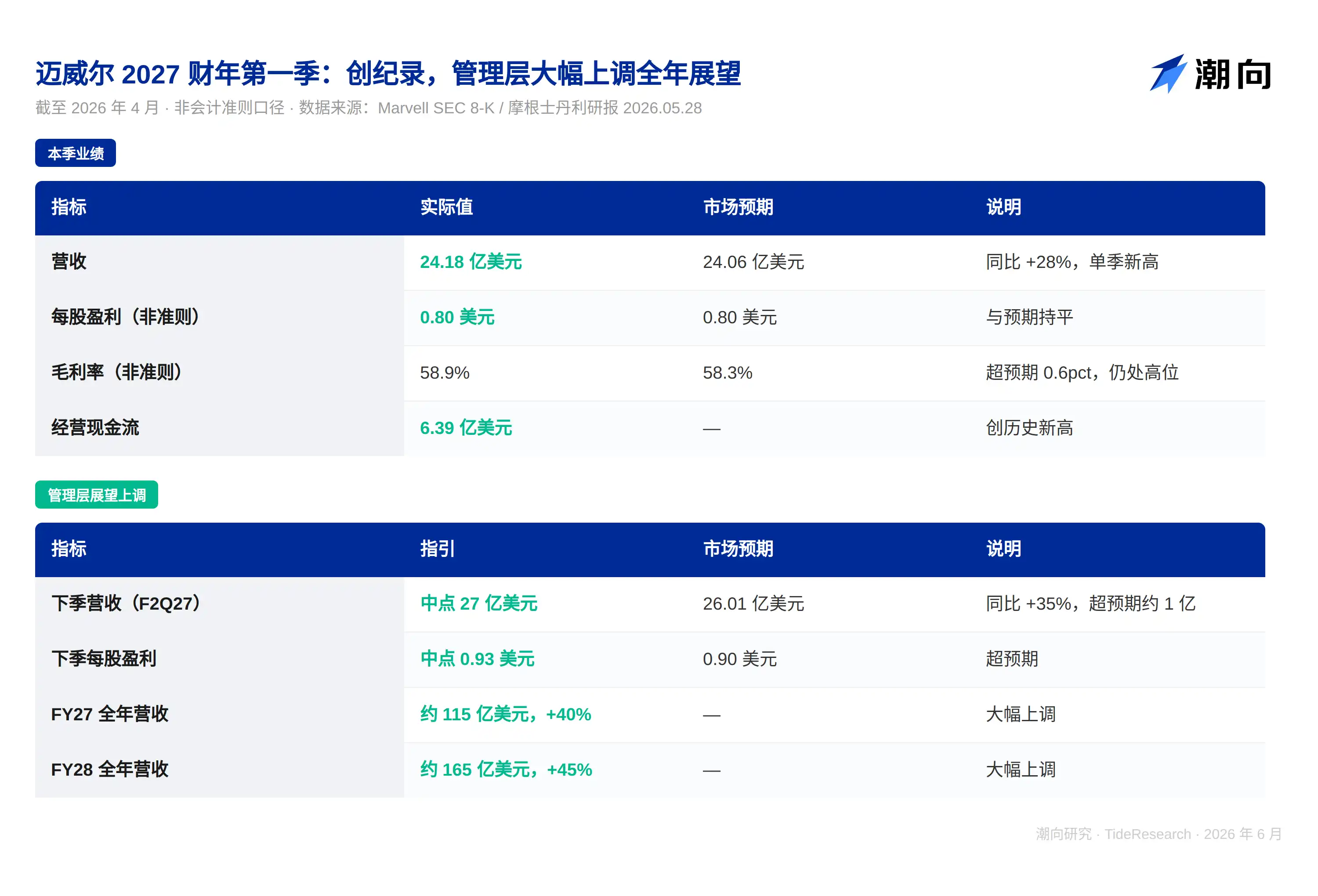
The Logic of Equal-Weight: The Opportunity is Real, The Price is Too

Moore does not question Marvell's AI opportunity; he raised estimates for all three major growth drivers. The problem is the stock price has already run ahead.

Behind the 40x P/E multiple lie several assumptions that must simultaneously materialize: continued optical interconnect volume growth, custom chips transitioning from ramp-up to large-scale shipments, and stabilization/recovery in the storage and enterprise businesses. If any of these three falters, this valuation multiple becomes difficult to sustain.

Moore specifically compared Marvell to Nvidia in his report. With similar stock prices, Nvidia's next-fiscal-year EPS is more than double Marvell's, meaning the earnings base bought for the same money is vastly different. This is one of the core reasons for his Neutral rating.

What Part of the AI Chain Does Marvell Occupy?

Marvell doesn't make GPUs. It handles moving data *between* GPUs and between racks. The larger the AI training cluster, the more data needs to be transferred between chips, and the tighter the demand for high-speed optical interconnect. This is currently Marvell's strongest segment, and Moore has the highest visibility here – the optical module product line (from the Inphi acquisition) is expected to reach a $1 billion annualized run rate in the coming quarters. Another growth point is scale-up optics within clusters, growing from about $150 million to over $300 million.

Custom chips represent another logic. Cloud providers wanting to reduce reliance on a single GPU supplier engage Marvell to design their own AI-specific chips. Moore's confidence in FY28 is increasing, stemming from three areas: the existing custom chip business, companion sales, and a major new customer slated for volume production in FY28. However, volume production is next year, so this revenue is not yet visible this year.

Weighing on the other side are Storage, Enterprise Data Center, and traditional networking, which are still working through inventory digestion with no clear near-term catalyst for recovery.
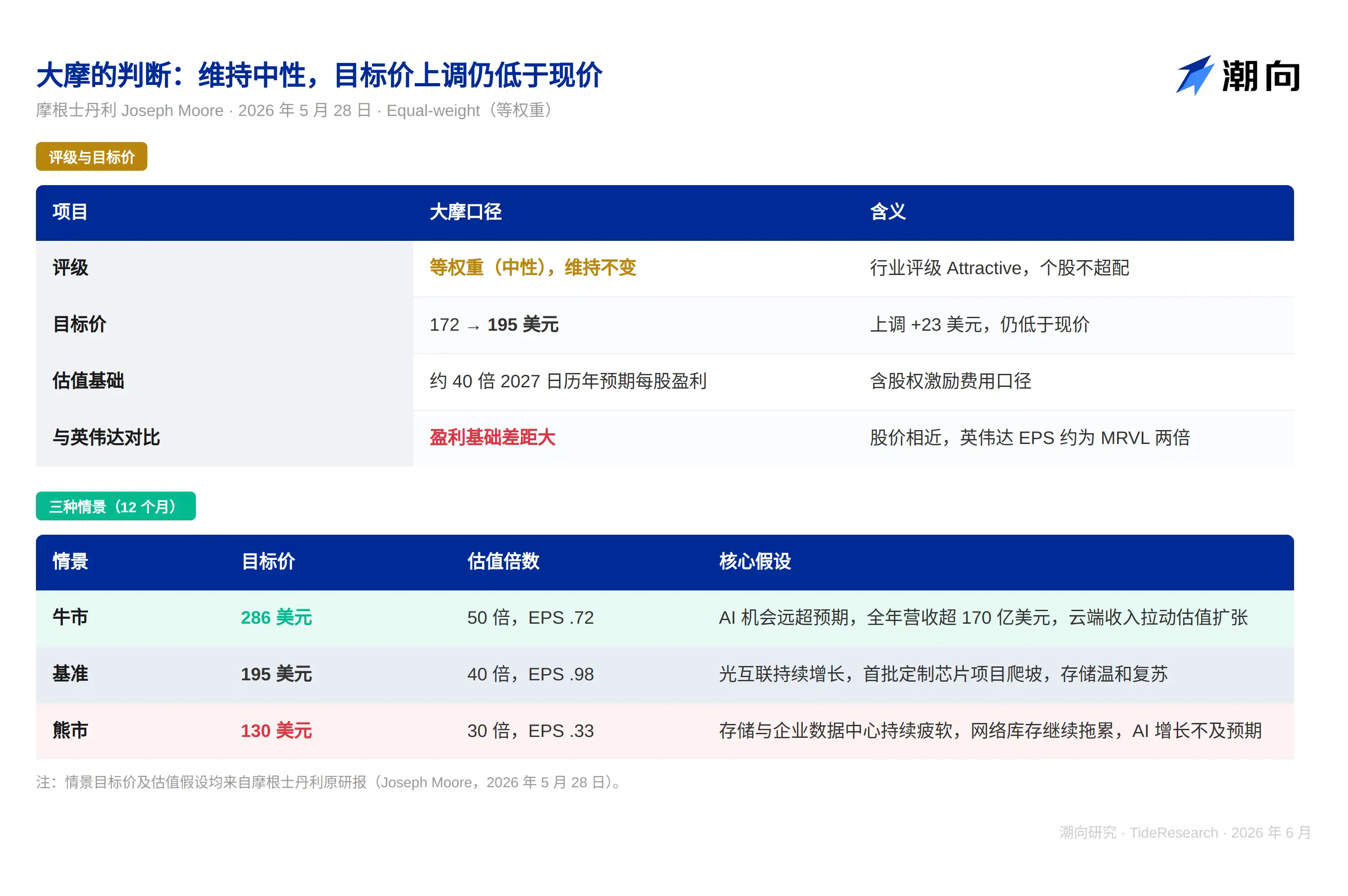
What Morgan Stanley is Betting On, Not Betting On, and Watching

It is betting that Marvell's optical interconnect thesis holds and AI data center demand continues, reflected in the price target increase and long-term outlook revisions. It is *not* betting that the current stock price has significant upside, hence Moore's choice of Neutral over Overweight.

Key signals to watch are threefold: whether the optical module product line can reach the $1 billion annualized revenue run rate as expected in the coming quarters; whether the new major customer's custom chip project can ramp to volume production smoothly in FY28; and when signs of recovery appear in the Storage and Enterprise businesses. If any of these three underperforms expectations, the 40x valuation needs to be recalculated.

This article is Tide Research's compilation and interpretation of a third-party brokerage research report. The ratings, price targets, earnings forecasts, and related judgments cited herein are the views of the respective analyst and represent only the stance of their affiliated institution. They do not represent the views of Tide Research and do not constitute any investment advice.

Please note three points while reading: First, price targets are analysts' expectations for approximately the next 12 months; they are forecasts, not promises, and are subject to frequent adjustments based on performance and market conditions. Second, sell-side research reports are inherently biased towards bullishness, and some covered companies may have investment banking relationships with the brokerage. Third, the value of a research report lies in its core logic and underlying assumptions, not in a single price target. Focus on the logic, not just the price.

The market involves risks; decisions should be made independently. This article should not be used as the basis for trading any securities.

Data Sources: Marvell FY27 Q1 Earnings Report (SEC 8-K) · Morgan Stanley Research Report (Joseph Moore, May 28, 2026) · Public Analyst Rating Aggregators (MarketBeat, GuruFocus, Benzinga)

Tide Research · TideResearch · June 2026

Trending Cryptos

Related Questions

QWhat are the three key takeaways from Morgan Stanley analyst Joseph Moore's updated report on Marvell (MRVL)?

A1. Marvell delivered a record quarter and management significantly raised the full-year outlook. 2. Moore maintains a Neutral (Equal-weight) rating because he believes the current stock price already reflects the growth prospects. 3. AI growth has two components: fast-growing optical connectivity and a slower-ramping custom AI chip business.

QWhy does Joseph Moore maintain a Neutral rating on Marvell despite acknowledging its strong AI opportunities?

AHe maintains a Neutral rating because the stock's valuation (approximately 40x the 2027 calendar year EPS estimate) already prices in the expected growth. He highlights that at similar stock prices, Nvidia offers more than double the earnings per share for the next fiscal year. For Marvell's valuation to be justified, it needs to deliver on three key assumptions: continued optical scaling, successful mass production of custom chips, and stabilization of its storage and enterprise businesses.

QWhat are the two main legs of Marvell's AI-related growth, according to the report?

A1. Optical Interconnect (the fast-running leg): This includes high-speed optical modules (from the Inphi acquisition) and scale-up optics within clusters. Growth expectations for FY27 were raised to over 70%. 2. Custom AI Chips (the slower-climbing leg): These are Application-Specific Integrated Circuits (ASICs) designed for cloud providers. While confidence for FY28 is increasing, revenue from a new major customer is not expected until production ramps in FY28.

QWhat specific metrics or milestones does Moore identify as crucial to watch for Marvell's future performance?

AHe identifies three key signals to monitor: 1. Whether the optical module product line can achieve its targeted $1 billion annualized run rate in the coming quarters. 2. Whether the new major custom chip program can successfully ramp into mass production in FY28. 3. When signs of recovery appear in the Storage and Enterprise business segments. Any shortfall in these areas could pressure the current valuation.

QWhat is the core business area where Marvell is positioned in the AI infrastructure chain, and what is its specific role?

AMarvell is positioned in the data connectivity layer of the AI infrastructure chain. It does not manufacture GPUs. Instead, its role is to enable the high-speed movement of data *between* GPUs and *between* server racks through its optical interconnect and networking solutions. As AI training clusters grow larger, the demand for this high-speed data movement increases, driving demand for Marvell's products.

Related Reads

Football Draw Harvests Whales: Extreme Profit-Loss Divergence on Polymarket's World Cup

A bettor known as "fishalive" made a stunning profit of nearly $9 million on the Polymarket prediction platform by correctly wagering against favorites during the 2026 FIFA World Cup group stage. The account, registered just before the tournament, risked roughly $400,000 on two contracts for a Spain vs. Cape Verde match: one that Spain would *not* win, and another on a Cape Verde +2.5 goal handicap. The resulting 0-0 draw triggered both payouts. This single event, with a total market volume of $64 million, highlighted extreme profit-and-loss divergence. Other traders, like "betoor619" and "leeeeroyjenkins," lost millions by betting heavily on favorites Spain and Belgium to win outright—contracts that become worthless in a draw. The article explains that while markets heavily favored strong teams, the "team to win" contracts are binary and do not account for the common outcome of a draw. This creates high-risk, low-reward scenarios for favorite backers, while asymmetric profits flow to those betting on underdogs or against outright wins. The transparency of Polymarket's on-chain ledger publicly documents these massive wins and losses, driving mainstream media coverage. As the tournament progresses, the author suggests traders may shift towards hedging strategies that account for draws. The piece also notes growing regulatory scrutiny in the US and Europe, questioning whether such large-scale, anonymous sports prediction markets should be regulated as gambling or financial derivatives.

Foresight News26m ago

Football Draw Harvests Whales: Extreme Profit-Loss Divergence on Polymarket's World Cup

Foresight News26m ago

ChatGPT Loses Half Its Market: From Monopoly to Shared Market in Three and a Half Years

In a landmark shift three and a half years after its debut, ChatGPT's global market share in the AI assistant market has fallen below 50% for the first time, dropping to 46.4% as of May 2026. This signals the end of its initial dominance, with the market now diversifying among competitors like Gemini (27.7%) and Claude (10.3%). The report from Sensor Tower indicates the AI assistant landscape has matured from a phase of awe and experimentation into one of product comparison, ecosystem integration, and monetization. Users are increasingly pragmatic, readily switching between assistants based on specific use cases, brand trust, and value propositions. The industry is moving past the "free lunch" era, with users demonstrating a willingness to pay for premium features, driving significant in-app expenditure. Major players are adopting varied monetization strategies: Claude boasts a high subscription conversion rate, while ChatGPT is increasingly testing ads and shopping integrations to complement its subscription revenue. However, this growth comes with immense costs, as exemplified by OpenAI's soaring cash burn for model training and infrastructure. While ChatGPT remains the largest single player, its declining share symbolizes a broader normalization of AI. The technology is no longer a novelty but an integral, scrutinized part of daily digital life, judged on practical utility, price, and seamless integration. The battle has shifted from proving AI's potential to competing in a crowded field where no single product holds a permanent monopoly.

marsbit37m ago

ChatGPT Loses Half Its Market: From Monopoly to Shared Market in Three and a Half Years

marsbit37m ago

Trading

Spot
Futures

Hot Articles

Discussions

Welcome to the HTX Community. Here, you can stay informed about the latest platform developments and gain access to professional market insights. Users' opinions on the price of S (S) are presented below.

活动图片