Quarterly Loss of $12.4 Billion: Why Can’t It Stop Strategy from Frantically Buying Bitcoin?

比推Published on 2026-02-06Last updated on 2026-02-06

Abstract

MicroStrategy (now Strategy) reported a staggering net loss of $12.4 billion in Q4 2025, primarily due to the adoption of a new fair value accounting standard that required marking its holdings to market amid Bitcoin’s sharp decline to around $65,000. Despite the loss, the company aggressively expanded its Bitcoin position, purchasing an additional 41,002 BTC in January 2026, bringing its total holdings to 713,502 BTC — approximately 3.4% of Bitcoin’s total supply — with an average cost of $76,052 per coin. The firm’s core software business, though profitable with $123 million in Q4 revenue, was overshadowed by its Bitcoin-centric strategy. Strategy raised over $25.3 billion in capital during 2025, leveraging financial instruments to amplify its Bitcoin exposure. It maintains $2.25 billion in cash reserves to cover dividends and interest for 2.5 years. CEO Phong Le acknowledged risks, stating that if Bitcoin fell to $8,000, the company might need to restructure debt rather than sell BTC. The firm’s "Bitcoin flywheel" model relies on continuous capital raising and BTC appreciation, but compressed mNAV (1.07) and high-yield preferred shares (STRC, 11.25% dividend) reflect market skepticism. A prolonged downturn could trigger a negative feedback loop: falling BTC value → reduced ability to raise capital → potential forced BTC sales. Executive Chairman Michael Saylor emphasized long-term optimism, citing supportive U.S. policy and institutional adoption, while downplaying quan...

Author: KarenZ, Foresight News

Original Title: Ten-Billion-Dollar Loss, Strategy's Earnings Report Sounds Alarm! What Do Executives Say?


The current cryptocurrency market is deeply mired in a sharp correction vortex. As Bitcoin's price retreats to $60,000, market sentiment has rapidly turned to extreme panic.

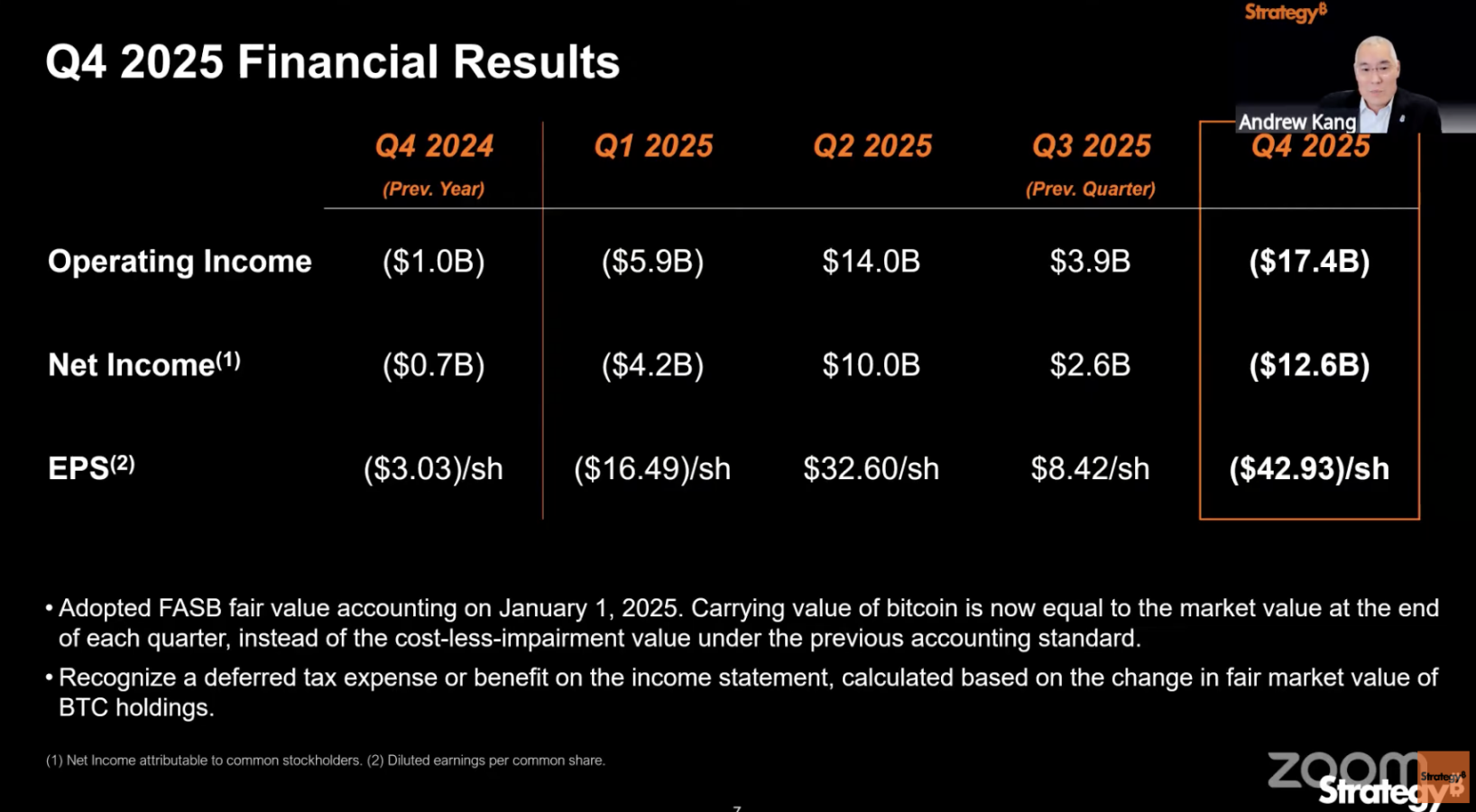
Amid this turmoil, the Q4 2025 earnings report released by the world's largest corporate Bitcoin holder—Strategy (formerly MicroStrategy)—is undoubtedly adding fuel to the fire, pouring a bucket of ice-cold water on an already sluggish market: a net loss of $12.4 billion in a single quarter.

On the day of the earnings release, Strategy's stock price plummeted by approximately 17%. As of now, its stock price has fallen nearly 80% from the all-time high set in November 2024.

From a star company that once soared with its "Bitcoin Treasury Strategy" to now being mired in huge losses and seeing its stock price halved repeatedly, Strategy's situation is the most realistic缩影 of the current cryptocurrency market turmoil—on one hand, there are massive paper losses, and on the other, an almost obsessive hoarding of Bitcoin. With a series of分裂 data, this company is staging a high-stakes gamble betting on its future.

Core Data: Frenzied Accumulation Amid Huge Losses

The core contradiction in Strategy's Q4 2025 earnings report lies in the stark contrast between the record-high paper losses and the all-time high Bitcoin holdings.

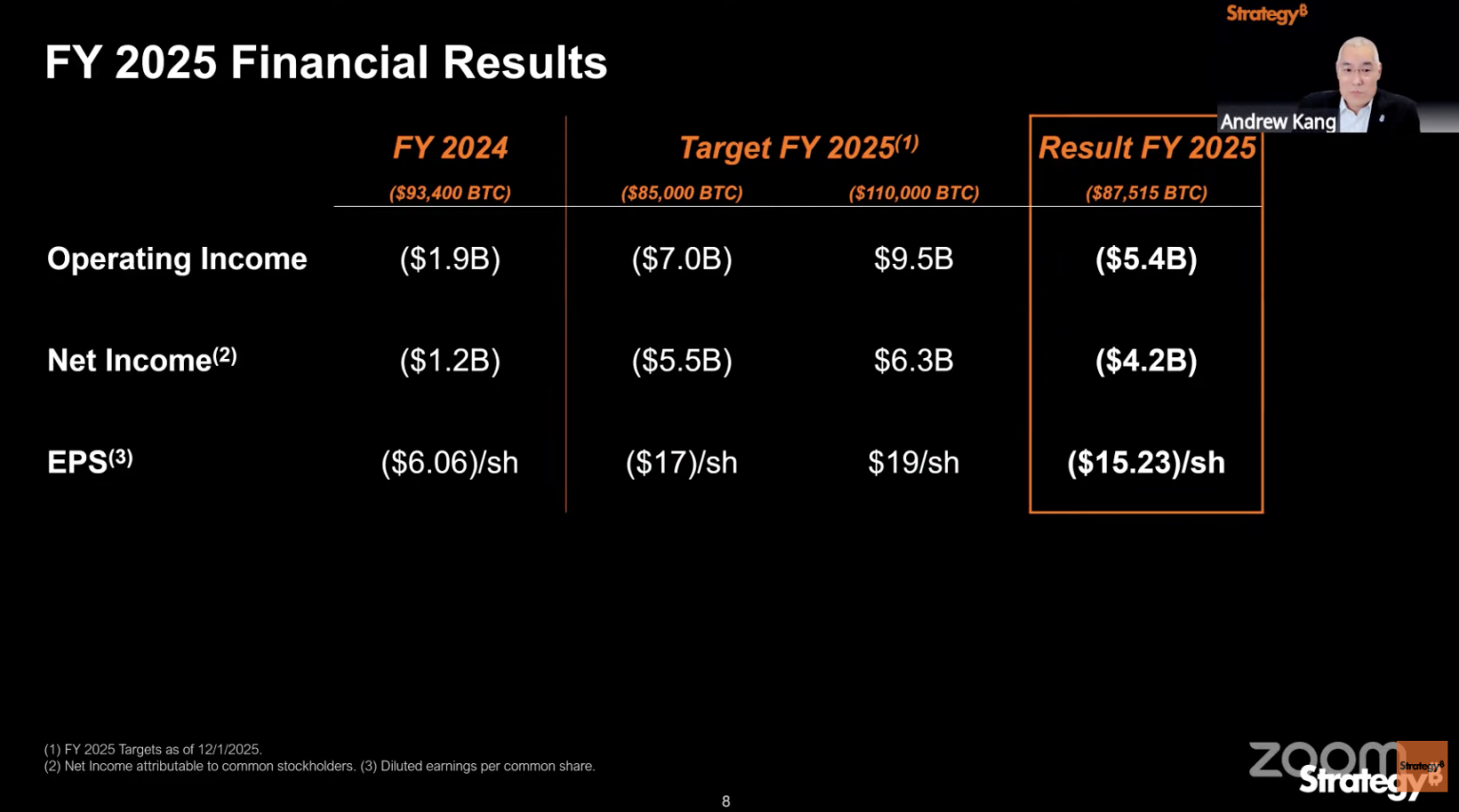
1. Huge paper losses under fair value accounting: In Q4 2025, Strategy's operating loss reached a staggering $17.4 billion, with a net loss of $12.4 billion. This is mainly due to the new fair value accounting standard adopted by the company starting January 1, 2025. According to this standard, the company must re-evaluate all Bitcoin holdings at market price at the end of each quarter, and price fluctuations are directly included in the income statement. The continuous correction in Bitcoin's price has turned the shrinkage in holding value directly into paper losses, becoming the most直观 "bearish" factor in the earnings report.

2. The obsession with buying Bitcoin against the trend: Despite market volatility, Strategy is still buying frantically, purchasing 41,002 Bitcoins in a large transaction in January 2026. As of February 1, 2026, Strategy holds 713,502 Bitcoins, accounting for about 3.4% of the total Bitcoin supply, firmly securing its position as the world's largest corporate Bitcoin holder.

3. Super financing machine: In fiscal year 2025, Strategy raised a total of over $25.3 billion in capital, a figure that accounts for about 8% of the total U.S. equity financing for that year.

4. Special reserve for risk buffer: As of February 1, 2026, Strategy has $2.25 billion in USD reserves specifically to cover preferred stock dividends and debt interest payments for the next 2.5 years, attempting to alleviate market concerns about its cash flow pressure.

In terms of holding cost, Strategy's total original cost for holding Bitcoin is $54.26 billion, with an average cost per coin of $76,052. With the current price of Bitcoin at approximately $65,000, the company's Bitcoin holdings have an unrealized loss of over $7.8 billion.

Marginalized "Main Business" and Amplified "Leverage"

It is highly ironic that Strategy's traditional main business—enterprise analytics software—has been reduced to a nearly forgotten footnote in the earnings report. The scale and contribution of its business are worlds apart from the size of its Bitcoin strategy.

In Q4 2025, the company's software business maintained positive growth, but the data performance was relatively flat: total revenue was $123 million, up only 1.9% year-over-year; subscription service revenue was $51.8 million, up 62.1% year-over-year; overall gross profit for the quarter was $81.3 million, with a gross margin maintained at a high level of 66.1%.

From the data, it is clear that while the software business has stable profitability and high gross margins, its revenue scale is only in the hundreds of millions. Compared to the company's tens of billions in fundraising scale, tens of billions in Bitcoin holding costs, and over ten billion in quarterly losses, the marginal contribution of this main business is almost negligible.

For today's Strategy, the company's core resources and strategic focus have completely shifted towards Bitcoin. Strategy provides investors with a leveraged Bitcoin exposure through complex financial instruments such as stocks, bonds, and preferred shares. It has itself彻底 become a "shadow of Bitcoin," with its corporate development deeply tied to the price of Bitcoin—prospering together and falling together.

What Happens When Convertible Bonds Mature?

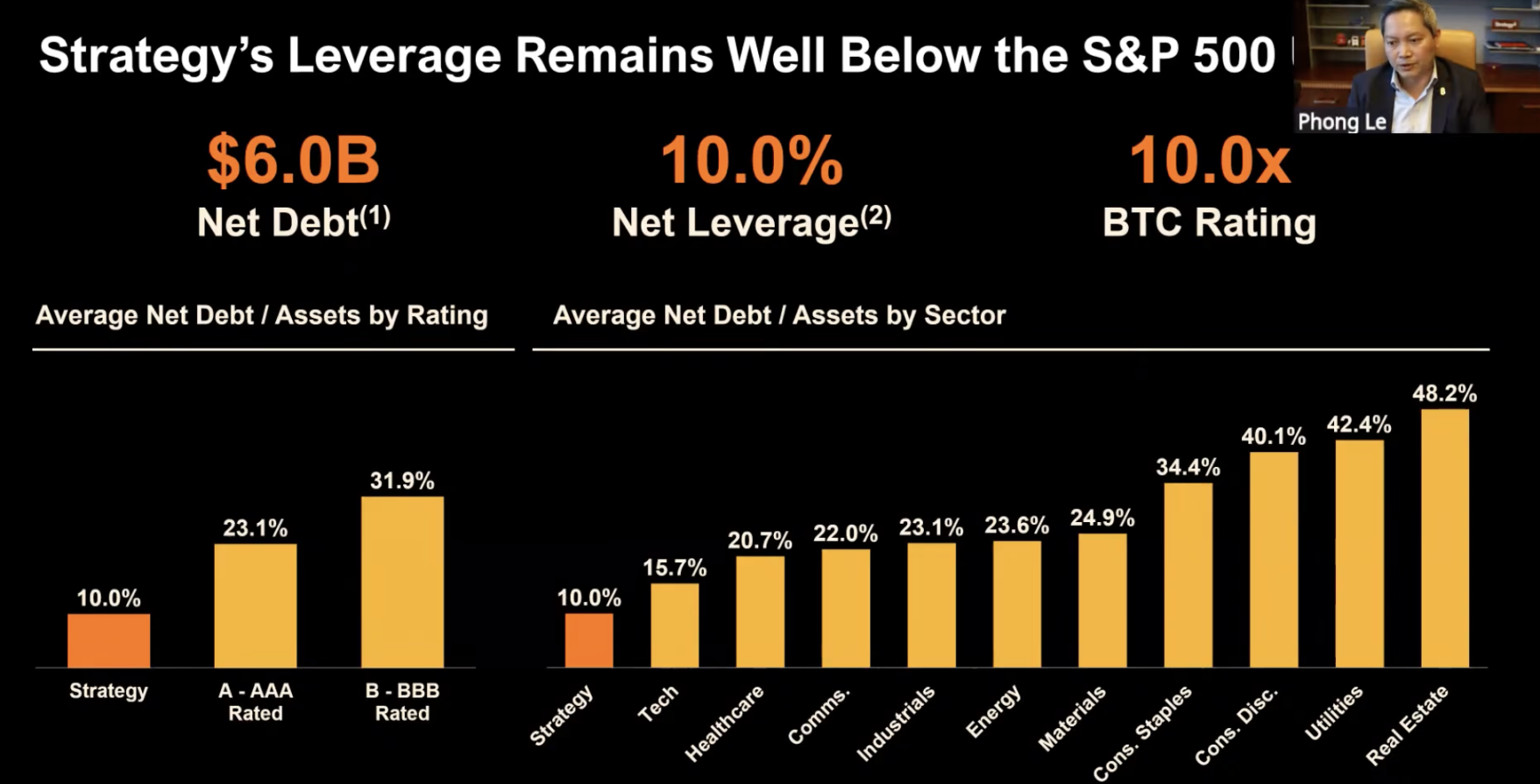
In the latest earnings call, Phong Le stated, "Strategy currently has $6 billion in net debt, and the current leverage ratio is around 13%, which is only half that of investment-grade companies and one-third that of high-yield companies. In an extreme scenario, if the Bitcoin price falls by 90% to $8,000, then our Bitcoin reserves would equal our net debt. At that point, we would be unable to use Bitcoin reserves to repay the convertible bonds and would consider restructuring, issuing additional shares, or issuing more debt."

Additionally, Phong Le hopes the company will gradually achieve equityization. If equityization cannot be achieved by then, they will seek other ways to restructure the debt, aiming to sustainably reduce leverage, avoid selling Bitcoin, and continue the Bitcoin accumulation strategy.

When the "Flywheel" Loosens

Strategy's "Bitcoin flywheel" model is built on a very fragile assumption: that the Bitcoin price will spiral upward in the long term, and the capital market will always be willing to provide premium financing for the company. The two form a positive循环, driving the company's stock price and holding规模 to grow simultaneously.

However, when the Bitcoin price falls below its average holding cost ($76,000), the risks and paradoxes Strategy faces are also exposed.

STRC High Dividend Yield: High Return Corresponds to High Risk

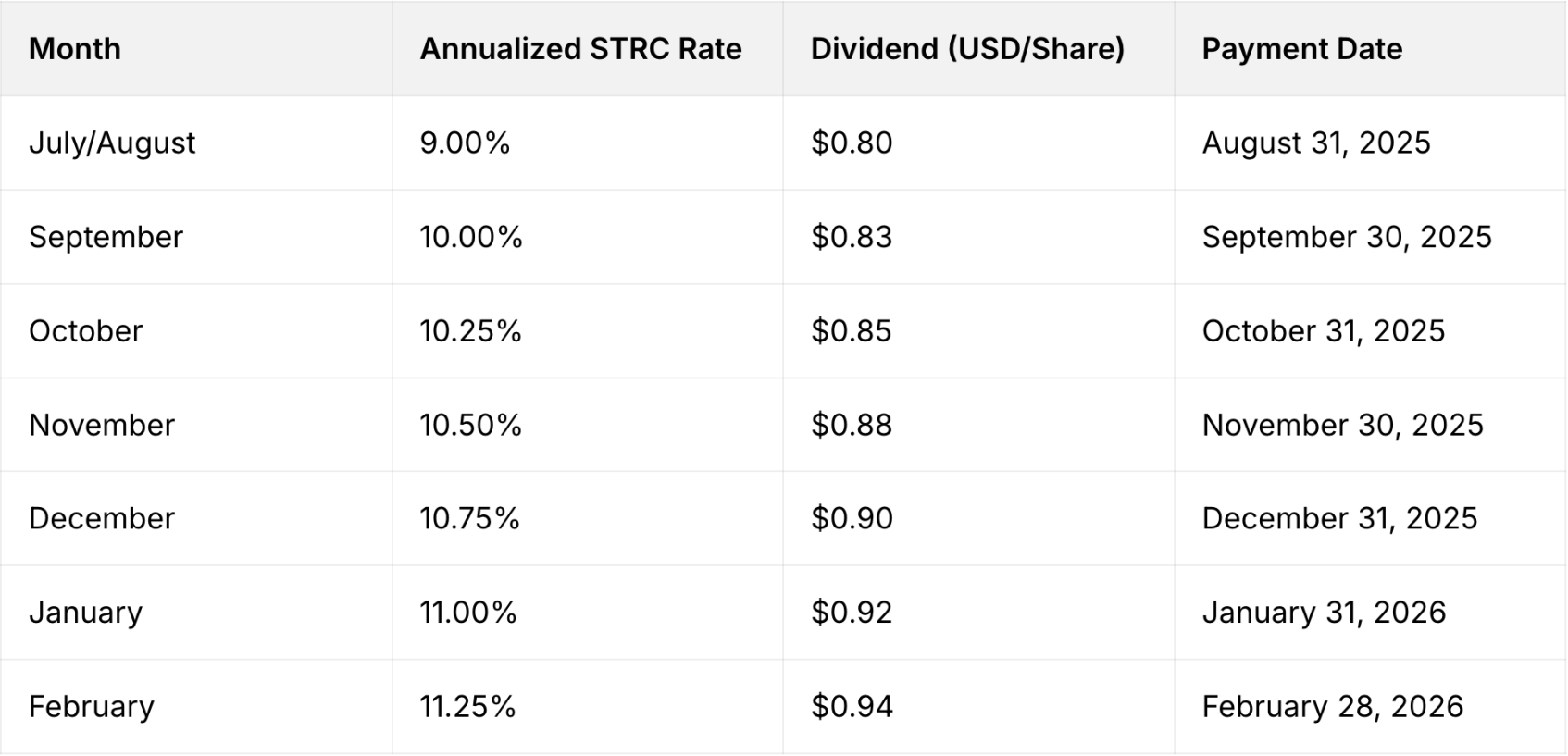
The perpetual preferred stock STRC launched by Strategy currently has a dividend yield of 11.25%, and this yield has been continuously上调 since July 2025.

Strategy designed this variable mechanism to keep the STRC price as stable as possible around the $100 face value, reduce volatility, and position it as a "short-term high-yield credit" or a "high-yield savings account" alternative.

In the current low-interest-rate environment, an 11.25% nominal yield is indeed very attractive, especially for investors seeking high fixed income. But the basic logic of the capital market has never changed: high returns必然 come with high risks. The high dividend of STRC is backed by the huge uncertainty deeply tied to Strategy's Bitcoin strategy.

Strategy's core strategy is "Bitcoin leverage + financing expansion." Its solvency highly depends on: the long-term rise of the Bitcoin price, and continuously raising funds by issuing MSTR common stock, other preferred shares, or debt to buy more BTC.

If a prolonged Bitcoin bear market occurs, with mNAV持续低迷 or even at a discount, and equity financing becomes more difficult, the reserves could be quickly depleted. Although the company has established a $2.25 billion USD reserve as a buffer, this is merely buying a 2.5-year insurance policy for this high-stakes gamble.

The current market has already reflected some concerns: the STRC price is below the $100 face value, currently at $93.67.

mNAV Compressed to 1.07, Can the Financing Channel Remain Smooth?

The core motivation for Strategy to无限 issue shares to buy Bitcoin lies in its mNAV indicator, a key metric used to measure its stock valuation relative to its Bitcoin reserves. When mNAV > 1, it means the market gives Strategy a valuation higher than the value of its Bitcoin holdings (i.e., trading at a premium), and investors are willing to pay an additional premium for its "Bitcoin leverage strategy."

Currently, Strategy's mNAV has been compressed to 1.07. Once it falls below 1, the financing channel may be forced to close. At that point, Strategy may lose its ability to support the stock price and add positions,彻底 becoming a prisoner of Bitcoin price fluctuations.

Contrary to what was emphasized in the latest meeting, Strategy CEO Phong Le said in an interview with "What Bitcoin Done" in November 2025 that if the company's mNAV falls below 1 and financing options dry up, selling Bitcoin would be "mathematically" reasonable. But he clarified this would be a last resort, not a policy adjustment.

Negative Feedback Loop?

For Strategy, the most terrifying thing is not the current huge losses, but the potential触发 of a negative feedback loop, which is also the script that all crypto market players最不愿 face:

Bitcoin price falls → Company's net assets shrink → mNAV falls below 1, premium disappears → Unable to raise new funds through financing → Unable to pay high interest and dividends → Forced to sell Bitcoin to raise funds → Increased Bitcoin selling pressure, price falls further → Net assets shrink further......

Can Policy Benefits and Technical Commitments Restore Confidence?

In the earnings call, Michael Saylor did not focus solely on the short-term bearish news of the company's single-quarter loss. Instead, he used the comprehensive shift in U.S. policy and the accelerated adoption by the financial industry as the centerpiece to outline the long-term bullish blueprint for Bitcoin's development. At the same time, he addressed the market's biggest concerns about quantum technology risks and implementation plans to重塑 market confidence in the company's Bitcoin strategy.

Michael Saylor emphasized that Bitcoin's development is currently迎来 unprecedented policy and financial双重红利期. On the policy front, the U.S. government's attitude towards digital assets has completed a fundamental shift from suspicion to recognition. The President and 12 cabinet members have clearly expressed support for Bitcoin, and bipartisan consensus on digital asset regulation and adoption has made the U.S. a leading阵营 in global digital asset development.

On the financial front, Bitcoin's industry adoption has experienced explosive growth: large banks have纷纷 launched full-chain services for Bitcoin trading, credit, and custody; fintech companies continue to加码 Bitcoin布局. The dual entry of public markets and traditional financial institutions has continuously strengthened Bitcoin's financial attributes, with liquidity and recognition持续提升.

In response to the various FUD sentiments弥漫 in the market, Michael Saylor also gave direct responses, particularly focusing on quantum computing, a core technical concern: The commercial-level threat of quantum computing to Bitcoin will take at least 10 more years to materialize, and the Bitcoin community has the ability to achieve global consensus upgrades to meet future technical challenges.

Michael Saylor further stated that Strategy will proactively shoulder industry responsibility by launching a global Bitcoin security initiative. It will unite global resources in cybersecurity and cryptocurrency security to research and launch consensus solutions for quantum computing and emerging security threats, promoting the healthy and stable development of the entire cryptocurrency industry.

Summary

If the market continues to fall, the $17.4 billion quarterly operating loss and $12.4 billion net loss may only be the beginning of Strategy's困境.

The real test lies in whether faith can overcome gravity when market panic spreads, when the "premium" disappears, and when new funds dry up? For investors, the current Strategy may be an option contract with extremely high risk and extremely high odds: if they bet correctly, the Bitcoin price recovers, the flywheel restarts, and investors get returns; if they bet wrong, the negative feedback loop starts, the company falls into crisis, and investors face heavy losses.

The outcome of this high-stakes gamble betting on the company's future is still unknown, but Strategy has already sounded the alarm for the entire cryptocurrency industry—in a狂热 market sentiment,过度偏执的信仰 and不加节制的杠杆 may face the backlash of reality.


Twitter:https://twitter.com/BitpushNewsCN

Bitpush TG Discussion Group:https://t.me/BitPushCommunity

Bitpush TG Subscription: https://t.me/bitpush

Original link:https://www.bitpush.news/articles/7609741

Related Questions

QWhy did Strategy (formerly MicroStrategy) report a net loss of $12.4 billion in Q4 2025, and what accounting change contributed to this?

AStrategy reported a net loss of $12.4 billion in Q4 2025 primarily due to the adoption of a new fair value accounting standard starting January 1, 2025. This standard requires the company to revalue all its Bitcoin holdings at market price at the end of each quarter, and any price decline is directly recorded as an impairment loss on the income statement. The significant drop in Bitcoin's price during the quarter led to this massive paper loss.

QDespite the huge loss, how many Bitcoins did Strategy purchase in January 2026, and what is its total holding as of February 1, 2026?

ADespite the loss, Strategy purchased 41,002 Bitcoins in January 2026. As of February 1, 2026, the company holds a total of 713,502 Bitcoins, which represents approximately 3.4% of the total Bitcoin supply, making it the largest corporate Bitcoin holder globally.

QWhat is the average cost per Bitcoin for Strategy's holdings, and what is the current unrealized loss given the Bitcoin price of ~$65,000?

AThe average cost per Bitcoin for Strategy's holdings is $76,052. With the current Bitcoin price at approximately $65,000, the company is facing an unrealized loss of over $7.8 billion on its Bitcoin portfolio.

QWhat is the mNAV metric, and why is it critical for Strategy's 'Bitcoin flywheel' strategy?

AmNAV (market NAV) is a key metric that measures Strategy's stock market valuation relative to the value of its Bitcoin holdings. An mNAV greater than 1 indicates the market is valuing the company at a premium to its underlying Bitcoin assets, which is crucial for its strategy. This premium allows Strategy to issue new shares at a favorable valuation to raise capital for further Bitcoin purchases, fueling its 'Bitcoin flywheel' of buying more Bitcoin with raised funds. If mNAV falls below 1, this primary funding channel could close, severely hampering its strategy.

QAccording to CEO Michael Saylor in the earnings call, what are the two main pillars of long-term optimism for Bitcoin that he highlighted to counter the negative quarterly results?

ACEO Michael Saylor pointed to unprecedented policy and financial sector adoption as the main pillars for long-term Bitcoin optimism. Policy-wise, he noted a fundamental shift in the U.S. government's stance from skepticism to support, with the President and 12 cabinet members endorsing Bitcoin and bipartisan consensus on digital asset regulation. Financially, he highlighted explosive growth in adoption, with major banks offering full-service Bitcoin trading, credit, and custody, and continued investment from fintech companies, strengthening Bitcoin's financial properties and liquidity.

Related Reads

Has the 'Digital Gold' Narrative for BTC Failed?

**Title: Has the "Digital Gold" Narrative for Bitcoin Failed?** The article argues that Bitcoin's "digital gold" narrative remains valid despite a recent sharp price decline (from a peak near $126k in Oct 2025 to briefly under $61k in Feb 2026). It presents a long-term investment framework based on three core points: **1. Viewing Bitcoin as an Asset:** Bitcoin is presented as a superior potential store of value compared to gold. Key arguments are its absolute scarcity (21 million cap), superior portability, and transparent auditability via its public ledger. While acknowledging its current use in early, volatile stages (~3-4% global adoption), the author draws parallels to the early, disruptive phases of the internet and e-commerce. **2. Understanding the Recent Downturn:** The current ~50% correction is framed as a predictable, consensus-driven cycle following its post-halving peak (the 2024 halving preceded the Oct 2025 high). A crucial factor is a historic "changing of hands": the influx of new institutional buyers via ETFs allowed early, low-cost holders (miners, OG believers) to take profits. The author notes that while severe, Bitcoin's historical drawdowns (e.g., 93% in 2011, 77% in 2021-22) have been progressively smaller, suggesting maturing holder structure and decreasing volatility over time. **3. The Long-Term Perspective:** The long-term thesis hinges on Bitcoin capturing a portion of gold's market value. With Bitcoin's market cap at ~$1.4 trillion (at $70k) versus gold's ~$20 trillion, significant upside potential exists if the "digital gold" narrative is partially realized. However, the author strongly cautions that short-term risks remain, the bottom is unpredictable, and high volatility is inherent. The real risk is not Bitcoin failing but poor personal position management (over-leverage, wrong capital) and a lack of deep understanding, which can force investors out during severe downturns. The conclusion uses Amazon's 95% crash post-2000 dot-com bubble and subsequent 42x recovery as an analogy. The ultimate question is not if Bitcoin's price will rise, but if an investor's strategy and conviction can withstand the volatility to see the long-term play out. The recent divergence (gold up, Bitcoin down) is posed not as a narrative failure, but as potential evidence of this ongoing, painful transition from a speculative asset to a mainstream allocation.

marsbit9h ago

Has the 'Digital Gold' Narrative for BTC Failed?

marsbit9h ago

Has BTC's 'Digital Gold' Narrative Failed?

The article discusses Bitcoin's "digital gold" narrative, its recent price drop, and long-term outlook through the perspective of "Jason". It argues the narrative is not a failure but that Bitcoin represents a superior, new asset class due to its fixed supply (21 million), portability, and auditability. The piece compares its current ~3-4% global adoption rate to early internet/e-commerce, suggesting significant growth potential. Regarding the 2025-2026 price decline (from ~$126k to briefly under $61k), the author views it as a predictable, consensus-driven sell-off within Bitcoin's ~4-year cycle post-halving, exacerbated by a major "handover" from early, low-cost holders to new institutional buyers via ETFs. A key observation is that historical peak-to-trough drawdowns have lessened over time (e.g., 93% in 2011 to ~50% in 2026), indicating maturing volatility as holder structure changes. For the long term, the author uses a simple framework: Bitcoin's total market cap (~$1.4T at $70k) is only about 7% of gold's (~$20T). Even capturing 30-50% of gold's value would imply substantial upside. However, the article strongly cautions against viewing this as investment advice, emphasizing extreme volatility and the critical importance of risk management, position sizing, and deep fundamental understanding to survive severe drawdowns. It concludes by drawing a parallel to Amazon's 95% crash in 2000 and subsequent 42x recovery, stressing that the key is surviving market cycles to realize long-term potential.

链捕手9h ago

Has BTC's 'Digital Gold' Narrative Failed?

链捕手9h ago

From Code to Cognition: A Ten-Thousand-Word Guide to the Evolution of the Robot Brain

"From Code to Cognition: The Evolution of Robot Brains" The journey of robotic intelligence has shifted dramatically from manually coded systems to AI-driven brains. For decades, robots relied on layered software stacks—perception, state estimation, planning, control—each handcrafted. While predictable, they lacked adaptability. The 2010s saw deep learning revolutionize perception (e.g., object detection) and control (via reinforcement learning), but learned skills remained narrow. The arrival of Large Language Models (LLMs) marked a turning point. LLMs acted as high-level planners, interpreting natural language instructions and generating sequences of actions for traditional robotic systems to execute. However, true integration came with Visual-Language-Action (VLA) models, which fused vision, language, and motion prediction into a single network. Pioneered by models like RT-2 and open-source projects like OpenVLA, VLAs enable robots to reason and act directly from visual input and commands. The most advanced humanoid robots now employ a "dual-brain" architecture: a slow-thinking, large VLA (System 2) for reasoning and planning, and a fast-reacting, small network (System 1) for high-frequency motion control, sometimes with an even lower-level System 0 for balance. This split balances cognition with the physics of real-time movement. Computation is split between onboard hardware (e.g., NVIDIA Jetson) for safety-critical control loops and cloud/edge servers for non-critical tasks like learning and interfaces. A crucial driver is the open-source ecosystem—models like GR00T and OpenVLA allow startups to build upon pre-trained brains and fine-tune them with their own data, accelerating development. Despite progress, current systems struggle with recovery from errors, sample inefficiency, and long-horizon tasks. This has spurred the rise of **World Models**—neural networks that predict the consequences of actions. By simulating possible futures before acting (like NVIDIA Cosmos or Meta V-JEPA), robots can plan, recover, and generalize better. This represents the next frontier: shifting intelligence from learned reactions to an internal model of physics and cause-and-effect. The field is rapidly evolving. While not yet at its "ChatGPT moment," the convergence of cheaper hardware, scalable simulation, and world models points toward robots that are increasingly capable, adaptive, and useful. The question is shifting from "what can robots do?" to "what *should* they do?"

marsbit10h ago

From Code to Cognition: A Ten-Thousand-Word Guide to the Evolution of the Robot Brain

marsbit10h ago

Trading

Spot
Futures

Hot Articles

What is $BITCOIN

DIGITAL GOLD ($BITCOIN): A Comprehensive Analysis Introduction to DIGITAL GOLD ($BITCOIN) DIGITAL GOLD ($BITCOIN) is a blockchain-based project operating on the Solana network, which aims to combine the characteristics of traditional precious metals with the innovation of decentralized technologies. While it shares a name with Bitcoin, often referred to as “digital gold” due to its perception as a store of value, DIGITAL GOLD is a separate token designed to create a unique ecosystem within the Web3 landscape. Its goal is to position itself as a viable alternative digital asset, although specifics regarding its applications and functionalities are still developing. What is DIGITAL GOLD ($BITCOIN)? DIGITAL GOLD ($BITCOIN) is a cryptocurrency token explicitly designed for use on the Solana blockchain. In contrast to Bitcoin, which provides a widely recognized value storage role, this token appears to focus on broader applications and characteristics. Notable aspects include: Blockchain Infrastructure: The token is built on the Solana blockchain, known for its capacity to handle high-speed and low-cost transactions. Supply Dynamics: DIGITAL GOLD has a maximum supply capped at 100 quadrillion tokens (100P $BITCOIN), although details regarding its circulating supply are currently undisclosed. Utility: While precise functionalities are not explicitly outlined, there are indications that the token could be utilized for various applications, potentially involving decentralized applications (dApps) or asset tokenization strategies. Who is the Creator of DIGITAL GOLD ($BITCOIN)? At present, the identity of the creators and development team behind DIGITAL GOLD ($BITCOIN) remains unknown. This situation is typical among many innovative projects within the blockchain space, particularly those aligning with decentralized finance and meme coin phenomena. While such anonymity may foster a community-driven culture, it intensifies concerns about governance and accountability. Who are the Investors of DIGITAL GOLD ($BITCOIN)? The available information indicates that DIGITAL GOLD ($BITCOIN) does not have any known institutional backers or prominent venture capital investments. The project seems to operate on a peer-to-peer model focused on community support and adoption rather than traditional funding routes. Its activity and liquidity are primarily situated on decentralized exchanges (DEXs), such as PumpSwap, rather than established centralized trading platforms, further highlighting its grassroots approach. How DIGITAL GOLD ($BITCOIN) Works The operational mechanics of DIGITAL GOLD ($BITCOIN) can be elaborated on based on its blockchain design and network attributes: Consensus Mechanism: By leveraging Solana’s unique proof-of-history (PoH) combined with a proof-of-stake (PoS) model, the project ensures efficient transaction validation contributing to the network's high performance. Tokenomics: While specific deflationary mechanisms have not been extensively detailed, the vast maximum token supply implies that it may cater to microtransactions or niche use cases that are still to be defined. Interoperability: There exists the potential for integration with Solana’s broader ecosystem, including various decentralized finance (DeFi) platforms. However, the details regarding specific integrations remain unspecified. Timeline of Key Events Here is a timeline that highlights significant milestones concerning DIGITAL GOLD ($BITCOIN): 2023: The initial deployment of the token occurs on the Solana blockchain, marked by its contract address. 2024: DIGITAL GOLD gains visibility as it becomes available for trading on decentralized exchanges like PumpSwap, allowing users to trade it against SOL. 2025: The project witnesses sporadic trading activity and potential interest in community-led engagements, although no noteworthy partnerships or technical advancements have been documented as of yet. Critical Analysis Strengths Scalability: The underlying Solana infrastructure supports high transaction volumes, which could enhance the utility of $BITCOIN in various transaction scenarios. Accessibility: The potential low trading price per token could attract retail investors, facilitating wider participation due to fractional ownership opportunities. Risks Lack of Transparency: The absence of publicly known backers, developers, or an audit process may yield skepticism regarding the project's sustainability and trustworthiness. Market Volatility: The trading activity is heavily reliant on speculative behavior, which can result in significant price volatility and uncertainty for investors. Conclusion DIGITAL GOLD ($BITCOIN) emerges as an intriguing yet ambiguous project within the rapidly evolving Solana ecosystem. While it attempts to leverage the “digital gold” narrative, its departure from Bitcoin's established role as a store of value underscores the need for a clearer differentiation of its intended utility and governance structure. Future acceptance and adoption will likely depend on addressing the current opacity and defining its operational and economic strategies more explicitly. Note: This report encompasses synthesised information available as of October 2023, and developments may have transpired beyond the research period.

363 Total ViewsPublished 2025.05.13Updated 2025.05.13

What is $BITCOIN

Discussions

Welcome to the HTX Community. Here, you can stay informed about the latest platform developments and gain access to professional market insights. Users' opinions on the price of BTC (BTC) are presented below.

活动图片