Pundit Says Current Altcoin Trend “Feels” Like January 2019, Here’s What Happened Back Then

bitcoinistPublished on 2026-01-12Last updated on 2026-01-12

Abstract

A crypto analyst, Chad Steingraber, has drawn parallels between the current altcoin market trend and January 2019, a period marked by extreme negative sentiment that preceded a significant market turnaround. Back then, Bitcoin was trading near $3,000 and Ethereum around $100, but the market eventually rebounded strongly. By mid-2019, Bitcoin surged past $13,000, finishing the year 95% higher, which fueled a broader crypto rally. The total market cap grew over 44%, peaking at $350 billion, with trading volume surging 600%. While some altcoins like Ethereum and Litecoin gained over 40%, others like XRP underperformed. Currently, another analyst, @brain2jene, highlights a Falling Wedge breakout in the altcoin market cap (excluding top 10 coins). The key resistance level is $221.87 billion; a break above this could add $50-$60 billion to the market, targeting the upper trend line. The RSI breakout from a downtrend suggests strong momentum, potentially igniting a broader altcoin rally, with coins like VET, SUI, ICP, and IMO poised for gains. Traders are watching closely to see if history repeats.

Talks of an impending altcoin season are once again gaining traction in the market as major cryptocurrencies saw a fresh rebound at the start of this year. A crypto analyst has likened the current altcoin market trend to that seen in January 2019—a period that marked the early stages of a major market turn. The comparison now has many traders watching closely to see whether the market could be setting up for a similar move.

Current Altcoin Market Echoes Trend From January 2019

Crypto pundit Chad Steingraber said in a recent X post that today’s market feels a lot like January 2019, when investor sentiment was extremely negative. At the time, Bitcoin was trading near $3,000, and Ethereum’s price was around $100, when most believed the market was over. Yet despite the downtrend, the analyst revealed that he had invested heavily in both cryptocurrencies.

Although the market was recovering from a bear market, Steingraber revealed that things began to turn around in April of that year, leading to the strong long-term results that are now widely known. Notably, during that time, the crypto market saw a strong breakout that changed sentiment across the space.

According to CoinGecko’s yearly report for 2019, Bitcoin’s price surged over $13,000 in June and ended the year 95% higher than where it started. This price jump helped drive a broader market rally and marked a key transition from bear market lows earlier in the year. Altcoins also reacted to this surge in market momentum, as traders and investors sought growth beyond Bitcoin and diversified into lower-cap cryptocurrencies.

While some altcoins, including Ethereum, Litecoin, and Bitcoin Cash, climbed by more than 40% in 2019, other large-cap tokens, such as XRP, performed poorly, finishing the year significantly weaker despite earlier strength in 2018. Excluding individual altcoin gains, the total cryptocurrency market capitalization grew by more than 44% in 2019, peaking at $350 billion in late June. The market also experienced a surge in trading volume of over 600%, along with renewed enthusiasm among investors who had stayed on the sidelines during the prior downturn.

Altcoin Market Eyes Breakout As Analyst Flags 221B Level

In a separate post, crypto analyst @brain2jene shared a chart tracking the total altcoin market capitalization, excluding the top 10 coins. He explained that a Falling Wedge breakout has already set the stage for the market’s next move. The analyst noted that the wedge pattern has been forming for weeks and emphasized that altcoins typically begin to move once the price breaks above the wedge lines shown on the chart.
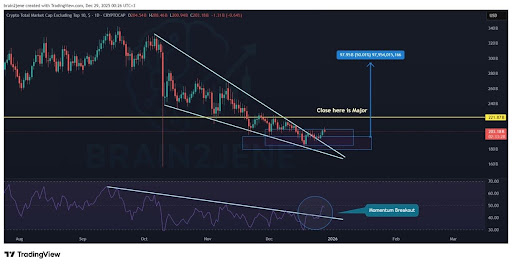
Source: Chart from @brain2jene on X

The chart also shows a clear pullback after the price hit the 221.87B resistance, which @brain2jene identified as the key level to watch. He explained that a clean break above 221.87B is critical and could add another $50-$60 billion to the market, with the target zone near the upper trend line.

Related Reading: Altcoin Season Index Crashes To Low 17 As Bitcoin Price Struggles, What This Means

Supporting this outlook, momentum appears strong, as the RSI on the chart has broken out of a downtrend. The analyst noted that this could signal the start of a broader altcoin rally, potentially boosting the price of coins like VeChain (VET), SUI, Internet Computer (ICP), and IMO.

Overall market cap excluding BTC at $1.25 trillion on the 1D chart | Source: TOTAL2 on Tradingview.com

Related Questions

QWhat does crypto pundit Chad Steingraber compare the current altcoin market trend to, and why?

AChad Steingraber compares the current altcoin market trend to January 2019 because the current market sentiment feels similar, with extreme negativity among investors at that time, yet it marked the early stages of a major market turnaround.

QWhat were the prices of Bitcoin and Ethereum in January 2019, as mentioned in the article?

AIn January 2019, Bitcoin was trading near $3,000 and Ethereum's price was around $100.

QAccording to CoinGecko's 2019 report, how much did Bitcoin's price surge by June 2019, and what was its yearly gain?

ABitcoin's price surged over $13,000 by June 2019 and ended the year 95% higher than where it started.

QWhat key resistance level does analyst @brain2jene identify for the altcoin market capitalization, and what could a break above it lead to?

AAnalyst @brain2jene identifies the 221.87B level as key resistance, and a clean break above it could add another $50-$60 billion to the market, targeting the upper trend line.

QWhich altcoins does the analyst suggest could potentially be boosted by a broader altcoin rally based on the chart analysis?

AThe analyst suggests that coins like VeChain (VET), SUI, Internet Computer (ICP), and IMO could potentially be boosted by a broader altcoin rally.

Related Reads

a16z: AI's 'Amnesia', Can Continuous Learning Cure It?

The article "a16z: AI's 'Amnesia' – Can Continual Learning Cure It?" explores the limitations of current large language models (LLMs), which, like the protagonist in the film *Memento*, are trapped in a perpetual present—unable to form new memories after training. While methods like in-context learning (ICL), retrieval-augmented generation (RAG), and external scaffolding (e.g., chat history, prompts) provide temporary solutions, they fail to enable true internalization of new knowledge. The authors argue that compression—the core of learning during training—is halted at deployment, preventing models from generalizing, discovering novel solutions (e.g., mathematical proofs), or handling adversarial scenarios. The piece introduces *continual learning* as a critical research direction to address this, categorizing approaches into three paths: 1. **Context**: Scaling external memory via longer context windows, multi-agent systems, and smarter retrieval. 2. **Modules**: Using pluggable adapters or external memory layers for specialization without full retraining. 3. **Weights**: Enabling parameter updates through sparse training, test-time training, meta-learning, distillation, and reinforcement learning from feedback. Challenges include catastrophic forgetting, safety risks, and auditability, but overcoming these could unlock models that learn iteratively from experience. The conclusion emphasizes that while context-based methods are effective, true breakthroughs require models to compress new information into weights post-deployment, moving from mere retrieval to genuine learning.

marsbit1h ago

a16z: AI's 'Amnesia', Can Continuous Learning Cure It?

marsbit1h ago

Can a Hair Dryer Earn $34,000? Deciphering the Reflexivity Paradox in Prediction Markets

An individual manipulated a weather sensor at Paris Charles de Gaulle Airport with a portable heat source, causing a Polymarket weather market to settle at 22°C and earning $34,000. This incident highlights a fundamental issue in prediction markets: when a market aims to reflect reality, it also incentivizes participants to influence that reality. Prediction markets operate on two layers: platform rules (what outcome counts as a win) and data sources (what actually happened). While most focus on rules, the real vulnerability lies in the data source. If reality is recorded through a specific source, influencing that source directly affects market settlement. The article categorizes markets by their vulnerability: 1. **Single-point physical data sources** (e.g., weather stations): Easily manipulated through physical interference. 2. **Insider information markets** (e.g., MrBeast video details): Insiders like team members use non-public information to trade. Kalshi fined a剪辑师 $20,000 for insider trading. 3. **Actor-manipulated markets** (e.g., Andrew Tate’s tweet counts): The subject of the market can control the outcome. Evidence suggests Tate’sociated accounts coordinated to profit. 4. **Individual-action markets** (e.g., WNBA disruptions): A single person can execute an event to profit from their pre-placed bets. Kalshi and Polymarket handle these issues differently. Kalshi enforces strict KYC, publicly penalizes insider trading, and reports to regulators. Polymarket, with its anonymous wallet-based system, has historically been more permissive, arguing that insider information improves market accuracy. However, it cooperated with authorities in the "Van Dyke case," where a user traded on classified government information. The core paradox is reflexivity: prediction markets are designed to discover truth, but their financial incentives can distort reality. The more valuable a prediction becomes, the more likely participants are to influence the event itself. The market ceases to be a mirror of reality and instead shapes it.

marsbit2h ago

Can a Hair Dryer Earn $34,000? Deciphering the Reflexivity Paradox in Prediction Markets

marsbit2h ago

Trading

Spot
Futures
活动图片