Pundit Reveals How XRP Investors Can Avoid Making This “Expensive Mistake”

bitcoinistPublished on 2026-02-26Last updated on 2026-02-26

Abstract

Amid XRP's price struggles and negative sentiment, leading to significant sell-offs, pundit Max Avery warns investors that panic-selling is an "expensive mistake." Instead of selling XRP to take profits—which triggers a 15-37% tax burden and forces investors to time market re-entry—Avery suggests borrowing against XRP holdings. This approach provides cash without selling tokens, avoids taxable events, and maintains exposure to potential price rebounds. Currently, XRP faces a bearish trend with open interest crashing from $10.8 billion to under $3 billion and daily trading volume declining sharply. However, such conditions have historically marked market bottoms, suggesting a possible rebound ahead.

With the XRP price still struggling to reclaim $1.5, it comes as no surprise that sentiment has plunged toward the negative. Naturally, this has led to major sell-offs across the board, causing a downward cascade. Amid this sell-off, a pundit has warned that XRP investors could be making a grave mistake by panic-selling. Instead, he has proposed a way that XRP investors could use their coins without having to offload them on the market.

Selling XRP To Take Profits Is Not The Way

Max Avery, a staunch XRP supporter, went to the X platform to warn investors of an expensive mistake they could be making. According to the pundit, selling off XRP coins right now in a bid to “take profit” could turn out to be a very expensive mistake for investors.

According to Avery, by selling their coins, XRP investors are not just risking losing their coins, but also getting themselves on the hook for taxes. Explaining further, Avery said that the sell-off could trigger a 15-37%, depending on the jurisdiction.

After doing this, to get back into the digital asset, investors are now burdened with trying to time the market and figuring out the best time to re-enter the altcoin. Essentially, trying to call the bottom, something that has been historically near impossible to do.

Instead, the pundit tells investors that rather than selling off their their coins, it is better to borrow against the asset. This way, investors are able to get cash to spend when needed, while also maintaining their token holdings. Additionally, this triggers no tax event, making it easier to spend.

How XRP Is Faring

Some interesting developments surrounding XRP during this time include the fact that its open interest has seen a major crash, data from Coinglass shows. It went from a peak of over $10.8 billion to sitting below $3 billion at the time of writing. Since open interest is the total of the contracts open on the cryptocurrency, it means that participation among traders has waned for the digital asset.

In the same vein, daily trading volume has also seen a notable decline. In the last few months, XRP’s daily trading volume has trended below $10 billion, a stark contrast compared to the $78 billion that was recorded in late 2024.
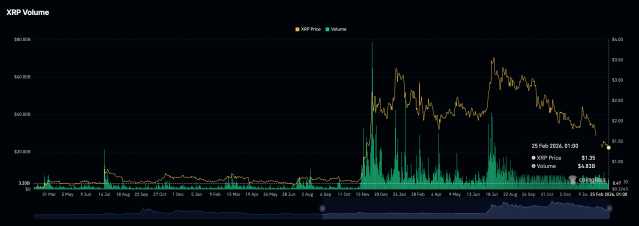
Source: Coinglass

These trends suggest that XRP is now in a bear market, especially as investors begin to take profits from the market. However, times like these have often helped to mark a bottom in the past, and if that is the case here, the altcoin may be gearing up for a rebound soon.

Price surges toward $1.5 | Source: XRPUSDT on Tradingview.com

Trending Cryptos

Related Questions

QAccording to the pundit Max Avery, what is the 'expensive mistake' that XRP investors could be making?

AThe expensive mistake is panic-selling their XRP coins to take profits, which could trigger a 15-37% tax liability and force them to try to time the market to re-enter their position.

QWhat alternative strategy does the pundit propose instead of selling XRP?

AThe pundit proposes that investors borrow against their XRP holdings instead of selling them. This provides cash when needed while maintaining token ownership and avoids triggering a taxable event.

QWhat two key metrics mentioned in the article indicate a decline in market participation for XRP?

AThe two key metrics are a major crash in open interest (from over $10.8 billion to below $3 billion) and a notable decline in daily trading volume (trending below $10 billion compared to a previous $78 billion).

QWhat is the current price struggle for XRP mentioned at the beginning of the article?

AThe XRP price is struggling to reclaim the $1.5 price level.

QWhat does the article suggest periods of major sell-offs and bear markets have often helped to mark in the past?

AThe article suggests that such periods have often helped to mark a market bottom, potentially setting the asset up for a rebound.

Related Reads

Ethereum's 11th Year: Why Is This Year Particularly Crucial?

Ethereum's 11th year proved pivotal, marked by a dual evolution in its technical roadmap and organizational structure. The year saw the completion of the Fusaka upgrade, introducing PeerDAS to make data availability sampling more efficient and laying groundwork for future L2 scaling. This was followed by a significant reorganization of the Ethereum Foundation (EF). The EF downsized, redefining its core mandate around user sovereignty and CROPS principles, while spinning off key functions. Independent entities like Ethlabs (non-profit R&D), Ethereum Institutional (institutional onboarding), and EthSystems (institutional privacy solutions) now operate separately. Technologically, the community debated a bold, long-term vision outlined in Justin Drake's "Lean Ethereum" proposal and the collaborative "Strawmap." These point toward a "third major iteration" for Ethereum, targeting goals like faster finality (~1 second), gigagas-scale L1 throughput, teragas-scale L2 capacity, post-quantum cryptography, and protocol-level privacy. Data underscores Ethereum's dominant position: its L1 still holds roughly half of all stablecoin value, leads in tokenized Real-World Assets (RWA), and commands over 55% of total DeFi TVL. While L2s now handle over 10x more transactions than the mainnet, high-value assets remain concentrated on L1. The launch of Robinhood Chain, an EVM-compatible L2 for stock tokens, signals growing institutional adoption. The immediate roadmap includes the Glamsterdam upgrade (featuring ePBS for in-protocol proposer-builder separation and Block Access Lists for parallelism), potentially followed by Hegotá focusing on anti-censorship via FOCIL. In summary, Ethereum's 11th year was defined by setting ambitious technical foundations for its next decade and restructuring its core development ecosystem to be more modular and sustainable, all while maintaining its role as the leading settlement layer for decentralized finance and assets.

marsbit6m ago

Ethereum's 11th Year: Why Is This Year Particularly Crucial?

marsbit6m ago

Notable Forecast from an Analytical Company Regarding Bitcoin (BTC): After This Date, a New Bull Season Could Begin!

Bitcoin continues to trade sideways around $64,000 amid ongoing uncertainty regarding U.S. monetary policy and geopolitical risks in the Middle East. As BTC struggles for direction, an analyst predicts the next major uptrend could commence after the U.S. midterm elections. João Wedson, founder and CEO of crypto analytics firm Alphractal, revisited the connection between Bitcoin's price movements and the U.S. election calendar in his latest analysis. Wedson claims that analyzing past market cycles reveals similar patterns in Bitcoin's price behavior, particularly around U.S. midterm and presidential elections. Historically, Bitcoin has faced headwinds leading up to midterms but tends to recover once election-related uncertainty subsides. Based on historical data, Bitcoin entered bear markets roughly a year before past midterm elections, only to initiate prolonged bull markets after the elections concluded. In some cycles, price bottoms formed just days before the vote, while in others, the low occurred immediately after. The analyst also noted presidential elections have a distinct impact: Bitcoin experiences strong rallies each time a president wins re-election and approaches the peak of its main cycle shortly after the presidential inauguration. As an example, Wedson pointed to XRP, which began a sharp rise on the day Donald Trump won the 2024 election and reached a local peak on January 20, 2025, his inauguration day.

cryptonews.ru21m ago

Notable Forecast from an Analytical Company Regarding Bitcoin (BTC): After This Date, a New Bull Season Could Begin!

cryptonews.ru21m ago

Lummis: The CLARITY Act mechanism "is not working" as the Senate drags its feet

U.S. Senator Cynthia Lummis has argued that the current regulatory framework for digital assets is inadequate, harming industry, investors, and regulators alike. She is urgently pushing for the Senate to pass the Digital Asset Market Clarity Act (H.R. 3633/CLARITY Act) before the August recess, warning the current momentum for the bill is a unique opportunity this decade. The legislation aims to divide oversight between the SEC and CFTC. Time is running out, as the Senate must act before its August 8th recess. Delays would push the debate to September, further squeezing the legislative calendar before the midterm elections. Forecasting platforms now estimate only a 30% chance of the bill becoming law in 2026, a sharp drop from over 80% in February. Passage requires 60 votes, meaning at least seven Democrats must join Republicans, a task complicated by Democratic opposition. Key objections from figures like Senator Elizabeth Warren center on concerns the bill could weaken oversight of decentralized finance (DeFi) and consumer protection, potentially endangering the financial system. Over 200 crypto industry organizations, including Coinbase and Ripple, are lobbying for a vote, arguing continued uncertainty drives innovation and jobs overseas. Lummis contends the bill's custody and disclosure rules are precisely the consumer protections needed to close existing loopholes. The bill's fate now hinges on whether Senate Majority Leader John Thune schedules a vote this week or delays it until the fall session, where it would face an even more constrained political environment.

cryptonews.ru21m ago

Lummis: The CLARITY Act mechanism "is not working" as the Senate drags its feet

cryptonews.ru21m ago

Trading

Spot

Hot Articles

What is XRP 2.0

XRP 2.0: A New Frontier in the Cryptocurrency Landscape Introduction to XRP 2.0 In the ever-evolving realm of cryptocurrency, new projects continuously emerge, vying for attention and adoption. One such promising initiative is XRP 2.0, a novel cryptocurrency project designed to leverage advanced blockchain technology and robust encryption methodologies. While the name draws parallels with Ripple’s XRP, it’s crucial to note that XRP 2.0 operates independently, focusing on enhancing transaction security, privacy, and scalability. As the digital financial landscape increasingly embraces decentralized solutions, XRP 2.0 aims to contribute meaningfully to web3 and the overall expansion of crypto projects. What is XRP 2.0? At its core, XRP 2.0 is a cryptocurrency project that aims to create a secure and decentralized digital currency ecosystem. Its foundational technology integrates sophisticated blockchain principles with cutting-edge encryption techniques. The overarching goal of XRP 2.0 is to establish itself as a reliable and efficient platform enabling swift transaction execution while prioritizing enhanced privacy protections for its users. The project is promoted as a solution to many limitations faced by existing cryptocurrencies, proposing a system that can handle a higher volume of transactions with improved speed and privacy. This versatility positions XRP 2.0 as a significant contender in a marketplace riddled with various digital currencies. Who is the Creator of XRP 2.0? The identity of the creator behind XRP 2.0 has been flagged as ‘Wilbur.’ However, comprehensive details regarding Wilbur or their associated entity remain elusive. The anonymity of many cryptocurrency creators is not an uncommon phenomenon in the industry, often designed to maintain a degree of privacy and security. Who are the Investors of XRP 2.0? As of now, specific information related to the investment foundations or organizations supporting XRP 2.0 is not publicly available. In the cryptocurrency sector, the backing by reputed investors can significantly influence a project's credibility and success, yet the transparency regarding the financial supporters of XRP 2.0 has not been established. How Does XRP 2.0 Work? XRP 2.0 stands out by employing a combination of blockchain technology and advanced encryption algorithms that ensures secure and decentralized transactions. Its innovative structure includes unique features designed to foster user engagement and broaden functionalities beyond conventional cryptocurrency transactions. Among these features, XRP 2.0 incorporates AI-powered capabilities, such as text-to-image and text-to-speech functionalities. These additions are designed to enhance the interactive experience for users, promoting broader applicability across various sectors. By bridging technological advancements with user-centered design, XRP 2.0 aims to capture the attention of a diverse range of individuals and enterprises looking to integrate cryptocurrency solutions into their operational frameworks. Timeline of XRP 2.0 Understanding XRP 2.0 requires examining the milestones that have defined its journey thus far: July 23, 2023: XRP 2.0 is introduced as a novel cryptocurrency project, aiming to revolutionize secure and decentralized transaction capabilities in the blockchain domain. September 8, 2023: The launching of another project, XRP20, occurs, marking the emergence of an ERC-20 token on the Ethereum blockchain that remains unrelated to XRP 2.0. November 13, 2023: The XRP Ledger undergoes a significant update with the release of rippled server software version 2.0.0. It is essential to note that this development is disconnected from the XRP 2.0 cryptocurrency project. Key Points About XRP 2.0 To distill the essence of XRP 2.0, several critical factors emerge: Unique Features: The inclusion of features like AI-powered text-to-image and text-to-speech further diversifies the potential applications of XRP 2.0. Blockchain Technology: The framework utilizes advanced blockchain mechanisms and encryption protocols, ensuring a secure and decentralized environment for transactions. Scalability and Privacy: XRP 2.0 prioritizes enhanced privacy protections in transaction processes and the scalability necessary to accommodate a growing user base. No Affiliation with Ripple: Importantly, despite its name, XRP 2.0 does not have any allegiance or collaboration with Ripple’s XRP, distinguishing its operational framework and objectives within the cryptocurrency ecosystem. Conclusion XRP 2.0 represents an ambitious venture into the cryptocurrency sphere, aiming to offer a combination of security, privacy, and efficiency in digital transactions. By integrating sophisticated technologies and user-friendly features, the project sets out to broaden the horizons of what cryptocurrency can achieve in today's digital economy. While the anonymity of its creator and lack of disclosed investors might raise questions for some, XRP 2.0's focus on advanced functionalities and decentralisation enhances its appeal amidst an increasingly crowded crypto market. As the cryptocurrency landscape continues to evolve, XRP 2.0 may yet emerge as a pivotal player in the expansion of secure and scalable blockchain solutions.

1.3k Total ViewsPublished 2024.04.01Updated 2024.12.03

What is XRP 2.0

Discussions

Welcome to the HTX Community. Here, you can stay informed about the latest platform developments and gain access to professional market insights. Users' opinions on the price of XRP (XRP) are presented below.

活动图片