Original Author: KarenZ, Foresight News
In 2015, Ethereum brought the concept of the "world computer" on-chain; in 2026, it is simultaneously restructuring the organizational network maintaining this machine and reshaping its underlying architecture for the years to come.
Over the past year, the Fusaka upgrade laid the foundation for Ethereum to carry more L2 data; the Ethereum Foundation underwent a major reorganization, with parts of its research & development, institutional outreach, and privacy operations being transferred to independent entities like Ethlabs, Ethereum Institutional, and EthSystems; Lean Ethereum and Strawmap then placed the next round of protocol redesigns on the table, covering consensus, validation methods, cryptography, and state, all of which may be redesigned in the coming years.
The First Decade, Condensed into a Few Lines
On July 30, 2015, the Frontier mainnet launched. Ethereum evolved from a concept in a whitepaper into a public network where anyone could deploy and run smart contracts.
In the ten years that followed: In 2016, The DAO was attacked, leading to a hard fork of Ethereum, with the unforked side continuing as Ethereum Classic; in 2020, the Beacon Chain launched; in 2022, The Merge transitioned the mainnet from Proof-of-Work to Proof-of-Stake; in 2023, Shapella enabled staking withdrawals; in 2024, Dencun introduced Blobs via EIP-4844, providing cheaper data space for Rollups.
In May 2025, Pectra further improved account functionality via EIP-7702 and increased the maximum effective balance for a single validator to 2048 ETH.
This roadmap never followed a fixed blueprint neatly. Ethereum's characteristic is precisely that it replaces its own core components while it runs.
The first decade laid Ethereum's foundation, and the past year has redefined where it is headed next.
Fusaka: No Longer Requiring Every Node to Download All Blob Data
On December 3, 2025, Fusaka activated on the mainnet. This was the second major mainnet upgrade Ethereum completed in 2025, following Pectra.
The most important change in Fusaka is PeerDAS. Previously, nodes needed to download the complete blob data to check its availability; PeerDAS allows nodes to only sample and verify a portion of it, then through division of labor and erasure coding mechanisms between different nodes, collectively confirm that the complete data indeed exists.
It's somewhat like inspecting a vast shipment of goods: no longer requiring each inspector to recount all boxes, but having many inspectors each sample check, then combining their results to form a reliable judgment of the entire shipment.
After the upgrade, Ethereum also increased the target blobs per block from 6 to 14 and the limit from 9 to 21 through two BPIs that adjusted only blob parameters; the default block Gas Limit was also raised from 45 million to 60 million.
Fusaka is more like an underlying structural construction, still far from the endpoint of performance expansion. Users may not immediately feel drastic changes, but subsequent increases in Blob capacity and reductions in L2 costs will be built upon this layer.
The Foundation Shrinks, Functions Grow Outward
Protocol upgrades happen on-chain, while another adjustment occurred at the organizational layer. Over the past year, the Ethereum Foundation underwent a reorganization of rare scale.
In March 2026, the Foundation published a Mandate, establishing user sovereignty as a core goal and summarizing censorship resistance, open source, privacy, and security as the non-compromisable CROPS principles.
On June 23, the Foundation announced the completion of a reorganization that lasted several months, with 54 people leaving, representing about 20% of the original team.
The reorganized Foundation set up five work areas: Protocol Layer, Access Layer, User Layer, Community Layer, and Institutional Layer, in addition to an Operations Cluster and management & support teams. It no longer attempts to house all protocol R&D, product access, ecosystem communication, and institutional outreach within a single organization, but focuses limited resources on work it believes only it can sustain long-term.
This reorganization also continued the Foundation's previously announced treasury policy. The EF's treasury policy started from annual operational expenses representing about 15% of the treasury in 2025, planning to linearly decrease over five years to a long-term level of roughly 5%. It chooses to concentrate resources on core protocol, sovereign access, privacy & security, while having more ecosystem functions undertaken by independent organizations.
Meanwhile, a number of new entities involving former Foundation members began operating independently:
- Ethlabs is an independent non-profit R&D institution. The team includes several former Ethereum Foundation researchers, focusing on Ethereum protocol, scaling, interoperability, and infrastructure R&D.
- Ethereum Institutional is a non-profit institution incubated within the Foundation and now independent. It positions itself as a neutral entry point for banks, asset management companies, and public institutions into the Ethereum ecosystem, responsible for education, demand aggregation, and ecosystem coordination. On July 29, Ethereum Institutional announced the completion of its first ecosystem funding round and supporter alliance formation, receiving support from over 100 ecosystem participants, led by BitMine, SharpLink, and Ethereum co-founders Joseph Lubin and Mihai Alisie. The amount was not disclosed.
- EthSystems continues the work of the Foundation's Institutional Privacy Task Force, but operates as an independent for-profit company, designing privacy, compliance, and confidential transaction systems for institutions.
Strictly speaking, these three should not be broadly described as legal "spin-offs" of the Ethereum Foundation: Ethlabs was created by former Foundation researchers, Ethereum Institutional was incubated within the Foundation and then became independent, and EthSystems took over the relevant team and work. A more accurate description is that the Ethereum Foundation is having some talent, funding sources, and specialized functions move outside the Foundation, forming multiple organizations capable of independent financing and decision-making.
This does not directly change the governance of the Ethereum protocol, but it changes the organizational structure around protocol development, institutional communication, and product building. Related work no longer needs to be concentrated on a single balance sheet.
Lean Ethereum and Strawmap: One Vision, One Sketch
Behind this organizational adjustment lies a longer technical thread.
On July 31, 2025, the day after Ethereum's tenth anniversary, Justin Drake published the Lean Ethereum vision, proposing a more radical technical roadmap for the protocol's next decade.
At the consensus layer, Lean Ethereum aims to compress finality time to seconds; at the data layer, it plans to expand Blob capacity through next-generation data availability sampling; at the execution layer, it proposes adopting a leaner instruction set more suitable for SNARK proofs, while trying to preserve EVM compatibility and existing network effects.
On top of these modifications, the protocol also needs to gradually replace signature and cryptography components potentially threatened by quantum computing, preparing in advance for long-term security.
Long-term goals proposed by Lean Ethereum include roughly 1 gigagas/s for L1 and 1 teragas/s for L2, corresponding to its estimated ~10k TPS and ~10 million TPS. It is crucial to emphasize that this document was explicitly labeled as Justin Drake's personal vision upon release, aiming to spur community discussion, not a finalized upgrade commitment that has passed governance procedures.
In February 2026, the Strawmap maintained by EF Architecture went live. Justin Drake, Vitalik Buterin, and others participated in its maintenance and curation. Strawmap is a portmanteau of "strawman" and "roadmap," which can be understood as a sketch of a route awaiting further community modification.
On July 4, Vitalik Buterin published an updated interpretation after the Berlin researcher meeting: He estimated the main parts of Lean Ethereum would take three to four years to be implemented gradually through multiple upgrades; recursive STARKs, post-quantum cryptography, consensus and finality redesign, multi-dimensional gas, new state types, and client architecture are all within the scope of discussion. He termed this phase the "third major iteration" following early Ethereum and The Merge, and emphasized privacy had become a first-class goal.
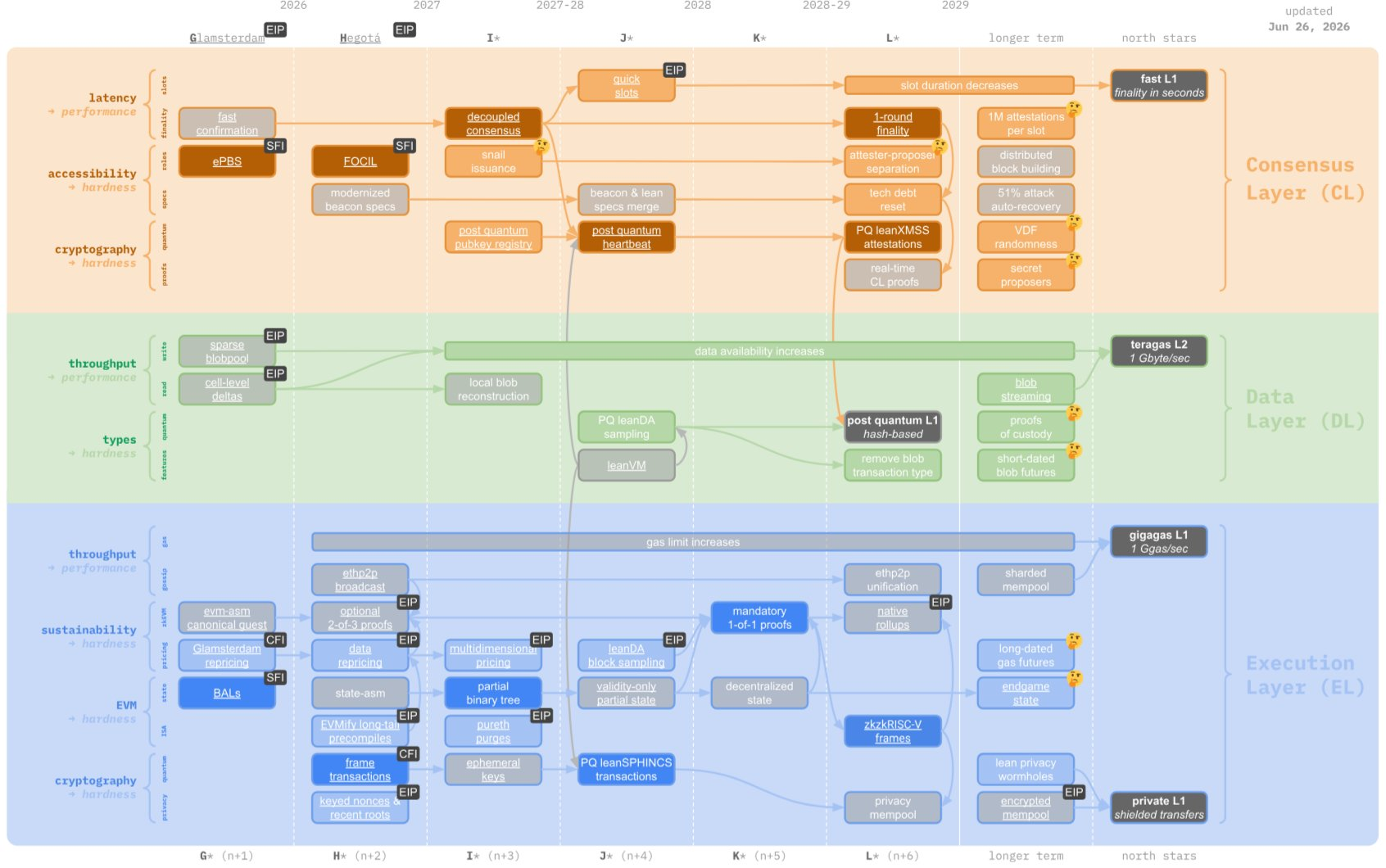
The five "directional goals" given by Strawmap are Fast L1, Gigagas L1, Teragas L2, Post-Quantum L1, and Private L1. In plain language, these are faster confirmation, higher mainnet throughput, larger L2 data space, quantum-resistant cryptography, and protocol-native privacy.
These are research directions and engineering goals, with significant design, implementation, testing, and community coordination work remaining before full deployment.
Four Sets of Data to Understand the 11-Year-Old Ethereum
The first set of data comes from stablecoins.
As of July 31, 2026, RWA.xyz statistics show the stablecoin scale on the Ethereum mainnet is approximately $155.9 billion. Compared to its global statistical value of ~$296.9 billion, the Ethereum mainnet accounts for about 52.5%.
DeFiLlama uses a different set of asset coverage and network classification criteria, reporting the stablecoin scale on Ethereum as approximately $146.9 billion, accounting for about 49.0% of the ~$300.1 billion total scale.
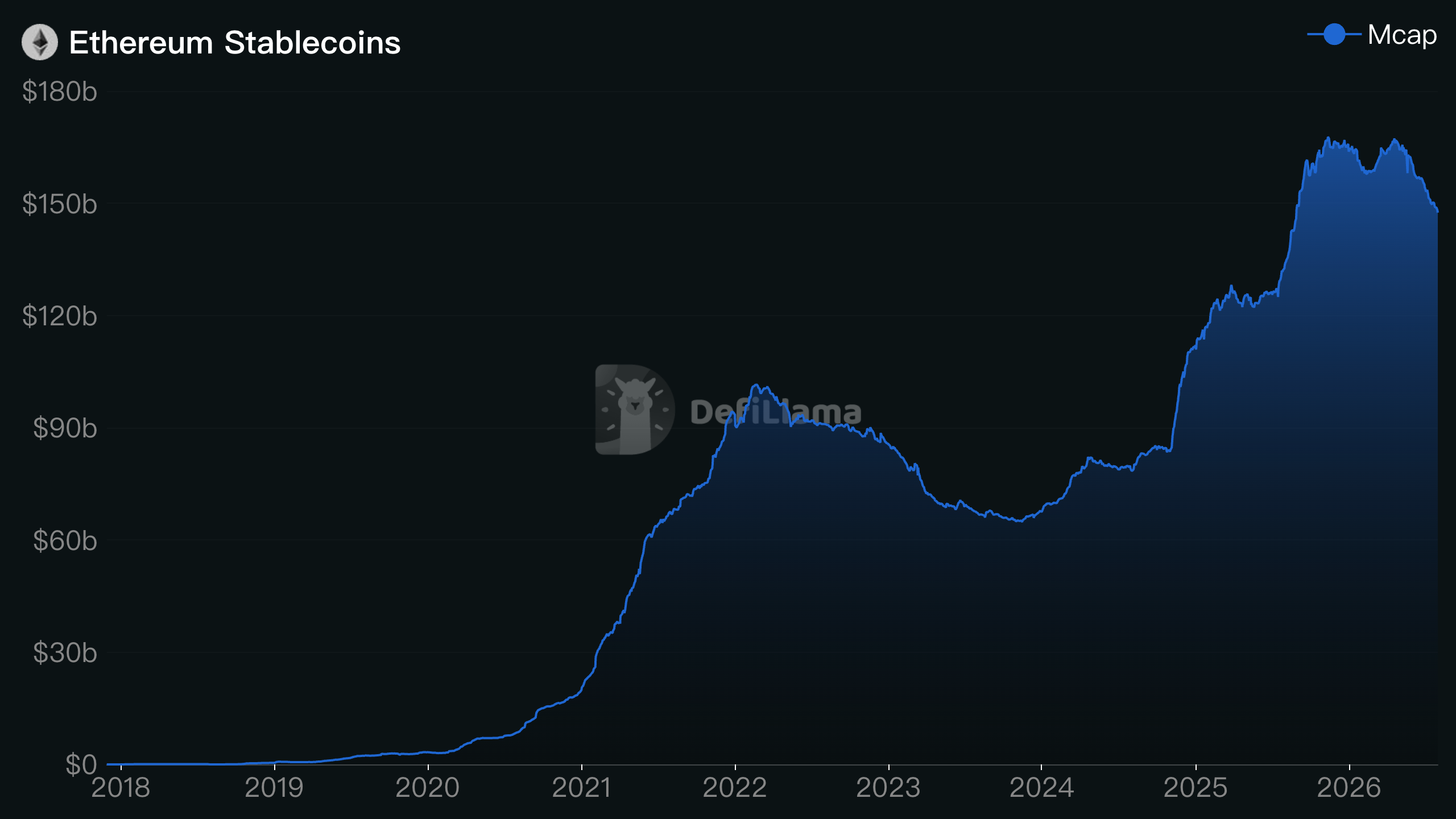
Source: DeFiLlama
The two datasets differ, mainly due to variations in token coverage, cross-chain assets, and statistical methods. However, the common conclusion they point to is that the Ethereum mainnet still carries close to half of the global stablecoin stock.
The second set of data comes from tokenized real-world assets.
According to RWA.xyz statistics, as of July 31, 2026, there are 1,552 RWAs on the Ethereum mainnet, with on-chain distributable asset value of approximately $17.15 billion, about 3.3 times that of the second-ranked BNB Chain, leading among the 38 networks it tracks. On-chain distributable assets refer to tokens that can leave the issuance platform and be transferred between wallets meeting whitelist or investor qualification requirements.
The institutional-grade Ethereum ecosystem service provider Ethereum Institutional, citing RWA.xyz's ecosystem criteria, states: Ethereum and its L2s host over 60% of stablecoin supply and over 75% of tokenized RWAs. This criterion includes L2s and broader asset classes and cannot be directly divided or mixed with RWA.xyz's single L1 data.
The third set of data comes from DeFi.
DeFiLlama statistics show Ethereum L1's DeFi TVL is approximately $41.2 billion, accounting for nearly 55% of all network TVL, with the following BSC and Tron both around $4.9 billion. As a single network, Ethereum's TVL is about 8 times that of the second place.
Another set of data comes from L2.
growthepie data shows that as of July 31, 2026, the tracked Ethereum L2 networks collectively process approximately 24.61 million transactions daily, 13.9 times the mainnet's 1.77 million; about 159.9 million weekly, 9.76 times the mainnet's 16.38 million; and about 661.46 million monthly, 10.4 times the mainnet's 63.51 million.
This data is sufficient to indicate that a large amount of execution activity has moved to scaling layers. Meanwhile, stablecoins, RWAs, and DeFi TVL remain highly concentrated on L1.
Beyond these data points, Robinhood Chain provides a more specific case study.
On July 1, 2026, the Robinhood Chain public mainnet launched. It uses the Arbitrum tech stack, is an EVM-compatible L2 that uses ETH for gas and ultimately settles to Ethereum, primarily targeting stock tokens and other financial assets. A securities brokerage platform with a massive retail user base has begun placing part of its future financial infrastructure within the Ethereum ecosystem.
The aforementioned data and cases cannot individually prove Ethereum has become a "global financial settlement layer." What they can prove is that Ethereum has accumulated substantial stock in stablecoins, DeFi, tokenized assets, and L2 execution activity, while beginning to attract traditional financial platforms to build on-chain infrastructure serving real users.
Next Stop: Glamsterdam, Then Hegotá
Ethereum's next mainnet upgrade is Glamsterdam, a name combining the execution layer upgrade Amsterdam and the consensus layer upgrade Gloas.
As of July 30, 2026, the official planning window is the second half of 2026, but the mainnet activation date has not been announced.
Glamsterdam has two core features. The first is ePBS, which writes the division of labor between proposers and block builders into the Ethereum protocol, reducing the network's reliance on extra-protocol relay services and leaving more time for block propagation. The second is Block-level Access Lists (BAL), allowing nodes to know in advance which accounts and storage locations a block will read and modify, creating conditions for parallel execution and faster synchronization.
Developers believe in testing that combining ePBS, BAL, and EIP-8037 repricing can provide a technical foundation for a post-upgrade baseline Gas Limit of 200 million.
Extended Reading: "Ethereum's Next Stop Glamsterdam: The Core Upgrade Points You Must Know"
The subsequent upgrade is Hegotá, for which a mainnet date has not been announced yet; it will likely be executed in 2027, largely depending on Glamsterdam's progress in the coming months.
Hegotá has selected FOCIL (EIP-7805) as the core feature for the consensus layer. It uses an in-protocol transaction inclusion list to let more validators participate in deciding which transactions should be included in a block, thereby reducing the ability of a single block builder to persistently filter transactions and improving the network's censorship resistance.
Frame Transaction (EIP-8141) is currently in "considered for inclusion" status. This proposal aims to split transaction validation, execution, and gas payment into different Frames, providing a foundation for native account abstraction, flexible signatures, and future migration to quantum-resistant accounts. However, "considered for inclusion" does not mean it's confirmed for the upgrade; client teams may still modify the design or choose other solutions.
Summary
Ethereum's most profound changes over the past year unfolded simultaneously along two lines:
On the technical level, Lean Ethereum and Strawmap pushed targets towards a systemic redesign of consensus, validation methods, cryptography, and state structure.
On the organizational level, the Ethereum Foundation actively shrank its boundaries, with some work previously undertaken internally by the Foundation now being advanced by multiple independent entities.
Eleven years ago, Frontier's first block brought the "world computer" from the whitepaper online. Eleven years later, Ethereum faces a more difficult challenge: how to allow a public network already carrying a massive load of assets, applications, and users to undergo self-reconstruction while maintaining continuous operation.