In his podcast "The Peter Schiff Show," the economist and longtime Bitcoin critic stated that this week, the stock market for AI-related companies crashed, even though overall indices held up. Alphabet's stock fell by 10% after the company announced capital expenditures higher than investors had expected. Oracle's stock dropped nearly 8% for the week and is now down 41% for the year. Meta's stock fell by 7.3%, Amazon's by 6.8%, and Microsoft's by 2.7%, bringing their year-to-date decline to 19.3%, close to bear market territory.
Schiff noted that the market reaction signals a change from previous quarters, when announcements by hyperscale companies about increased artificial intelligence (AI) budgets typically led to rising stock prices. "Investors are finally starting to question whether these investments will actually pay off," he said.
SpaceX and Tesla Took the Biggest Hit
SpaceX's stock fell another 7.7% this week and is now trading 49% below its post-IPO high. By the end of the year, the company's free float is set to increase from 5% to 40%, which, according to Schiff, could put additional pressure on the stock.
Tesla's stock fell 18% over the same period and is now trading 35% below its 52-week high. Schiff estimates that the combined drop in Tesla and SpaceX stock cost Elon Musk nearly $100 billion in just one week.
Comparison to the Dot-Com Crisis
The gold advocate and economist compared the annual AI capital expenditures, roughly three-quarters of a trillion dollars, to the expansion that preceded the dot-com bust. He noted that many of the early internet favorites into which investors poured money ultimately went bankrupt without ever recouping their costs. He does not doubt AI's long-term potential but argues that markets are overestimating the short-term returns on investments in hyperscale companies.
Japanese Bond Market Under Pressure
Schiff pointed to Japan as a more serious and immediate risk than the sell-off in AI-related stocks. The yen fell against the dollar to its lowest level in 40 years. The yield on Japan's 30-year government bonds closed around 4%, a record for that maturity, while the yield on 10-year Japanese government bonds rose to levels last seen in 1996.
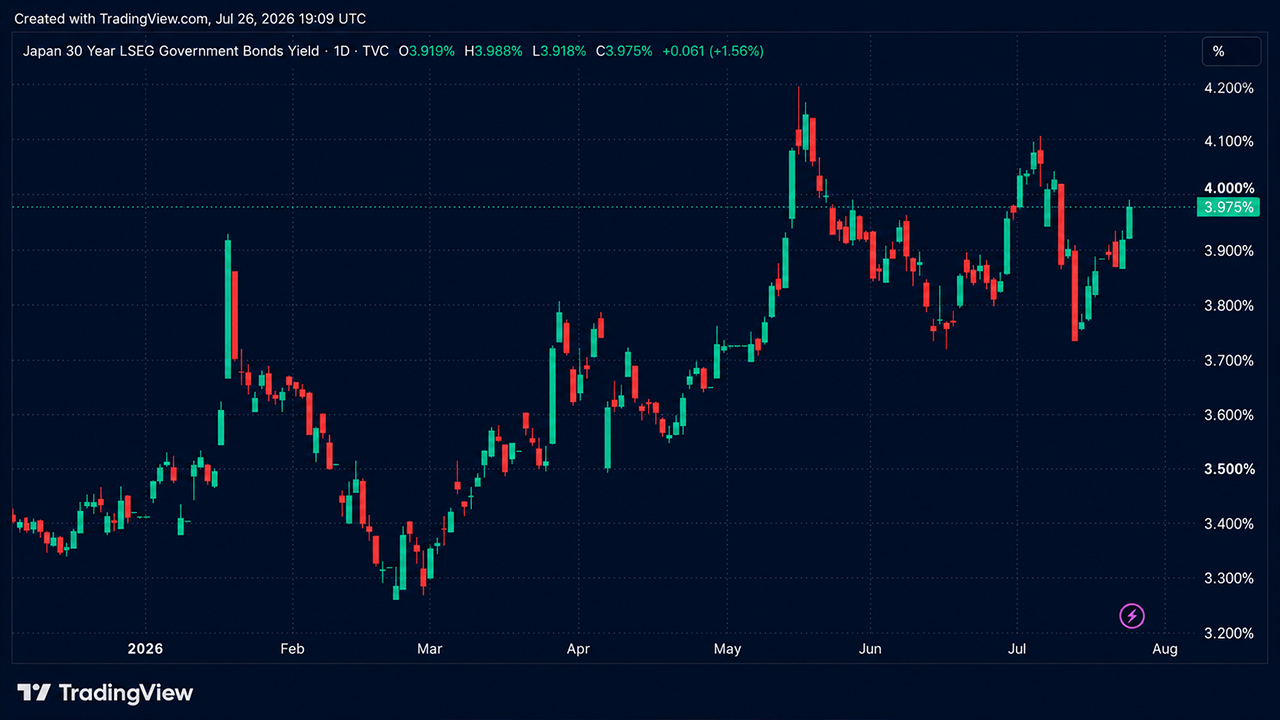
Japan's national debt exceeds 200% of its gross domestic product, and the country's base discount rate remains at just 1%. Schiff stated that the Bank of Japan faces a choice: either aggressively raise rates, which could trigger a domestic recession and a wave of capital repatriation, or remain passive and risk a currency collapse. Schiff emphasized that either path would have consequences for the United States.
Japan holds over $1.1 trillion in U.S. Treasury bonds, the largest foreign portfolio among all countries. Schiff noted that a Japanese debt crisis could force Japan into a large-scale sell-off of these assets. "That could be the pin that pops our bubble," he said, commenting on the situation in Japan within the context of the U.S. economy. Schiff added:
"Popping the Japanese bubble will ultimately pop an even larger American bubble."
U.S. Treasury Yields Reach Multi-Year Highs
The yield on 30-year U.S. Treasury bonds ended the week at 5.16%—the highest level since 2006—while the national debt exceeded $39.6 trillion. Schiff noted that the national debt today is more than four times the 2006 level, making today's borrowing costs harder to cover than the last time yields were this high.
Oil, Gold, and Inflationary Pressure
Oil prices rose above $100 per barrel and increased by about 30% in July alone amid tensions with Iran. Schiff stated that this rise virtually guarantees higher Consumer Price Index figures when July data is released in August.
Gold appreciated by about 1% for the week despite the jump in bond yields and oil prices—a combination Schiff called remarkable given gold's recent inverse correlation with oil since the conflict with Iran began. Mining stocks performed better than gold itself: the GDX index rose 5.6%, and GDXJ rose 5.8%. Schiff interpreted this as a possible signal that a bottom is forming in the sector.
The Labor Market and Trump Tariffs
Schiff also criticized the Trump administration's interpretation of the recent drop in weekly unemployment claims to 187,000, arguing that the growth of the gig economy and weak hiring trends make this figure far less significant than in previous decades. Furthermore, he criticized new tariffs imposed on about 60 countries under a provision of the 1974 Trade Act targeting goods linked to forced labor, calling this policy an unconstitutional tax that ultimately falls on American consumers, not foreign governments.
end-content